Can we all finally agree that both major political parties are irrelevant and are in fact two branches of the same ruling party? Both have exponentially grown an inefficient and corrupt government via unsustainable increases in spending, including both social and corporate welfare, debt, and taxation. In retrospect, the differences in how each party governs couldn't fill a coffee can.
Which means Americans can thank the mainstream media for perpetuating the myths that there are meaningful differences between Democrats and Republicans when there are virtually none; that a political challenge between the two is the only thing at stake; and that by supporting and voting one party over the other on election day, Americans are participating to create some desired change for the better.
It is an illusion. Americans have allowed themselves to be utterly manipulated by the media, which answers to the politicians, the largest infrastructure (food, energy, communications, medical, finance, and insurance) monopolies' executives/owners, and the party leadership, all of whom control most of the purse, and the laws that protect that purse.
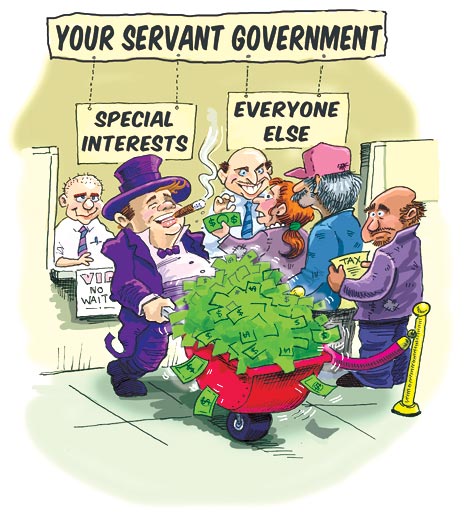 Were our federal and state constitutions written to limit and control the actions of the people or limit and control the actions of the government? The Iowa Constitution reads: "All political power is inherent in the people. Government is instituted for the protection, security, and benefit of the people, and they have the right, at all times, to alter or reform the same, whenever the public good may require it."