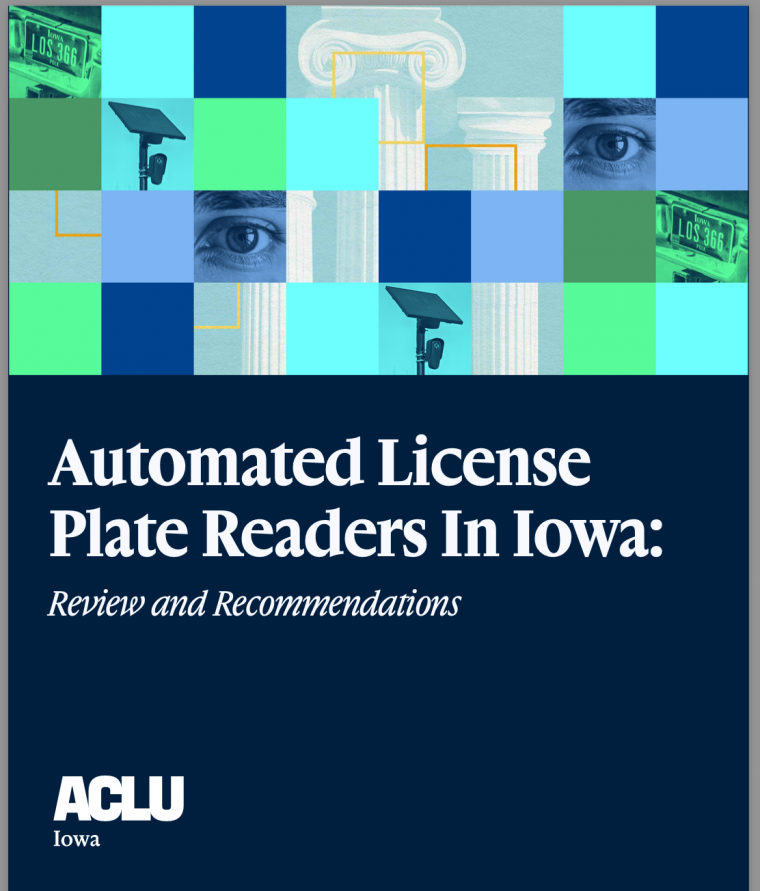
Automated License Plate Readers in Iowa: Review and Recommendations by ACLU Iowa Dec 2026
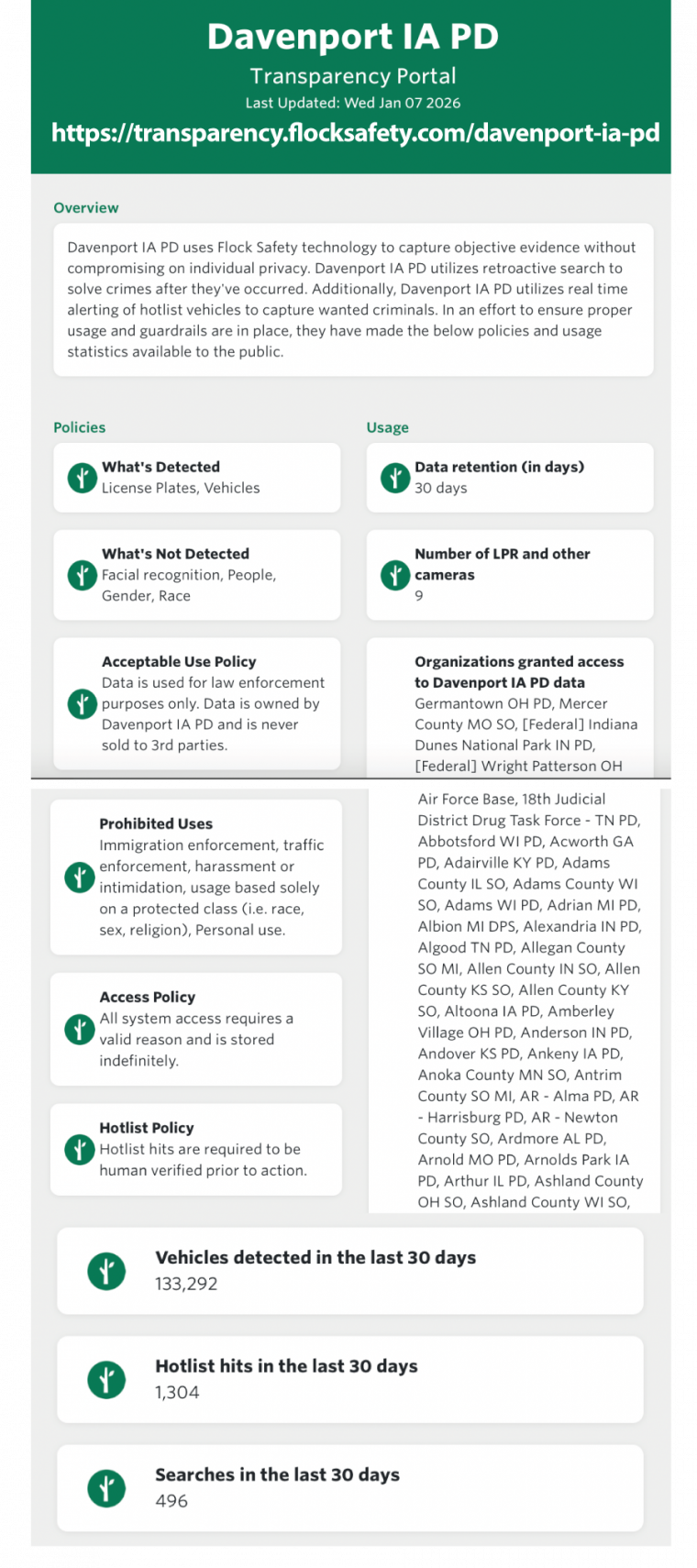
The ACLU's 63-page report released last month is a very valuable and exhaustive work product that every elected official who has an oath of office to uphold the state and federal constitution, and protect the governed who consented to have their rights protected, should read. Here are some key excerpts from the report (RCReader.com/y/ia-aclu-alpr) below. Note that while Davenport originally told the report's researchers that the meta data about its ALPRs was confidential, the technology vendor Flock provides a publicly available “transparency portal” for its customers answering much of their questions in real time at Transparency.flocksafety.com/davenport-ia-pd. Screen shots of that portal are below, as well.
• Some agencies were not transparent about the number and location of their ALPRs. Bettendorf and Oelwein claimed that information about the number and location of their ALPRs would be confidential under Iowa open-records law and declined to provide them. Altoona and Davenport said the number and location were confidential, but an online search found an informational website provided by the ALPR vendor that publicly listed the number of cameras.
• Access to ALPR databases has been abused. With so little oversight, ALPR access can be grossly misused. There are recurring national media accounts of law-enforcement officers using them to stalk an ex-girlfriend or ex-wife. Texas police used their access to ALPR networks to search 83,000 cameras nationwide to track down a woman who had an abortion in Illinois, where abortion care remains legal.
• The price of local government surveilling Iowans in their communities is steep. Communities spend anywhere from a few to several thousand dollars each month for these cameras. Cedar Rapids, for example, spends an average of more than $20,000 a month on ALPRs.
• Vendors that offer ALPRs have not always been forthcoming on who they share the data with and their business practices. Flock Safety, the largest vendor of ALPRs in Iowa, has specifically said that it does not give access to Immigration and Customs Enforcement (ICE) or U.S. Border Patrol. But nationally, local police have been found to regularly run searches on ICE’s and Border Patrol’s behalf. After finding this out, some communities around the country have terminated their contracts with Flock Safety.
The documents collected as part of our open records requests can be viewed at TinyURL.com/IowaALPRs.
Chapter 22 of the Iowa Code requires agencies to provide public records promptly and as soon as feasible, although the law allows for delays of up to 20 calendar days in some cases, including when reasonably necessary to determine whether a record is confidential or should be released. However, delays should not normally exceed 10 calendar days. Agencies can either deliver the records, give an estimate of when they will send the records, or explain why per statute they believe the requests contain confidential information and that they will not comply. We followed up at regular intervals and eventually received records from 43 agencies.
The response to our open records request varied widely. The Davenport Police Department told us that all the information we requested was confidential. However, we sent the same request to the Scott County Sheriff (the county where Davenport is located), and they provided arguably one of the most thorough responses of any agency.
In some cases, law enforcement agencies said they didn't have transparency portals, which are public websites hosted by the ALPR vendor that contain selected key facts about the agency’s ALPRs. Urbandale, Davenport, and Clive police departments all said they didn't have transparency portals, but we were able to locate them through independent online research.
Conclusion
The current lack of state regulations on ALPRs, especially around ALPR data retention and sharing, puts Iowans at risk. Iowans are being surveilled without their knowledge every day through ALPR data collection. The people of Iowa, and the United States, are entitled to certain rights: to be free to move without being surveilled, to associate where and with whom they choose, and be to free from unreasonable searches. If ALPRs are unregulated, these rights are just empty promises.
The clinic’s findings show that ALPR use across the state of Iowa is only growing more prevalent, but our state laws have not progressed with technological advances. To uphold Iowans’ rights and prevent unreasonable government intrusion into their lives from ALPR use, timely, proactive statewide protections are needed.
There's an App for That!
Pictured on the cover is a screen shot from the free website and mobile app DeFlock.me. It's clear that local activism is much more active on the Illinois side of the river than the Iowa side at this time. DeFlock provides a mobile app for crowd source documenting ALPR's where one travels.
Get the Flock Out QC
Perhaps this is due to the phenomenal grass roots activism of David Stoner from Moline, Illinois. His educational and petition efforts were featured on a KWQC TV interview recently. The website GetTheFlockOutQC.com is stunningly informative and useful, providing all the tools and information one needs to get engaged and confront one's public servants who currently surveil us all with no consequences and no probable cause. We were unable to reach Mr. Stoner prior to print deadline and hope to feature the results of his efforts in next month's edition.