
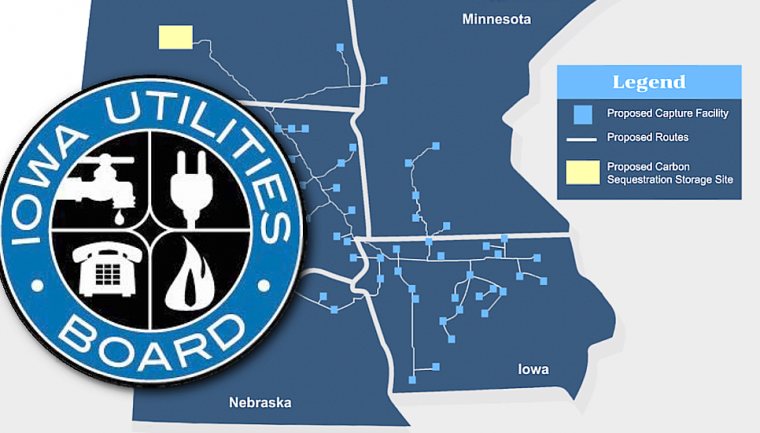
The Senate and House bills for the use of eminent domain for the Co2 pipeline, now called hazardous liquid pipeline, have become the same as they move into discussion by our legislators. We must review SF2067 and HF2104 to understand how to argue against this legislation.
Contract law relating to how I use my land allows me to contract with whomever I want as long as it’s within the planning and zoning rules of a county/state. Those negotiations are private.
Eminent domain and condemnation for a public use project are not private negotiations. Look at Mr. Criswell at the Middle Road/I80 interchange. The step-by-step process is codified and the terms including settlement are transparent.
The language of the bills are trying to shoehorn the private, constitutional right to contract and the very transparent act of government applying eminent domain. There are 13 instances in this bill for contact between the company and the landowner. Some of these engagements are being codified to share with the commission, some not. Whether its contract discussions with a landowner that will or will not reach an easement agreement, I would argue that any exchange of information between the company and the commission is unlawful. The bill has the commission approving the valuation methodology. How is it lawful to have the government involved in my contract negotiation with a private company?
Nowhere in the bill is the landowner given a definition of what constitutes a diligent effort to acquire a voluntary lease or the definition of what deems the efforts unsuccessful. Most language in the bill is subjective with the subjective language favoring the pipeline company. One of the bullets that triggers eminent domain reads, “Economic infeasibility of the pipeline due to excessive easement acquisition costs for alternative routes to avoid the eminent domain. For the purposes of this subparagraph, economic infeasibility shall be shown by clear and convincing evidence.” This is totally subjective. Whose standard? Again, this is not a government use of eminent domain to this point in the process. The bill is trying to blend a private negotiated contract process with a state eminent domain process. It does not work.
And now I go back to a person’s right to contract and that the contract is as confidential as the two parties agree to, and certainly have this right. With this bill, why do the landowners that agree to an easement contract have their terms protected in 5.(e), free from disclosure via government applying the protections of Chapter 22. Chapter 22 pertains to “Examination of Public Records.” What gives the state the right to protect a contract not acquired through eminent domain under Chapter 22 and what section of 22 is being applied, and yet what is acquired through eminent domain will be public? The bill makes no mention of the condemnation board of the county making this determination.
The opening paragraph states the goal of the bill is to vindicate and safeguard the property rights of all Iowans. I believe they’ve missed the mark and my belief is that eminent domain should never be used by a for profit private company. The legislation needs to state that the pipeline company must jog around the map until they find willing landowners. If it’s not a viable project due to cost, that’s the risk a private company needs to weigh.
Diane Holst is a former Scott County Supervisor who lives in Eldridge, Iowa.
Send your letters to letters@rcreader.com.
Author

Anonymous (not verified)