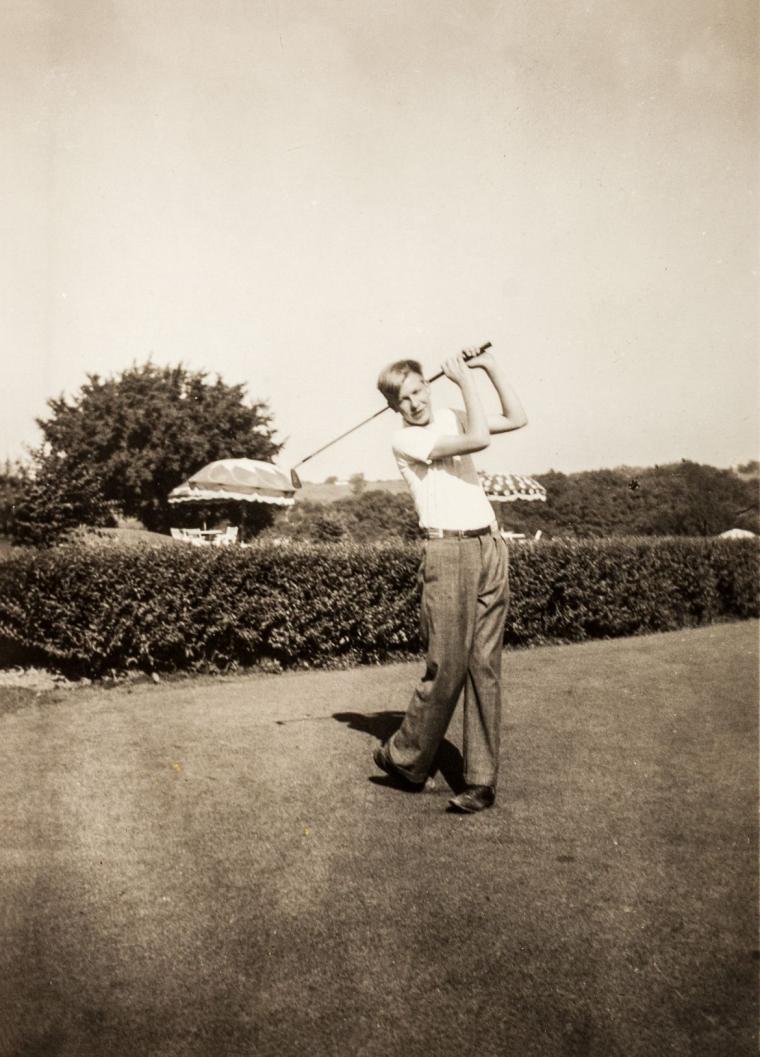
Young Whitey Barnard at the Davenport Country Club in the 1930s.
[Publisher's note: The following words are transcripts of the remarks delivered at the Echo Valley Country Club in Norwalk, Iowa, on October 17, 2025.]
Hello to all, and a great big thank you from our family for inviting us to this lovely evening. We have three generations here with us tonight. We feel so proud of Whitey’s legacy and want to share a little about it. Chris and I (Barb Stein) are Whitey and Patty’s children, David and Nicole are Whitey’s grandchildren, and Rigby and Ian are Whitey’s great-grandchildren. The most wonderful thing is that they are here for this induction, and when they are grown up, they can come back and see his legacy in this building. We are talking about Whitey’s legacy in two parts. I am making comments about one part and we have invited Craig DeVreize here to add the big part.
Whitey’s Early Life and Lessons Learned from Golf
Whitey’s entire life was shaped by the game of golf. Growing up during the Great Depression with a single mother who worked 12-hour shifts to care for her three children – with little help and no car – Whitey’s story is one of resilience and determination. It remains a mystery how our dad, at just 12 years old, found his way to the Davenport Country Club. According to Craig, the caddies from that club would gather on the main street of Bettendorf, wearing their red caps, and hitchhike out to Pleasant Valley – a journey of about 25 minutes. There, in the caddy shack, they would be hired to caddy for club members. In the process, they learned to interact with all kinds of people, earned money, and, most importantly, discovered the game of golf. For Whitey, this opportunity was truly the greatest gift he could have received, shaping his entire life. We learned many things from Whitey. Above all, he was an optimist – a trait common among golfers, who always see each day as a new opportunity and believe it never rains on the golf course. He taught us that hard work and perseverance make a big difference. Through golf, we also learned that you meet wonderful people, whether at your home course or traveling around the world; It truly is its own tribe.
Friendships, Traditions, and Adventures
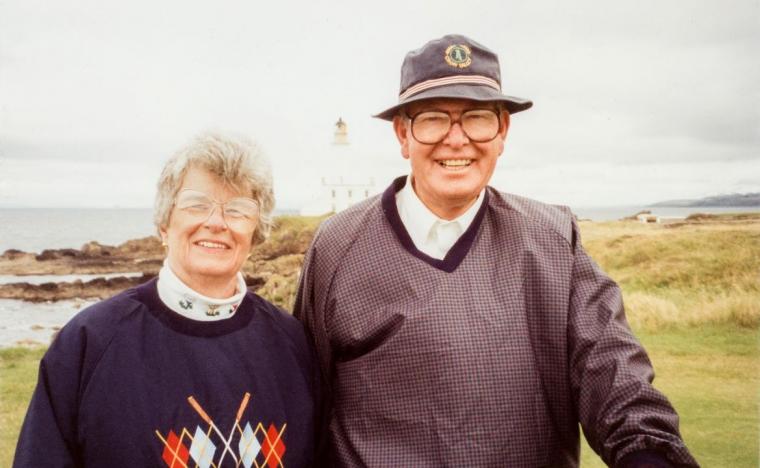
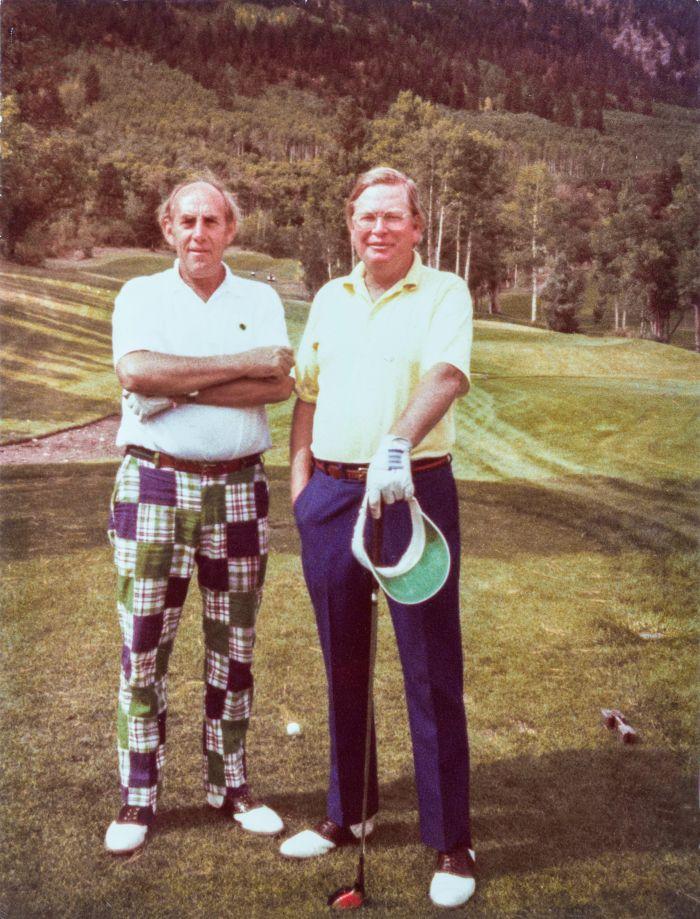
Whitey belonged to a group of players who called themselves the Gorillas. He also had a regular group of about 25 friends who organized their own annual tournament, the Knickers Open. Participants wore plus-fours or tucked their pants into their socks, and the trophy – a cherished find from a garbage can – was passed to the winner each year. After the game was over, families were invited for dinner to hear the tales of the day. These traditions show how much fun and camaraderie golf brought to Whitey’s life. Whitey demonstrated that you can combine your passion with your work, as he did with travel and golf. He started his own travel agency and that gave him many opportunities to explore the courses of the world. He played in Scotland 27 times, sometimes with Patty, sometimes with friends, and occasionally with large groups. In his later years, he even won a World Senior Tournament in Southern France. He played all over the United States, as well. His quest for a place to buy a second home was fulfilled in the 1990s when he and his family purchased a place in Palm Springs.
Family and Values
We ate dinner together every night, and our conversations often included important life lessons. One topic that came up frequently was the importance of giving back to your community. When he served as Park Board Commissioner, Whitey worked diligently to ensure the creation of a third public golf course. I remember driving out to Northwest Davenport in the family station wagon during my high-school years to see the land being prepared for what would become Emeis Golf Course. At my 50th class reunion, I asked those who had participated in the golf event where they had played. It turned out to be Emeis, and they shared that it was a wonderful mature course and they loved playing there. My only wish is that he had been here to hear that feedback. His buttons would be bursting. I would like to introduce Craig DeVrieze. He has had a long career as a sports writer in the Quad Cities. He gladly wrote a supporting letter for Whitey’s application. He also has written three books on Quad Cities' golfing history. He will fill in the details of Whitey’s legacy for what he himself felt was his biggest accomplishment, now called the John Deere Classic Tournament.
Pilot and Top Stick on the Navy Golf Squad
Thank you, Barb, and thank you, esteemed members and guests of Iowa Golf Association. Congratulations to each of tonight’s inductees. It is a privilege to join in this much deserved celebration of a man whose contributions to the game of golf have had a lasting impact in the State of Iowa and especially in my native Quad Cities.
I spent 30 years as a sports writer for two of my hometown newspapers, the Quad-City Times and the Argus-Dispatch. In that role, I had the good fortune to report and write about the game of golf and the interesting people who grew the game on the banks of the Mississippi. As Barb noted, I most recently had the great privilege of authoring books about the eventful histories of the John Deere Classic and Davenport Country Club.
Franklin “Whitey” Barnard was a primary player in both of those magnificent histories, and in so many ways he made the game he loved better in his and my hometown. I’d like to illustrate Mr. Barnard’s passion for golf by sharing a brief passage from each of those books.
From Magic Happened: Celebrating 50 Years of the John Deere Classic, published in 2021:
“Whitey Barnard was absolutely obsessed with golf, and he was good at it, too. Whitey won a lot of amateur events, and led a lot of golf tours to Europe and elsewhere,” said legendary QC sports television anchor Thom Cornelis, who once accompanied Barnard on a golf trip to Hawaii. When the young broadcaster went to the hotel lobby in advance of a morning tee time in Honolulu, he found his host bleeding from the head after having fallen into a coffee table.
“I said, ‘Whitey, you’ve got to get to the hospital,’’’ Cornelis remembered. “He said, ‘I’ll do it afterward.’ He tied a kerchief around the gash, and went out and shot 76 at Wailaei Country Club, wiping blood the whole time.”
Now this, from Davenport Country Club: A Century on the Bluff, published in 2024:
“Also serving the World War II effort was a DCC caddie-turned-member named F.L. Barnard. A wartime pilot and flight instructor at a naval base in Florida, Ensign Barnard years later would tell his son Chris stories of harrowing wartime flights in turbulent skies. 'In battle?' I asked. 'No. To play golf in the States,' the son replied with a grin. Whitey’s service to his country was as a top stick on the Navy golf squad. They also serve who make birdies.
I personally did not know Whitey well, as his most noteworthy contributions to Quad Cities golf occurred years before I took over the golf beat for the Moline Dispatch in 1984. I certainly knew then that he was an iconic figure in the local game. I also knew he had played foundational roles in the creation of Emeis Park Golf Course in Davenport, Crow Valley Country Club in Bettendorf, and, especially, in creating the Quad Cities Open.
The latter, of course, is now known worldwide as the John Deere Classic, a PGA Tour event which has taken place in my hometown for going on 55 years.
First Quad City Open at Crow Valley in 1971
On one of the few occasions I did interview Whitey prior to his passing in May of 2000, he told me his vision for bringing a pro tournament to his hometown had been sparked while serving as a teenaged caddie for Tommy Armour at the 1936 Western Open at DCC.
Along with future U.S. Open champion Jack Fleck, Whitey was one of several members of the Davenport High School golf team who served as caddies at that historic event.
More than a half-century later, Whitey told me enthusiastic community response to having many of the greatest golfers in the world competing in their town in he middle of the Great Depression had sparked his passion for bringing those great players back on an annual basis.
In 1951, Whitey was a member at Davenport Country Club and a key member of the Quad City 200 Civic Golf Association.
In January of that year, Whitey welcomed Western Golf Association icon Chick Evans into his home to finalize plans to bring what was then considered one of pro golf’s majors back to the bluff the following June.
After that successful Western Open, he joined with the QC 200 in making plans to bring a pro golf tournament to Davenport’s Credit Island Municipal Golf Course the following year. But Credit Island wasn’t quite up to Tour standards and, after being rebuffed by the Tour for a couple of years, the QC 200 group disbanded.
But Whitey more than anyone clung to the dream he’d fostered while carrying Tommy Armour’s bag for a grand total of $20 over four days in 1936.
Meanwhile, his commitment to golf in his hometown led him to join the Davenport Park Board in the late 1950s. There, he helped oversee the addition of a third municipal golf course, Emeis Park, in 1961, and championed the hiring of Bob Fry as the city’s head professional.
Inducted into the Iowa Hall of Fame in 1993, Fry played the pro circuit part-time, and he proved to be a valuable ally in creating Crow Valley Country Club, which opened in June of 1969.
Other community business leaders who joined what was called the Crow Creek 34 saw the new Bettendorf club as a real estate development opportunity, and, most importantly, a chance to launch a modern golf course that didn’t require tee times.
But Barnard and Fry had a larger vision.
From a Caddy Shack Vision to $200 Million Raised for Local Charities
That became a reality when the first Quad Cities Open teed off at Crow in the fall of 1971.
Whitey served as a co-chair of that and three subsequent QCOs held at the Bettendorf course. He also invested a considerable sum of his own money to keep the event on the tee through 1974.
Those QCOs at Crow struggled financially, and efforts to retreat the QC 200 to help fund it struggled, too.
In the spring of 1975, Whitey was on hand for a news conference to announce the end of the event. But when a group of Jaycee’s pleaded to keep the tourney alive minutes prior to the scheduled announcement in the spring of 1975, he agreed to throw out a news release and accepted a buyout of his investment.
Whitey proudly watched the 1975 tournament come together that July at a new course, Oakwood Country Club in Coal Valley, where Roger Maltbie’s final-round rally from seven shots back was overshadowed by Ed McMahon’s announcement that same day that he would host the event the following year, and bring many of his showbiz past along to add pizzazz.
That 1975 moment was one at least five times the Quad Cities tournament survived an existential threat.
But survive, it did.
The first John Deere Classic took place at Oakwood in 1999, and TPC Deere Run, the tournament’s TOUR-managed host in Silvis, Illinois, was less than a month away from opening when Whitey died in 2000.
That means Franklin Whitey Barnard knew the vision that began in 1936 would survive and thrive.
Thanks to Whitey, Quad Citians have seen major champions such as Payne Stewart, Steve Stricker, Zach Johnson, Jordan Spieth, and Bryson DeChambeau win in their midst.
And this past July, the John Deere Classic celebrated an amazing milestone, with its Birdies for Charity program surpassing $200 million raised for hometown charities.
That’s an incredibly significant impact of an event Whitey dreamt of as a teenager, and an indelible legacy for his foundational work to bring it to life.
As a golfer, Whitey won numerous club championships both at Crow Valley and DCC, and was a multi-time winner of the Quad City Amateur tournament. He also competed in and won amateur events across the globe, and played alongside many of the game’s greatest players.
Whitey still was swinging a golf club in 1999, months after undergoing a kidney transplant and months before his passing.
This was an Iowan who lived and loved the game golf.
Please join me in welcoming this true champion of golf to his rightful place in the Iowa Golf Hall of Fame.
Author

Anonymous (not verified)