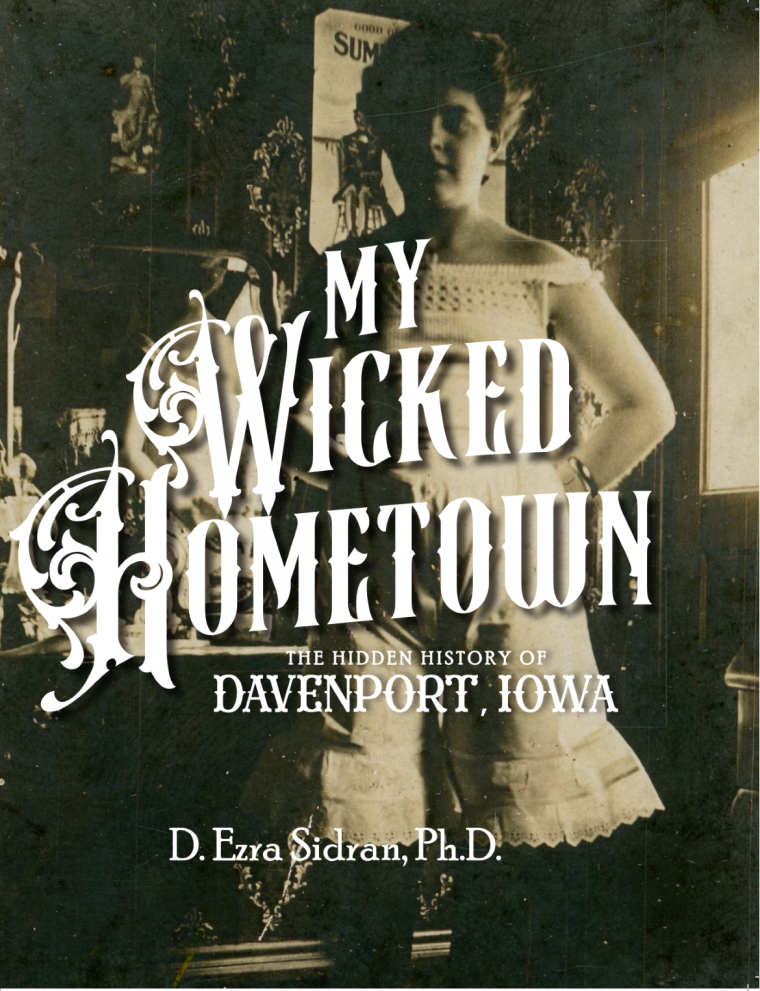
"My Wicked Hometown: The Hidden History of Davenport, Iowa" by D. Ezra Sidran Ph.D.
Any citizen of Davenport can tell you that our town was named after Colonel George Davenport. They might not know much else of the city's history, but that they are pretty sure of. Unfortunately, much of what they think they know is wrong.
The person commonly called Col. George Davenport was, in fact, born John King in Lincolnshire, England, and the highest rank in any army that he obtained was probably sergeant. He changed his name sometime after arriving in America but before appearing at Fort Armstrong (now the location of the Rock Island Arsenal located in the middle of the Mississippi River between Davenport, Iowa, and Rock Island, Illinois). Along the way, he married a widow, Margaret Lewis, 17 years older than himself, who had two children, William and Susan, from a previous marriage. Col. Davenport impregnated Susan, his stepdaughter, who gave birth to their first child, George L'Oste Davenport, in 1817, and then again in 1823 with their second child, Bailey Davenport. The prolific Colonel also allegedly impregnated his cook resulting in the birth of Mathilda Barrett [described as a “mulatto (who) grew up in the house.1”] The frisky colonel was presumed to have also fathered “a number of Indian children as well.”2
The Colonel and Mrs. Davenport and various step-children and sundry offspring lived happily together on the island in the middle of the Mississippi until the colonel was murdered by banditti on July 4, 1845.3 Three men – John Long, Aaron Long, and Granville Young – would be convicted for the murder and publicly hanged in Rock Island, Illinois, before a crowd estimated at 4,000.4
My wife Kelly likes to say that Davenport, Iowa, is not just funky; it's River City funky. It's a special kind of funky. There are other funky towns, but there is a unique funkiness to a river city town. This is not Meredith Willson's River City from The Music Man. This is not ice-cream socials and dancing in the square River City. This is a hardscrabble river town where fleecing the rubes was business as usual.
John Burrows arrived in Davenport on July 27, 1838. Eventually he would own a great deal of land including the very plot where my home is built. His mansion, Clifton, still stands across the street. But that morning, when he had to cross the Mississippi to get to where he would live for the next 50 years he got a quick lesson on how it was done in Davenport. Burrows writes:
“At that time, the ferry was run by that veteran, Captain John Wilson, and consisted of two steamboat yawls and a flat-boat. There were several passengers besides myself, and, as soon as we left the shore, the old gentleman began to collect his fares. I noticed that each passenger paid twenty-five cents. I tendered my quarter, when I was informed my fare was fifty cents. I demurred, of course, and was surprised, as well as somewhat amused, to be told that for “citizens” the fare was twenty-five cents, but for strangers it was fifty cents. I replied, “Oh! that is the way you do here, is it? Where I came from, they treat strangers the best.”5
Ha ha! Silly man! Welcome to Davenport. Yes, that's how they do here in Davenport. It's usually the small con – the quick barroom sleight of hand or the old badger game that leaves you broke and with your pants down below the knees somewhere out in rural Scott County. But sometimes it's breathtaking in its preposterousness.
Consider how Antoine Le Claire ended up owning most of where downtown Davenport would be built. Consider it all you want, because I still can't get the story straight. The Black Hawk War ended in 1832 with the capture of Black Hawk and the few hundred warriors and noncombatants that remained with him to the end.6 Sometime after that General Winfield Scott arrives, a treaty is signed, Antoine Le Claire provides some translation services and, because the Sauk are so grateful for these translation services, they give him all the land that ends up being downtown Davenport.7 Yeah, it could happen. At the same time, Black Hawk is literally clapped in irons, traveling to Washington City to meet the Great Father,8 and the alcohol was flowing freely in Davenport.
Davenport is a rough town. Make no mistake. And it always seems like the alcohol is flowing when the mischief is going down.
How can I explain Davenport? I've lived here most of my life (44 of my 70 years). I like the people and the people like me. I washed up on its shores like most of the musicians I know did. We just ended up here. And we felt comfortable and safe here. At the time there were plenty of good paying jobs for unskilled labor building farm equipment (most of those jobs are now long gone, exported to Mexico). But back then, there were a lot of bars; there were a lot of gigs. If the cops cracked down in Davenport, we moved to Rock Island. When the cops closed down Rock Island, we moved to Davenport. There was always an undercurrent of graft. We weren't stupid. We went with the flow. We made a living. We put down roots. We married local girls. We had families. Our children have moved away because they didn't like what Davenport had become, which, frankly, was always what it was if you just scraped away the veneer.
The Mississippi River is achingly beautiful. Every morning I walk a mile or two with my dog along the shore. I've seen it in drought and I've seen it in flood. I've seen it when ice is forming and thick clouds of moisture hang low over the river like fog. I've sandbagged at the local gay bar when the river is seven feet over flood stage. It's important for me to see the river every day. It's even better watching it from your front porch.
I thought that the best way to tell Davenport's story was through its newspapers. I have loved newspapers all my life; ever since I first published the Thursday Gazette (with the help of my mother) in fourth grade.
I'm not so naïve as to think that newspapers report the unvarnished truth. Newspapers are reflections of some percentage of the population. Reading these newspaper clippings can be painful at times. Stories about slavery, stealing Native American lands, murder, extraordinary racism, taxing prostitution, and corrupt elections can be eye opening. But if you want to know history, it's important to go back to the primary sources; what the people who were there actually wrote.
There's no escaping the fact that Davenport and its newspapers in the 19th century were about as racist as you can get. I'm using the actual newspaper clippings, so there's no way to clean this up or bowdlerize it. Another thing: I've decided to capitalize the words Black and White when used in reference to race. If you have a problem with it, I don't want to hear it.
Footnotes:
1. Page 216 of The Trader at Rock Island: George Davenport and the Founding of the Quad Cities by Regena Trant Schantz, published by Heritage Documentaries, Inc, 2020.
2. Ibid, page 217.
3. Darlene Ward Paxton quoted in a letter to Marcie Fisher published by Davenport Family History and Genealogy. – published on “Davenport Family Records” GenealogyTrails.com/ill/rockisland/family_davenport.html.
4. The Trader at Rock Island: George Davenport and the Founding of the Quad Cities by Regena Trant Schantz. Published by Heritage Documentaries, Inc., 2020.
5. Page 2 of Fifty Years in Iowa: Being the Personal Reminiscences of J. M. D. Burrows Concerning the Men and Events, Social Life, Industrial Interests, Physical Development, and Commercial Progress, of Davenport and Scott County, During the Period from 1838 to 1888 by John Burrows, published by Glass & Co. Printers, Davenport, Iowa, 1888.
6. Read Black Hawk’s autobiography. Trust me, it’s short and will open your eyes. It’s available for free here: Gutenberg.org/files/7097/7097-h/7097-h.htm, or search for “Black Hawk online autobiography.”
7. This was called “The LeClaire Reserve.” See the Wikipedia article on the “Black Hawk Purchase” for the gross details including this bon mot: “LeClaire's reserve was different from the Half-Breed Tract, which was designated and set aside west of the Missouri River before the Black Hawk Purchase.”
8. Black Hawk “writes” (it was dictated to Antoine Le Claire and, well …) in his autobiography: “On our arrival at Washington, we called to see our Great Father, the President (Harrison, who just a few years earlier, as Territorial Governor Harrison signed the infamous St. Louis Treaty which took Black Hawk’s village, Saukenuk which, in turn, started the Black Hawk War). He looks as if he had seen as many winters as I have, and seems to be a great brave. I had very little talk with him, as he appeared to be busy and did not seem to be much disposed to talk. I think he is a good man; and although he talked but little, he treated us very well. His wigwam is well furnished with every thing good and pretty, and is very strongly built.”
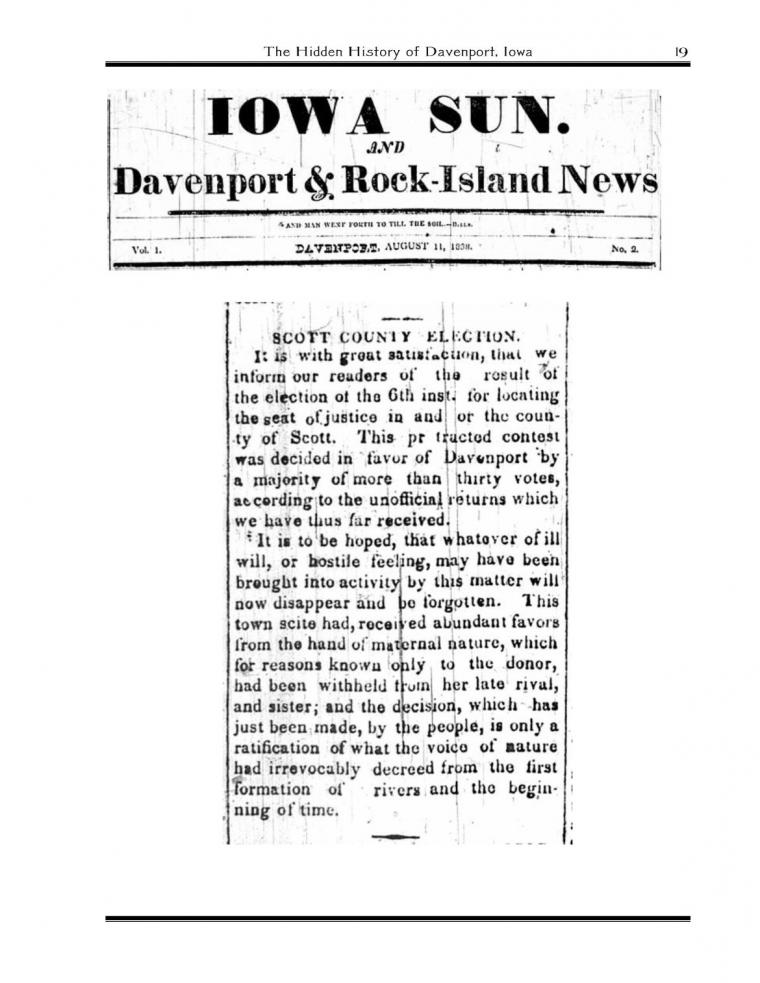
Davenport Becomes County Seat with Help from 11 Sleigh Loads of Drunken Miners
August 11, 1938, Iowa Sun and Davenport & Rock Island News
[Publisher's Note: This the first of more than 100 clippings from historical newspaper archives Ezra Sidran curated in his recent book My Wicked Hometown: The Hidden History of Davenport, Iowa.]
The “protracted contest” mentioned in the August 11, 1838 edition of the Iowa Sun and Davenport & Rock-Island News was, in fact, a vicious, underhanded, political brawl between the cities of Davenport and Rockingham as to which city would become the county seat of Scott County, get the big limestone court house and, eventually, consume the loser. There were three ̳elections held to decide the county seat. Davenport openly cheated in every one. In the first election, Davenport's founding fathers decided to bribe – with cash and vast quantities of alcohol – the lead miners upriver in Dubuque. The voting of the out-of-town ringers was described in The History of Davenport and Scott County:
“The day of election came and with it came also the importation of voters … . They were from Dubuque and Snake Diggings, eleven sleigh loads of the most wretched looking rowdies and vagabonds that had ever appeared in the streets of Davenport. They were the dregs of the mining district of that early day; filled with impudence and profanity, soaked in whiskey and done up in rags. Illinois contributed largely by vote for Davenport. There was no use in challenging such a crowd of corruption, for they hardly knew the meaning of the word perjury, so they were permitted to vote, unmolested. Rockingham at this election, whatever she may have done afterwards, observed a strict, honest and impartial method of voting. There was no necessity for a resort to intrigue. She knew her strength and had it within herself. The election being over, the Dubuque delegation of miners returned home having drunk ten barrels of whiskey and cost the contracting parties over $3,000 in cash!”9
There were two other disputed elections. Davenport won both; again relying on imported voters from upriver and citizens from Illinois (presumably ferried over at 25 cents per head). Soon, the town of Rockingham would be no more. It was absorbed into Davenport and all that remains is Rockingham Road which leads through Davenport's West End and downriver to Buffalo, Iowa.
Davenport was built on corruption. It has always been so.
Footnote 9: Pages 125-129 of The History of Davenport and Scott County by Harry E. Downer, published by the S. J. Clarke Publishing Company, Chicago. 1910.

Citizen's Case Reveals Incurious Davenport Mayor and Council Gave Away $1.6MM to Spiegel Without Requesting or Reviewing Demand Letter Addressed to Themselves
Three days of depositions in Sidran v. Davenport were concluded at the end of September (the depositions were supposed to occur on September 15, 2025, but the city stalled it out for another week). This lawsuit was filed because the city of Davenport deliberately withheld the “Spiegel Demand Letter” from numerous legitimate FOIA requests for approximately 300 days in violation of Iowa Code Chapter 22 and the Belin v. Reynolds Iowa Supreme Court ruling. I was one of the people that put in a Freedom of Information Act request for the Spiegel Demand Letter. Rather than give me the letter, as required by law (Iowa Code Chapter 22), the city of Davenport sued me to hide the letter. I defended myself, won in court, and the judge ruled that the Spiegel Demand Letter is a public record.
If you are unaware of the Spiegel Demand Letter (also known as the $1.60MM Nothing Burger as reported on the cover of the May 2024 River Cities' Reader), here is a summary: Davenport City Administrator Corri Spiegel on September 15, 2023, wrote a letter to Davenport Mayor Matson and the Davenport City Council demanding $2.5 million plus other benefits including health insurance and free college tuition. You can find the actual letter at RCReader.com/y/spiegel1. Eventually, Spiegel would be paid $1.6 million dollars plus health insurance and free college tuition.
Those deposed were current city council members Gripp, Jobgen, T. Dunn, R. Dunn, Meginnis, Mayor Matson, and former city council members Condon and Dickman.
All eight current and former elected officials testified, under oath, during their depositions, that they had not seen nor read the Spiegel Demand Letter until I acquired it and made it public by releasing it to the media approximately one year after the Spiegel payoff.
All eight current and former elected officials testified, under oath, during their depositions, that they never requested a copy of the Spiegel Demand Letter.
In other words, elected Davenport officials gave away $1.6 million to Corri Spiegel without knowing the contents of the Spiegel Demand Letter (the allegations). They simply gave away the city's money with no idea as to why.
I have asked my attorney if I can release the videos of the depositions. He replied:
“I am not aware of any protective order in place in this case. Nor am I aware of any rule that would prohibit the dissemination of these videos. I looked up the local rules for the Seventh Judicial District, and I did not see anything.” Consequently, I am releasing the videos of these depositions. You may watch the videos yourself at RCReader.com/y/depositions.
Author

Anonymous (not verified)