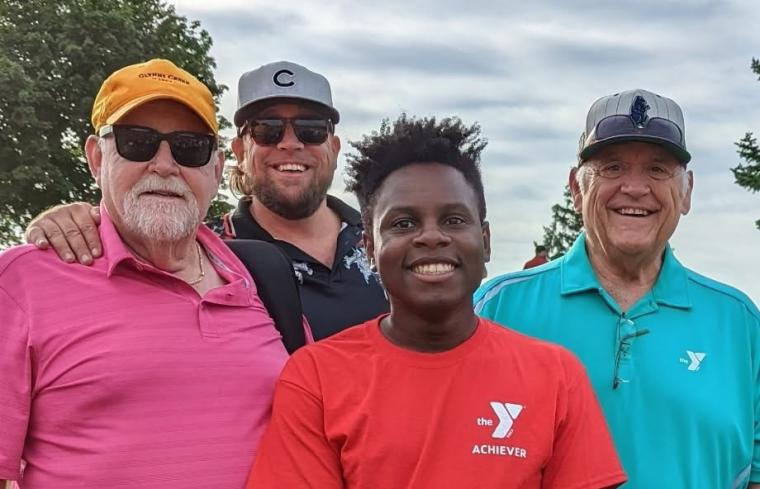
Frank Clark, Frank Klipsch IV, Dozmen Lee, and Frank Klipsch III.
Relief and Opportunity Lessons During Uncertainty
I’m standing on a sidewalk at the sideways bend of our great river – a perfect place to reflect on the legacy of my father, former YMCA CEO and Davenport mayor Frank Klipsch III. On this spot 170 years ago, the first rail bridge connected the opposite coasts of a fast-growing nation. Today it serves as a landing for country-long tourist river cruises, resting beneath the flagship branch of one of the fastest-growing YMCAs in the country.
Here, in the lingering energy of a thousand hugs and handshakes recently remembering my Dad, I briefly worry that the flood of love and goodwill recently shared in his honor might just fly away beautifully into the setting sun, like the dozens of bald eagles migrating away every spring.
Just weeks after his passing, my return to normalcy has included news stories of violence in Rock Island public schools, a stabbing at NorthPark Mall, relentless political division, and now full-scale warfare in the Middle East. Against that backdrop, grief feels intertwined with a larger question about the health of our communities and diminishing hope for our volatile world.
I am grateful to have learned several iron-clad tenets of my father’s leadership philosophy – lessons I believe offer both relief and opportunity for those struggling through these increasing moments of uncertainty.
My mandate is to ensure my father leaves a legacy far more substantial than a fleeting sense of Kumbaya. Even the central idea of his leadership – that relationships are the heart of positive community development – only superficially explains the measurable impact of his mission in action.
Collaborative Economic Outreach
My father was a master of the economics of collaborative outreach. A few key tenants would be: relationships are the nucleus for all positive growth; transparency and open-door access are the starting points for action, but only with the assurance that service providers and leaders walk through them, inside to out, in order to directly and respectfully engage the source of disruption and disengagement. (It was hard to picket or protest when the mayor would likely walk out of city hall, ask how he could help, and offer to buy lunch as he listened.) He believed urgency in outreach is mission critical. Every moment our vulnerable kids are not engaged and incentivized to a positive path, they are likely to be pulled further downward toward lifetimes of lost potential, increases in mandated services and expensive subsidies.
My dad would often say, “It’s much more cost-effective to put up guard rails than it is to wait for a crash and descend a mountainside only to pull bodies from a fiery wreck.” And finally, he constantly made the case that capital development, too often seen as the hallmark of civic success – the big buildings with honorarium names, the pools and fitness centers, the offices and housing complexes – are not the goal, but rather the tools to achieve a much greater mission.
His strategic relationships that scaled the first proof of this concept were built through fun-loving and flatulent-filled “workouts” in the YMCA cafeteria that not only engaged local CEOs, bank presidents, and school headmasters, but also the teachers and priests, the custodians and meter readers, retirees, mail carriers, and factory workers. The cafeteria was his classroom to teach his peers explicitly about inclusion, positivity, spirituality, effort, movement and sweat. Lots of jokes and countless laughs also helped establish connections that fostered and scaled his first great collaborative economic outreach.
Our local YMCA’s Outreach Program remains a signature annual campaign where more than 2,000 supporters individually make personal face-to-face asks and raise more than $1-million in gifts that fulfill said greater mission. A couple decades ago, an outstanding leader arrived here from south Chicago, Coach Reece Morgan. Coach Reece’s lived-experience and skill sets added huge value to my father’s Outreach Program. His ability to quickly engage, earn trust, motivate and incentivize at-risk students, made him a great captain to my father's cause.
Coach Reece Breaks Acting Out's Vicious Circle
Basically, students – many of whom were not receiving adequate positive attention outside of school – were acting out. The disruption negatively affected the other students and teachers, and the remedy was to remove them. However, when disengaged from the classroom, they fell further behind which made the psychological landscape even more difficult to overcome when they returned to the regular classroom.
I first got to see the work of Coach Reece in a converted Elementary school custodial closet, which itself was indicative of the transformation made possible through mission-focus. Elbow grease, a couple more lamps, a few posters of Michael Jordan, a single table with chairs for everyone to be included, and instead of an ugly room used for punishment, Coach Reece created an empowerment zone. Students were met right where they were, emotionally, intellectually, and educationally. They were seen and more importantly heard. And when they returned to the classroom, they did so with a newfound passion for their own possibility, incentivized goals, and mentors to guide them along the way.
“Actually, Coach Reece just got me to shut up,” recalled Dozmen Lee, a married, 29-year-old college graduate, veteran, home-owner, and father who was brought into my father’s “Character Development Network” as a nine-year-old elementary student. “I think I just felt so un-heard, so invisible in school, and I knew I had so much more to offer than anyone seemed to recognize, until Coach Reece showed up. Getting suspended and meeting him and working with him in that little janitor closet literally changed the path of my life forever. The 'smart' people I saw in my neighborhood didn’t do college or the military. Too often, their gifts were pulled toward something else, and unfortunately they usually ended up dead or in jail.”
Coach Reece and his team's efforts scaled into more than 85-percent improvement in grades, attendance, and behavior for at-risk students in schools, which inspired my dad's the next economic collaborative outreach.
While taking their frequent friendly walks on adjacent YMCA treadmills, my father, Dr. Jim Blanche, and Jim Andrews, the Superintendent of Davenport Schools and the Principal of North High respectively, discussed a problem that – via the economics of collaborative outreach – quickly transformed to opportunity.
Swimming Pool Engagement Catalyst
North High needed a swimming pool and had just enough money to build it. But the greater and often neglected cost was in operations, cleaning, treating, lighting, staffing, heating and maintenance that required far more money operationally than just construction.
If the case was made, the community could invest not just in helping students get a pool, but in an incredible shared resource for all citizens to utilize every day, all year long. With community-wide participation there would readily be enough resources to make an aquatic center a reality.
During the morning workout classes, amidst the pulse checks, beads of sweat, and jokes at the downtown Y, myriad members and friends such as the great Terry Lundardi made my father and the school team aware of a new possibility. The SILO (School Improvement Local Option) fund in the late 1990s had been enacted in just one Iowa county. The concept: One penny per dollar from an additional sales tax could fund local school's capital projects, via a voter referendum. The case: by recognizing the inclusive and urgent model of YMCA Outreach, not only for at-risk students, but for older folks, for child care, after-school programs, cancer survivors, Parkinson’s patients, people in need of fitness and movement and strength training, and anyone looking for healthy ways to improve and connect, a swimming pool could actually be a major capital investment utilized as an engagement tool for an entire community.
This might have been my dad’s most important career phase.
Through community meetings and town halls, talking with booster clubs and volunteer groups, service organizations, church meetings and anywhere people gathered, my father and his team of advocates asked tons of questions, shaped conversations about what a healthy community looked like, and pitched the possibilities for what a single penny could accomplish.
National Model
Not only did the vote pass, but it did so with such consensus that before the North Y was complete, the West YMCA had also broken ground with a collaborative framework that provided more gym space, community access to a pool, fitness center, and wellness programs, as well as a full-time Youth Development Director and meeting spaces, after-school programs, summer camps, and senior-wellness classes.
Over the next eight years, the Y successfully scaled the collaborative model in joint partnerships with Genesis Hospital System for the Bettendorf YMCA, and with a municipal entity by finishing a 10-year-stalled community center becoming the Maquoketa Area Family YMCA. Over the next nine years, the SILO fund generated tens of millions of dollars for the school district, as well.
Not only did leaders from throughout the State of Iowa take notice, but groups of people from all over the country began to make visits here to understand the framework. Although they looked deeply at contractual arrangements and case statements, picked apart bond processes and sales tax concepts, the magic was the nucleus: relationships, not only between my father and community leaders and voters, but between staff and participants, students and counselors, church leaders and business execs that brought the paperwork to life.
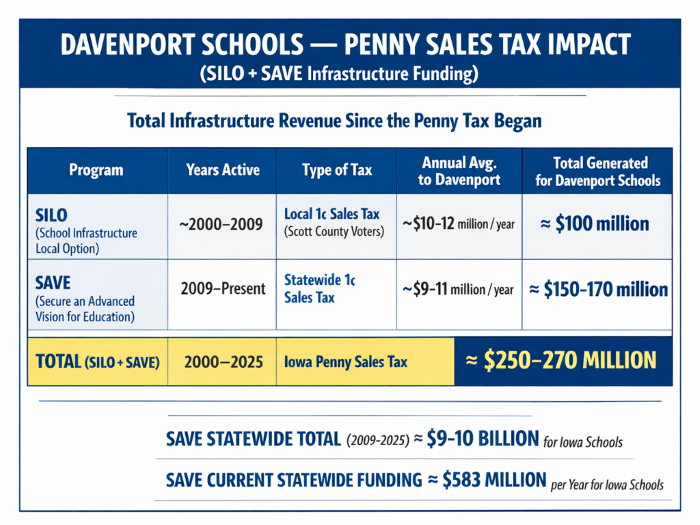
Less than a decade after the SILO-fund vote, the State of Iowa decided to codify the partnership by creating the SAVE-fund. This turned the local option that required activated strategic relationships into an automatic funding stream for all local schools in Iowa. Combining the SILO into SAVE from 2000 to today and the spirit of collaboration has generated more than $360 million for Davenport Schools, and more than $16 billion for public school infrastructure in the state. He saw these as community investments that could be maximized just like the Y facilities, ensuring maximum access by nonprofits, community programs, career opportunities and creative ways to build relationships within these state-of-the-art structures.
The Politics of a Toilet Flush
While Davenport schools are eagerly building more than $100 million in new middle schools, the best outcome meant that other partners would come together to create the most value possible inside, and not compete by working to build other multi-million dollar facilities near by.
As mayor of Davenport, my dad continued to put the economics of collaborative outreach into action. He didn’t campaign. He went anywhere possible to meet new people, to ask them questions, to listen, and to discuss opportunities to create answers together. After elected, he continued to make appearances and connections at every event possible, from ribbon cuttings to baby showers.
He used a phrase familiar to his morning workout friends that he called “The Politics of a Toilet Flush.” He knew that antagonism, cynicism, and disenfranchisement ended through a two-way relationship. The more that citizens not only understood, but were able to meet and get to know the people responsible for the essential and often-taken-for-granted aspects of civic activity, from plumbing and water treatment to roads and emergency services, safety, parks and amenities, the more people built the soul of a community. The Davenport Citizens Academy is still in effect today. (And he would encourage you to sign up!)
Dad knew that good intentions didn’t automatically overcome poor or mediocre services. But by looking through the lens of passionate human beings, working hard, being rewarded and held accountable through transparency and communication, we would continue to build connections and outcomes that transcended differences and created shared – and measurable – outcomes.
To his last day, my dad knew a legislated penny tax wasn’t enough to continue to scale the collaborative framework. He would vote for and encourage the PPLE fund to maintain these great investments as tools, not rewards. Following recessions, political turmoil, on-going feasibility studies, and thousands of strategic plans created by hundreds of nonprofits and businesses, a spirit of competition between nonprofits could create a dangerous undercurrent beneath the powerful flow of trusted collaboration.
Not only did my father abhor the toxic concept of “those people,” but he also shunned the competitive nature that often led to minimized shared goals, even between goodhearted and well-meaning leaders that created an “Us” versus “Them” scenario. My dad believed that winners make losers, but leaders make leaders. And only through shared vision, trust, honesty, transparency, and collaboration could our community realize its full potential.
Well-Funded School Buildings Address Only 14 Percent of a Student's Life Annually
The current generation of young Dozmen Lees are still being removed from classrooms and fitness centers, and they are only in our well-resourced school buildings for 14 percent of their annual lives. Even when well-motivated and -behaved, they are students just seven hours a day, for 180 days a year. In alignment with the Economics of Collaborative Outreach, the target for our work is in the 86 percent of spaces where vulnerable kids, adults, and families are working to survive every day. In this space lies the challenging framework where we can – and will – respond to the most urgent challenges of today, including but not at all limited to homelessness, underemployment, mental health, youth violence, political antagonism, and the toxic lack of trust many have with leadership in the highest offices.
As the social challenges explode – quite literally – around us on a daily basis, I’m comforted by the truth our own river has witnessed for generations. Together, respectfully, patiently, lovingly, through education and the meeting of basic needs and the trauma-informed attention to our most vulnerable, we will determine the best way forward, together.
Author

Anonymous (not verified)