
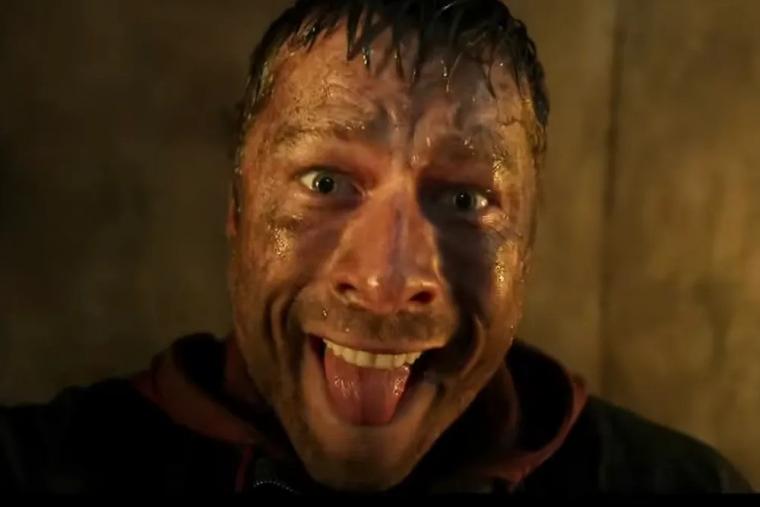
Glen Powell in The Running Man
THE RUNNING MAN
This opinion may seem counterintuitive, or even downright crazy. But I found director/co-writer Edgar Wright's The Running Man, a violent, profanity-laden dystopian thriller based on a Stephen King novel … kind of adorable.
That was at least partly guaranteed given the casting of lead Glen Powell, who, at present, seems constitutionally incapable of hiding the good time he's having as a movie star, sharing his dimpled grin and sculpted physique and breezy charisma with all the world. Powell certainly makes the movie a more charming place to be. Yet watching Wright's and co-screenwriter Michael Bacall's take on the book – a pre-Hunger Games published by King (under his “Richard Bachman” pseudonym) in 1982 and set, yes, in 2025 – I couldn't help thinking that this “futuristic” outing was astoundingly behind the times. You mean to tell us that reality TV is fixed and faked? That great gobs of viewers will buy the lies they're fed without a second thought? That corporate overlords don't have the nation's best interests at heart? Awww … . How cute, Running Man! Take a seat in the back and welcome to 2025 as it legitimately is – which is way the eff scarier.
You may recall that, almost two-months-to-the-day ago, director Francis Lawrence's own King-as-Bachman debuted. Titled The Long Walk, it took place in an American hellscape in which the financially underprivileged agreed to a murderous endurance test for a chance at staggering riches and the promise of a better life. Wright's offering is clearly the more adventurous of the two, in that it takes place in an American hellscape in which the financially underprivileged agree to a murderous endurance test for a chance at staggering riches and the promise of a better life – but this time, on frequent occasion, they have to run. (Proof that this is higher-concept entertainment? The Long Walk didn't have a film version until this year. The Running Man got one in 1987, and with Arnold Schwarzenegger as its star.)
In the case of both Bachman books, though – The Last Walk having debuted in 1979 – King was remarkably prescient about where our collective societal interests would lead in the subsequent decades. We would become a nation addicted to screens, addicted to manufactured drama beyond our personal purview – addicted to the notion that if the on-highs tell us something is true, it must be true. (Both books, like much dystopian fiction about the U.S., live in the shadows of George Orwell's 1984 and Paddy Chayefsky's Network.) Still, Lawrence's The Long Walk gave us a vision of present-day America, despite its late-1960s/early-'70s period trappings, that wound up even more disparaging of our current situation than King's book. Wright's film appears designed as a big-screen thrill ride first, which might account for this update addressing something as relatively benign as reality television. Sure, until the very end, it's a largely faithful rendering of the King, and pity the fools who feel that Survivor (or The Apprentice) shows them an accurate impression of life. But reality TV isn't the enemy these days. The enemy is the bifurcation of information through outlets that have nothing to do with TV-competition programs, and it seems willingly naïve, if not negligent, of Wright and Bacall to ignore that 2025 truth. Toward the finale, Powell's Ben Richards makes a plea to home viewers to demonstrate their ire to the rank-and-file by turning off their TVs. Okay. Done. Now what?
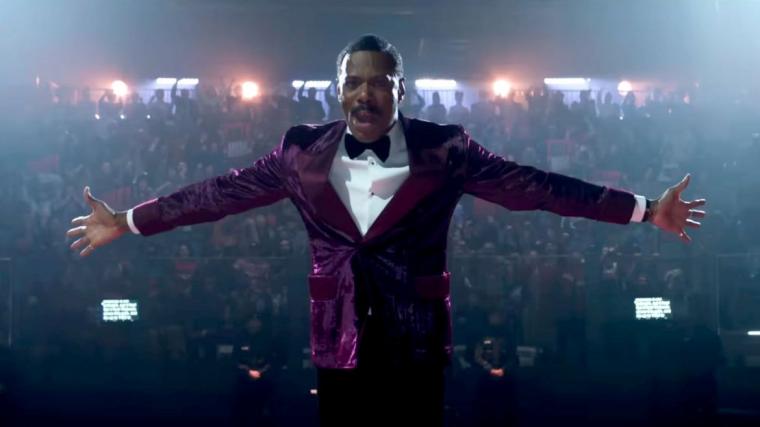
Despite my long-winded tirade, I did think that a lot of The Running Man was a lot of fun. After Powell's slum dweller Ben Richards grudgingly enters the televised Running Man contest for a chance at a billion-dollar payoff – the man needing funds for his wife (Sinners' Jayme Lawson) to avoid sex work and his infant daughter to receive medication for her flu – much of the traditional Edgar Wright spirit enters the picture, which proves a blessed relief after the grand disappointment of 2021's Last Night at Soho. Boasting a pair of joyously nasty performances by Josh Brolin as network CEO Dan Killian and Colman Domingo as The Running Man's resident Ryan Seacrest Bobby T., these preparatory sequences outline the show's rules in admirably specific detail. They also make clear that Ben's hope for winning the bil is unfounded from the start, as no one in the series' long history has ever survived the 30 days to payday, given that hired mercenaries and the general public are constantly at-the-ready to kill you.
Needless to say, in our present era of ICE and people willing to rat out their neighbors in the name of “the public good,” Ben and his fellow competitors (Martin Herlihy and Katy O'Brian) being amazed that fellow Americans would turn against them rings pretty hollow in 2025. So do multiple aspects of Wright's and Bacall's and maybe King's plotting: Ben's shock upon learning that deep-fakery is employed in his televised diary sessions to the masses; Ben needing to be schooled in the ways of 21st-century television by a rebel ally (Daniel Ezra); Brolin's all-business sociopath having to wait to kill Ben on live TV until 7pm EST, so as not to interrupt previously scheduled programming. (The Running Man's adherence to broadcast television's traditional prime-time viewing schedule in the age of streaming is the funniest, and most unacknowledged, joke in the entire movie.) With its rotating-globe drones and cars accented with fluorescent lighting on the door handles, The Running Man is clearly set in a post-2025 future. But it's a weird, unconvincing, backward future in which the Internet apparently doesn't exist, and one insistent that audiences are as glued to their TVs as they were during the series finale of M*A*S*H. Wright's film isn't tone-deaf so much as culture-deaf.
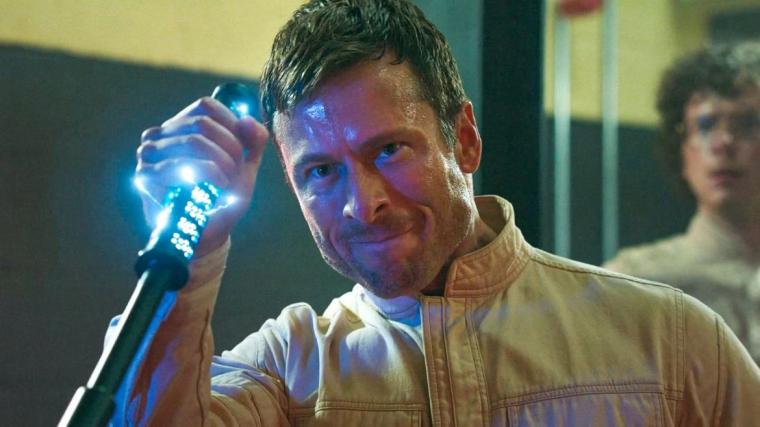
Powell, at least, makes this an easy sit. There's almost no question but that Wright saw the actor in Hit Man and figured him the exact right guy to occasionally don goofy disguises and speak in exaggerated accents, with Powell's bit as a hobbled Irish priest here feeling like a deleted scene from Richard Linklater's 2024 comedy. Still, I'm not entirely convinced that Powell has it in him to play murderous rage – again, he seems to be having so much fun – and it hurts to say that Schwarzenegger was probably the better choice for Ben Richards. Arnie, at least, convinced you that vengeance, and winning, were the only things on his mind. Powell is actor enough to suggest that many other things – Ben's life, his wife's and child's lives, the country's ultimate well-being – are of critical importance, and he's unfortunately saddled with a script less multi-dimensional than he is. As in the manner of so many thrill rides, everything's at stake yet nothing's at stake; Wright would rather we giggle at the image of Ben wagging his tongue and flipping off the camera than get bummed out over the material's darker implications.
Still, there's nothing wrong with a nicely seasoned bowl of popcorn entertainment, with particularly salty kernels served up by William H. Macy as Ben's trusted handler, Lee Pace and Karl Glusman as Ben's chief hunters, and Michael Cera, who steals an entire scene through the mere act of juicing up a super-soaker. (In his cameo, Sean Hayes shows up as another preening game-show host, and I think there's an encoded joke in his lines being dubbed in by a lower-voiced, presumably more alpha-bro actor.) We also get CODA lead Emilia Jones as a civilian who becomes an accidental accomplice, though the best I can say about her participation as both performer and character is that Ben being a devoted married man at least prevents her from becoming a romantic distraction. We already have distraction enough in The Running Man. And as diverting as the film is, I wish its leanings didn't suggest that it should've instead been titled The Amazing Race.
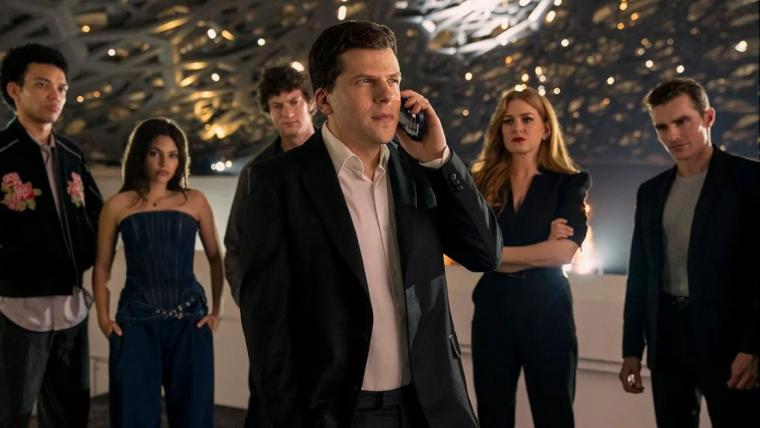
NOW YOU SEE ME: NOW YOU DON'T
On awards shows and Nicole Kidman AMC ads, Hollywood loves to extol the “magic of movies.” Magic in movies, however, is another story. In most cases, it's insultingly stupid. You're right to exclaim “How did they do that?!” when live magicians pulls rabbits out of their hats right in front of you. That question, though, is meaningless when it comes to watching illusionists perform their craft with the aid of editing and busy camera moves and dozens of behind-the-scenes CGI artists. How did they do that? By forcing you to look wherever they damn well wanted you to look, and by cheating whenever necessary. Arguably, the only decent modern movies about magicians – Nolan's The Prestige, say, or even del Toro's Nightmare Alley – are those that honestly pull back the curtain and reveal the relatively low-rent nuts-and-bolts procedures behind the trickery.
The Now You See Me franchise (and I hate calling this sadly resurrected series a franchise) doesn't function like this. Yes, its professional and amateur prestidigitators – and God help us, there are nearly twice as many in director Ruben Fleischer's Now You See Me: Now You Don't as before – perform impossible miracles by the truckload, and the “How?”s behind their biggest feats of hocus pocus are, in due time, “explained.” But the explanations are generally more ludicrous than the feats themselves, requiring us to buy not just advance knowledge but prescience about when and in what manner characters will behave, to say nothing of the magicians seemingly having warehouses of holographic imagery to pull out at a moment's notice. For the totality of schemes to be at all believable, you have to believe that hundreds of people were working behind the scenes to ensure their success. You also have to believe that the series' fabled Horsemen aren't magicians at all; they're superheroes. Dave Franco's playing cards act as heat-seeking missiles and have the blunt force of anvils. Woody Harrelson can create debilitating hypnosis with one sentence. And it feels silly to complain about any of this, because over the course of three movies, the filmmakers obviously don't care, and apparently, neither do their audiences. A friend of mine rationalized enjoying these films by saying the Now You See Mes are “like music videos without good music.” Fair enough. But these particular videos also look like crap.
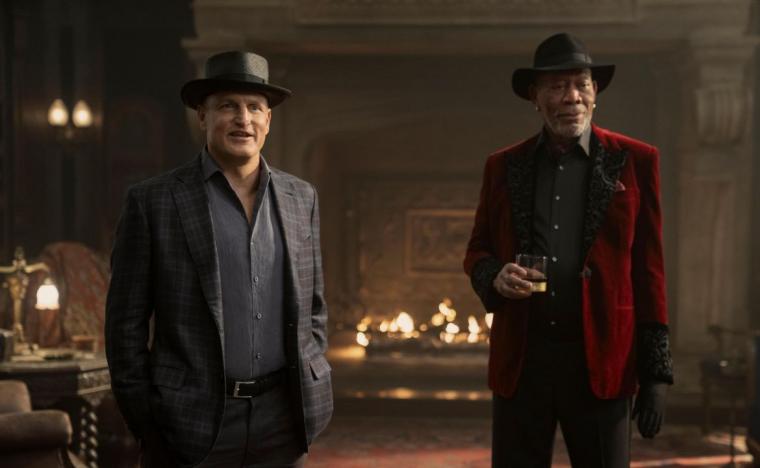
All you need to know about the Now You Don't story is that the original four Horsemen from 2013 (Franco, Harrelson, Jesse Eisenberg, and Isla Fisher) are back, this time joined by a trio of gifted tyros (Dominic Sessa, Justice Smith, and Ariana Greenblatt), and they're teaming up to thwart the evil machinations of a money-laundering diamond-company heiress (Rosamund Pike). Series mainstay Morgan Freeman and 2016's Now You See Me 2's Lizzy Caplan, Fisher's lady-magician replacement, show up, too. With the exceptions of Smith, who appears to be actively trying, and Caplan, who remains as impervious to crummy material as ever, they're all insufferable. Plenty of scenes in Fleischer's threequel would qualify as the movie's worst. But if forced to choose, I'd have to go with the sequence of present and wannabe Horsemen successively one-upping each other with closeup magic, a segment of whirling camera spins and forced bonhomie so lousy with smug, noxious entitlement that it's astounding the floor didn't collapse under the weight of their crushing self-regard. Then again, the finale does give this woebegone scene a run for its money, when an evidently spontaneous “Gotcha!” ends with all of our many, many protagonists addressing a captive audience with “We're the Horsemen! Good night!” Speaking in unison. And subsequently taking a bow. As if they'd been rehearsing this variety-show routine for days, when they couldn't even have known about their precise circumstances until a few minutes before.
I'm gonna keep this tirade relatively brief, because I don't want to critique Fleischer's movie so much as slap the shit out of it. But if I may ask: Are screenwriters, like sitcom writers, among the only people on Earth without friends of varying generations? The gags built on “You don't know anything – you're a kid!” and “You don't know anything – you're old!” are so routinely rehashed as to be wearying, their only purpose to make the incredulous questioners look foolish when, ta-da!, it turns out their younger/older compadres actually do know things! I loathed Now You See Me: Now You Don't for innumerable reasons: the witless script that evidently required five writers to make terrible; the “Where's my paycheck?” disinterest of the original Horsemen performers; the unfortunate waste of Sessa's Holdovers promise; Pike's ludicrous stab at a South African patois; the least moving death-of-a-series-regular in franchise history. Yet as a 57-year-old who is honored to have friends ranging in age from 11 to 80-plus, I especially detested Fleischer's continuation for what felt like a full quarter of the movie dedicating itself to tired generation-gap gags, tropes that already felt lazy in The Brady Bunch. “Like music videos without good music.” Agreed. But don't take that as any incentive to watch this series. My friend who voiced that opinion is young. He doesn't know anything.

KEEPER
With Keeper arriving on the heels of February's The Monkey and last July's Longlegs, I've now seen debuting Osgood Perkins horror flicks more often over the past 17 months than I've seen a number of very dear friends. And if absence does indeed make the heart grow fonder, I'm hoping the director will give us a longer breather between now and his next project, because I think I've more than reached my saturation point.
Helming another author's script – the screenwriter is Nick Lepard – for the first time since 2020's wonderfully unsettling Gretel & Hansel, and for only the second time in his nine-feature career, Perkins does manage to keep us invested for a good half of the film's 99 minutes. It certainly helps that his lead in Tatiana Maslany, who was rather palpably misused in The Monkey, but who's allowed a far broader showcase for her gifts this time around. She plays Liz, a Canadian painter who's celebrating her one-year anniversary with doctor boyfriend Malcolm (Rossif Sutherland) by joining him at his spacious cabin in the woods of Vancouver. The pair seems comfortably content in that one-year-later way, the house is warm and inviting, and there's even a boxed cake awaiting them – a gift, Malcolm says, left by the caretaker. Sure, the box appears to have blood-stained (or are they merely chocolate-stained?) fingerprints on it. But things are about to get more unsettling. Malcolm's obnoxious next-door cousin Darren (Birkett Turton) shows up with his vaguely lobotomized date Minka (Eden Weiss). Liz begins hearing unexplained sounds and having visions of people who aren't there. A ghostly apparition, unbeknownst to Liz, finger-draws a heart on the fog of the bathroom window. And then there's sweet, solicitous, soft-spoken Malcolm with that cake. “Won't you have a piece?”
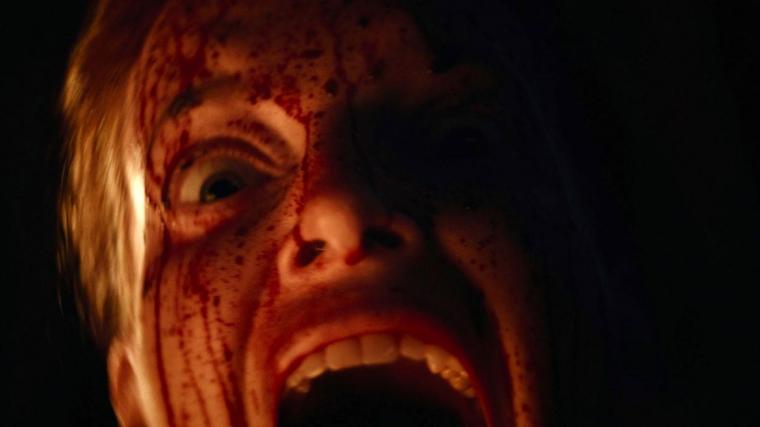
Under ordinary circumstances, this last bit would be all we'd need to demand that Liz get the hell out of there. But the best surprise – really, the only surprise – of Keeper is that Malcolm doesn't exude one iota of threat, not even the purposeful lack of threat that can instantly make characters threatening. We know in our bones that Liz shouldn't accept that slice, which she does; we're even more fearful for her welfare when she wakes up in the middle of the night and, as if in a trance, devours the whole freaking cake. But Sutherland, in a legitimately inscrutable portrayal, makes bearded Malcolm such an endearing bear-hug of a guy that malevolent intent barely seems possible. We're almost more worried that whatever madness Liz is evidently succumbing to will unfairly claim him, as well. Until, that is, you remember the prelude, perversely scored to Mickey & Sylvia's 1956 hit “Love Is Strange” (a tune familiar from Dirty Dancing), which shows beautiful women through the decades being successfully wooed and just as successfully murdered.
Between Sutherland's friendly calm, Maslany's ravaged desperation, and Perkins' traditionally off-kilter framing that inspires you to look for scares in the wide-open spaces around our central points of focus, I hung in with this thing as long as I could. But the film eventually, and rather predictably, devolves into a series of meaningless shock cuts and context-free nightmare images, its visual motifs of rivers and honey and plastic bags not making a lick of sense in the moment yet somehow making less sense when ultimately, unconvincingly explained. Because he's a director-for-hire on his latest release and the script consequently isn't his fault, Perkins can't exactly be accused of crawling up his own ass in the movie's latter half. But crawling up someone else's hardly proves preferable, and although Keeper left me with about a zillion unanswered questions – Where does Darren disappear to? What happened to Minka? Who dropped that incriminating photo and why? – the only one I really want addressed is: Was I wrong to enjoy Gretel & Hansel as much as I did? Osgood may be Anthony Perkins' son, but it's his increasingly unflattering résumé that's starting to seem truly psycho.
NOUVELLE VAGUE, BEING EDDIE, and THE PERFECT NEIGHBOR
This is the point in the movie year in which Oscars obsessives such as myself have to be vigilant, because “For Your Consideration” titles begin their streaming debuts all the time, often with little fanfare. (Are awards hounds even aware that Nia DaCosta's updated Hedda Gabler adaptation Hedda, with its sublime work by Tessa Thompson and Nina Hoss and the designers, has been available through Amazon's Prime Video for weeks now?) As has been the case dating back to 2015's Beasts of No Nation (no Oscar nominations) and 2017's Mudbound (four nominations), Netflix has been the chief perpetrator of the annual, autumnal, throw-it-at-the-wall-and-see-what-sticks prestige dump. So with A House of Dynamite and Frankenstein behind us and Train Dreams and Jay Kelly ahead – not to mention June's KPop Demon Hunters, which might score the service's most Academy Award wins this year (!) – what else is currently available?
Well, as of this past weekend, there's Nouvelle Vague, which, following his marvelous Lorenz Hart comedy Blue Moon, is director Richard Linklater's second feature released over the past four weeks. (So I suppose I should leave Osgood Perkins' prolificity alone.) There's a certain segment of Netflix viewers – I'm gonna guess about 98 percent – who would no doubt find the movie unbearably precious, if not annoyingly pretentious. To begin with, it's shot in black-and-white, presented in the old-timey 4:3 aspect (square) ratio, and performed almost entirely in French, a first for the Texas-bred filmmaker. Like the characters in the Now You See Me series, the ones here clearly believe they're cooler than other humans – though unlike the NYSM magicians, Linklater's less literal wizards might be right. And if the movie's very title, French for “new wave,” didn't make it off-puttingly artsy enough (the “vague” rhymes with “cog”), experiencing the film's barrage of European cinema legends is like playing “Where's Waldo?” if every other figure were Waldo. Look! It's François Truffaut! Jean Cocteau! Agnès Varda! Roberto Rossellini! Éric Rohmer! Was Claude Chabrol not on the scene? Oh wait … there he is!

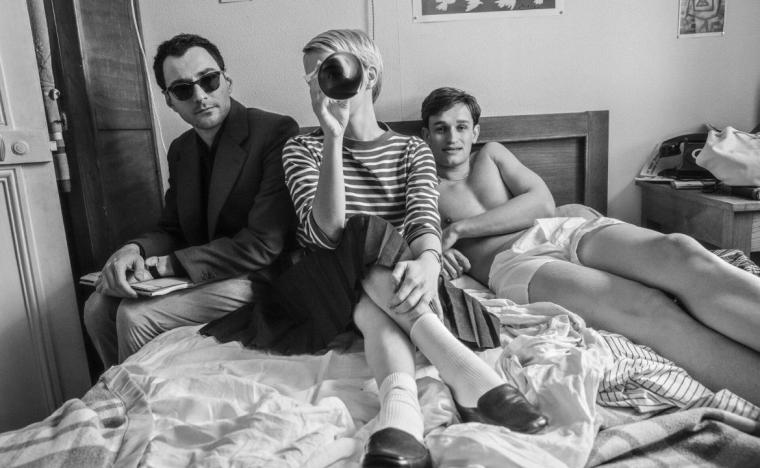
So yeah, Nouvelle Vague is bound to have limited appeal. But if you're a fan of New Wave cinema, and a particular fan of Jean-Luc Godard's Breathless, or even if you've merely been curious about that movement and that movie, Linklater's latest is practically unmissable – as well as a helluva lot of fun. Set in France in 1958 and '59, it's essentially the Breathless origin story, demonstrating how Godard (the deservedly confident newcomer Guillaume Marbeck) rose from his noted career as a Cahiers du Cinéma film critic to, with his debut feature, acclaim as perhaps the most influential filmmaker of his generation. The movie takes us from Godard's initial plans for the legendary crime drama (its story by Truffaut) to its screening in front of wowed colleagues, placing particular emphasis on how Godard's speedy, unfussy shooting style was revolutionary, though some of the production's participants would more readily call it nuts. Denied full scripts, actors were given lines seconds before filming commenced. Live sound wasn't employed, so Godard could shout direction at the cast without a pause in filming. Some planned shooting days were scrapped entirely so that the director could, say, spend an afternoon playing pinball. The plot was indiscernible. The meaning was unclear. No one, least of all leading lady and native Iowan Jean Seberg (Zoey Deutch, looking phenomenally chic), thought a masterpiece was in the making. In other words, Nouvelle Vague is very much like Tim Burton's Ed Wood … if Plan 9 from Outer Space had wound up one of the most celebrated films of all time.
Although I admire the decision to have everyone on-screen (aside from Seberg) wholly speak French, part of me selfishly wishes the film were in accented English, because this is the type of chatty, funny Linklater that I routinely play as background noise – a Dazed & Confused or Bernie or Hit Man that keeps me smiling while I wash dishes or pay bills. (This one joins a half-dozen others among Linklater outings he didn't also write or co-write, the credited scribes here being Holly Gent, Michêle Halberstadt, Laetitia Masson, and Vincent Palmo.) Yet Nouvelle Vague will be an easy one to again actively watch, given the gorgeous David Chambile cinematography and ticklish set pieces, with Seberg and her former-boxer co-star Jean-Paul Belmondo (a huggable Aubry Dullin) hiding their flirtation from Seberg's husband, and Duetch offering a priceless “Gimme a break” reaction upon Godard's avowal that they'll create “the saddest shot in the history of cinema.” Plus, we're treated to the enticing, iceberg-lettuce chill of Marbeck's Godard, who is never, ever seen without his sunglasses; had this Godard been given a shower scene, he'd be wearing them there, too. Linklater's New Wave love letter is one of the richest, most trenchant making-of-a-movie movies we've been treated to in ages, as informative as it is entertaining. And I mentioned that Godard starts out as a humble film critic, yes? Our profession's writers may not be spotlit often, but when we are – be it through Marbeck here or Michael Fassbender in Inglourious Basterds – we do tend to look good.
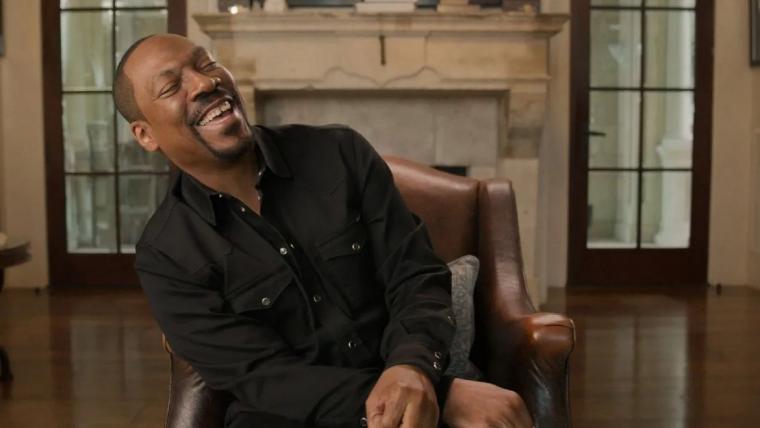
Much like its subject in regard to his own future chances, probably no one at Netflix expects the celebrity-endorsed Eddie Murphy documentary Being Eddie (which began streaming November 12) to be an eventual Oscar winner, or even a nominee. The star himself implies that he'll likely never get that gold trophy, recalling how he preceded his Best Picture presentation in 1988 with an incendiary statement about how Black actors had been unjustly ignored by the Academy over the decades, and hinting that his speech cost him favor with the Academy. (Friends and I watched that speech live; it was much-less fiery than Murphy suggests.) In director Angus Wall's doc, Murphy also sidesteps the fact that when he was Oscar-nominated, for 2006's Dreamgirls, and lost to Alan Arkin, he promptly left the building, explaining his exodus by saying he simply preferred to be at home. All good; as a Golden Globe- and SAG Award-winning frontrunner who lost, I'm not sure I'd want to stay, either. But in both instances, the star is clearly re-framing the narrative to serve his personal interests. And while that's understandable in a “candid” feature-length documentary endorsed by the man it's about, it also means that some of us might be left with a whole bunch of queries that aren't satisfactorily addressed.
To get the obvious out of the way, Being Eddie is absolutely worth seeing as a treasure trove of the comedian's professional highlights, as well as for the equally expected home-video footage of the man absolutely killing it as a kid with his impressions and unbridled confidence, most of his act admittedly, and understandably, stolen from Richard Pryor. (These clips were so phenomenal that, upon finishing Wall's feature, I immediately re-watched 1987's Eddie Murphy: Raw, and was flabbergasted again by Murphy's channeling of Pryor and Murphy's love/hate influence Bill Cosby.) We also get lots of SNL, 48 HRS, Trading Places, Beverly Hills Cop, and Coming to America – though little of Dreamgirls, Dolemite Is My Name, and other 21st-century film work. Almost a full half-hour, however, is devoted to Murphy's 2019 return as an SNL guest host, his 35-year absence from the series evidently fueled by one rather benign David Spade crack in a “Weekend Update” segment. And that's where your fundamental enjoyment of Being Eddie truly becomes interesting.
Murphy doesn't outright say that Spade's joke about the long-forgotten A Vampire in Brooklyn (“Look, children – it's a falling star!”) was so off-putting that it made him detest the show that made him famous. But it's certainly implied. And that's when I, at least, began notching, and continued to notch, a whole bunch of fascinating holes in this rags-to-riches saga. Was Murphy really so thin-skinned that one sub-par gag caused a 35-year shunning? Does he have any response to his homophobic routine in 1983's HBO special Delirious? (“They kiss them and come home with that AIDS on their lips.”) What led to his 2006 divorce, after 13 years together, from Nicole Mitchell? How do his 10 kids from different partnerships get along? Aside from his easy disregard toward his participation in 2008's Meet Dave – “Don't ever play a spaceship” – does he have any regrets about the many, many, many godawful comedies he's made over the decades, one of which, Norbit, perhaps cost him that Oscar? Murphy ain't sayin'. What he does say in Wall's doc is “I can’t think of another actor – a comedic actor, a dramatic actor, Black, white – who’s done more different types of things.” Being Eddie is supremely watchable for what Eddie Murphy has done. It might be invaluable for the image he's choosing to present.
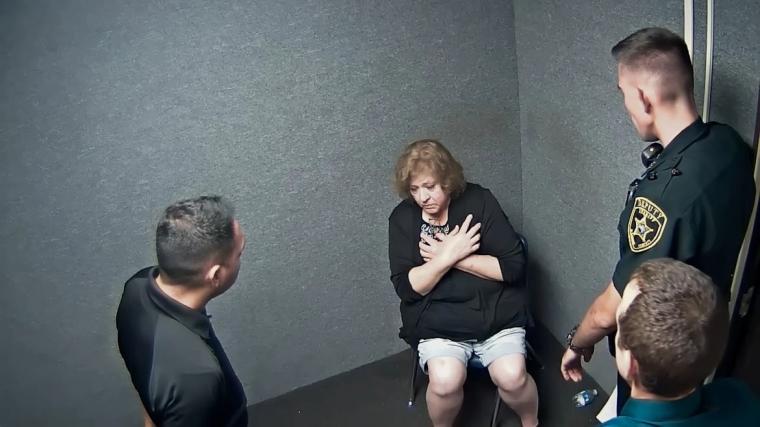
Like many of you, probably, I landed on director Geeta Gandbhir's and Netflix's true-crime documentary The Perfect Neighbor when it debuted about a month ago. It was just one of those nights when you're absentmindedly scrolling looking for something new to watch, and the preview was grabby, so I dove in. I found it completely arresting, if more than a little manipulative, and catalogued it alongside hundreds of similarly engaging/enraging streaming docs over the years. But in the wake of the film, on November 9, receiving five Critics' Choice Documentary Awards including its top prize, and being the apparent front-runner for next year's Best Documentary Feature Oscar, maybe a few words are in order.
For the record, none of them will be in defense of Susan Louise Lorincz, a (white) middle-aged Florida resident who spent many months complaining to police about noisy children in her subdivision and who, one evening, fatally shot her (black) neighbor Ajike Owens. What makes Gandbhir's documentary unique in presentation is its near-complete employment of police footage – primarily bodycams. There's no narration on the soundtrack. Instead, COPS-like, we simply follow officers as, over and over, they interview Lorincz at her home about her latest complaint, and subsequently tell the area youths and their folks to please do whatever they can to stop (unwittingly?) antagonizing their neighbor. But kids are kids. They play outside. They make noise. And even if its deliberately, unsettlingly generic title didn't immediately tell you what direction The Perfect Neighbor was heading in, you might find the movie hard to watch for for its unmissable sense of escalating threat. Every time we see and hear her, Lorincz looks and sounds more harried, more at wit's end. And then, for Ajike Owens, there ultimately is an end.
This really has been quite the past few weeks for cinematic dread. Not the fun kind employed for most horror flicks and thrillers, where your fear is based on not knowing what'll happen next, but the determinedly not-fun kind – the sort that puts an unpleasant knot in your stomach because you feel you know precisely what's gonna happen next. My personal poster child for this particular brand of anxiety will probably always be 1999's Boys Don't Cry, a movie that, despite Hilary Swank's Oscar-winning excellence, forced us to wallow in sickening apprehension as we waited, and waited, for Brandon Teena to be savagely beaten, raped, and murdered. But already this fall we've had Die My Love, Christy, and even, to a certain extent, the ultra-dark comedy If I Had Legs I'd Kick You – screw-tightening works in which the prevailing question is, “When will our heroine reach her lowest possible ebb?” Though assembled with considerable skill and propulsive as all get-out, The Perfect Neighbor leaves a similarly sickening aftertaste. (The lengthy epilogue that at least gives Lorincz a measure of just desserts also makes you feel a bit ill for relishing her discomfort.) I appreciate the film's indictment of presumed racial bias regarding Florida's stand-your-ground laws, and applaud Gandbhir for her cool-headed approach, which couldn't have been easy to maintain in a doc that climaxes with so many weeping children. I'm glad the movie exists, and am glad I saw it. I just don't ever want to see it again.