
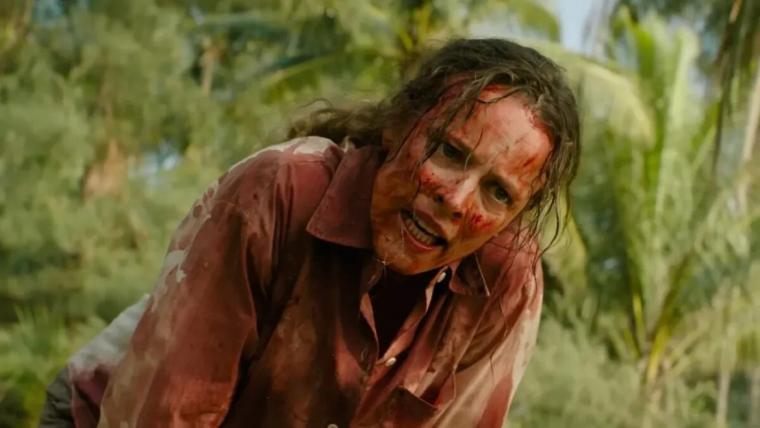
Rachel McAdams in Send Help
SEND HELP
I've heard Send Help succinctly described as “Survivor meets Misery,” which is pretty accurate, despite James Caan's novelist being infinitely more empathetic than Dylan O'Brien's injured detainee here. Yet I prefer to think of director Sam Raimi's latest as “Survivor meets 9 to 5,” albeit with two fewer heroines, copious gore, and no catchy Dolly Parton anthem, although Blondie's “One Way or Another” does get a nice shout-out. It's the ultimate “revenge on a horrible boss” comedy, one far nastier than Horrible Bosses itself, and like 9 to 5's empowered kidnappers, Rachel McAdams' marginalized, fed-up office drone is eminently worth cheering. Ma-a-aybe not when holding a knife dangerously close to her paralyzed employer's privates, but … . Oh, who am I kidding? Especially then.
Working in a big-city skyscraper for a generic financial-management firm, McAdams' Linda Liddle toils in “strategy and planning,” her fastidiously researched quarterly reports inevitably passed off as their own by d-bag male higher-ups. It's evident why these Jordan Belfort wannabes presume they can keep getting away with this, because put-upon Linda, with her timidity and social awkwardness, keeps letting them. Following the death of her former boss, who promised Linda a promotion to vice-president, the company is now in the hands of the deceased's son Bradley Preston (O'Brien), whose über-preppie name immediately signals noxious entitlement. Bradley can't stand a thing about Linda: her forwardness; her chunky shoes; that speck of tuna fish outside her mouth that he can't believe she's unaware of. Linda is clearly meant for the chopping block, and Bradley intends to let her go as soon as their team returns from a business trip to Bangkok. Needless to say, en route, the plane crash that strands Bradley and Linda on a deserted island somewhat derails that plan.
It's important to remember, as Send Help lands on its raison d'être, that Raimi's outing is first and foremost a comedy – and an aggressively broad comedy, at that. The brightly lit office scenes have the unmistakable Wall-Street-in-the-'80s sheen of Working Girl and The Secret of My Success, and everyone, the traditionally more subtle McAdams and O'Brien included, performs at maximum stereotype. In an attempt, I guess, to make her look dowdy (as if!), frizzy-haired McAdams in bathed in hideously unflattering outfits and contorts her face into wildly elastic expressions; she's a riot, but Linda isn't really a convincing human being. Creepy, reedy-voiced Bradley, meanwhile, is like Patrick Bateman without the vivid imagination, and you can sense the relish O'Brien takes in playing a rich, wholly unapologetic scumbag. Bradley's loathsome yes-men are just as (intentionally) lacking in nuance, and so when the company plane blows an engine and Raimi gets to the first of his film's many, many gross-outs, there's no pretending that we're meant to care about anyone's grisly fate. We're meant solely to laugh, to roar, as the screaming commences and the blood sprays and passengers are cruelly sucked from the fuselage – one of whom, pitifully hanging onto a wing, makes desperate eye contact with Linda while begging for help. She does the decent thing. She shuts the window shade.
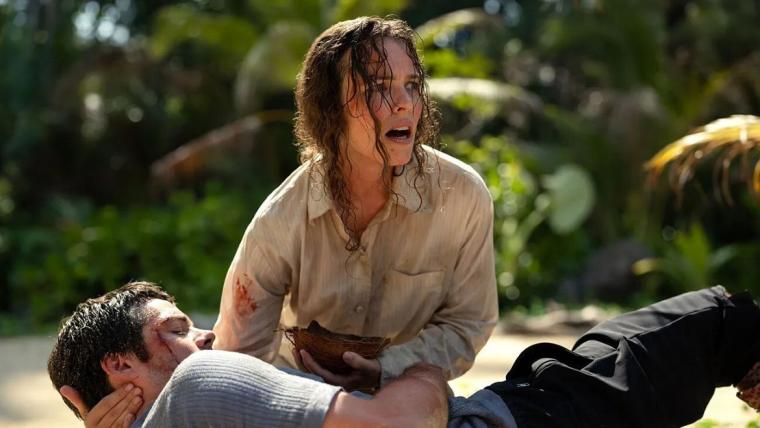
Despite the tense hilarity of that sequence, it's after Linda and Bradley wash up on the beach that the fun really starts. Unconscious and suffering a broken leg, Linda's boss is useless. Linda herself, however, is anything but. One of the last things her soon-to-be-departed co-workers saw aboard the plane was Linda's audition video for Survivor, in which she boasted about knowing three ways to start a fire and demonstrated her enviable climbing skills. The frat dudes cackled at her nerdiness – but who's laughing now? Surveying her situation, Linda quickly springs into action: setting up camp; securing food and drinkable water; sheltering Bradley from the elements. She is, it's fair to say, as fulfilled as she's ever been. It's Bradley who, once awake, finds himself in Hell, aching to return to civilization and at the mercy of this employee he detests. (In one of O'Brien's most hysterical acts of physical comedy, he purses his lips and shakes his head back and forth – an infant refusing to eat his strained peas – as Linda tries to get some fish in his mouth.) Send Help consequently becomes a ticklishly fraught battle of wills between a helpless “superior” who can't fathom relinquishing his power, and a wholly capable “subordinate” giddy in the knowledge that she owns the power. Guess whose side we're on.

To be fair, screenwriters Damian Shannon and Mark Swift do complicate matters, slightly, with the suggestion that having so much control is no better for Linda than it was for Bradley. When, on a hike for supplies two weeks after the crash, Linda sees a potential rescue boat and refuses to make contact (“Not yet … not yet ...”), you begin wondering whether a full-scale Kathy Bates turnaround is on the horizon. But for there to be a victimizer Annie Wilkes, there also has to be a victimized Paul Sheldon, and Bradley is admirably kept an asshole. That, in turn, keeps Raimi's movie a comedy. Because while Linda endures plenty of indignities and offenses – the stabbed wild boar drenching her in viscera ranks way up there – she keeps returning to jubilance, and a jubilant Rachel McAdams, even covered in blood, is about the happiest sight there is. As for Bradley, whose intentions and fevered stare keep growing darker in O'Brien's ferociously funny portrayal, he remains deliriously unsympathetic, causing your giggles to escalate with every figurative, and sometimes literal, twist of the knife. (His most classic moment of comeuppance, however, involves no weaponry whatsoever – just a ton of puke and a nod to Raimi's Drag Me to Hell.)
With Send Help taking its director back to his pre-Spider-Man, B-movie glory days of lunatic plotting and cheesy effects and nothing in the way of redeeming social value, I had the time of my life at this thing. Due to a few late-in-the-day twists and contrivances too ludicrous for even this material to sustain, Raimi's movie doesn't completely work as a survival thriller. And if you've seen Triangle of Sadness, or simply its final third, you might be off-put by just how many of Ruben Östlund's story beats are echoed here, if not baldly appropriated. (One uncomfortable encounter suggests that Linda and Bradley may have seen that film, too, with Bradley wishing he hadn't.) Still, overall, it's sensational fun, with McAdams' go-for-broke enthusiasm suggesting that Linda Liddle isn't a character name you'll forget any time soon. One way or another, she's gonna find you. And she's gonna get ya get ya get ya get ya.
IRON LUNG
Most boring movies adapted from video games can be, and have been, casually dismissed with a blithe “It's like watching somebody else play a video game.” But that activity, as real life and innumerable YouTube channels have demonstrated, can actually be entertaining. Written by, directed by, and starring online sensation Mark Fischbach (better known by his pseudonym Markiplier), Iron Lung is like watching somebody else play a video game – only they have no idea what their objective is, or how to advance to another location, or how to work the controller so that their avatars aren't merely spinning in circles and bumping into walls. It is, hands down, the most staggeringly inept movie of its type I've ever seen, for the simple reason that no one beyond those familiar, maybe too-familiar, with creator David Szymanski's 2022 game could possibly know what's happening on even the most simplistic narrative levels. I spent more than two hours staring at the screen in hopeless, increasingly maddening confusion and despair, and was no closer to comprehension at the end than I was at the start.
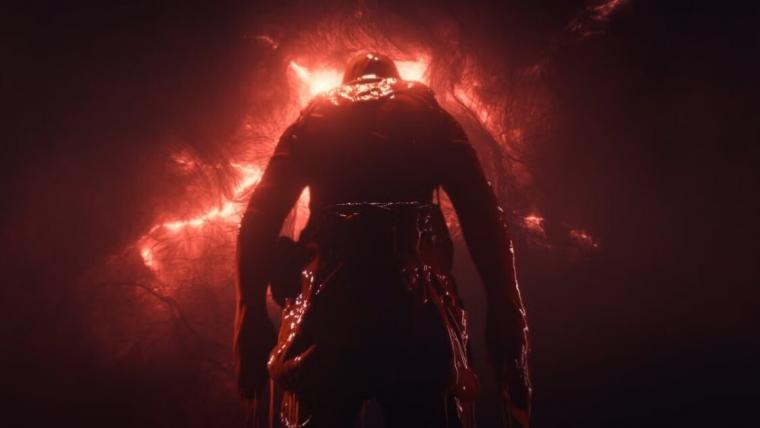
Portentous opening narration informs us that we're in the far future following an event known as the Quiet Rapture, which caused all the galaxy's stars to disappear. Humanity is in danger of extinction, and our only means of survival, apparently, is the procurement of … something … from a literal ocean of blood on a faraway moon. Sent to locate this mysterious whatsit is Fischbach's long-unnamed convict, who's welded shut into a submarine and instructed, via scratchy-voiced radio contact, to investigate. What is he looking for?, he asks. He isn't told. What's he supposed to do when he finds it? He isn't told. How do the sub's fancy gadgets work? He isn't told. He descends. He sweats. He makes meaningless notes on charts and graphs. A windowed X-ray device occasionally allows him to see through the blood. What he sees is never discernible. The sub moans and creaks. The ceiling occasionally drips. The convict keeps making faces implying unimaginable horror, even though nothing we witness is remotely scary. Eventually, he ascends and talks to a human. And then what happens? He's sent back down. And the same. Process. Repeats. All. Over. Again.
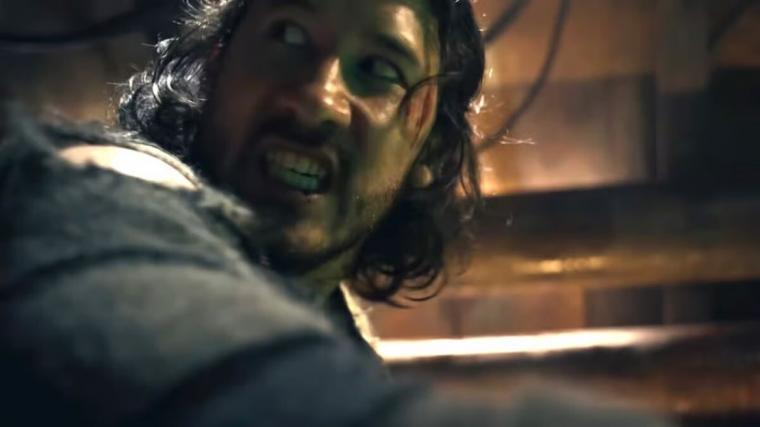
For the game's fans, and there must be at least a few of them, this intentional repetition and banality might be transfixing – like watching Kubrick's Barry Lyndon if the whole movie were shot in the cockpit of Alien's Nostromo. Because, as I haven't made explicitly clear yet, we never leave the sub. To Fischbach's credit, his feature debut might resemble a legit video game more than any of its genre predecessors, though not quite as much, blessedly, as 2016's nausea-inducing first-person action thriller Hardcore Henry. I totally got what the writer/director was going for, and there's a degree of integrity in his choice to (I presume) faithfully replicate Iron Lung's game-play elements: the finding and amassing of objects; the hazy directives provided by unseen figures; the exploration of the sub's hidden passageways. With the battle-worn décor suitably grimy and the sound effects completely passable, Fischbach has admirably pulled this project off on a reported $2 million budget. It's just that … . Ugh. I hated it.
I hated the cramped quarters and the film's six (!!!) cinematographers so quickly running out of interesting ways to photograph them. I hated the incessant pops and buzzes of radio chatter, only one-third of which, I'd argue, results in words you can halfway understand. I hated the fact that, whenever we were given a view from the sub's exterior, the fuzzy black-and-white images didn't look like the things we were told they were; how the convict detected a skeleton within that haze is beyond me. I hated the flashbacks/visions/whatever that made no sense, and were wholly immaterial, in the film's context. I hated the witless dialogue, much of it an interrupted monologue, in which every fourth word was “f---” … though my screening did find some younger patrons chortling at every last drop of the “F” bomb. I hated that, despite vaguely resembling a Korean-American Adam Driver, Fischbach, with his sorely inexpressive readings, didn't appear to possess one tenth of Driver's talent or charisma, his scrunched-up expressions of misery leading to no actual tears shed. I hated the redundancy. I hated the tediousness. I hated the torrent of blood that arrived far too late to be of any consolation. And I ha-a-a-ated that Iron Lung kept me so willfully in the dark about basic considerations such as motivation and stakes and narrative clarity. Say what you will about Tommy Wiseau's legendarily awful The Room, but at least you could follow the plot, moronic though it was. Fischbach's movie earned $17.8 million over the weekend. That's roughly one dollar for every moment that irked me.

ARCO
Currently Academy Award-nominated for Best Animated Feature, director/co-writer Ugo Bienvenu's Arco enjoyed a three-screening run at Davenport venue The Last Picture House this past Saturday and Sunday. I'm certainly hoping that this wasn't the big-screen end for this imaginative, touching charmer in our area, because when the Oscar inevitably goes to KPop Demon Hunters instead, I'd like to have more local company when I shout “Arco was robbed!” at the TV.
A sci-fi adventure baked onto another sci-fi adventure, Bienvenu's and co-writer Felix de Givry's time-travel odyssey finds the 10-year-old of its title (voiced, in the dubbed version, by Juliano Krue Valdi) living on – or rather, above – the Earth of 2932. As life on land is presently inhospitable to humans, we've taken to sprawling subdivisions in the sky, and among those searching for an end to our exodus are Arco's parents (America Ferrera and Roeg Sutherland), who can travel through time via rainbow-colored capes. Without his folks' knowledge's, dinosaur obsessive Arco borrows one of those capes to visit the prehistoric era, but only gets as far back as 2075, when he crash-lands and is found by another youth, Iris (Romy Fay), who helps him try to reunite with his family. In short, in rough outline, Arco is kind of like E.T., which is similarly kid-driven and more focused on awe and wonder than peril. Also like E.T., on two separate occasions, it made be bawl like a baby.
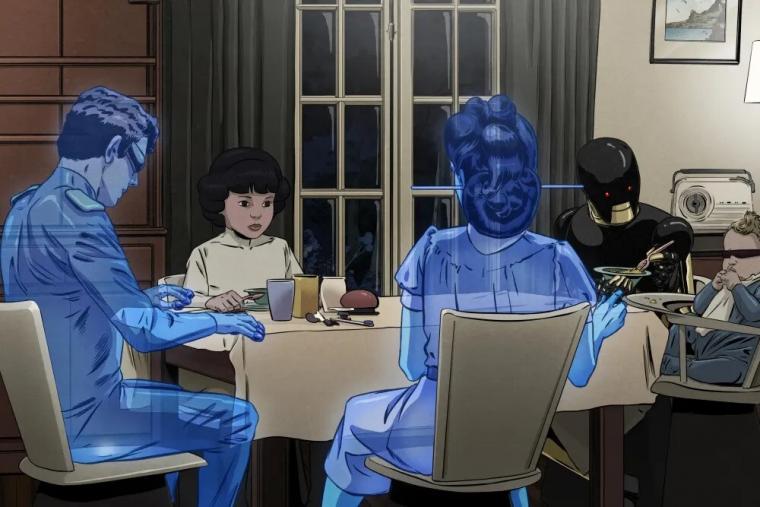
Earning massive points for inventiveness, Bienvenu and de Givry treat us to two distinct visions of future Earth. The 2932 version is certainly magical, with its time-travel capes and Jetsons art deco and blissfully serene sight of sleeping family members floating six feet off the ground. But 2075 Earth is perhaps more fascinating, given that it looks like a completely plausible vision of where we'll be in 50 years' time. I'm personally anticipating more AI, but the friendly robots who serve as 2075 teachers, caregivers, and blue-collar workers seem like reasonable substitutes. I adored the detail of every house being equipped with a retractable dome that can be sealed when frightening weather conditions arise. (Arco's most endearing sight may be of neighbors continuing to enjoy outdoor cookouts and tossing the ball around while a ferocious storm ravages the community.) The immersive classrooms in which students are 360-degree surrounded by history-lesson images were also supremely clever. And although it took a few seconds to figure out what was going on, it eventually made perfect sense when Iris' devoted nanny-'bot Mikki spoke in what sounded like the voices of Natalie Portman and Mark Ruffalo simultaneously, considering Portman and Ruffalo were also voicing Iris' away-on-business parents. Fashioning a babysitter who sounds, to a child, like their mom and their dad? That's some smart thinking there. A little unsettling, but smart.
Between the animators' eye-catching, hand-drawn visuals, composer Araud Toulon's lovely score, our pre-teen heroes' endearing camaraderie, the Wild Robot-esque poignancy of Mikki (teary breakdown #1), and the rather startling climactic message that even a child's forgiven mistakes can have enormous consequences (teary breakdown #2), Arco is 89 minutes of delight. My only grievance came from the film's trio of conspiracy-theorist goofballs who add some mild threat and a lot of slapstick silliness, and are voiced, in the dubbed rendition, by Will Ferrell, Andy Samberg, and the Red Hot Chili Peppers' Flea. Even though I was never convinced that this trio was in the same studio, at the same time, when their vocals were recorded, they're moderately amusing side characters. More often, though, they're simply dippy, obnoxious, and not half as funny as the movie seems to think, and it reminded me that while France has delivered no end of masterpieces through the years, the country does have its cinematic blind spots. I guess that Jerry Lewis infatuation was a for-life kind of thing.