
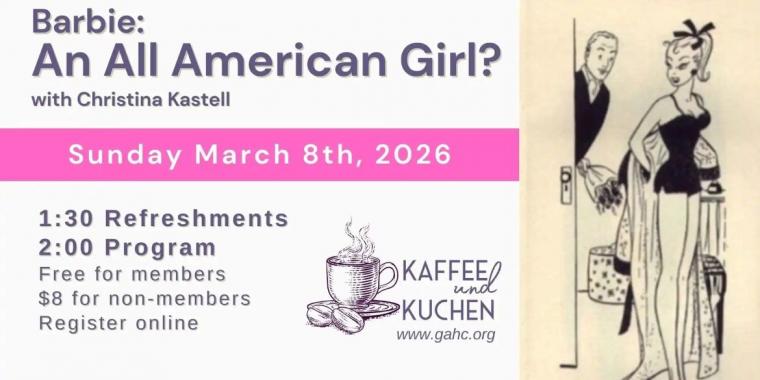
“Barbie: An All-American Girl?” at the German American Heritage Center -- March 8.
Sunday, March 8, 2 p.m.
German American Heritage Center, 712 West Second Street, Davenport IA
Patrons of the German American Heritage Center are invited to discover the history of one of the world's most recognizable dolls – and how she evolved from a comic for adult men in Germany (!) – in Barbie: An All-American Girl?, with Putnam Museum and Science Center Curator of History and Anthropology Christina Kastell leading a fascinating March 8 program in the Davenport venue's popular "Kaffee und Kuchen" series.
Barbie is the largest multimedia-supported fashion doll franchise created by American businesswoman Ruth Handler, manufactured by American toy and entertainment company Mattel, and introduced on March 9, 1959. The toy was based on the German Bild Lilli doll which Handler had purchased while in Europe. The figurehead of an eponymous brand that includes a range of fashion dolls and accessories, Barbie has been an important part of the toy fashion doll market for over six decades. Mattel has sold over a billion Barbie dolls, making it the company's largest and most profitable line. The brand has expanded into a multimedia franchise since 1984, including video games, animated films, television/web series, and Greta Gerwig's Oscar-winning live-action film.
Barbie and her male counterpart, Ken, have been described as the two most popular dolls in the world.Mattel generates a large portion of Barbie's revenue through related merchandise – accessories, clothes, friends, and relatives of Barbie. Writing for Journal of Popular Culture in 1977, Don Richard Cox noted that Barbie has a significant impact on social values by conveying characteristics of female independence, and with her multitude of accessories, an idealized upscale lifestyle that can be shared with affluent friends.
Ruth Handler watched her daughter Barbara play with paper dolls, and noticed that she often enjoyed giving them adult roles. At the time, most children's toy dolls were representations of infants. Realizing that there could be a gap in the market, Handler suggested the idea of an adult-bodied doll to her husband Elliot, a co-founder of the Mattel toy company. He was unenthusiastic about the idea, as were Mattel's directors.
During a trip to Switzerland in 1956 with her children Barbara and Kenneth, Ruth Handler came across a German toy doll called Bild Lilli. The adult-figured doll was exactly what Handler had in mind, so she purchased three of them. She gave one to her daughter and took the others back to Mattel. The Lilli doll was based on a popular character appearing in a satirical comic strip drawn by Reinhard Beuthin for the newspaper Bild. The Lilli doll was first sold in West Germany in 1955, and although it was initially sold to adults, it became popular with children who enjoyed dressing her up in outfits that were available separately.
Upon her return to the United States, Handler redesigned the doll (with help from local inventor-designer Jack Ryan) and the doll was given a new name, Barbie, after her daughter Barbara (born May 21, 1941). The doll made its debut at the American International Toy Fair in New York City on March 9, 1959, and this date is also used as Barbie's official birthday.
Barbie: An All-American Girl? will be presented at Davenport's German American Heritage Center on March 8, with refreshments for this “Kaffee und Kuchen” event served at 1:30 p.m. and the program beginning at 2 p.m. Guests are welcome to bring their own mugs if they wish; disposable cups are provided, but mugs from home will help the venue reduce waste. Participation is free for Heritage Center members and $8 for non-members, and more information is available by calling (563)322-8844 and visiting GAHC.org.