

Robert Pattinson in Primetime
PRIMETIME
As you may be aware from any number of media outlets, Chris Hansen, the former host of NBC's grim “Gotcha!” hit To Catch a Predator, isn't a fan of director Lance Oppenheim's Primetime. Like really, really, really not a fan. And I get why. With Robert Pattinson supplying a demented stare, wicked grin, and one of his signature affected accents, this big-screen Hansen is magisterially icky: sweaty, scary, pathetic, and wholly deserving of the downfall you know is coming. For the real-life man, that Pattinson is a more charismatic Hansen than Hansen himself must only be driving the knife in further.
Yet part of me actually wants to side with Hansen; not because the portrayal is unflattering, but because it's ultimately meaningless. For the record, I think Primetime, which screenwriter Ajon Singh adapted from an Esquire magazine article by Luke Dittrich, is a great deal of lurid fun. Oppenheim's direction has vitality and drive, David Bolen provides arresting, Expressionistic cinematography, the supporting cast is aces, and Pattinson has a stranglehold on a riveting figure and plays him for all he's worth. I still left the movie not comprehending what it was trying to say, or even why it was made. Barring one or two exceptions, everyone in the film is some level of cretinous: the To Catch a Predator creative team; the predators themselves; the network suits and law-enforcement officials piggybacking on the program's success. What's missing, though, is any sense of a bigger picture. What do Predator's high ratings say about us? Who's watching and why? Did anyone, viewers included, learn anything from the show's eventual public implosion or did they/we simply shrug and move on? I had a largely terrific time at Primetime, yet for a work that touches on so many hot-button issues, it leaves precious little residue.
In the movie's 2006 setting, To Catch a Predator has already graduated from its status as a recurring Dateline segment and has become its own thing, host Hansen essentially emceeing sting operations in which adult men are busted for planning to have sex with minors. (Through online chat rooms, the accused are lured to empty houses by adults posing as kids; after the men arrive, out pops the disdainful Hansen, followed by the police.) By this point, as shepherded by producer Andie Bender (Merritt Wever) and Internet bait-and-switcher extraordinaire Xavier Von Erck (Matthew Maher), Predator is a well-oiled machine, with everyone involved proud to not only be making a hit, but theoretically protecting the nation's children from harm. Seeing an opportunity for even greater impact, NBC CEO Jeff Zucker (playing himself … and !!! to that) decides to give the Predator specials a choice primetime slot, and against ABC's behemoth Lost, no less. Succeeding there, though, will demand even higher ratings than what Predator currently achieves. As opposed to the schlubby persons of interest they traditionally nab, can Hansen and his staff perhaps find bigger catfish to fry?
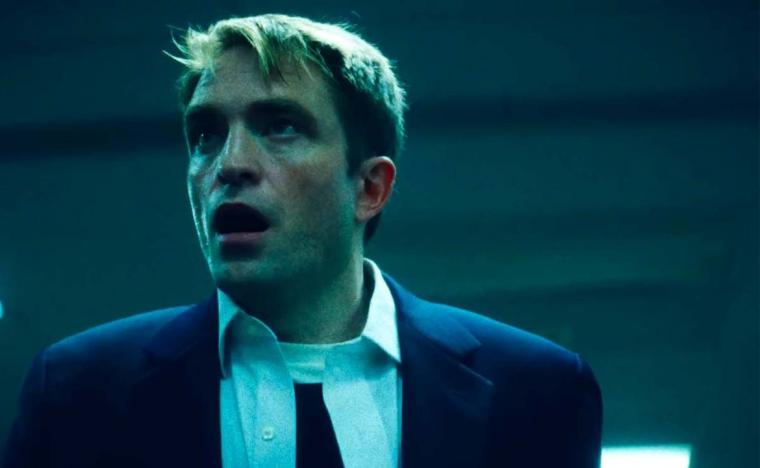
One thing's for sure: Chris Hansen is willing to drive himself mad trying. From Primetime's first scene, in which the Predator host practices his hyper-stylized enunciation in front of a mirror, Oppenheim and Pattinson leave no question as to how close to the brink the guy already is. Performing his vocal ritual with concentrated, nearly religious fervor, Hansen looks ready to snap, making it quite the shock when, greeting his show's latest prey, he serenely wafts down a grand staircase like a Golden Age Hollywood diva, confronting the accused not with a bark, but a gentle purr. On camera, the guy is, or desperately wants to be, a smoothie. Off-screen, he's anxiety incarnate, feverish in his quest to snag higher ratings, seethingly jealous of perceived rival Stone Phillips (perfectly replicated by Bill Heck), and internally apoplectic at the phone threats he's receiving from the National Enquirer, which has photographic evidence of his adultery. (Anna Faris play's Hansen's long-suffering wife.) Over the movie's 110 minutes, Pattinson never once takes his foot off the throttle, and Hansen's epic disintegration is riveting, harrowing, and hilarious.
It's also, paradoxically, rather one-note, because Pattinson's Hansen barely changes – what minimal humanity he has just seems to gradually empty out. This doesn't make the actor's portrayal any less entertaining, and the equally limited arcs for other Primetime characters don't hinder their actors at all: the consistently excellent Wever, given the rare, electrifying chance to play morally bankrupt; Maher, his Perverted Justice founder a frighteningly banal zealot; Bokeem Woodbine and Jessica Hecht as figures using Predator's success to further personal agendas; Creed Bratton, a one-scene wonder who briefly suggests the show's chief, deeply angry demographic; Tony Revolori, Bob Ari, an unrecognizable Alex Winter, and Jonathan Lipnicki as potential sex offenders. (Expect all your memories of Lipnicki's adorableness in Jerry Maguire and Stuart Little to vanish instantly.) Grammy-winning singer/songwriter Phoebe Bridgers, whose on-set decoy Del is adept at disguising herself as pre-teen girls and boys, is first-rate, and also allowed more personality and motivational shading than most of her co-stars.
Still, if Oppenheim's film belongs to anyone beyond the hard-working Pattinson, it's Skyler Gisondo, whose aspiring actor Dan Plum emerges as the film's only real evidence of a soul. Grateful for his big break in Hollywood yet increasingly unsure about whether his participation is ethical, or even legal, Dan seems to be forever pulled in about six directions at once, and your stomach falls as Gisondo's initial, gee-whiz wonderment morphs into jaded, self-loathing realization. Primetime may not be terribly concerned with the knotty ambiguities behind To Catch a Predator's creation, success, nosedive, and legacy. If it is, this enjoyably blithe outing is hiding that concern awfully well. Gisondo, though, appears to be acting in a richer, wiser, more trenchant movie altogether, and I was grateful every time he was on-screen. Before the end credits roll, Dan Plum gets everything he always wanted. It's about the saddest Happily Ever After you've ever seen.
HEART OF THE BEAST
In the annals of big-screen adventure dramas involving man and man's best friend, director David Ayer's Heart of the Beast is something exceedingly rare: a movie in which your fear isn't that the dog will die, but rather that his owner will die. Ayer and screenwriter Cameron Alexander waste no time informing us that their heroic German shepherd Odin – playfully nicknamed Odie – will survive when, not 60 seconds into the film, a motorist traveling through a vast Alaskan landscape finds the pup standing stock still in the middle of the road. Getting out of the car, the driver gauges the canine as the friendly type, and asks Odie where his person is. The soulful-eyed creature, of course, says nothing. The on-screen text, however, says a lot when the subsequent fade-out is accompanied by the words “One Week Earlier.” So we're clearly entering flashback territory, and no matter what happens over the week to come, Odie, thank Heaven, is gonna be okay. But what about poor Brad Pitt?!
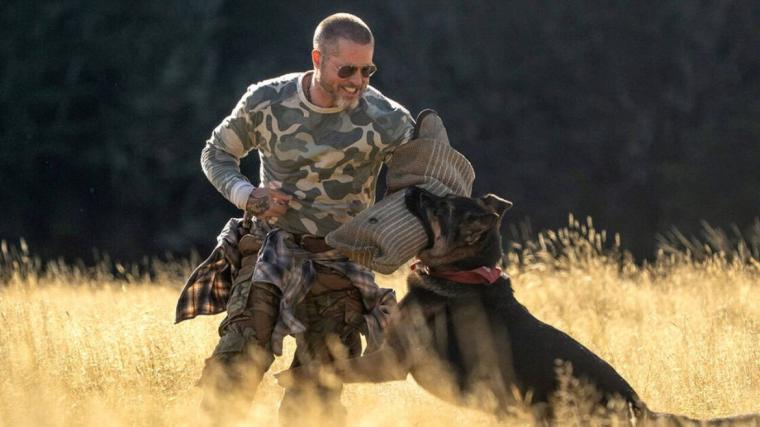
Among tales of outdoor survival, Heart of the Beast is practically Spartan in its simplicity. As the feature-length flashback begins, we're introduced to Pitt's retired Special Forces Command Sergeant James Belmont and the faithful pooch who was James' combat dog overseas. Although both are suffering from PTSD-induced nightmares (and Odie, who lost half a leg in an explosion, is outfitted with a metal cast over the severed limb), their daytime hours are jovial as they board James' cozy Cessna and head to a remote locale for a fishing expedition. The besties catch fish, enjoy games of fetch, lounge on the shore, briefly interact with a grizzled coot played by J.K. Simmons. Then, the next day, it's back in the air they go … at which point James has a heart attack, there's a terrifying descent, and Odie is ripped from the Cessna and hurled into the woods before James and his plane crash into a lake. I have no idea if that prelude on the Alaskan road was originally in Alexander's script or if it was added at the studio's insistence, but to whomever made the decision to include it, thank you. Had we not known in advance about Odie's survival following that horrific mid-air exodus, it's likely that not one viewer, not even his mom, would've cared about Mr. Pitt's own well-being.

Suffice it to say that James does escape the downed plane, despite having another heart attack while making panicky calls for his dog, the two are eventually reunited, and bruised man and pup are forced to navigate a 58-mile trek back to civilization with only a working compass, moderate supplies, and continued threats to their existence. There's literally nothing more to Heart of the Beast than that, and between Pitt's wholly believable affection for Odie (who's alternately enacted by four beautifully directed canines) and the loving shots of James' three-legged ally whose actions and reactions only seem slightly anthropomorphized, we don't really need much else. Unfortunately, the movie is still kinda dull, mostly because it's all so familiar.
We're given the obligatory, grainy, sepia-toned wartime memories – flashbacks within a flashback – and the requisite careening-down-raging-river-rapids sequence, and, of course, that creaky old standby: the slow walk along the wooden rope bridge, which, here, is actually a downed tree conveniently bridging one cliff to another. (It isn't a noticeable improvement on the cliché.) There are grizzly bear confrontations and attacks by wolves, all of the vicious animals rendered through depressingly unconvincing CGI. (At one point, when racing across that makeshift bridge, Odie himself is momentarily yet unmistakably computer-generated.) And through it all, despite his undying love for Odie, James Belmont remains a curious blank – a man's man so stalwart and competent that he never experiences an instant of uncertainty or regret, making him, as a central character, profoundly uninteresting. Odie's impenetrable metal cast only covers his leg; James' seems to coat his entire body. With the stunning vistas of New Zealand doing an adequate job of impersonating Alaska, Heart of the Beast is objectively postcard-pretty. That German shepherd's endearing mug notwithstanding, it's also close to terminally bland.
FORGOTTEN ISLAND
Given that anything capable of being drawn can happen in an animated movie, you'd think we'd get more insanity from these projects than we generally do. For those of you who might also bemoan the relative lack of unbridled nuttiness in big-screen animation, allow me to guide you to Forgotten Island, which is, with apologies for the family-unfriendly sentiment, deliriously, joyously, batshit crazy.
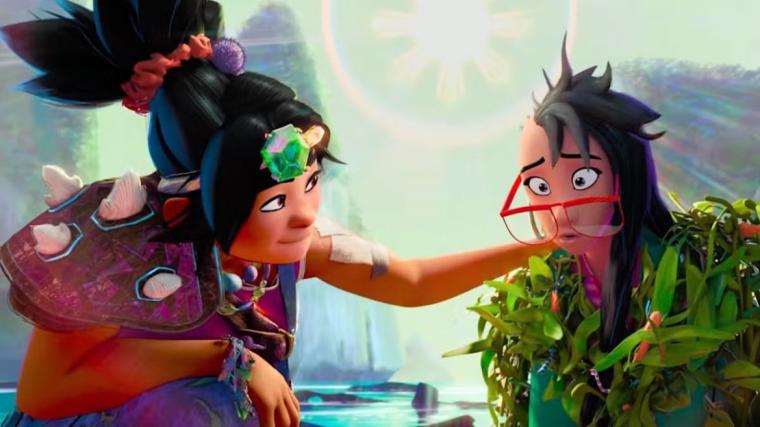
In it, teenage Filipina besties Jo and Raissa (respectively, excitedly voiced by H.E.R. and Liza Soberano) fall through a wormhole to the fabled isle of Nakali, and after regaining consciousness the next morning, the young women realize they have no memory of what happened the night before. All they have are Polaroids suggesting the magical debauchery they indulged in with a series of formerly unimaginable creatures, and aided by a hyperactive wolf-dog voiced by Dave Franco, Jo and Raissa have to retrace their steps – discovering what they actually did last night – before they can return to the Philippines. Yes, folks: It's The Hangover as an animated family comedy. Now that's insane.

Going in, I didn't realize that DreamWorks Animation's latest was written and directed by Joel Crawford and Januel Mercado, and even if I had, I wouldn't have registered that Crawford also helmed 2022's Puss in Boots: The Final Wish, the one animated title this decade that I paid to see a second time. I can easily imagine shelling out the dough for a return trip to Forgotten Island. In strictly visual terms, the film is a wonder, its explosion of eye-popping color and inventive character design always giving you something astounding to look at, and its breakneck pacing a credit to editor James Ryan. Sweet Pete, though, is this thing funny. Unseen though he is, Franco is as hyper-actively hysterical here as he was playing a drugged-out version of himself on The Studio, and H.E.R. and Soberano banter and bicker with the rat-a-tat familiarity of lifelong friends more capable of finishing one another's sentences than their own. But I also roared at Manny Jacinto's enormous infant dragon, and Kevin McCann's egomaniacal Mermahn (that's not a misspelling), and the purportedly fearsome race of diminutive Duwendes as stout and squeezable as Kewpie dolls. There's even a surprising amount of mild profanity, every unexpected cuss word eliciting a semi-guilty giggle.
And because there's quite clearly some Final Wish DNA in Crawford's and Mercado's venture, there's also room for genuine fright (Lea Salonga's shadowy Manananggai stares down the screen like Puss' Grim Reaper), honestly earned sentiment, and surreptitiously touching meditations on life and loss. So far, considering Hoppers and Minions & Monsters and Toy Story 5 and the new Shaun the Sheep and the hand-drawn/live-action hybrid that is Coyote vs. Acme, tipping my cap to those who enjoyed the Super Mario Bros. Galaxy Movie blockbuster), 2026 has been an overall banner year for animated features. Forgotten Island might be my new favorite. But check in again after Wildwood and Hexed and Ray Gunn debut. This might not be a trend that's ending anytime soon.