

Anne Hathaway in Verity
VERITY
In director Michael Showalter's adaptation of Colleen Hoover's Verity, the title figure is a fabulously wealthy celebrity who appears willing to go to psychotic extremes to get a little peace and quiet. Having now appeared in five films over the past six months, and with a new baby on the way, it's no wonder Anne Hathaway is so good in the role. She must relate to Verity Crawford like crazy.
Of course, the actor might've secured herself some deserved R&R just by saying no to Showalter's and screenwriter Nick Antosca's project, which wouldn't have been the world's worst idea. Although watchable in a trashy, Lifetime-TV-movie way, Verity is credulity-straining at every turn. It showcases the least likely human behavior imaginable, and feels so weirdly underpopulated that the material's original author doesn't appear to be Hoover, but rather Pirandello. (Call it Six Characters in Search of a Throughline.) But I'm still grateful that Hathaway agreed to participate, because she and the equally welcome Dakota Johnson and Josh Hartnett routinely invest this silly, tacky soap opera with what you could almost mistake for genuine soul. While the plotting and execution may frequently make you want to hide under a blanket, it would be hard to argue that the performers aren't giving it their all.
Despite Hathaway playing Hoover's titular mystery gal, the film's central star is Johnson, whose struggling NYC novelist Lowen Ashleigh is dealing with both her mother's passing and her own inability to secure audiences for her book readings that total more than four. An intriguing opportunity, however, falls into Lowen's lap when her agent (Ismael Cruz Córdova) informs his client that she's being headhunted by the management of Verity Crawford, a wildly successful writer of pulp thrillers as famed for her talk-show appearances as for her bestsellers. Unbeknownst to the public, Verity was recently involved in a crippling car accident, and with three manuscripts started and no return to work in sight, a like-minded author is needed to complete the novels. Based on the bland prose we hear at one of Lowen's ill-attended readings, and considering that cheeky Verity notoriously writes from the perspective of her books' killer, it's unclear what makes Lowen the right choice for the gig. She's about to be evicted, though, and the money is good. So off Lowen goes to wintry Vermont, where's she'll stay at the Crawfords' remote, intimidatingly posh home while studying Verity's notes. Also at the house is Verity's hunky hubby Jeremy (Hartnett). As you won't be shocked to learn, Lowen will study him, too.

All of this gets us about 20 minutes into Showalter's overstuffed 115, and I had already practically run out of fingers and toes on which to count Verity's implausibilities and nagging questions. To begin with the most obvious: Why is Verity's accident and present condition – bedridden, voiceless, tended to night and day by a sneering nurse (Inna Dvorovenko) – being so willfully hidden? We're given some mealymouthed reasoning involving her publishing company not wanting fans to fear the end of Verity's book series. But that doesn't quite hold water; to this day, through a ghostwriter or several, Flowers in the Attic creator V.C. Andrews is still churning out potboilers nearly 40 years after her death. (Did Hoover not want us to recognize that Verity Crawford is herself a “V.C.”?) Similarly lame explanation is given for Lowen not, you know, simply taking Verity's notes home with her, as opposed to being given the keys to the woodland mansion, the master bedroom, and easy access to the author's solicitous and ripped husband. At least in cinematic form, though, Verity is dopey even in its throwaway business.
In one of the more flabbergasting Meet Cutes yet devised, Lowen and Jeremy make their first acquaintance after witnessing, firsthand, a gory bike-messenger fatality. Jeremy escorts the blood-splattered author to a public restroom where he gallantly offers her his gleaming-white button-down, which she accepts. They converse while Lowen, looking in the mirror, cleans her face and puts on Jeremy's loaner … and I suppose we have the shock to blame for neither of them noticing, or caring, that the shirt's collar was mere millimeters away from the massive blood stains on Lowen's unwashed neck. It's a minor moment in the scheme of things. But I guarantee that no one watching this scene as it commenced heard a thing Johnson and Hartnett were saying – not when we were so accidentally obsessed with Lowen's mirror image, hoping that the writer's forthcoming payout would be enough to cover the eventual dry-cleaning bill.
Astoundingly, events grow somehow more ridiculous after Lowen discovers Verity's secret memoir, a tell-all that paints the picture of a deeply unstable woman who, after birthing the Crawfords' twins, set out to permanently remove the demanding children. Oh, and did I mention that Verity may not be catatonic after all, as Lowen suspects after occasionally catching Verity's direct gaze and, in one instance, seeing the woman roam the house? A gifted director of pop thrillers could conceivably make this lurid nonsense play. But Showalter, who demonstrated solid dramedy talent in The Big Sick, The Eyes of Tammy Faye, and The Idea of You (which also starred Hathaway), isn't that director.
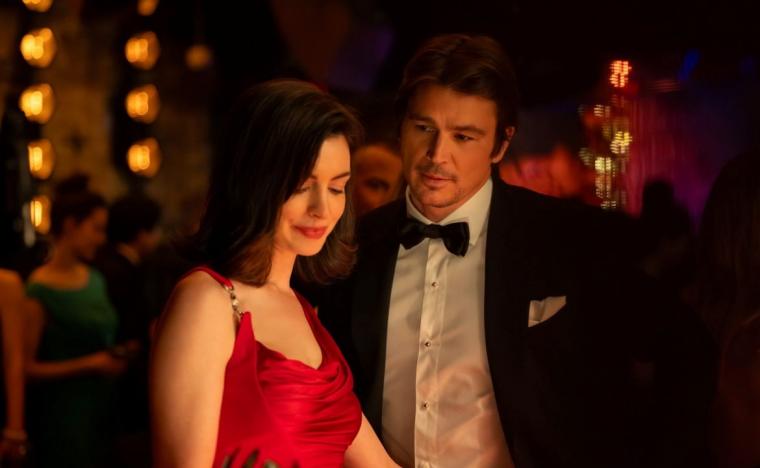
The random jolts here are weakly telegraphed, the suspense is nonexistent, and the memoir-fueled flashbacks of Verity behaving atrociously are so broad and unpersuasive – at one point, she kicks up her heels like Gone Girl's Rosamund Pike on the mini-golf course – that the hidden tome virtually announces itself as an unreliable narrative. To Antosca's discredit, although the fault is probably Hoover's, there's also a dispiriting paucity of characters to whom bad things can happen, which makes the movie, especially at nearly two hours, feel annoyingly static. Including the Crawfords' surviving child, I counted precisely a half-dozen figures of any significance whose fates, as the nastiness progressed, could be in jeopardy. Turns out I was severely high-balling the potential body count.
Still, despite the tired, daytime-drama subterfuge and needless red herrings – including the baby monitor whose ultimate purpose seemed so evident that it made me mad, and then made me madder when it wasn't employed for said purpose – the actors kept me modestly invested. So fundamentally honest and engaging a performer that she even managed to rescue (parts of) Madame Web, Johnson is effortlessly empathetic, her careful line deliveries bearing the formidable weight of real-world experience. Ever since Oppenheimer, I've been loving the career overhaul enjoyed by Hartnett, whose newfound warmth and charisma, particularly in middle-aged-dad roles, continually, juicily suggest perversion a few inches below the surface.
And wrapping up a film year that has found her wonderful in Mother Mary, The Devil Wears Prada 2, The Odyssey, The End of Oak Street, and now this, Hathaway is yet again on fire, whether silently suffering through debilitating inactivity or staring down the camera with sexy, glorious confidence. In a couple of sequences, we even see her character interact with Sean Evans, and Hathaway is so thoroughly terrific in Verity that I was almost glad to be watching this underwhelming thriller rather than a full 30 minutes of the busy star on Hot Ones. Just not quite glad enough.
DIGGER
[Author's note: While Digger's most significant “twist” lands before the movie is one-fourth over – suggesting, to me, that it's not a twist so much as a vital facet worth exploring – enough noise has been made about preserving the film's secrets that a Spoiler Warning feels necessary. I'll absolutely be addressing said “twist.” But I'll leave subsequent surprises mostly alone, and will give adequate warning about my analysis in bold so no one feels unfairly duped. After that, folks, you're on your own.]
Over the past three days, Verity made more than $30 million domestic, and following The Devil Wears Prada 2 and The Odyssey, it gave Anne Hathaway her third number-one opening of the year, But in terms of box-office news, that wasn't the weekend's big story. As you may have heard, the big big story was Alejandro Gonzâlez Iñárritu's comedy Digger not cracking double (by which I mean octuple) digits – it topped out at around $8 million – despite a huge marketing blitz and the star presence of Tom Cruise. If you care to delve into the online articles, and I feel like I've done little but over the past couple days, you'll find no end of editorial “What went wrong?!” hand-wringing regarding Cruise's ability, this time, to connect with and ensnare a mass audience.
Honestly? I think the only thing that went wrong was the movie itself. Sure, despite back-to-back Academy Awards for directing Birdman and The Revenant (the former having also won AGI trophies for Best Picture and Original Screenplay), it was possibly unwise of Warner Bros. to grant Iñárritu a $125 budget – that tally now reportedly as much as $180 million – for a broad climate-change satire that's among the most expensive art-house projects, if not the most, yet concocted. (Your days of shame are over, Megalopolis.) It perhaps wasn't helpful, though it was certainly on-point, for the movie's first teaser to be a career retrospective with just a li-i-i-ittle Digger tossed in, implying that Everything Has Been Leading to This – “This” being Cruise's first competitive Oscar win. (Later previews revealed that the actor, under loads of prosthetics, was essentially playing Les Grossman with an accent borrowed from Jackie Gleason's Buford T. Justice, and when has a brazen comic caricature ever won Best Actor? Maybe Roberto Benigni's Holocaust clown in Life Is Beautiful?)

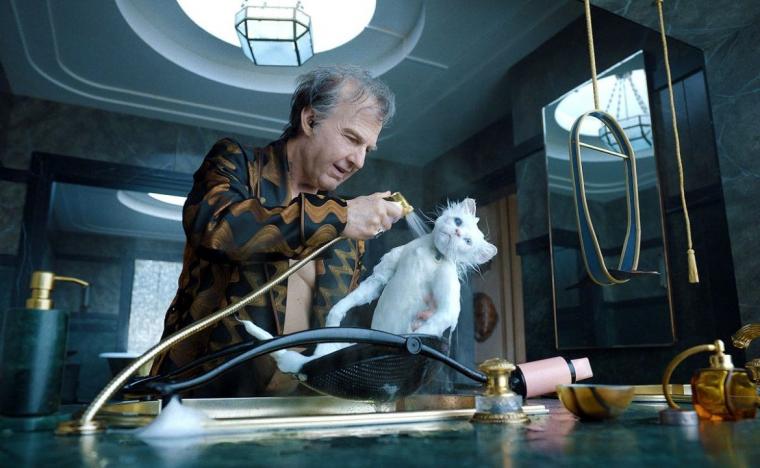
We can make presumptions about the film's recent, intensely public fallout all day long. The movie skipping the fall festivals was a bad sign. (Though it assuredly wasn't for last year's One Battle After Another.) Cruise's astoundingly empty cover-story interview with GQ was a bad sign. Warner Bros. dropping the estimated opening-weekend grosses from $50 mil to $30 mil to $12-15 mil was a bad sign. But even, I presume, without advance knowledge of “the twist” that evidently caused half of my Thursday-afternoon audience – all three of them – to walk out and not return, those who shied away from Digger did so, I think, for the right reasons. To fully work, satires need to be at least one of two things, and preferably both: smart and funny. Iñárritu's trailers didn't suggest smarts; they suggested a one-joke SNL sketch with major talents doing a lot of shouting amid distractingly bleachy lighting. (By three-time Oscar winner Emmanuel Lubeszki, no less.) And those previews definitely didn't suggest funny, the only half-amusing gag being a vet's diagnosis of a cat who had between two weeks and five minutes to live – the decrepit feline so obviously phony it almost made you look back on that embarrassing CGI tabby from Argylle with fondness.
At its worst, which is unfortunately often, Digger fulfills the threat of its trailers. It's loud, boorish, obvious, and resolutely, almost fiendishly unfunny. It also marks a career low for John Goodman and Sandra Hüller, actors whom I never previously thought I'd have an unkind word to say about. But then the film's much-vaunted reveal – the first of several – lands nearly a half-hour in, and this staggering mess of a movie becomes more interesting. For a few minutes. Before going right back to being the same grating, ludicrous spectacle it was before … but this time, with even more reasons to hate it. So let's start with the things I'm “allowed” to say.
Cruise's Digger Rockwell is an unspeakably rich oil tycoon who lives in a bespoke mansion and whose only companion is that aforementioned 30-year-old cat. A proponent of “Drill, baby, drill!” like no other, one of Digger's sites in the Arctic has inadvertently caused a crack in an ice shelf that has led to a methane explosion, causing an iceberg the size of Maryland to float toward Europe. This will inevitably lead to tsunamis and the loss of hundreds of thousands of lives. But for Digger, the U.S. president (a bloviating Goodman), the V.P. (the why-are-you-even-here? Michael Stuhlbarg), and the evidently Pete Hegseth-modeled cabinet, what's important isn't to warn the European masses, but to maintain deniability. With Digger's half-sister and conscientious environmentalist Emma (the sadly wasted Hüller) and environmental-safety head Dr. Nirav Ganesh (Riz Ahmed, doing his damnedest) parading in and out of Digger's home, showing up to deliver exposition and harangue the hateful oil baron while he projects no need for concern, Digger begins to resemble a bad play from the 1940s – or, really, any 'ol bad play regardless of publication year. We repeatedly hear an ugly “Clunk!” as characters trip over Digger's shovel, but the true clunks come from the dialogue, lack of wit, and overripe portrayals.
This is where the Spoiler-averse among you need to stop reading. I'll provide another boldface announcement when it's safe to return, and will even include a Digger photo here so you don't accidentally stumble on what happens next.
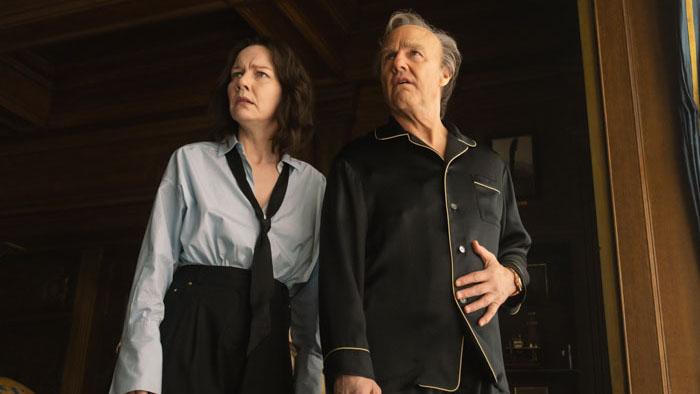
As it turns out, we are in a play. And as Cruise's true character – revealed to be frustrated stage actor Curtis Markson – observes, it is indeed a bad play, if a bad play that costs, according to Jesse Plemons' producer Kenny, roughly “a gazillion dollars.” During a scene between Digger and Goodman's President Compson, a technical snafu in this production of Fossil Fools forces the opening-day rehearsal to stop. This allows everyone to instantly drop character and Markson to confront his director Hannah (Sophie Wilde at maximum shrillness) about the stage satire – echoing what many of us in the audience were no doubt thinking – not being in any way smart or funny. Curtis insists that the performances, his included, are too exaggerated, that the jokes don't land, that none of what they're trying to capture is remotely believable or honest. Hannah shrugs off his complaints, countering that her team thinks what they're doing is hilarious and worthwhile. Afterward, a few minutes are spent with Curtis anxious about the fate of his daughter, whose plane has gone missing with her whereabouts currently unknown. Then it's back to rehearsal.
At this point, to borrow Kenny's numerical adjective, I had about a gazillion questions. So what we were watching in Digger's first half-hour was supposed to be dipshit-stupid and laugh-free? We were meant to find the strained overacting by Cruise, Goodman, Hüller, and others insufferable? (Ahmed is let off on a pass, as his sharp, clearly thought-out responses make his moments almost amusing.) Our not feeling involved in the presented global catastrophe, and cowering as normally excellent actors debased themselves, and realizing that Digger's cat was clearly not a living creature … . This was all intentional? Okay. Good one, Iñárritu. I guess. A nice way of covering your ass (and the asses of your four co-screenwriters and/or “story by” contributors) after delivering 30 minutes of excruciating cinematic blowhard-ery. With nearly 100 minutes left to go, this switcheroo will certainly become the primary focus of the movie, or will at least affect everything that we see going forward. Right?
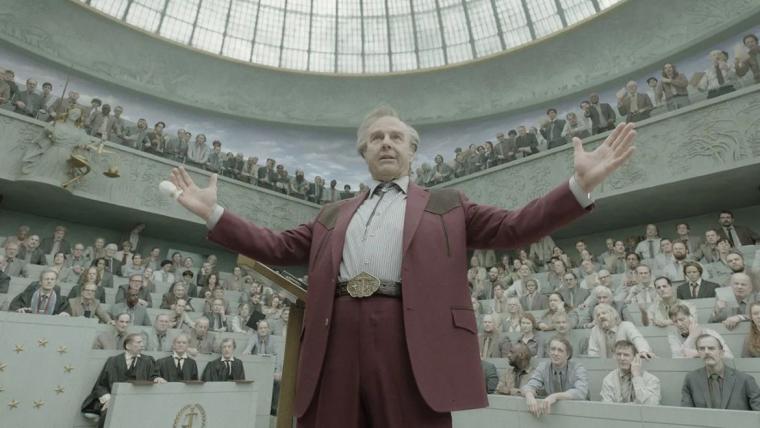
Wrong. After those too-brief real-world minutes, it's back to the faux world of Digger's end-of-days saga, only this time with awareness that it's a put-on. The interruption does the fake narrative no favors. Immediately, we're thrust into the White House war room (or maybe another room in Digger's lavish mansion … the scene setting, now and henceforth, is unclear) where our titular figure and the Joint Chiefs watch as Europe is decimated. Not long after, there's a scene set before the European Parliament in which hundreds of political attendees seethe and caterwaul as Digger, in an endless James-Bond-villain monologue, stakes his claim as the unsung hero that the world not only needs, but secretly wants. Both sequences are excruciating, because after all the cartoon dumbness that preceded them, you'd think these segments could at least give some indication of how they're reproduced in a stage format. How did that war-room conclave manage the effect of people's hair being blown back by the TV footage, considering the fans required to do so would've had to be positioned in front of the audience? How did a stage – even one with a gazillion-dollar budget – secure and position hundreds of extras to adequately replicate Parliament? How were these and other luxuriously art-directed locales shuffled back and forth with such apparent ease? Were the theatre wings, on each side, roughly the size of airport terminals? (Not based on the climatic view of the venue, they weren't.)
To be clear, I don't believe that the play-within-the-movie angle was added after the fact – that Digger, as it stood, was so abjectly crummy that Iñárritu and Warner Bros. et al needed to craft a safety net to explain why the movie was playing so badly. But that's sure what it feels like. In the wake of our being enlightened to the deliberate artificiality, and especially given the gargantuan budget, why isn't there more behind-the-curtain kick? A shot, say, of Stuhlbarg prepping for his on-stage vomit, or 100-plus Parliament extras waiting in the wings for their entrance and frantically scrambling into place on that four-tiered set … or even, in what might've been a fun aside, German actor Sandra Hüller nervously practicing her American accent? Digger gives us its Big Reveal and then, perversely, all but completely drops it, leaving us to ask a perfectly sensible question: “If even our protagonist is complaining that what we're seeing isn't logical and isn't funny, especially if that protagonist is played by Tom Cruise, why are we being continually subjected to the illogical and unfunny?”
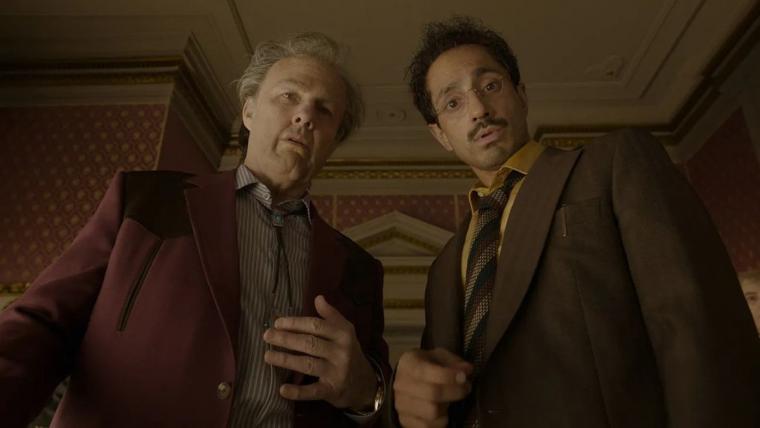
Another couple of questions that sadly popped into my head watching Iñárritu's latest: Does he consider theatre to be an inherently sub-par artistic medium, and consider theatre fans to be morons? Upon its release, I loved Birdman, that “one-shot” comedy about a fading Hollywood star's potentially final act of career rehabilitation. Following the new-car-smell excitement of its debut, the film's impact, for me (and apparently lots of others), has gradually dulled. But even on that first viewing, I was put off by the stilted dialogue of the play-within-the-play – the great Raymond Carver at his most banal – and stodgy staging decisions that appeared to signify Golden Age artistic integrity. From the start, Birdman's Broadway show looked like a chintzy, ponderous, pretentious loser that crowds would be right to howl at, and I almost sided with the film's evil New York Times critic who told Michael Keaton she was gonna ruin his reputation regardless of the play's quality. Even before it opened, What We Talk About When We Talk About Love seemed to deserve a beat-down. But audiences for the Carver, we were meant to believe, were ecstatic, just as we're told (and eventually shown) they'll be in Digger. I'm not sure what it means, if it means anything whatsoever. But in both cases, Iñárritu's crowds appear to be unbecomingly passionate about stage works that fundamentally suck.
Giving the film's finest and only truly sustained performance, a shockingly thin Plemons tells the play's participants – tells us – that it doesn't matter whether the Digger Show is funny, or whether it's smart, or whether it's in any way believable. Patrons are only there, he says, for the spectacle and catharsis of the thing, and given what we eventually learn about this film's universe (a detail even I won't Spoil), there's likely a certain truth in that. It still makes me wonder why Iñárritu, in two films now, has so clumsily made theatre audiences suckers who'll buy any big-ticket item placed before them. I understand that his rehearsing-until-the-last-possible-minute setup works better for stage than cinema, the latter medium obviously not having the advantage/disadvantage of last-second crises. But honestly: Couldn't this same material have instead been, ahem, a dig at the film industry? Offensively, at least for some of us, Iñárritu again finds ways to make theatre artists look like simpletons or worse (one of the Fossil Fools actors takes a cell-phone call on-stage during the opening-night performance, which no actor would ever do), and their audiences impressionable ninnies who don't recognize dross when it's directly in front of them. Hate on theatre all you want, Alejandro, but those who direct Digger shouldn't throw stones.
You're maybe wondering: How is Tom Cruise? He's fine. The guy is clearly having a good time venturing beyond the comfort zone he established not long after 1999's Magnolia, and while Digger's Fossil Fools readings are never really surprising and only randomly amusing, Cruise plays his deep-fried Southern stereotype to the hilt. Unfortunately, in the play-within-the-movie sequences, this causes his scene partners to make feeble attempts at matching or bettering him in enthusiasm, which makes it hard, post-reveal, to even look at Goodman and Hüller and even the hard-working Ahmed, who can't hope to win this overacting contest. As myriad movies have taught us, Tom Cruise always wins. (This year, it just won't be an Oscar.) Digger's star is randomly strong and produces some unexpectedly potent moments, particularly in the off-stage bits when he's allowed to ditch the caricature and behave, for the first time in what feels like forever, like a human. But Iñárritu's movie gives us scant few opportunities to properly reunite with this version of Cruise whom some of us deeply miss. That first Digger teaser, as it happens, was unnecessarily cruel – reminding us of Risky Business and Jerry Maguire and Magnolia and so much else yet giving us something that doesn't hold a candle to any of them.
The makeup application is topnotch. The visual effects, in those random moments they're employed as news-footage feed, are subtly phenomenal. As mentioned, I didn't at all appreciate the Lubeszki cinematography that was not only aesthetically unpleasant, but made no sense given the Fossil Fools conceit. (With his flagrantly over-lit, waxworks compositions, is Lubeszki, perhaps like Iñárritu, under the impression that theatre is inherently inferior to film?) But Dennis Gassner's and Richard Johnson's superior production design just about made up for Lubeszki's visual awkwardness, especially in the rare instances demonstrating how the Fossil Fools sausage was being made. And as much as I couldn't stomach Iñárritu's latest, I'll readily admit that its final five to 10 minutes genuinely affected me, and were, frankly, more powerful and bone-chillingly hilarious than the two hours that preceded them. Speaking figuratively, and only figuratively, I wanted to live in those minutes. It was the other two hours I would've been happy to do without.
Spoiler Alert now ending – feel free to enjoy the rest of the review!
So that's where I stand on Digger.