
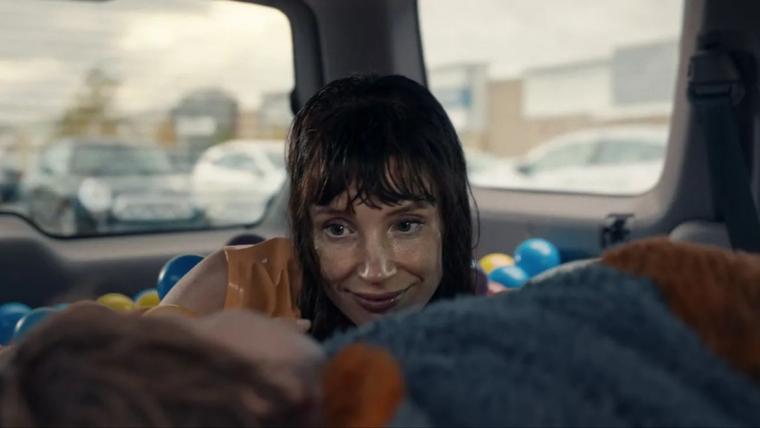
Jessica Chastain in Other Mommy
OTHER MOMMY
Like a lot of you, I'd imagine, I made my first acquaintance with director Rob Savage's Other Mommy via its trailer, which famously debuted during opening-weekend screenings of The Odyssey.
Because the preview's first half-plus was simply a scene from the film – Jessica Chastain's character chatting with, and boiling macaroni for, her grade-school daughter – it took a while to figure out the overall tenor. Initially, the mood appeared upbeat and familial, a twinkly piano score accompanying the brightly lit images. But as the music vanished and the warmth diminished, we became aware that something sinister was going on behind Chastain's sleek composure and maternal benevolence. And when the woman finally gazed upon her child with a tortured rictus grin and a single tear falling down her cheek, you could feel our audience's blood collectively freeze as we realized, yep: Chris Nolan's historical epic was indeed being preceded by the trailer for a Blumhouse shocker. That shot of Jessica twisted like a pretzel beneath the kitchen countertop may have sealed the deal, but it was ultimately unnecessary. My friend and I were so freaked by the preview's unnerving tone and Chastain's hideous smile that the first thing we talked about after three hours of The Odyssey was how excited we were for Other Mommy … or rather, how much we were excitedly dreading it.
Unfortunately, that three-minute coming attraction proves to be Savage's movie in its ideal form. Lasting roughly 30 times longer than its teaser, Other Mommy in full isn't particularly scary. Neither is it particularly good, leaving us with far too many narrative holes, largely shoddy visuals, a supernatural entity whose ability to do and be anything feels like a colossal cheat, and a wildly unwise ghost-hunter segment that, arriving as late as it does, practically nullifies any moderate fun you had before. Still, I can't bring myself to completely dislike the film. It's a mess, to be sure. Like the even-more-problematic Digger, though, it's at least a mess with stuff going on. Novelist Nathan Elston has adapted his 2024 Bram Stoker Award nominee Incidents Around the House, and there are numerous themes here worth exploring, especially in regard to how children discover and process the pain of their parents. The performances, meanwhile, are first-rate, specifically those of Chastain and the young, prodigious Arabella Olivia Clark. I may have been disappointed in Other Mommy, but it's hardly an ignoble failure, and it was kind of thrilling to see several genre norms smartly upturned before the picture was a half-hour old.
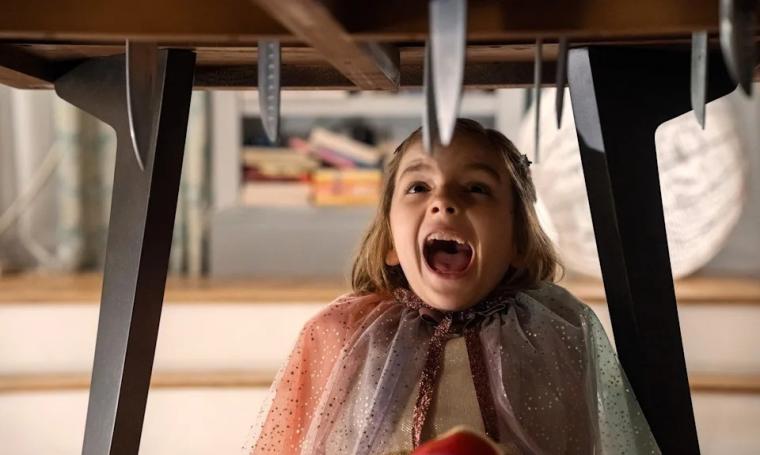
We're only a few minutes into Savage's movie when we learn that the titular figure is a “friend” to Clark's seven-year-old Bela Martin: a doppelgänger of the girl's workhorse mom Ursula (Chastain) whose “come play with us, Danny” vibe is far from innocent. Of course, this much is also gleaned from the trailer, which ultimately reveals Other Mommy to be a malevolent supernatural being with flexibility to shame a Cirque du Soleil contortionist. Another thing the preview reveals is that Bela's stay-at-home dad Russ (Jay Duplass) actually sees and is terrified by his wife's lookalike, his discovery landing around the 15-minute mark. I can't begin to tell you how refreshing this was. Almost no time is spent, or more accurately wasted, on Bela's parents not believing their daughter's tales of Other Mommy or thinking the child simply has an imaginary friend. From the outset, Russ is certain that this uninvited interloper is genuine – he does admit to smoking a little weed the morning he saw her – and all it takes is an anniversary party a couple scenes later for Ursula herself to become a believer, weirding out their guests in the process.
Yet in an additionally welcome touch, Elston's script (and presumably his book) keeps upping the ante in terms of Other Mommy's physical realness. The petrified Martins immediately evacuate their home – a smart move it takes most horror-flick clans forever to make – in the hopes that the creature will remain there. She doesn't, however, and as Ursula, Russ, and Bela trek from one theoretical “safe space” to another, the supernatural goings-on are witnessed by others in the Martins' vicinity: family pal Frank (Arian Moayed), with whom Ursula seems a little too close; Ursula's eccentric, occult-leaning mom (Karen Allen); a team of paranormal investigators; random onlookers at a Chuck E. Cheese-style eatery. No one, at first, seems entirely sure about what they're seeing. But they're definitely seeing something, and the supernatural detritus lingers. After the Martins' car becomes magically overstuffed with the contents of a kiddie ball pit (don't ask), the inevitable burst floods the parking lot with multi-colored orbs, the noise from the implosion also triggering the alarms of every car in sight. The threat may have momentarily passed, yet those folks who just wanted to eat pizza and play Skee-Ball with their kids are left with all this noise and all these balls, undeniably wondering, “What the hell just happened?!”
Because most films about demons restrict their locations to, say, a family's home or a community independent of outside scrutiny (monasteries and nunneries do nicely in this regard), it's both novel and exciting to see the inexplicable occur here in public settings, sometimes in broad daylight. But Other Mommy also demonstrates why those movies generally keep their settings limited, because after you open the supernatural activity to non-invested parties, you're stuck with a can of worms that can't be easily closed. Take, for example, the aftermath of the Martins' theme-restaurant visit, car alarms shrieking and plastic balls everywhere. Were the police called? Were statements taken? Did restaurant staffers fall under suspicion given the props used to initiate the crime, if it even was a crime? Did the event make the evening news? And considering the venue was evidently nearby, did anyone on the force connect the dots, realizing that police were also sent to investigate an incident at the Martins' home a few days ago, and the night after, and now the couple is at the center of this parking-lot strangeness? We never find out. The action instantly shifts to the Martins in their now-ball-free car, hitting the highway as they unwittingly lure Other Mommy toward other unintended victims.

This is the kind of narrative elision – a refusal to face the implications of presented actions – that makes you lose faith in a movie, and Savage's keeps giving us reasons to not buy into it. Fairly early on, Bela reveals that Other Mommy is a shape-shifter who can grow enormous or minuscule at will. Fair enough, and I guess that's why she's also able to shift into the physical forms of Bela's babysitter (a charming Sean Kaufman) and even Bela herself. Yet there doesn't appear to be anything O.M. can't do … except, naturally, force the child to accept her as Full-Time Mommy. She transports Bela to the ocean, with those increasingly maddening ball-pit balls tagging along. She makes people explode into sparkly mist. She turns rooms upside down and rips jaws out and transforms characters into puddles of goo. In other words, and despite Chastain's exuberant gameness, this monster quickly grows boring, considering the answer to “How can she do that?” is always “She just can.”
Not altogether surprisingly, the film is on much surer footing when it's content to be a domestic drama, allowing us to see Other Mommy's manifestation as the product of a fractured home. On the surface, things appear peachy with the Martins, even if Russ doesn't seem entirely comfortable in his (we sense) new career as house-husband, and Ursula doesn't appear terribly conflicted about rarely being at home. Yet kids, as we all know, pick up on mixed signals awfully easily, and as we delve deeper into the issues Ursula and Russ are facing, it becomes almost understandable that the child would create/invite a surrogate, if demonic, parent – one promising escape from the prevalent tension. Needless to say, what with the jaw ripping and limb twisting, this more subtle breed of fear isn't sustained. But it does sneak through even into some of Other Mommy's more viscerally outré passages, and is assuredly seeped into the performances of Clark, Duplass, and Chastain, the latter of whom certainly can't be accused of slumming.
While the Oscar winner no doubt has her pick of projects and hardly “needed” to take on a Blumhouse lead, Chastain is a horror veteran (Mama, It: Chapter Two) who doesn't turn up her nose at genre, and here, she's granted loads of juicy material. Until it becomes tiresome, the harridan-from-Hell stuff is fun. But watching the actor play Ursula's conflicted nature and complicated feelings about marriage and parenthood with such conviction and emotionalism is the sort of hurtful pleasure we fright-film fans are too rarely exposed to. (A more sideways pleasure, at least for stage fans, lies in seeing Chastain play opposite Moayed, the Torvald to her Nora in Broadway's 2023 revival of A Doll's House.) Despite Chastain's and her co-stars' excellence, plus the occasional diversions suggesting the stronger work that might've been, Savage's outing probably still isn't worth catching. Yet I'm still glad to have caught it … and, in a happy accident, alongside the same Chicagoland pal with whom I first saw the trailer. She didn't like Other Mommy either, and as opposed to our post-Odyssey convo, after this screening ended, we found plenty of other things to talk about.
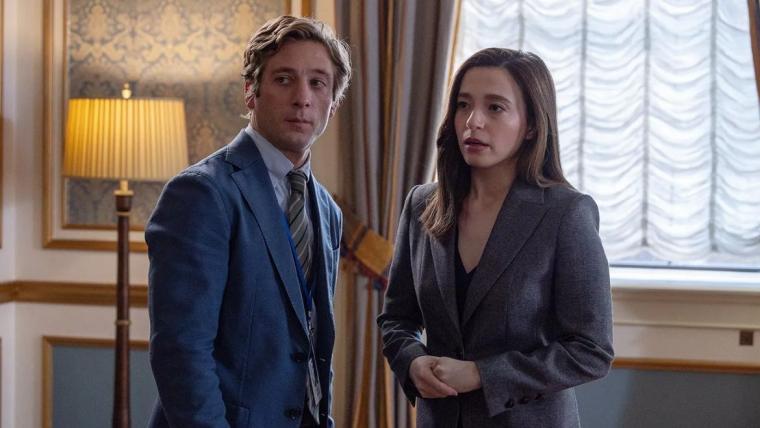
THE SOCIAL RECKONING
Each new one makes me want to proclaim this, but with The Social Reckoning, it might finally be true: This is the Aaron Sorkin-iest Aaron Sorkin entertainment ever made. In essence, it's a kinda-sorta sequel to The Social Network, director David Fincher's 2010 masterpiece that scored Sorkin a screenwriting Oscar and, as a buddy and I recently agreed, is among only a handful of 21st-century American movies that deserve to be called perfect. But what the film actually is, or at least seems to be, is a sequel to the entire Aaron Sorkin oeuvre dating back to A Few Good Men and continuing through The American President, The West Wing, Charlie Wilson's War, The Newsroom, Molly's Game, The Trial of the Chicago 7, and probably a few titles I'm leaving out. This thing reeks of Sorkin, and it'll be a litmus test of your tolerance for the man's writing whether you consider his latest excruciating, as many reviewers appear to, or enjoyable despite itself, an opinion I'm only semi-guiltily copping to.
Based on true events, with Sorkin's dramatic license pretty readily apparent in terms of specificity and chronology, the movie follows Facebook data engineer Frances Haugen (Mikey Madison) in her come-to-Jesus realization that the networking site may have nefarious intent, and may require her to turn whistle-blower. Jeremy Allen White plays Wall Street Journal investigative reporter Jeff Horwitz, to whom Hauger turns when she wants the story of Facebook's civic-integrity decline made public, and Jeremy Strong plays Mark Zuckerberg, billionaire CEO of Facebook (now Meta) who, as rendered, is somehow even more robotic and off-putting than the real-life Zuck in his public appearances. But really, all three of these actors, along with everyone in the expansive supporting cast, are playing the same recognizable Aaron Sorkin type: witty, intelligent, garrulous, self-righteous, and, for some of us, entertaining even when you don't believe a single word coming out of their mouths. Here, you usually don't. That didn't wind up bothering me much.
The most frequent complaint I hear about Sorkin's dialogue is “People don't talk like that!” But of course they do … in fast-paced sitcoms and Broadway farces. As unmistakable in their rhythms and cadences as those of Neil Simon and Woody Allen, the conversations and monologues of Sorkin mouthpieces are inherently, intensely theatrical. They're not designed to sound “real.” They're crafted, frequently self-consciously so, with musicality, appreciation for language, and the ebb and flow necessary for well-placed and -delivered punchlines. It's not discussion; it's banter. And the deliberate artificiality of it drives a lot of viewers understandably crazy.
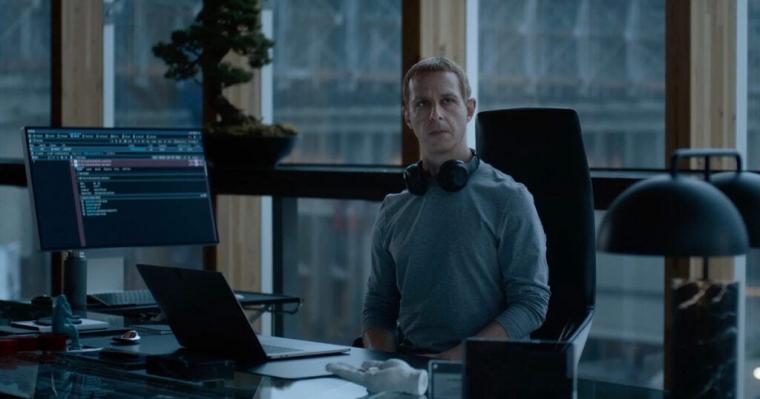
Occasionally, as in The Social Reckoning, that unhappy contingent includes myself. I found it beyond maddening that every time Haugen and Horwitz met for secret tête-à-têtes in his hotel room – meetings boasting reams of exposition on how Facebook not only turned a blind eye to misinformation and hate groups and bullying but actively encouraged loathsome behavior – these scenes lasted twice as long as necessary because of how many mood-lightening jokes Sorkin felt obliged to include. Horwitz's encounters with his two WSJ interns (Kelley Pereira and Aidan Laprete) are unfailingly overloaded with snippy commentary and shtick. The repartee between Zuckerberg and members of his legal counsel (Patrick Fischler, Joey Brooks, and a sadly sidelined Wunmi Mosaku) is so inhumanly rat-a-tat it may as well have been produced via machine gun. In his role as a disillusioned Facebook investor who becomes Zuck's most vocal in-the-room critic, I'm not sure that Bill Burr delivers a single sentence that couldn't go in the Aaron Sorkin Pithy Comeback Hall of Fame.
Yet I have to admit that the fraudulence, as wearying as it can be, is also a frequent hoot – I heard, and contributed to, more laughs at my modestly attended afternoon screening than at anything since Resident Evil – and when he puts his mind to it, good lord can Sorkin write. As a director on what's only his fourth feature (following Molly's Game, Chicago 7, and Being the Ricardos), the guy is still in his wobbly-legs period. Beyond his recreation of the January 6 insurrection, which is unconvincingly set at the exact time Zuckerberg is in the midst of courtroom prep, Sorkin's visual style is indistinguishable from that of “prestige” TV, and that's when it's not distinctly blander. The verbal fireworks, though, are lit from the prelude that finds a messy drunk (Portia Doubleday, breathtakingly feral) live-streaming her confrontation with roadside police officers – a legitimately scary, electrifying sequence that, unfortunately, remains the movie's high point.
All throughout The Social Reckoning, though, scenes reverberate with the sort of heightened conversational magic, even if it's merely well-honed stage/sitcom magic, that only Aaron Sorkin seems much interested in bringing to the cineplex these days. The continually extraordinary Betty Gilpin's relentless, acerbic cynicism as Horwitz's WSJ boss. Billy Magnussen's cruel detachment as a Facebook media-relations stooge. Madison's flummoxed apoplexy at the fact that a tech reporter for the Wall Street Journal can be so thunderously stupid about the very subject he covers. Strong, caricature or not, forcefully decimating everyone in his path, right up until Real Life forces Zuckerberg to go blessedly silent. As a followup to the genius of The Social Network, Sorkin's continuation is barely passable; in his entire life, David Fincher has perhaps never been more sorely missed. As an example of Aaron Sorkin's still-relevant skills as a showman, though, The Social Reckoning is very much worthy, and a pretty terrific time at the movies. Please like and share. Or, y'know, please don't.
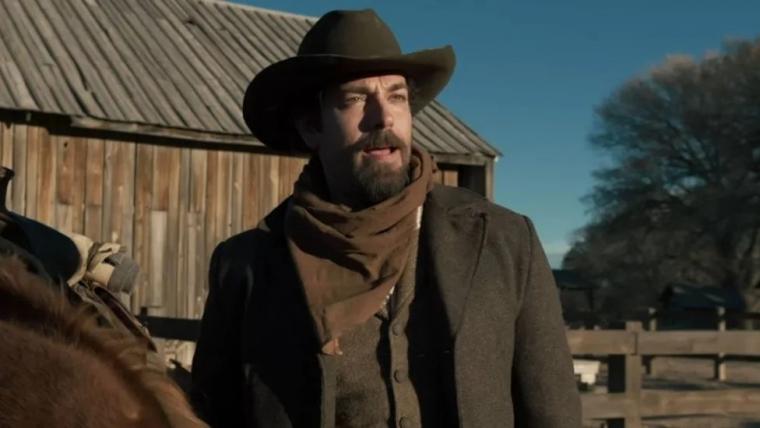
ANGEL & THE BADMAN
Mercifully dragging myself out of the auditorium after Angel & the Badman, desperate to leave before the inevitable post-show begging began, I almost made it to the door before I heard an on-screen figure shout (and I'm paraphrasing) “Stop! Put yer hands in the air, pardners! And raise yer phones to the QR code you see in the corner!” Yes, friends: Director Julio Quintana's pathetic Western is indeed the latest release by the über-insistent Angel Studios, which not only demands our money and (more often than not) considerable patience, but routinely bullies us into “paying it forward” by clicking our phones and sending discounted or free tickets to those who might otherwise not see this latest cinematic spectacle. By all means, capture that QR code, and share Angel & the Badman with whomever you most hate.
A remake of the 1947 Western that, luckily for the studio, entered U.S. public domain in 1975 on a technicality, Quintana's take casts Shazam! sweetheart Zachary Levi in the John Wayne role, and I was sincerely tempted to leave this review solely at that, allowing you to draw your own conclusions. Playing Quirt Evans, the baddest and meanest outlaw in the Wild Wild West, the mugging, grating Levi is hopelessly ridiculous whether romancing Meg Fraser's God-abiding Penny or running from Neal McDonough's bitter and dying (and predictably phlegmatic) Laredo, or, Heaven help him, sharing scenes with Tommy Lee Jones, the one actor perfectly in his element, as Marshal McClintock. It's your prototypical killer-redeemed-by-the-love-of-a-good-woman saga, and in the hands of Quintana, Levi, and a trio of screenwriters best left nameless, it's about as cheap-looking, unpersuasive, and ludicrously silly as these things get – by which I mean both earnest Western romantic dramas and Angel Studios products.
I did smile when Jones and Sean Bridgers, as McClintock's Deputy Eli, reenacted a scene unmistakably ripped off from No Country for Old Men, and there's one semi-decent punchline involving a stolen horse. Otherwise, Angel & the Badman is unconscionably bad, boasting the most staggeringly obnoxious performance by a minor (his name also purposely withheld) I've witnessed all decade; a grouchy-old-broad turn by Melissa Chambers to make you yearn for the subtlety of late-period Martha Raye; an unexplained, jaw-dropping, eye-glazing return from the dead; and one of the year's most astoundingly underwhelming and inept finales – and I only added that “one of” because I sat through Busboys. Given the film's themes and the studio's pro-faith bent, I understand why wall-mounted wooden crosses are strategically placed in just about every interior shot. The visual motif also makes sense given that the movie itself is crucifying.