
Political Ideology Is Not Driving Socialism's Rise in Global Cities, Structural Stability Amidst Unseen Resources Is
Over my 67 years in the Midwest, I’ve watched generations leave small towns for larger cities. I understand the appeal: opportunity, stimulation, anonymity, convenience. Alongside this pervasive trend, a political shift is taking place: socialism has become more acceptable and capitalism less revered, especially in the nation’s largest metros.
Conventional wisdom is that socialism has new appeal because of a purportedly growing wealth gap. This appeal is largely concentrated among educated, urban voters. But among my observations of human nature is that even people who moralize like socialists make personal choices like capitalists. Those choosing to move from rural to urban settings are doing so for their own self-interest; not to join a collective ideology. So, is it likely that urban dwellers’ self-interest naturally evolves to more redistributionist economic policy (i.e. “socialist”)? This essay explores whether the city life environment – dense, complex, and increasingly dependent on unseen systems – may be influencing the politics that emerge from it. We may be approaching a moment when the limits of our built environments are shaping our politics far more than our politics are shaping those environments.
Urbanization is attractive because of its relative efficiency. “Urbanization,” as defined by the U.S. Census Bureau, refers to the share of Americans living in “urbanized areas” (50,000+ people in dense settlement) or “urban clusters” (2,500–49,999 people). Another federal definition—metropolitan counties—simply captures economic reach, even if the county is mostly cornfield. Both metrics are included in the chart below. The percentage of Americans classified as urban has risen decade after decade, projected to reach ~89% by 2050. On the surface, what’s remarkable isn’t the rise—it’s the absence of reversals. Urbanization in the United States goes in one direction. Up. Partly because simple population growth contributes to urbanization. So small rural communities become urban by remaining in place and participating economically in the nearest metroplex.

But the force of urbanization has potentially adverse side effects. For example, population concentration. As natural population growth has combined with rural out-migration, our largest metro areas have expanded outward. Vast territories have been suburbanized and an ever-greater share of Americans have concentrated within their boundaries. No matter which measure of urbanization one chooses, the direction is the same: America’s metroplexes are concentrating more of the population. In the early 1900s, roughly one-sixth of the U.S. population—about five million people—lived in the ten largest metropolitan areas. Today, those same ten clusters contain between one-quarter and one-third of the nation’s population, roughly 90 million people. The metro region closest to me is Chicago, and the map below demonstrates its trend of expansion. This is among the most modest examples of concentrating population over 100 years.

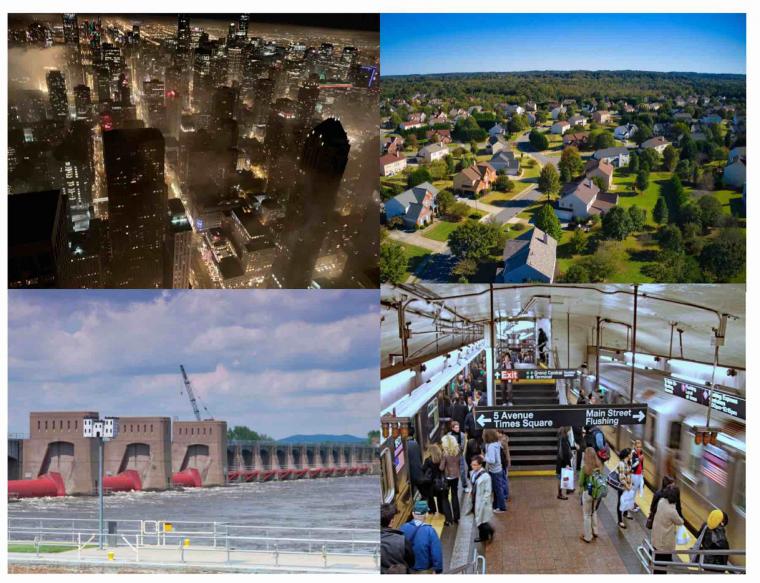
My Midwest community, the Iowa-Illinois Quad Cities, is urban by census definition, but lays outside the orbit of Chicago, and still with rural roots. (Among our largest regional employers is John Deere!) As such, I’ve always been close to the foundations of daily life. I can see where my food comes from—the fields, feedlots, and orchards I pass every day. I can see the river I’ve watched since childhood that provides my water, and the energy systems—from wind turbines to coal piles at power plants—that keep my lights on. These visible, tangible sources of sustenance create a quiet confidence. When you can point to what sustains you, the world feels manageable.
Now, though, people who live deep inside the largest and most concentrated of metropolitan regions don’t share my experience. As the metroplexes have grown geographically and denser, the sources of essentials – food, water, energy – have been pushed farther away. Their basic needs arrive from who-knows-where through extensive, multi-layered, invisible systems. Digital markets and algorithms represent whether there is enough physical resource for tomorrow or not.
Richard Longworth’s book Caught in the Middle explains part of this shift. When I read the book soon after publication in 2007—and later met with Longworth to discuss its implications for the Quad Cities—it became clear that globalization was forcing the American interior to reorganize. Longworth described a Midwest caught between its industrial past and a global economy that rewards the concentration of talent, capital, and innovation into a few dominant metropolitan regions. “Global cities” prospered. Much of the remaining Midwest became places that “didn’t matter so much.” Urbanization wasn’t demographic drift; it was a sorting mechanism, steadily reallocating opportunity.
Concentration, Continuity, and Collapse?
In the immediate future, though, rural migration cannot have much more impact on urban populations. There are not enough rural migrants left. In fact, domestic migration trends since 2020 move in a somewhat opposite direction. Many “global cities” have lost native-born residents to smaller metros, suburbs, and rural counties. It is another global force that is deepening the urban demographic concentration: immigration.
Immigrants bring vitality, entrepreneurship, and renewal at every economic level – all things we have a history of benefitting from. Interestingly, though, today’s immigration patterns differ from history. New immigrants persistently concentrate in Longworth’s “global cities” as opposed to diffuse throughout the country, likely for the same preferences that have driven domestic rural migration. The national average of foreign-born population is roughly 16%. But America’s major global cities—New York (~38% foreign-born), Los Angeles (~40% city), San Francisco (~35%), Boston (~27%), Seattle (~20%), Washington, DC (~25%)—absorb a disproportionate share of newcomers. This increases demand and complexity for housing, infrastructure, education, and public services. Thus, a small set of metropolitan regions must absorb global inflows while experiencing domestic outflows—a demographic churn that amplifies system strain.
Another book, Jared Diamond’s Collapse, which I read soon after its publication in 2005, argues that societies fail when environmental pressures, climate change, hostile neighbors, loss of trade, and—most critically—their own cultural and political choices converge to overwhelm their resilience. Diamond’s examples share a common thread: people depended on interlocking systems they did not fully understand and could not repair when those systems faltered. His accounts of the Maya cities, whose elites relied on distant agricultural systems they could no longer see or respond to as ecological stress mounted, and of Chaco Canyon, where an elaborate hub-and-spoke network grew so extended that even small climatic disruptions became catastrophic, illustrate how dense population centers can lose touch with the foundations that sustain them. In both cases, urban political dominance masked structural fragility—until it didn’t.
We can’t know what political choices were considered by the Mayans or the tribal leaders in Chaco Canyon. But the situations of our modern global cities resemble those systems. Their residents depend on unseen grids, reservoirs, pipelines, markets, and supply chains—vast machines of astonishing sophistication but finite resilience. As generations replace each other, and as immigrants replace native-born in the global cities, ever more of the urban population may never experience the actual mechanisms of their essential supply. If urban political preferences are shifting toward collective guarantees, perhaps it is not because voters suddenly adopted new ideologies but because the physical structure of their lives changed the structure of their concerns. When every necessity relies on large, complex networks, the desire for stability, not ideology, drives political choices.
I contend this may herald a historical break. Throughout history, civilization has never placed so many people into systems so large and so interdependent. As these systems swell—energy grids, water delivery, transportation, housing, supply chains—they grow more capable and more fragile at the same time. Individuals become disconnected from the sources of anything. Modern life becomes efficient, but also precarious. And inside that precariousness, political expectations shift. When millions depend on networks that must work flawlessly, people naturally seek political assurances that they will.
These dynamics suggest a working hypothesis: as urbanization pushes human systems past certain density and complexity thresholds, political preferences shift not because individuals abandon capitalist instincts, but because their daily survival depends on large, fragile, invisible systems requiring coordination. The rising appeal of socialist-leaning frameworks in major metros may be less ideological than adaptive—an evolution toward coercive governance tuned to the psychology of urban life, imagining control and certainty in unseen underlying structures, as opposed to more effective market-driven progressions.
A second hypothesis follows naturally: as the population becomes increasingly urban, national politics will increasingly reflect the priorities and dependencies formed inside these dense metropolitan environments, while rural regions—still responsible for producing much of the nation’s physical sustenance—will diverge further in worldview. The emerging divide may not be left versus right ideology, but complexity versus visibility: those who live inside systems they cannot see versus those who live beside the resources that sustain them. If correct, our political tensions are not merely ideological disputes but predictable outcomes of urbanization reaching critical mass.
I’m biased. I’ve never felt the pull of the city myself. Perhaps because I’m content, or perhaps because I lack ambition. Hard to know. But I view the urban drift toward socialism as an example of hope overwhelming history; perhaps unwittingly masking the diminishing benefits and potential risks of ever larger metro scale. It seems common sense that as more Americans live farther from the sources of their food, water, and energy, their sense of what government must promise will naturally diverge from those of us who still see these things every day. Urbanization is not just changing where Americans live; it may be altering what they believe is necessary for society to function.
Joel Lorentzen lives in Rock Island, Illinois, and publishes a column on Substack.com titled “Uncommon Sense.” Find all of his essays at JoelELorentzen.substack.com. His essays published in the Reader are found at this link here.
Author

Anonymous (not verified)