
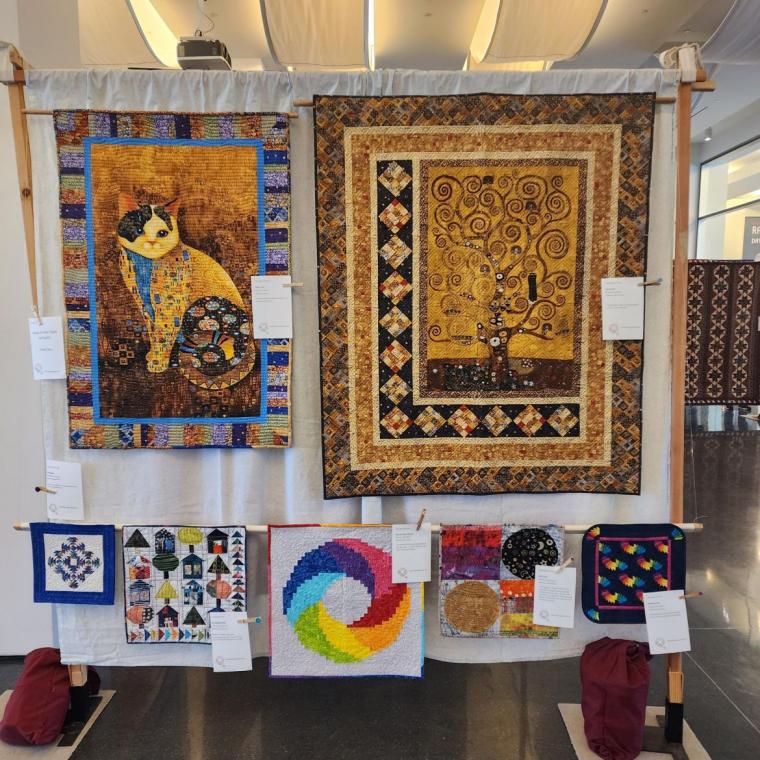
“Mississippi Valley Quilters Guild 2026 Display" at the Figge Art Museum -- March 3 through 8.
Exhibit: Tuesday, March 3, through Sunday, March 8
Reception: Thursday, March 5, 6 p.m.
Figge Art Museum, 225 West Second Street, Davenport IA
In celebration of National Quilt Day on March 16, Davenport's Figge Art Museum will again showcase a number of colorful and hand-crafted functional artworks in the March 3 through 8 Mississippi Valley Quilters Guild Display, with a special reception for the exhibit's gifted artisans scheduled for March 5.
On display in the Figge's Quad City Bank & Trust Grand Lobby, the quilts include traditional and modern art inspirations, with personal designs and interpretations created by the quilt artists. Visitors will see how the visual arts inspire quilt art through color, line, scale, balance, contract, proportion, texture, and more, with volunteers from the MVQG available to chat and answer questions,
The Mississippi Valley Quilters Guild was organized in 1983 to educate and encourage members in the quilting arts; to encourage high standards in color, design, and construction of the quilted medium; and to stimulate interest in quilting in the community. Membership is open to anyone interested in quilting. The Guild year runs from September 1 to August 31, with dues of $35 per year payable in August and September. The MVQG current membership consists of 250-plus women and men, and fiscal year 2024-25 has reported more than 2,000 volunteer hours towards general activity (e.g. meetings, etc.) with another 4,000-plus hours for Charity Committee work alone.
The history of quilting, the stitching together of layers of padding and fabric, may date back as far as 3400 BC, and for much of its history, quilting was primarily a practical technique to provide physical protection and insulation. However, decorative elements were often also present, and many quilts are now primarily art pieces. In Europe, quilting appears to have been introduced by Crusaders in the 12th century in the form of the aketon or gambeson, a quilted garment worn under armor that later developed into the doublet, which remained an essential part of fashionable men's clothing for 300 years until the early 1600s.
In the United States, quilt making was common in the late 17th century and early years of the 18th century. Colonial quilts were not made of leftover scraps or worn clothing as a humble bedcovering during this period, but were decorative items that displayed the fine needlework of the maker, such as the Baltimore album quilts. Only the wealthy had the leisure time for quilt making, so such quilting was done by only a few. Whole cloth quilts, broderie perse, and medallion quilts were the styles of quilts made during the early 19th century, but from 1840 onward the use of piecework and blocks, often made from printed fabric, became much more common. Today, of course, quilting is a popular hobby, with an estimated base of 21 million quilters.
A reception for the Mississippi Valley Quilters Guild 2026 Display will be held on Thursday, March 5, admission to the 6 p.m. program featuring MVQC members discussing their works is free, and the display itself will be on view in the Figge's Quad City Bank & Trust Grand Lobby from March 3 through 8. For more information, call (563)326-7804 and visit FiggeArtMuseum.org.