
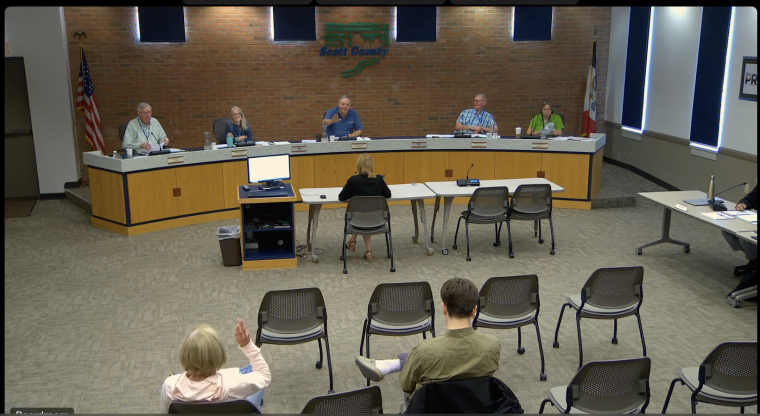
Scott County Board of Supervisors 2026.10.06 Committe of the Whole Meeting Screen Shot
Policy Practices, NDAs, and County Home Rule Relative to Iowa Utilities Commission
There are five supervisor seats on the county board, and elected supervisors serve four-year terms. This year, there are three open seats, and two of the three incumbents are running again, as Ross Paustian did not run again. Only one of the two incumbents, Jean Dickson, responded to the questionnaire. Supervisors are paid $45-50,000 annually plus health and retirement benefits. Five of the seven candidates vying for the three seats participated this year. Responses are in alphabetical order by family name.
1. CHANGE or KEEP?
What are the top two current standard practices or policy actions by the Board of Supervisors that you would strive to change should you be elected in the general election in November? And likewise, what are the top two current standard practices or policies that you would strive to maintain should you join the Board in 2027?
Jean Dickson (Incumbent): If I have learned anything about this board over the past 3 and a half years, it is that we are a dynamic, rather than a static, governing body. Local government cannot afford to stand still. As community standards, financial realities, or policy results justify the need for change, I will continue to work collaboratively with my fellow supervisors to implement those adjustments. Among many policy actions, I am proud of the board’s pay as you go philosophy and our vote on CIPCO.
Stephen Doerscher: Appointments to County Boards should NOT be family or Business Associates of a sitting Supervisor. Currently, there is no one stopping such appointments. The obvious appearance of potential conflicts of interest should not be tolerated by the citizens of Scott County.
The absolutist policy of no development on ground with a Corn Suitability Rating (CSR) of 65+ must be revisited. It is essentially a moratorium on developments like solar power generation nearly anywhere. If a farmer wants to make some of his ground into a solar field, he should have the right to. It’s their ground. In order for the farmer in this example to “farm the sun”, they are beholden to the decision of 5 individuals. There are roughly 175,000 people in Scott County. In this difficult time for small family farms to survive, I think they should be able to develop their ground as they see fit to profit from it.
Kevin Randle: There are many things I would like to see the Board of Supervisors improve, but two of my top priorities are improving the quality of life for working families and restoring County funding for the Center for Active Seniors, Inc. (CASI).
First, I want to improve the quality of life for working families by investing in affordable housing, attracting new jobs and responsible economic development, and strengthening public services. For families to build a future in Scott County, they need to be able to afford to live here. We can address that by attracting good jobs and investing in affordable housing to reduce housing cost burdens. Amenities such as recreation and strong public services also help make the County an attractive place to live, work, and raise a family.
Second, I would work to restore County funding for CASI. CASI provides valuable programs and services that support the health, wellness, and quality of life of our local seniors. I believe investing in the well-being of our senior community is a worthwhile use of County resources.
As for what I would maintain, I would uphold the County's responsible budgeting practices. Scott County has been recognized for responsible budgeting, and it will be important to preserve that discipline in the future. Being responsible with taxpayer money should always be a top priority so the County can continue to provide essential services to its residents.
I would also continue the County's investment in and improvement of public services, including parks and public safety. These services are important to the quality of life in Scott County, and maintaining strong public services should remain a priority.
Luana Stoltenberg: I am currently in favor of the standard practices and policies of the Board of Supervisors, but I think we can always look for places to improve. The two areas I would strive to change are:
1) Let’s put greater emphasis on controlling the growth of county spending and reducing property-tax pressure. The Board could work with each department to take a harder look at their budget and ask where we can reduce spending, if there are more efficient ways to do things, and whether services can be delivered at a lower cost. The county does have a formal budget process and publishes its tax levies, but we can continue looking for ways to reduce the burden on property owners.
2) We can strive to be more pro-active. Let’s create ordinances to protect the health, safety, and prosperity of our citizens and land in our county, as Energy Companies, Data Centers and economic developments seek to come here. Technology, economic development,and innovation are all very important and necessary, but they should never usurp or take precedence over the government's responsibility to protect the safety and well being of the public, property rights, or a safe environment.
The two practices I would strive to maintain are:
1) Responsible financial management and transparency. Scott County has a long-standing record of professional financial reporting and budgeting. In 2026, the county received the Distinguished Budget Presentation Award for its FY2027 budget for the 37th consecutive year, along with recognition for its annual financial reporting. We need to preserve those strong financial controls and continue making county finances available to the public.
2) Maintaining essential county services while working collaboratively. It's the Board’s responsibility to provide essential services and infrastructure while working cooperatively with county departments, elected officials, cities, and the public. I strongly believe a supervisor should listen before making decisions, be willing to ask difficult questions, and work with the other members of the Board to find practical solutions.
Wendy Walljasper: I am the first to admit that County Supervisor would be a new role for me, and that I do not yet know the nuance of all current practices. However, my entire career has consisted of being thrown in the deep end and learning the ropes very quickly-from a Starbucks barista dealing with grumpy customers, to domestic violence shelter advocate working the weekend with no supervisors to give direction on handling crisis after crisis, to division director at a non-profit having to understand state (from two different states!) and federal contracts and all the systems that guide those programs. I am well equipped to quickly assess practices and policies in a new environment. If those practices and policies are not efficiently using tax-payer funds, effectively working towards their stated goals, or failing to serve county residents FIRST, I will fight to change those policies, because I am not convinced by status quo arguments that "this is how we've always done it."
2. NDAs?
Do you support elected supervisors or county staff signing Non-Disclosure Agreements with local, regional, or statewide economic development organizations private and public, regarding entities seeking to locate or build facilities, factories or data-centers in Scott County. If yes, why? If no, if you are presented such an NDA to sign for you to be included in preliminary discussions before a proposal goes public, will you refuse to sign?
Jean Dickson (Incumbent): No. At its core, a “Non-Disclosure Agreements” is a legally binding contract with an offer, consideration, and acceptance. This question provides no specificity as to the terms. As an attorney, my professional training dictates that I would have to thoroughly read, analyze, and discern the terms before I could say I would or would not sign something. However, transparency is paramount. Discussions involving public entities and taxpayer funds should be open and accessible to the community.
Stephen Doerscher: NO! Absolutely and under no circumstances will I sign one. The only reason I would be in the position of occupying a seat on the County Board would be from the faith in my honesty and level of trust from the citizens of Scott County who put me there. We’ve already seen far too many examples of local government recently operating behind closed doors and not being open and transparent to the voters who put them there. We don’t need to continue that practice.
Kevin Randle: I support transparency in government while recognizing that there can be legitimate circumstances where confidential business information needs to be protected. I would never sign an NDA that violates Iowa law or compromises my obligation to represent the interests of Scott County residents. I am committed to working with developers and economic development organizations to pursue responsible economic development that attracts new jobs, expands the County tax base, and benefits our communities. At the same time, the public deserves transparency about major projects that could significantly affect Scott County. I would evaluate any NDA carefully to ensure it protects legitimate confidential information without unnecessarily limiting public accountability.
Luana Stoltenberg: No I do not support elected officials or staff signing a non-disclosure agreement. The people should always have access to all information. They are the people paying for services with their tax dollars. They are also the ones living and working in the community the development will be located in, so it effects every part of their life. The people should have access to all information so they can make an informed decision. I will refuse to sign a non-disclosure agreement if presented.
Wendy Walljasper: I am opposed to the use of NDAs for both elected supervisors and county staff with economic development organizations. As I’ve talked with county residents this summer, the theme of government transparency has been repeated over and over. Large scale facilities of any kind, especially factories, powerplants and data centers, have a huge impact on our local economy, property values and environment. Tax payers deserve to know the proposed benefit AND cost of these proposals BEFORE the deals are signed and it is too late to use our right to direct our representatives to work in our best interest-not the best interest of the corporations and developers. If I were asked to sign an NDA I would refuse to do so, as well as fight to bring public attention to the backroom dealing happening in our local government.
3. COUNTY HOME RULE & IOWA UTILITIES COMMISSION.
The pending Iowa Utilities Commission Evidentiary Hearing at 9am on November 17, 2026 at the Doubletree Ballroom in downtown Davenport brings to light one critical exception to the “County Home Rule, which was approved in a State-wide referendum in 1978, (and) broadened the power of the Board of Supervisors. Home Rule allows counties to determine their local affairs and government provided that it is consistent with and not expressly prohibited by the Iowa General Assembly.” Source: ScottCountyIowa.gov/board/about-board.
That critical exception being the Iowa Utilities Commission, a three-member governor appointed commission that has the authority to override county zoning policies/categories under the auspices of public good regarding utilities and energy. This came to light when Central Iowa Power Cooperative (CIPCO) sought approval for a proposed 240-megawatt gas-fired power plant on 90 acres east of Maysville after the county’s board of supervisors denied a special use permit for construction in February. The development violates ag-preservation zoning and does not qualify for an industrial floating zone variance on said zoning like other developments in north Scott County. More than 800 concerned citizens in Scott County have forced the hearing November 17 to review risk-reward and pros-cons.
Question: As a Supervisor, on a scale of 1 to 10, how much bandwidth should the board and staff dedicate to engaging state legislators in Scott County to draft a bill eliminating or modifying the IUC's ability to override county home rule? Should this be a priority that the Supervisors should collaborate with state law makers so they can direct the county's paid lobbyists to advocate for passing such home rule restorative legislation?
Jean Dickson (Incumbent): The 1978 County Home Rule Amendment gave the county home rule power and authority, provided our actions remain consistent with the laws of the general assembly. Iowa Code section 331.301. In 2008, Scott County made a deliberate decision to prioritize agricultural preservation, leveraging our legislative zoning authority under Iowa code Chapter 335 to protect our most productive soils. The current CIPCO application before the Iowa Utilities Commission (IUC) ignores those standards. However, unfortunately, the legislature has given the state authority under Chapter 474, and Iowa Code section 476A.5(3) specifically provides that CIPCO’s failure to meet local zoning requirements does not preclude the IUC from using a certificate, effectively superseding provisions regarding local control. To push back effectively, however, our strategy cannot just be broad rhetoric; it must be a narrowly tailored, legislative fix aimed at modifying section 476A.5(3). While it is difficulty to pledge “priority bandwidth” until a specific proposal is on the table, I support further investigation into legislative paths that support local zoning rights.
Stephen Doerscher: I believe Supervisors should be conversing with their State Senators and Representatives whenever possible. The State Government has already eroded staples of the Home Rule policy just in the last year. They have implemented a 2% annual growth cap on Property Tax revenue collections on local governments. All in a time when costs are rising due to a current inflation rate of 3.4%. This handcuffs local government’s ability to collect the revenues they need to provide the services required and expected by their citizens.
As far as the IUC is concerned, they are intended to look at the state as a whole, not just particular neighborhoods. We all see demand for energy rising at a rate that we are currently unable to keep up with. If there are opportunities to meet some of that demand and keep costs down for families on their utility bill in this particular economic time, as well as help solidify their energy reliability, I feel like we should all be looking forward to the future instead of only the current day. Yes, I acknowledge that over 800 citizens have banded together to resist the CIPCO plan. However, that means there are roughly 174,000 citizens who did not. I feel as if a loud group swayed the Board decision after the calendar turned to 2026, and an election year. This Board knows full well that the decision to turn the project down would have been appealed to the IUC giving them a safe “out” heading into a re-election year. To me it looks like this board is more than willing to jeopardize the financial security of Scott County families with their rates having to go up, and their energy reliability with the emergence of large Data Centers in areas surrounding the County.
Kevin Randle: I support local control and believe the people of Scott County should have a meaningful role in making decisions about their own communities. However, I do not believe that lobbying should be a significant priority for County resources. County resources are limited, and they should be focused primarily on improving the quality of life within Scott County, including affordable housing, public services, infrastructure, and responsible economic development.
I would remain open to working with our state legislators on proposals that strengthen local decision-making. However, I would not make a major County lobbying effort to change state law a priority when those resources could be directed toward addressing needs here in Scott County.
Luana Stoltenberg: As a Supervisor I think it is definitely worth meeting with State legislators in Scott County to discuss legislation and other options to stop IUC’s ability to override County Home Rule. On a scale of 1-10, I would rate it an 8, realizing we must look at other options as well.
We must remember the supervisors did not tell CIPCO they could not locate in Scott County. They simply said they could not locate on the 90 acres zoned for prime agriculture. So the board is not stopping “Public Good” regarding CIPCO coming, just saying they can’t be in that specific place. So I don’t believe IUC has the authority to override County Home Rule. It would also be worth speaking with the County Attorney to see other legal options we would have as a County to represent the will of the people.
Wendy Walljasper: Ten. Local control for local people is one of my highest priorities. Iowa citizens have lost faith that state and federal politicians will prioritize regular people in decision making, and a three person board appointed by a governor from either party is simply not going to prioritize the best interests of folks who are struggling to pay for gas and food. The upper levels of government are out of touch with the stressors of working people, and the need for Home Rule is more important now than ever. The current exception to county home rule is a dangerous precedent to undermining Scott County residents' ability to decide how our tax dollars are spent to care for OUR community, not line the pockets of corporations and developers.
See also: