
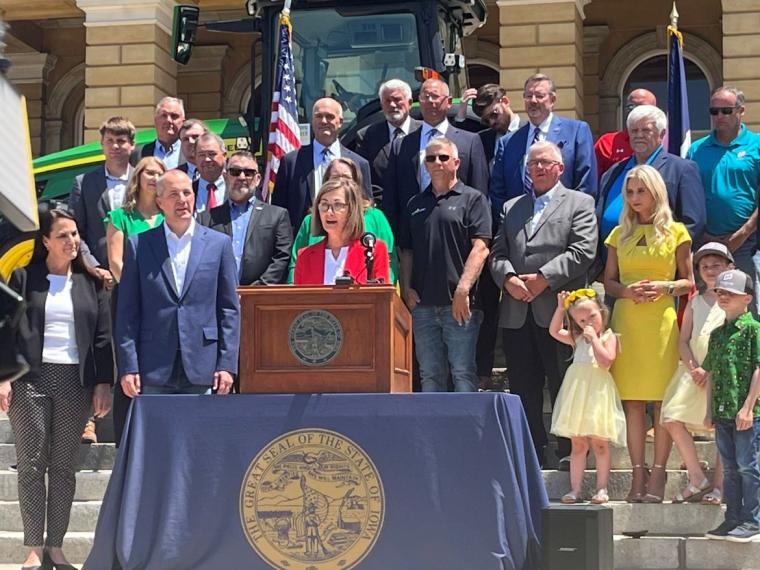
Iowa Gov. Kim Reynolds signs Senate File 2493 into law outside of the Capitol, exempting products that use 85% ethanol from the state excise tax, Des Moines, Iowa, June 1, 2026. (Photo by Kadin Luhmann/Iowa Capital Dispatch)
Governor Kim Reynolds signed several bills related to agriculture and the environment into law Monday, including measures related to water quality, ethanol and the Iowa Farm Act.
One of those bills, House File 2771, the state’s agriculture and natural resources budget bill, includes the “Farm to Faucet” water-quality proposal introduced by Reynolds, state Agriculture Secretary Mike Naig and other Republican officials in the final days of the 2026 legislative session.
The package represents a $319 million investment in improving Iowa’s water quality over the next 12 years, according to the governor’s office. It includes a one-time investment of $25 million going directly to Central Iowa Water Works to upgrade its nitrate-removal capacity, alongside a one-time $10 million revolving loan fund – the Rural Iowa Infrastructure Bank – to provide loans at a rate of 1 percent or less to finance small and medium-sized communities seeking to upgrade water and wastewater infrastructure.
The proposal makes several other funding shifts and investments, which GOP officials have said will direct money to programs that have proven to effectively improve water quality and agricultural best practices in the state. It eliminates the Water Quality Financing Program and redirects the $8.5 million currently going to the program to other initiatives, such as the Wastewater and Drinking Water Treatment Financial Assistance program.
It also creates a new Greater Des Moines Watershed Program with $3.72 million in annual funding. There’s also $800,000 going to the Iowa Department of Natural Resources annually for water quality monitoring efforts, some of which will be distributed through grants.
Water quality has become a top concern in Iowa in recent years, especially in central Iowa where Central Iowa Water Works implemented a lawn-watering ban in June and July of 2025 when nitrate levels were significantly elevated in the Des Moines and Raccoon rivers.
As worries grow about the potential risks of high nitrate levels – and the possible relationship between Iowa’s water quality problems and the state’s high cancer rates – Democrats in the state legislature moved to introduce multiple measures during 2026.
Though some Democrats voiced concerns about the Republicans’ proposal, saying it did not provide enough resources to water quality monitoring programs through the Iowa Water Quality Information System administered through the Iowa Flood Center or provide meaningful incentives to farmers to implement best water quality practices, the measure signed by Reynolds gained bipartisan support in both chambers.
At the bill signing Monday, the governor said improving water quality in the state is a top priority on both sides of the aisle. “We all want the same solution on water quality. And this is how we get there,” Reynolds said.
The governor also signed Senate File 2465, “The Iowa Farm Act,” a measure introduced by Naig early in the year. The new law will make the Choose Iowa program permanent and rename it the Choose Iowa Food Bank Purchasing Program, alongside creating the Choose Iowa School Purchasing Program – an expansion on the dollar-matching pilot program helping schools and food banks in the state acquire locally grown and raised products from Iowa farms.
It makes a variety of other changes, including a sales tax exemption for honeybees, expanding the state’s agricultural tourism law to include public educational events about agriculture on Iowa farms, and includes new confidentiality measures related to biosecurity and equipment data. The governor called the measure “a first of its kind – the Iowa Farm Bill,” and thanked Naig and the Iowa Department of Agriculture and Land Stewardship staff, alongside the DNR, for their work on the measure.
Naig thanked lawmakers, farmers, landowners and other parties for their willingness to work with his office to move the measure forward.
“Every item in the Farm Act can be traced back to an idea or feedback that came directly from farmers and businesses or community round tables as I’ve traveled the state,” Naig said. “It expands opportunities for Iowa’s agriculture, reduces unnecessary regulatory burdens, strengthens rural communities, supports beginning farmers and our ag workforce, and gives farmers greater certainty and more tools to prepare and plan for the future.”
The governor also signed Senate File 2493, a bill that exempts ethanol blends above 85 percent used in agricultural equipment from the state excise tax. The bill passed with strong bipartisan support, with a 44-0 vote in the Senate and an 85-1 vote in the House.
Reynolds, joined by members of the Legislature, Iowa Corn Farmers and John Deere executives on the Iowa Capitol steps, touted the benefits of statewide ethanol use and production.
“Ethanol isn’t just beneficial to Iowa agriculture as a product, it also is a fuel that farmers depend on to operate equipment at competitive prices,” Reynolds said. “This legislation builds on Iowa’s leadership in renewable fuels and recognizes the importance between agriculture and biofuel production in our state.”
Deanna Kovar, the president of John Deere’s Agriculture and Turf Division, emphasized that the bill will allow Iowa to continue leading the ethanol industry.
“Overall, it is important that Iowa continues to lead in ethanol with all of the refiners and all of the corn that we grow in this state,” Kovar said. “About 40 percent of U.S. corn crops go into ethanol, so it’s a really important business for all corn growers across the country.”
Kovar added that the bill will help facilitate more widespread ethanol use for newer agricultural technology, including the John Deere E98 Prototype 8R tractor that was on display.
Kovar said the tractor, which was manufactured in Waterloo, has “diesel-like” characteristics, and uses an engine that accommodates E98 fuel. Kovar said she has heard exclusively positive feedback from farmers. No release date is set for the model.
“We had two farmers help us get this bill passed, but just as importantly, they used this tractor in their fields last year,” Kovar said. “The agricultural community’s response to the tractor has been tremendous.”
This article originally appeared at IowaCapitalDispatch.com/2026/06/01/gov-reynolds-signs-agriculture-and-water-quality-bills-into-law.
Robin Opsahl is an Iowa Capital Dispatch reporter covering the state Legislature and politics. They have experience covering government, elections and more at media organizations including Roll Call, the Sacramento Bee, and the Wausau Daily Herald.
Kadin Luhmann is an Iowa State University student who has reported on transparency in Iowa's ESA program, student perspectives on global conflicts, and candidate profiles featuring Iowa politicians.
Iowa Capital Dispatch is part of States Newsroom, the nation’s largest state-focused nonprofit news organization.
Author

Anonymous (not verified)