
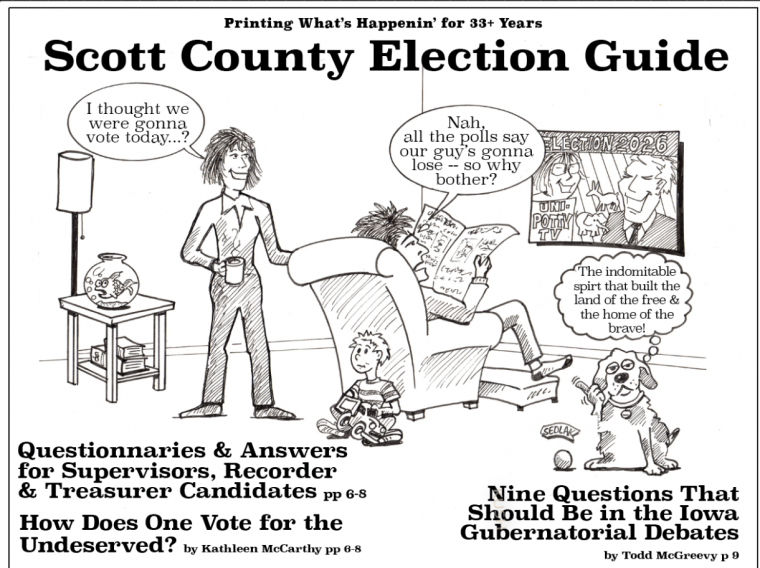
Cartoon by George Sedlak copyright 2026
My frustration with the looming 2026 midterm election is that so few candidates, whether incumbents or challengers, deserve my vote. Most incumbent career politicians stopped representing voting constituencies long ago. Newbie challengers hit the ground running in place, relegated to the fringe and saddled with newbie duties, such as marathon fund raising for their respective parties – duties deliberately designed to distract away from the serious business occurring elsewhere.
2026 Scott County, Iowa Election Guide Articles:
Three Topics for Scott County Supervisor 2026 Election Candidates
Two Topics for Scott County Recorder Candidates: No Appointment Necessary? and Mortgage Fraud Protection
Three Topics for 2026 Scott County Treasurer Election Candidates: By Appointment Only?, Paul Revere Square vs County Store, Public Hours
Meanwhile, serious voters can't forget the confidence factor relative to election results circling the drain. Many are keenly aware of the the five-year media blackout on the widespread election fraud being litigated around the country, especially in Georgia, Michigan, and Nevada.
Controversy still abounds relative to mail-in (sent without request)/absentee (sent upon request) ballots in general, let alone these ballots being counted after elections close and/or beyond any extended deadline. To further aggravate the matter, deliberately insufficient comparisons of signatures on the mail-in/absentee ballots with original signatures available in the Voter Registration Database mocked acceptable verifications.
Another huge gap in election security is the discovery that unlawful internet connectivity for electronic poll books and ballot tabulators permitted offsite access by anyone with either credentials or a beginner's knowledge of logins. By enabling Wifi connectivity, the elections system itself is entirely compromised by any standards. This is made exponentially worse because no one but the election system vendor is allowed to access the system to examine the software activity to see if outside access has occurred. Such undetectable access for election systems is a feature, not a bug.
In addition, the chain of custody for election results is squishy as its protocol is classified from public disclosure. What is known is that election results are either recorded to a thumb drive and transported by law enforcement to an unknown destination deep in the forest, or electronically transferred via a dedicated device that is “air-gapped” for secure electronic transfers that take place in a secure, thrice locked room 34 floors beneath the basement's foundation, accessible using a high speed elevator that glows when summoned by a remote device that is activated by speaking a secret language known only to the holder of “the key.”
But the unresolvable red flag is our Secretary of State farming out the management of our state's elections, otherwise under the purview of county auditors and staff, to a private vendor that hoards the system, claiming proprietary rights and blocking any inspection, authentication, etc, to deliver secure, accurate, and fair elections. Prohibiting election officials from accessing the vendor's election systems' hardware and software, even though it is physically purchased with tax dollars – ergo, by rights, should be ours to inspect and dissect at will.
Is it not a whole new level of absurdity that something as important as election management is, for all practical purposes, off limits to Secretaries of State, county auditors, and relevant election and IT personnel? It could arguably be considered one big plausible deniability scheme.
Which leads to the logical conclusion that, going forward, proving that election fraud occurred or that the system is vulnerable due to detectable anomalies is no longer the public's burden. How can it be when it is not allowed to inspect and collect the requisite evidence?
Instead, proving that the election system provides secure accurate reliable and fair election results necessarily becomes the burden of the vendor precisely because no other party/user but the vendor is permitted access to the equipment and code.
The potential for manipulation of election outcomes is greatest when eligible registered voters don't cast ballots during elections. This is because the number of falsified ballots needed for the desired winner to overcome cast ballots for other candidates is much less. But such an unworthy cheater is ipso facto marginal, deceitful, with no intention or obligation to represent the popular sovereign as guaranteed by the U.S. Constitution.
I sometimes wonder how often Democrats masquerade as Republicans, and visa versa, to get elected and join their comrades, working covertly to advance hidden agendas that the majority of voters oppose? This explains a lot of legislation that gets passed by elected Conservatives that is antithesis to Conservatism and visa versa, legislation gets passed by elected Liberals that is antithesis to Liberalism.
Once elected, politicians' allegiances are largely to their own largest campaign contributors, and to their Party's largest donors, inevitably ignoring the interests of their constituencies. Yet every election, Americans go through the same performative motions, picking a side and voting in a hollow effort to check the good citizenship box.
My question is: How are we any better than the derelict politicians we support/oppose? Can we honestly expect any politician to robustly represent us when our individual grasp of governance is shockingly limited, uninformed, with precious little participation on any level other than periodic elections.
Make no mistake: Americans' lack of participation is interpreted by leadership as timidity, insecurity, and mostly indifference. Both politicians and bureaucrats take full advantage of our civic weakness and sloth, some understandably bearing real contempt for our abdication as America's sovereign authority, constitutionally guaranteed as a Republican form of government via Article IV, Section 4.
“Labor respects what management inspects” is an old union meme that proves itself perfectly relative to politics.
Politicians marginalize constituents because they can, rarely suffering consequences for such dereliction thanks to the dominate two-political-parties trap that almost always guarantees reelection. Meanwhile, politicians play the campaign game, casting “promise” spells that are broken upon election/reelection, after which these faux representatives gets busy enriching themselves and their preferred tribes.
If the American people are the ultimate governing authority guaranteed by the U.S. Constitution, how can voters and taxpayers, who enable leadership's adverse conduct to begin with, remedy the same? What exactly is a Republican form of Government?
The U.S. Constitution Article IV, Section 4 guarantees to every state a “Republican form of Government, which means a government in which political power rests with the people, also called popular sovereignty. The sovereigns, the body of people of the United States, govern via elected representatives rather than direct rule. Article IV, Section 4 as follows: “the United States shall guarantee to every State in this Union a Republican Form of Government, and shall protect each of them against Invasion; and on Application of the Legislature, or of the Executive (when the Legislature cannot be convened) against domestic Violence.”
Law.cornell.edu/constitution-conan/article-4/section-4/meaning-of-a-republican-form-of-government
Since the founding of America, and signing of the Declaration and U.S. Constitution, a steady usurpation of the Constitution by enacting Administrative Law using an unconstitutional 'emergency declaration' titled the “Continuity of Government (COG).” I've written about COG in the not too distant past.
COG claims an emergency declaration can provide for the suspension of the U.S. Constitution, meaning the suspension of Americans' constitutionally protected natural rights. However, the U.S. Constitution is the founding law of the land and no administrative statute, declaration or doctrine has the requisite authority to suspend any part of it. That would require a constitutional amendment that must be ratified by a super majority of Americans in a minimum of 38 states.
Administrative Law is increasingly progressive, stepping all over Americans' constitutionally protected rights. Lawfare usually runs in tandem with these administrative usurpations, therefore constitutional challenges will have to eventually prevail to permanently put Lawfare back on the shelf where it belongs.
For my part, progressivism is not exclusively the realm of Democrats. Many Republicans are equally progressive. Whether Democrat or Republican, progressivism is more tactical for achieving political goals, regardless of the governing model. There is no question it creates inherent incompatible hurdles for both Classical Conservatism and Liberalism, most critically, Progressives' priorities in group dynamics over individual primacy.
A Brief Observation Regarding Iowa's Republican Gubernatorial Candidate Zach Lahn
My frustration with the midterm elections, and this issue's particular musing thus far, is a preamble for my observations about the Republican candidate for Iowa's next Governor, Zach Lahn. It is important to note that the Reader is in its 34th year of publishing, and I can count on one hand the number of candidates I have supported in print since 1993.
That said, I do support Zach Lahn's candidacy because his positions mirror mine relative to vital issues facing Iowa. Before I list them, I want to clarify malinformation coming from Zach's Democrat opponent, Rob Sand, relative to Zach's residency.
Zach lives in Iowa. He repurchased his grandparents' farm in 2014, including the house his grandfather built that Zach restored and, in which, now resides. Zach has a blended family with his wife Annie and their seven children, for whom they are bound by a co-parenting agreement that requires their presence in Kansas.
If elected, Zach will easily adapt, especially with the support of all involved. Perhaps more notable is that the co-parenting agreement reflects demonstrably committed parents to their children's best interests.
I recently watched Rob Sand's various town halls. He is a bit of a maverick, claims the two-party political system is a means to control us, and thinks Iowa's problems can be solved with greater collaboration from both sides of the aisle. I certainly concur with all of that. Rob's confidence and seemingly easy manner made him likable.
That is why it is disappointing that Rob's campaign continues to disinform Iowa voters that Zach doesn't live in Iowa – that he resides in Kansas, but if elected, intends to fly himself from Kansas to govern Iowa as conditions permit. Rob's claim is patently inaccurate and therefore the kind of distortion that is damaging … except that Zach does fly airplanes, is an accomplished legacy pilot, taught at an early age by his war-hero grandfather.
It occurs to me that, especially as Iowa's Auditor, if Rob believed Zach lived somewhere other than Iowa, why would he not just file a challenge to Zach's candidacy as a nonresident? I have to say, for a billionaire-by-betrothal, Rob's gossip in Zach's case is just not classy.
Back to Iowa's issues that resonate with me and with Zach Lahn, Iowa's Republican Gubernatorial candidate, according to his various interviews and his featured speech at this year's Scott County Reagan Dinner.
The first is a potential transition to regenerative farming for productively and profitably growing healthy food crops. The added benefit would be to naturally restore Iowa's nutrient rich soil, while simultaneously restoring clean water throughout Iowa's aquifers, streams and rivers with the reduction of forever chemicals, pesticides, fertilizers, and especially glysophate.
Most of these poisons travel from our farms through our natural resources via runoff, compromising surrounding natural resources and wildlife, including Iowa's grand and glorious Oak trees, considered the Midwest's keystone tree.
The overall process, equipment and inputs, for the predominate corn crops grown in Iowa for Ethanol and animal feed is largely captured by Big AG. Mandated inputs include pesticides, herbicides, fertilizers full of nitrates, and Glysophate, a highly toxic known carcinogen unfit for human and animal consumption. Seed inputs are limited to just two suppliers, diminishing choice and reduced price opportunities.
Finally, these chemicals' continued proliferation in Iowa is almost certainly contributing to the stunningly high rate (70 percent) of new cancers in Iowans. As such, Iowa requires a governor whose allegiance is first to Iowans health, in tandem with healthful food products, clean air, clean water, clean soil, and equally healthy trees, natural resources, and critters.
Big AG is comprised of unyielding (pun intended) anti-trust adverse oligarchs, and no longer physically sustainable for Iowans, or humanity, for that matter. For Iowans to thrive going forward, new and innovative AG processes must emerge. Iowa's economy is highly simpatico with agriculture, deserves factful problem solving science and ingenuity that safely and productively serves both humans' and animals' health profitably. Farming cannot continue to be the binary choice that it is currently.
Hopefully, this renewed approach will position young people to retain their family farms and continue the tradition of farming and ranching, along with potential assistance via programs backstopped by Iowans in the spirit of collaboration and support for the singular economic effort of farming that defines so much of our heritage.
Education in Iowa needs an urgent overhaul. Full spectrum reform in K-12 curricula, with a return to a bona fide conveyance of history, American Civics with a grounding in our constitutionally protected natural rights, Individual Primacy Doctrine, Due Process underpinned by the Presumption of Innocence Doctrine and Equal Justice, comprehensive geography, STEM, reading with a special emphasis on fiction to create new neuro-pathways, writing skills for thought organization, articulation, and communication, critical thinking and problem solving, and functional money/finance. In other words, essential fundamentals to navigate and eventually compete in job markets amid an increasingly technical world.
Recommitting to the primacy of private property ownership, constitutional protections of natural rights, popular sovereignty expressed in the three superpowers of the individual – power of the vote, power of the purse, and power of the jury. And the nonnegotiable principle/value to do no harm to others or their property. Simple, easy to remember.
Anti-trust laws need to be updated if necessary, but certainly renewed enforcement to restore competition in economic activity where prudent. Monopolies and oligopolies are the antithesis to true capitalism, which requires true competition for a successful socioeconomic model. Advantaging one company while disadvantaging another, whether thru government subsidies for just one, or special loan terms for one but polar opposite for the other, are quintessential examples of corruption of the capitalism model.
Fair opportunities based on sound criteria could reliably serve smaller family farms, who need affordable solutions to compete at smaller scale, whose products local consumers crave in increasing numbers. In addition, the elimination of legislative immunity that shelters Big AG et al from liability for harm caused by their products' use could also change the calculation for how it does business in the future.
Zach talks about our personal histories, our individual stories that connect us through time to our ancestors and their accomplishments, sacrifices, all the unique characteristics and qualities that contribute to our personal legacies. Collectively, our stories form cultural values, social cohesion, and if sustained, peace and strong family continuity and sense of belonging that we, in turn, pass along.
To conclude, Zach Lahn is a deeper thinker than I am accustomed to in politicians. It is refreshing, and perhaps endows him with a larger capacity to see more of the field (pun intended again), and hopefully to choose humanely versus expeditiously. Such choices are hard, but to have them at all is the greatest of God's Blessings.
Another Honey Badger Reveal! Former Supervisor Diane Holst Continues to Hold Scott County Auditor Accountable for Answers
On October 6, 2026 at the Scott County Board of Supervisors' Committte of the Whole meeing, Scott County Auditor Kerry Tompkins requested that the board approve a $1 million purchase consisting of voting equipment upgrades, which are really all-new replacement machines consisting of 80 ES&S DS300 tabulators and 90 ES&S Express Vote voting machines for handicapped voters purchased in 2017.
However, as former Supervisor Diane Holst pointed out in her remarks about this agenda item, this request was presented to the SCBS by Tompkins with no competitive bids, nor persuasive evidence that savings would occur by sticking with ES&S, but postponing the purchase of two additional ES&S DS450 large tabulators used in central counting during elections.
You can watch the meeting at this link here, and Holst's observations and recommendations are within the meeting's first few minutes.
Auditor Tompkins proposal and request information about the $1,000,000+ expense is avaialble here.
The Board voted to postpone the entire purchase, finding a lack of relevant information, including comparative pricing and rationale for the timing of purchases. Supervisor Maria Bribriesco, pleased with former Supervisor Holst's questions for Auditor Tompkins, and realizing that more information was necessary before approving this million dollar purchase, “ I don't like getting into these sole sourcing purchasing scenarios” was the gist of her of understandable comment on this subject.
Especially as it relates to a purchase involving voting equipment in the current political atmosphere. “My suggestion today, put all equipment out for bid. The public expects a purchase of this size to be competitively bid,” advice wisely proffered by Holst relative to this substantial purchase, hopefully for an opportunity to coax more competitive pricing in the bargain.
ES&S is listed among the vendors of election equipment, all of whom require more thorough evaluations by voters nationwide, many of whom are still coming to terms with election integrity issues. Diane Holst's prepared remarks she read into the record at this meeting are published below, unedited.
Diane Holst's Comments to the Committee of the Whole Scott County Board of Supervisors October 6, 2026
"My comments are regarding Item 7, purchase of election equipment.
There is no explanation in the letter we have to explain where the compatibility issue lies. When the justification is, and I quote, “to ensure all the machines will continue to be compatible it is necessary to purchase these machines through ES&S”. How does this justification provide an exception to the bid process for this million plus purchase?
Replacing the two DS450 machines was covered in the budget. Is this a self-inflicted compatibility issue created by not replacing those 2 scanners in this cycle? One might consider it convenient that ES&S would happen to share a tidbit promised two years down the road and lock in the purchase of 80 scanners 90 Express Vote without competitive bids.
This starts a perpetual loop with this vendor when equipment or software is out of sync in a purchasing cycle, with compatibility requiring we stay with the company. I experienced proprietary capture when I was on the board, and I’m sure you have.
How can you make the statement that purchasing the new equipment through ES&S will minimize cost? You did not put the purchase out for bid. Delaying the purchase of two scanners for 2 years does not minimizing the cost, it postpones it.
Quoting again, “Therefore, separate bids are not provided”. You all, and the public, at a minimum would expect a quote and a draft of the contract to be included today.
So my tip for two years down the road, perhaps ES&S or the other vendors approved by the state will achieve the VVSB 2.0 certification standard that was set in 2021, and we’ll have the improved cybersecurity it offers and of most importance, the 2.0 standard that the vendor’s source code must no longer be proprietary.
Certified Voting Systems | U.S. Election Assistance Commission
My suggestion today, put all equipment out for bid. The public expects a purchase of this size to be competitively bid.
Or, delay the entire purchase for two years when your life expectance of the 450’s is reached and put all of the equipment out for bid.
Fyi, the DS300 is not currently included on the SOS’s site of approved voting systems"