
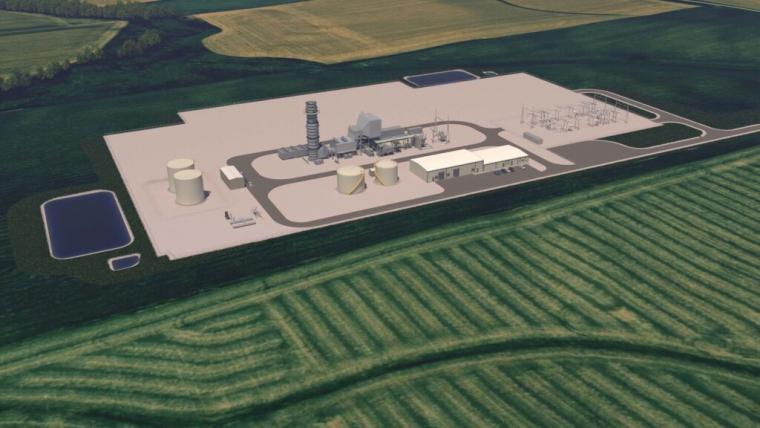
Maysville Iowa Central Iowa Power Cooperative Plant Rendering
Here we are again, a decade later, fighting for the preservation of Scott County's exceptional land, with its rich soil, as farmland in perpetuity (and that of Iowa at large), especially due to its 100 rating as the best soil in the world for food production. We learned this a decade ago when a fertilizer plant from India was trying to bulldoze its way onto Scott County land zoned as Agriculture Preservation that disallowed such a worse-use project.
So naturally, a variance was given by disrepresentatives, including self-defined gentleman farmer Tony Knobbe, then a Scott County Supervisor, who voted to change the zoning where the plant wanted to locate. Supervisor Knobbe and his ilk's ill-advised support of such an inappropriate land-use project in spite of well-represented opposition is quintessential disrepresentation.
Now comes Iowa energy supplier Central Iowa Power Cooperative (CIPC), a provider of electricity via the use of wind, solar, and now a second natural gas facility, because wind and solar can't keep up with energy requirements to meet electricity demand in the area they operate.
A definite rub is that CIPC does not provide electricity to Scott County, this is MidAmerican Energy's turf. Yet CIPC wants to put a natural gas operation here, on farmland zoned agriculture requiring yet another zoning variance for the project to proceed and bulldoze soil perfection, acknowledged and respected worldwide.
We also learned a decade ago that there is only approximately 30-35 percent arable land across the entire planet Earth. That alone makes every inch of Scott County's productive soil a precious asset and worth preserving at any cost. I keep believing that if Scott Countians knew how valuable our farmland truly is, they would rally together, demanding its nonnegotiable preservation. This belief somehow still extends to elected Scott Countians, who otherwise consistently disappoint when it comes to approving economic development projects they claim will increase the County's property tax coffers.
Except that rarely happens either, largely due to lucrative tax exemptions, tax credits, even cash incentives offered to lure economic developers here. It's really another form of “pay to play” in reverse, therefore hardly in the interest of Scott Countians at large, because it does not increase the property tax base anytime soon. By the time the generous incentives expire, usually 20 years minimum, the property’s value is greatly depleted. Nor do the recipients of these development incentives produce the number of permanent high-paying jobs always projected but rarely realized. Yet there is never any clawback penalty for that pesky-but-substantial broken promise.
Furthermore, promises made by developers for ancillary projects to increase property values or at least greater amenities, for the nearby rural townships to offset the natural decline in property values due to an industrial operation in their backyards, rarely comes to fruition, either. Its almost always “all hat and no cattle” posturing. The neighboring residents who will be directly impacted by the project are not invited to the table during negotiations/planning. Yet while residents are shut out of the process, except for the State-required public hearings, where CIPC men, representatives from the Iowa Utilities Commission (IUC), lawyers, contractors, and politicians show up in numbers to match any objectors, whose peace and quiet enjoyment of place will potentially be upended.
For my part, I prefer natural gas, so a spanky new modern facility, to backstop the consistent lack of renewable wind and solar energy, is necessary wherever attempts to replace fossil fuel and nuclear energy have ensued, especially since natural gas is clean energy in and of itself.
Wind energy production has proven not only as unreliable as solar, it has a vastly greater carbon footprint relative to the associated processes for wind production. More importantly, it has devastating consequences to innocents, such as dangerous and cruel harm to critters, birds, and sea creatures; unhealthy levels of noise pollution; requires another nonrenewable energy source to start the extremely heavy blades turning; and is a distasteful, cold, incongruous landscape against otherwise natural, pristine vistas of farmland, mountain views, ocean and river views.
In addition to the above, wind energy creates a monumental scourge of non-recyclable, non-biodegradable, mega-heavy dangerous blades, whose edges fray quickly with use thus shortening blades' productive life. This has created unjustifiable cost increases that can only realistically be overcome via government subsidies since the increased cost is too high to pass on to consumers.
To further pile on, the used frayed blades are already creating an unsustainable refuse dilemma due to their unwieldy size and extreme weight. So much for the promised efficiencies of at least one of the two renewable energy sources the US has bet the farm on – literally!
In the case of CIPC's proposed natural gas plant, the land it is negotiating for is practically on top of the recently installed CO2 pipeline for easy on/off ramping for transport and the modern upgraded communication lines running underground though Iowa. While I appreciate the convenience to CIPC in terms of both construction and operating costs, it does not justify plowing the world's best soil under for the benefit of an operation that we are told is only going to operate 20 percent of the time, with a standby capacity that tops out at 40 percent in an emergency.
First, define “emergency.” Second what is the state's process to increase both CIPC's operation percentage and its emergency use? Ding ding ding, winner winner chicken dinner! Could it be to providing energy to one of the new data centers being proposed nearby?
And this is the real reason CIPC is courting Scott County: location location location. That pipeline and transmission line(s) are critical to be competitive in the near future. Governor Reynolds acknowledged she wants to prioritize attracting data center business to Iowa … as she walks out the door on the heels of signing legislation allowing eminent domain for such projects. Again classic disrepresentation. No Iowan property owner supports eminent domain, especially for a private economic use. It is unconstitutional and yet again, classic disrepresentation. It is important to learn which Iowa legislators voted in favor of this, a statute that advances the interests of a few over those of Iowans et al.
Is this some newly minted version of democracy?
To confirm this speculation that data centers are driving the energy bus in Iowa, one only has to look through the bills afoot in the Iowa legislature. There are all kinds of specific legislation to remove development obstacles, eminent domain (HF2104); address energy issues (HSB630) (HF2620) (HF843) (SSB3181) (HF2702);; transmission and pipe lines (HF2227) (SF2067) (SF2069); new tax incentives for such development (HF2688, SF2498), new authorities for agencies like the IUC (HSB755) (HF2229); and most important bills to accelerate water issues that accrue specifically to data centers (HF2687).
More details about the huge number of myriad relative bills is forthcoming, but it is critical that Scott Countians and Iowans at large avail themselves to the Iowa legislative website because these bills are only a fraction of what is afoot, but these energy and data center related bills are moving quietly but quickly through both the Senate and the House, and the only leverage we have is the upcoming midterm election. But we better be about all cattle and screw the hat.
P.S.: There are bills unrelated to energy and data centers that are equally critical, even chilling, and require voters' immediate attention. Learn things, because knowledge is real power in these circumstances, and precisely how you hold elected representatives accountable. Savvy?