
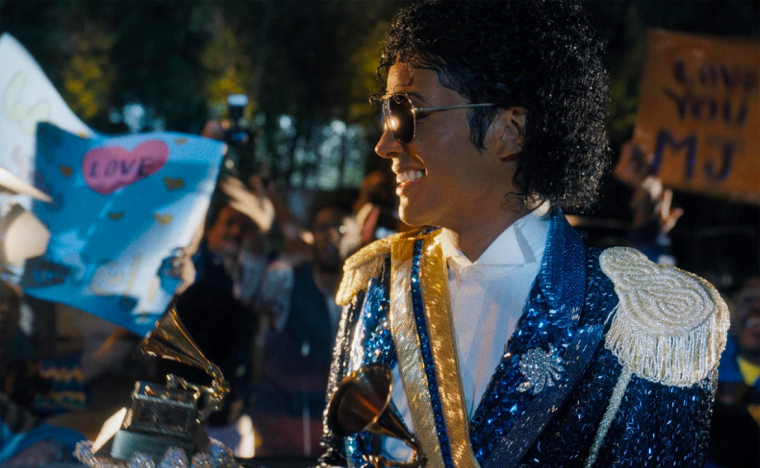
Jaafar Jackson in Michael
MICHAEL
In their coverage of director Antoine Fuqua's Michael Jackson bio-pic Michael, a number of reviewers have pinpointed one line as particularly instructive. It lands early in the 127-minute movie, when the titular dynamo is 10, and told by Motown president Berry Gordy to claim he's only eight – a fib that, for the media, will augment Jackson's impressiveness. “In this business,” says Gordy, “you can make up just about anything.”
Those words are resonant, to be sure. They would no doubt have been more so had the movie kept its initially planned, and actually shot, framing device involving the 1993 sexual-abuse allegations against the singer. (With the film produced, in part, by members of Jackson's estate who continue to profit from their relative's catalog, it's easy to imagine Gordy's sentiment being employed to imply Michael's innocence from the start.) Yet I think there's another line, or rather a lyric, that more fully encapsulates what Fuqua's and screenwriter John Logan's screen tribute is about, and it's found in Jackson's 1983 smash “Billie Jean”: “And be careful of what you do / 'Cause the lie becomes the truth.”
Even though, after reportedly massive and expensive re-shoots, the movie now opens and closes with the Wembley Stadium concert on Jackson's triumphant Bad tour, no one could have legitimately anticipated a warts-and-all telling of the superstar's life and times through 1988. Michael is pure hagiography, which is just what its trailers indicated, and likely just what its target audience of Jackson fanatics wanted. (The film grossed $217 million globally on its opening weekend.) And honestly? I'm okay with that. By which I mean I'm at peace with it, having long ago stopped hoping that earnest bio-musicals wouldn't be inherently indistinguishable from Walk Hard: The Dewey Cox Story. We know these things will play fast and loose with the facts, and follow the traditional rags-to-riches blueprint, and either glide over or wholly ignore thorny issues that might derail the artists' “inspirational” sagas. So long as the songs and their presentation are great, who cares? Don't Jackson devotees deserve a Bohemian Rhapsody of their own? (As Michael is pure bio-bic formula bookended by Wembley and with BoRhap's Graham King among its producers, they're almost literally getting a Bohemian Rhapsody of their own.)

For the record, the concert and music-video segments here are, for the most part, genuinely thrilling, and if lead Jaafar Jackson (Jermaine's son and Michael's nephew) does nothing else in his nascent career, this first film venture will be enough to make him a mini-legend. The man's dance moves are astonishing. If, like me, you were fortunate enough to see Michael Jackson's historic performance of “Billie Jean” on the original 1983 airing of Motown 25: Yesterday, Today, Forever, you probably thought you'd never again see moves like that in your lifetime. Jaafar Jackson recreates them flawlessly – or at least appears to, considering the overly antsy editing. But Jaafar is phenomenal whenever Fuqua just lets the guy dance: in a parking-garage workshop rehearsal for “Beat It”; filming the “Thriller” video; absolutely killing Bad's title song at Wembley (despite way too many cutaways to the crowd's shrieking, fainting fans). As for the singing, I'm not sure how much of it is actually Jaafar; as with Austin Butler's Elvis crooning, the Michael songs are apparently some blend of the lead's own vocals and the genuine article's. It's a mixing process I won't pretend to understand, but it sounded like Michael to me.
Talent this evident and copious is enough for two-hours-and-change at the cineplex, and if screen novice Jaafar is less persuasive as an actor than he is an entertainer, that's hardly something to carp about. With his lilting, falsetto line deliveries and demonstrably timid physicality (except when on stage), he's believable enough as his uncle in Logan's “book scenes.” Besides, the musical sequences are so exhilarating that you can practically block the rest of the movie from memory. At the very least, you should. When Michael focuses on the music, it's frequently sublime. When it doesn't, Fuqua's latest is almost painfully terrible, both for what it shows and what it chooses not to. And if any of the film's purpose involved humanizing its subject – convincing post-Gen-Xers that Jackson was more than a tabloid stable and unparalleled weirdo – I'm sorry to say: mission not accomplished. If anything, this estate-approved biography makes the pre-1988 artist look even odder than he perhaps was.
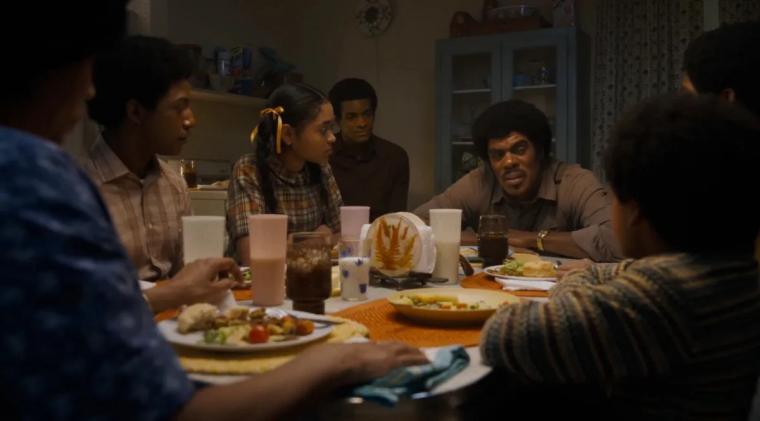
John Logan is a fiercely gifted Tony Award winner and three-time Oscar nominee, so I'm choosing to believe his script's awfulness is based more on decisions made in the editing room (or subjects deemed inappropriate from on high) than lousy writing. But almost nothing makes sense here. Ten-year-old Michael (a terrific, spirited Juliana Krue Valdi) talks about not having flesh-and-blood friends because other kids treat him differently, which purportedly explains why his only “friends,” from childhood on, are fictional characters, pets, and unseen fans. Yet this is hearsay: The movie doesn't provide even one scene of Michael, child or adult, interacting with anyone who isn't a family member or business acquaintance. Couldn't we have been given some insight into how others behaved in his presence, which might've made Jackson's neuroses more comprehensible? It's to be taken as a given that his angry, controlling dad Joe Jackson (Colman Domingo, doing a lot with very little) deprived Michael a childhood. Yet that alone can't rationalize an emotional development so stunted that the closest Michael gets to grown-up R&R involves snuggling on the couch watching movies with his mom (a desperately ill-used Nia Long), or explain why Michael is confused and hurt when his adult siblings won't join him in a game of Twister. (Those siblings, by the way, don't include Janet, Randy, and Rebbie Jackson, who refused to participate in the movie and have subsequently been erased from this biography entirely.)
In truth, just about everything regarding the Jackson clan reads as confounding, and almost none of the confusion has to do with factual liberties taken; the family dynamics don't cohere even on the film's own omission-filled terms. We see Joe wallop little Michael with a belt, a punishment he seems eager to continue into his son's adulthood. (Whether he does hit him after Michael turns 18 isn't disclosed.) Did Joe's other children suffer such abuse? Did his wife, who doesn't make a move, or a sound, to prevent her husband from smacking Michael? And what's with the kids' living situations after they've grown? Do they, as the film suggests, continue to live on the Jacksons' Encino estate? (When Michael introduces the clan to his pet chimpanzee Bubbles, played here by an unconvincing CGI replicant, the siblings tumble out of the house en masse, like they were waiting in the doorway for their brother to return.) And did any of Michael's sibs, especially those formerly in the Jackson 5, at all resent their brother's staggering success? It's bad enough that the movie doesn't bother to differentiate Jackie, Tito, Jermaine, and Marlon (LaToya is at least recognizable as the only female child), but could they possibly have all been this one-dimensionally supportive? Michael's Michael is so wholly innocent and blameless that, aside from the cartoon villain Joe Jackson, he even neuters the personalities of those in his periphery.
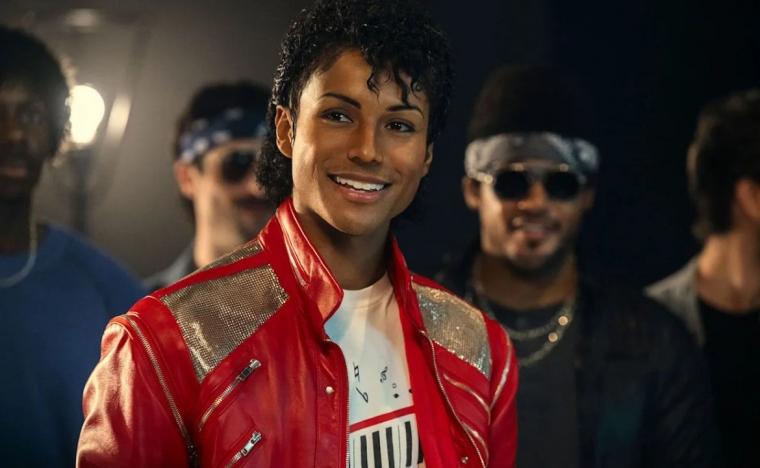
Equally problematic is the movie's approach to Michael's artistic genius. Again, given the genre, this isn't surprising; bio-musicals are notoriously awful, or perhaps simply lazy, about showing greatness at work. But surely Logan could have come up with more clever demonstrations of Jackson's light-bulb inspirations. A news segment on L.A. Crips-v-Bloods warfare leads directly to “Beat It.” A late-night horror movie leads directly to “Thriller.” Barring the welcome “Beat It” rehearsal improvisations and the scratching out of a few random song lyrics, we're deprived the pleasure of watching Michael Jackson compose his masterpieces, and a bunch of stories we're dying to be told aren't, or are handled through ridiculously easy fixes. Did anyone at Epic Records have a problem with “Billie Jean” and its tale of a Baby Daddy who refuses to recognize his infant as his own? Could MTV's notorious exclusion of Black artists from its rotation possibly have been amended, as presented here, with one simple phone call? Did the ensemble kick of “Thriller” really come about through Michael, in an aside to a P.A., whispering that director John Landis should make sure to include the dancers' feet in his shots?
While it's bypassing all aspects of Jackson's pre-1988 life that are even remotely complicated, Michael works overtime in recognizing its subject as a saint. Michael brings toys to young cancer sufferers, who beam with gratitude alongside their parents. He responds to the horrific Pepsi-commercial conflagration that set his scalp on fire by vowing to make the world a better place (and donating the lawsuit proceeds to young burn victims). He kisses his pet llama on the face. And even when Michael makes his long-awaited stand against his greedy, manipulative father, he does it in the gentlest way imaginable: on stage, in front of cheering thousands, from 40 feet away. He's like Jesus without the nuance. At best, the nods to Jackson's tabloid issues – the routine plastic surgeries, the painkiller addictions – are blithely referred to in “If you know, you know” terms; a bandage on Michael's nose is all the evidence we get that he's had work done yet again. But without full disclosure on Jackson's '80s activities, much of what we see winds up incomprehensible. When Joe forcefully tells his youngest that he booked the Jackson family in a lengthy tour the star doesn't want to participate in, Jaafar Jackson's expression is stoic, unreadable. Is that because Michael felt nothing? Because he refused to let Joe see emotion? Because the artist was so far into his enhancements that, as ultimately became evident, he was no longer capable of genuine facial expressions?
Not all of the off-stage moments are demoralizing. Larenz Tate is excellent as Berry Gordy, Deon Cole is briefly divine as Don King, and Colman Domingo, although saddled with an overabundance of prosthetics, saves one scene after another through sheer wit and performance power. (As is the case with most of the cast, Domingo is at his finest here when not required to speak, and he reacts to Michael's increasing eccentricities – and, in the actor's grandest non-verbal bit, the discovery of Michael's first new nose – with pricelessly aghast incredulity.) Despite its electrifying renditions of Jackson's repertoire, however, I left Michael more bummed than elated. If you love Michael Jackson, I get it. If you can't stand him, I get that, too. Fuqua's film ultimately fails because, no matter how you view its subject, it refuses to see him as human. It appears infinitely more invested in making a lie become the truth.
I SWEAR
I feel a bit hypocritical admitting that I enjoyed the British dramedy I Swear while being largely disappointed with Michael, because unexpectedly and weirdly, they're kind of the same movie. Both employ a “present-day” (though actually period) framing device in which most of the events unfurl in flashback. Both are two-hour bio-pics whose adult protagonists are played by younger actors in their opening half-hours. Both protagonists suffer from either psychosomatic or medically legitimate challenges that curtail their exposure to the public. Both scripts take enormous liberties with factual record. Both are designed to be triumphant, inspirational celebrations of individuality. But only one them boasts a hero prone to shouting “F--k!” and “C--k!” and “C--t!” at top volume. Guess which one.
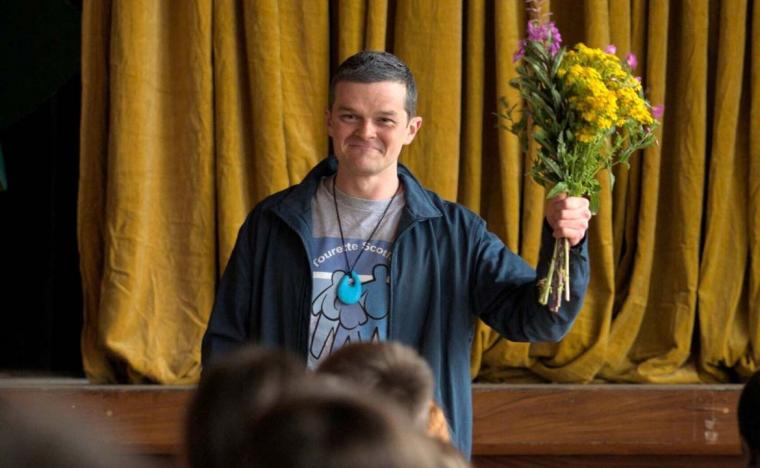
Okay, I'll tell you. It's I Swear, writer/director Kirk Jones' screen biography on John Davidson, a Scottish activist with severe Tourette syndrome who has spent decades helping others understand the motor disorder. If the film's title or Davidson's name is prompting a “Hmmm … that's ringing a bell …” response, it's likely because of a truly unfortunate recent incident. While presenting a trophy at February's BAFTA Awards in England, Sinners' Michael B. Jordan and Delroy Lindo were verbally (involuntarily) accosted by Davidson, who shouted a hate slur at the co-stars from his seat in the auditorium – a slur that, bizarrely and regrettably, the BBC didn't edit from its broadcast of the event. Davidson made an anguished public apology, the BBC made a more corporate one, and the film about the man, which won statuettes for casting and lead actor Robert Aramayo, now seems destined to be remembered only as the movie that caused all that BAFTA ruckus in 2026. Hopefully, though, the extraordinary portrayals of Aramayo and his younger counterpart Scott Ellis Watson will ensure that the movie enjoys a lifespan beyond the outrage.

As played by Watson, Davidson is initially a prototypical male adolescent – he likes sports, he likes girls, he likes rock music – until, newly in high school, he begins to experience unusual physical tics, his head jutting out with spasmodic irregularity, along with random outbursts of uncontrollable cursing. His teachers and fellow students think he's faking it. His family, including parents played by Steven Cree and the great Shirley Henderson, think he's faking it. But not long after Dad leaves the house and Mom forces her son to eat his meals sitting in front of the fireplace, as he'll leave less residue when food involuntarily shoots from his mouth, John is diagnosed with Tourette's, which no one in Scotland, or anywhere in 1983, adequately understands. I Swear is consequently Davidson's triumph-of-the-underdog saga, tracing his trajectory from abused (and verbally abusing) youth to more contented adult, with Aramayo's John still enduring more than his share of pitfalls before and after being awarded an MBE (Most Excellent Order of the British Empire) by Elizabeth II. She kindly chooses to forgive him, or perhaps simply ignore him, when her bestowal of the honor is proceeded by middle-aged John shouting “F--k the Queen!” at the ceremony.
There's quite a bit to be offended by in I Swear, and almost none of it is the profanity. Because Jones' film follows the bio-pic template to a T, Davidson has to endure a lot of depressingly repetitive hardships – uplift/downfall, uplift/downfall – before finally agreeing to Love Himself and Be the Man He Was Meant to Be. Trouble is, in that pesky universe known as Real Life, the actual John Davidson did have that epiphany, and awfully early: He was the subject of a famed 1989 BBC documentary, John's Not Mad, when he was 16, by which point he was already educating the public on Tourette's. He subsequently appeared in roughly a half-dozen additional docs on his condition prior to I Swear, and has spent most of his adult life as a well-known advocate for widespread understanding of the malady. As referenced repeatedly in my Michael review, I get that bio-pics fudge the facts. But why fudge these facts? Isn't a 16-year-old who goes on television to not only explain but demonstrate his Tourette syndrome more inherently moving, more interesting, than the manufactured bio-pic clichés Jones provides?
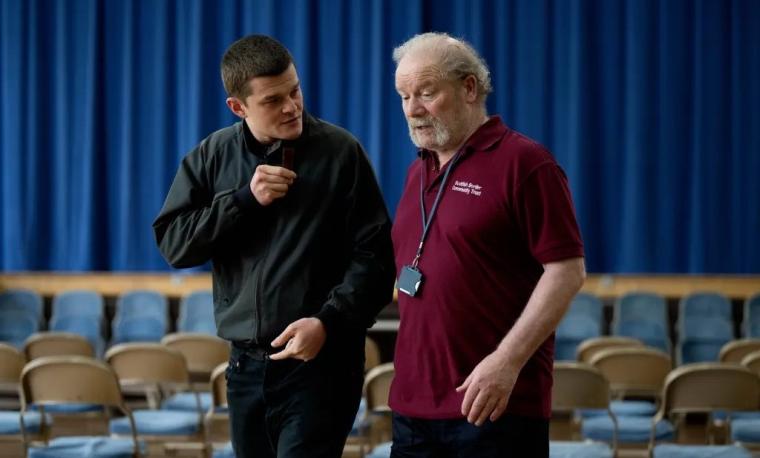
As is also typical, and irritating, with bio-pics, Jones seems to sand down the rough edges wherever possible. Yes, it's commendable that he includes some of Davidson's more virulent verbal offenses, as when he assails eventual benefactor Dottie Achenbach (a lovely, if too-sweet-to-be-believed, Maxine Peake) with his knowledge of her terminal-cancer diagnosis. But in I Swear, as in Michael, there are no gray areas in the storytelling. Characters are either unremittingly kind or inarguably cruel – or, in poor Henderson's case, so bafflingly conceived that they may as well not factor in at all. Yet I still enjoyed I Swear a lot, partly because, on technical levels, Aramayo and Watson are giving rough performance equivalents of what Oscar winners Daniel Day-Lewis and Geoffrey Rush did, respectively, in My Left Foot and Shine. But also because Jones, as Davidson himself does, gets the inherent and sometimes ugly humor in Tourette syndrome, yet never employs the condition solely for laughs. Davidson's outbursts here are shocking – sometimes achingly so. But they're human, and affecting, and nearly always unexpected, and that makes this bio-pic something that its fellow genre outings almost never are: surprising.
I don't tend to audibly gasp at the movies; after so many decades, this job does lead to desensitization. But I honest-to-God yelped at more than a couple of Davidson's involuntary physical spasms – particularly the one that sent Dottie reeling in a grocery store – and instinctively cackled at a few of John's outbursts that were so heinous I immediately hated myself for laughing. Jones understands that this is part and parcel when dealing with Tourette's, even as an audience member exposed to the subject, and the film is refreshingly clear-headed about the dichotomy of feelings it evinces. You can expect to expect anything, and in agreeing to do so, and agreeing that it's okay if you occasionally laugh, it makes the condition less foreign, less inherently incomprehensible. In that grocery-store incident with Dottie, the woman is reminded that she should never walk on John's right, as his right arm is the one liable to do the most involuntary damage. Some time later, John's new employer Tommy (a wonderful Peter Mullan) walked on John's right, and did so for about five seconds before I thought, “Wait a minute … move to his left, dude!” That was when John involuntarily punched Tommy in the nuts. Like Tommy in that moment, I felt educated. Even with its clichés and elisions, I feel like a more informed person for having seen I Swear. A more entertained informed person, at that.
OVER YOUR DEAD BODY
When was it decided that what audiences most wanted in their thrillers, principally comedy thrillers, were the most brutal and gruesome atrocities imaginable? Or is this current state of affairs just a natural progression in our escalating, collective mentality toward entertainments – where animation, be it in films or TV or video games, is better if it looks like real life; where serialized dramas are better if they look like documentaries; where TV comedies are better if there aren't any laughs? (I'm lookin' at you, The Bear. And also Barry.)
I've never considered myself a violence prude, at least in terms of faux for-our-enjoyment violence, and at age 57, will happily recount the gory '80s joys of Re-Animator and John Carpenter's The Thing. But 2026 is freaking killing me. I anticipated viscera in the latest Scream, if not to the extent of watching McKenna Grace's guts spill out while suspended mid-air in her high school's auditorium. Yet after Normal, They Will Kill You, Cold Storage, Send Help, and Ready or Not 2: Here I Come – and those are just the “funny” ones – I readily admit that my patience has been thoroughly tested. That last title found its lead Samara Weaving routinely, savagely beaten by malevolent freaks. Guess what! She gets routinely, savagely beaten by malevolent freaks in Over Your Dead Body, too!
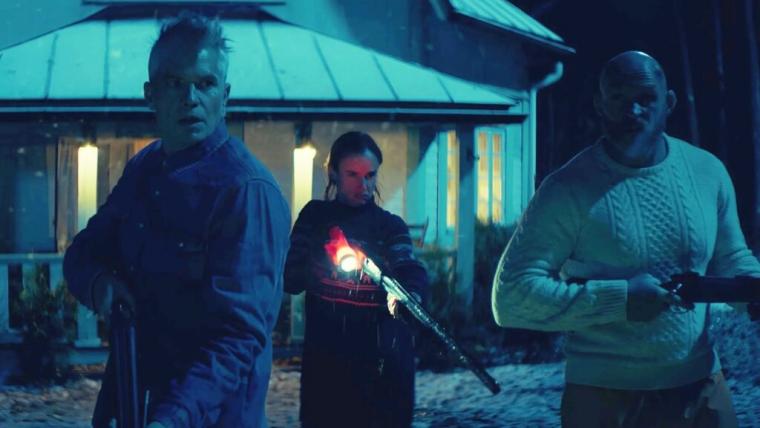
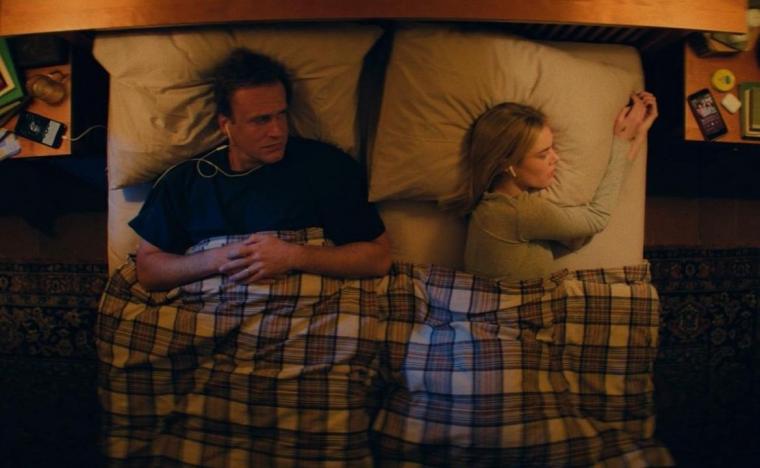
Adapted from the 2021 Norwegian feature The Trip, this gory lark by director Jorma Taccone (a member of Andy Samberg's The Lonely Island comedy outfit) and screenwriters Nick Kocher and Brian McElhaney (the BriTANick duo responsible for Hulu's recent, delightful Pizza Movie), Over Your Dead Body starts well and stays strong for a full half-hour. The gist is that unhappily married Weaving and Jason Segel, as Lisa and Dan Burton, agree to a remote weekend retreat at which each is secretly planning to kill the other, and there's initially enormous fun in their passive-aggressive loathing, from Dan's disgust at his wife's condescension to Lisa's annoyance at her husband's inability to touch raw meat. The actors are a hoot together – Weaving has never before been so comedically assured – and their barbs sting, much of the nasty delight coming from the schadenfreude of watching entertainment hacks so viciously claw at one another. Dan, a film and stage director, accuses Lisa of being a dreadful actor, and Lisa counters by saying that if were as talented as he thinks, he wouldn't be directing crappy commercials. I adored all of this. And then what happens? A trio of prison escapees crash through the ceiling and ruin everything, including our hopes that a 2026 comedy thriller could proceed without making us want to avert our eyes.
Considering the forced, overscaled, unfunny performances of Juliette Lewis and Keith Jardine, you may want to avert your eyes for reasons beyond bloodshed. But even with the incomparably handsome, quick-witted Timothy Olyphant as the third member of this dipstick cabal, Taccone's film quickly morphs from genuinely enjoyable to borderline-unwatchable. With the possible exception of Anne Frank, surely no subject is beyond the realm of imposed hilarity nowadays, so if you're the sort to instinctively laugh at bits involving threatened and nearly accomplished rape, by all means have a blast. Be aware, though, that this dispiriting, ultimately boring endurance test also traffics in achingly convincing beatings, mutilations, exploded heads, half-severed feet, and a face shoved into a lawn mower. (Character-actor treasure Paul Guilfoyle plays Dan's dad, and his only true purpose is to toss in exhausting F-bombs.) The 14-year-old boys among you may be thinking “Cool!”, as might any of you, regardless of gender, with direct access to your inner 14-year-old boy. I resented the hell out of Over Your Dead Body for starting so smart and winding up so colossally stupid, and so stupidly predictable, offended that this initially witty, trenchant marital comedy wound up catering to the perceived needs of a demographic that wouldn't go to the movie in the first place. Early on, Dan chides Lisa for her habit of taking five-hour baths. After sitting through this insufferable thing, I desperately needed one.