
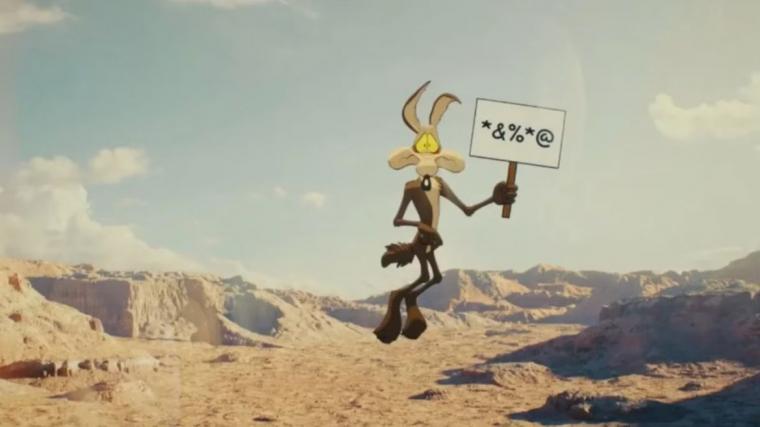
Wile E. Coyote in Coyote vs. Acme
COYOTE VS. ACME
Every once in a while, you'll find yourself really having fun at a movie up until a certain moment when you realize you don't actually like the film – you're actively in love with it. In the case of director Dave Green's long-shelved Coyote vs. Acme, that moment, for me, came roughly an hour into the picture, when a cartoon map showed a plane's trajectory headed toward the American northwest, after which it suddenly veered east, and the pilot apologized for making that wrong left turn. The plane took off in Albuquerque.
Unless you're familiar with the Looney Tunes oeuvre, and therefore instinctively understand why making a wrong turn at Albuquerque is innately memorable and hysterical, you might find Green's and screenwriter Samy Burch's slapstick energetically amusing, but little more. But if hearing Bugs Bunny, in innumerable animated shorts, bemoan his New Mexico-based mistake sticks in your brain from childhood the way it does in mine, this comedy's devastatingly smart, subtle, super-fast joke is enough to tell you that the filmmakers, here, genuinely adore the IP under their care. You'll no doubt glean that information much sooner: in the sight of Daffy Duck at a minimum-security nuthouse; in Foghorn Leghorn cast as the drawling showboat from any number of John Grisham adaptations; in the blink-and-you'll miss it removal of Pepé Le Pew. Yet astonishingly, especially for a movie that runs roughly 35 times longer than any Looney Tunes classic ever did, Coyote vs. Acme doesn't run out of invention, and might even necessitate a second viewing just to notch the gags you didn't fully appreciate the first time around. It took two days, for instance, for me to recognize the brilliance of bespectacled Granny discussing her 30-years-missing husband: “They told me he ran off with his secretary, but I don't think so – his secretary was a penguin!”
In many ways, Green's film is a miracle – easily the funniest, most continually surprising, most professional blend of live action and hand-drawn (and occasionally pixelated) animation since Robert Zemeckis' Who Framed Roger Rabbit from 1988. For those in the know, it's also a miracle that Coyote vs. Acme was allowed to see the light of day. If you're inclined to read them, there are reams of articles available on how this planned 2023 Warner Bros. release was initially shelved by its parent company – a tax write-off more theoretically profitable than letting us see the damned thing – until spunky upstart Ketchup Entertainment came through with a $50 million offer that couldn't be refused. I find the financial ins and outs too sad and pointless to regurgitate considering how much the end product is suffused in joy. Also meta-joy. Coyote vs. Acme is all about how Wile E. Coyote wants to sue Acme – supplier of all those slingshots and TNT boxes and rocket boots that go horribly awry – for pain and suffering after decades (since 1949!) of not capturing and eating the Road Runner. Were it about Wile E. suing Warner Bros. for similar hardship due to profit-driven dismissal, the narrative wouldn't necessarily have to change a bit.
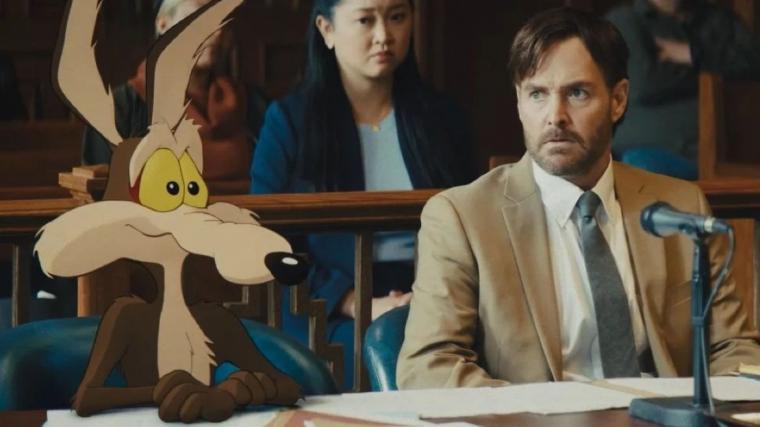
Her Oscar-nominated script for 2023's May December hinted at it, but with this movie, I'm thinking Samy Burch might be a genius. Yes, this outing is a spectacularly clever, Roger Rabbit-esque adventure for Looney Tunes fixtures that should shame those responsible for those two unfortunate Space Jams. But Burch also found a way to connect Bugs Bunny's timeless Albuquerque punchline with a central human figure – the terrific Will Forte's ambulance-chasing lawyer Kevin Avery – reminiscent of Bob Odenkirk's Breaking Bad/Better Call Saul shyster Saul Goodman … who was also based in Albuquerque. (Silly as it is, this unpretentious entertainment occasionally makes your head spin.) Fueled into genuine public service by his intern niece Paige (a delightfully chipper Lana Condor), Kevin begrudgingly takes Wile E. on as a client, and eventually uncovers a series of long-term misdeeds at the Acme corporation, many of them willfully hidden by the company's smarmy lawyer Buddy Crane (John Cena, clearly having a ball). That's really more plot description than any viewer should need, though, given that the film's 103 minutes are almost entirely composed of jokes: witty jokes; stupid jokes; a lot of Looney Tunes-specific jokes; and even jokes, perhaps added in light of the pre-release brouhaha, on the film's very existence. The opening “based on a true story” title card made one fellow patron legitimately cackle with glee.
Oh yeah, and at a couple of intervals, Coyote vs. Acme might even make you well up. I can hear you now: “Come again?!” But it's true. As a kid, watching Road Runner cartoons on Saturday mornings, I never presumed that Acme's products were crap; I just imagined that our tireless coyote was terrible at handling them properly. But Burch's plotting makes an excellent argument for the purchases' worthlessness – or rather, their worthlessness to a certain hungry carnivore – while corporations benefit mightily from their failures. Wile E. has always been an underdog. Here, however, he's an underdog whose decades-long blunders are actually not his fault, and if that sounds undeservedly sentimental, it doesn't at all play that way. Our coyote is just as scheming as he's forever been – so much so that I was taken aback, three-quarters of the way in, when we were reminded that Wile E. was still, in essence, a villain. Yet despite not uttering a word (most of the other animated characters' dialogue is delivered by next-best-thing-to-Mel-Blanc Eric Bauza), Wile E. is truly, oddly moving in Coyote vs. Acme, and a late-film courtroom encounter with his fleet-footed nemesis inspired sniffles in nearby audience members. Call it manipulation or the lingering effects of nostalgia – either way, it worked.
I can't imagine what viewers a full half-century younger than me might make of this thing. How does a generation raised on The Amazing Digital Circus even begin to react to Looney Tunes slapstick? But at my Thursday-afternoon screening, it was a non-issue, because the two-dozen-ish adults (and zero kids) with me appeared colossally happy. We laughed at the traditional “scientific” names given to our protagonists. (Road Runner's was “Fastus Hellus.”) We laughed at the court transcriber trying to get the Tasmanian Devil's gibberish into legal record. We laughed at the cartoon über-violence – Wile E. endures so much physical abuse! – and the violence only hinted at in court-artist drawings. And with the release of Coyote vs. Acme, I, for one, thanked the gods of justice for one instance of fairness in what seems to be an increasingly unfair world. It almost wouldn't have mattered if the movie were good. It escaped tax-write-off Purgatory nonetheless. In 2026, that, in itself, is a win. That the movie is very good makes this underdog victory all the sweeter.
IT ENDS
Joining Obsession's Curry Barker and Backrooms' Kane Parsons – at least in terms of age, if not (yet) box-office power – Alexander Ullom is the third 20-something with a YouTube background to have a buzzy, feature-length thriller released this summer. But It Ends isn't a movie I'm antsy to review. I'd much rather have a beer with it, or preferably several – sitting the film down for hours, discussing its philosophical themes, finding out what makes it tick. Ullom's fiercely compelling semi-horror outing, with its echoes of Jean-Paul Sartre's No Exit of all things, is by no means formulaic, audience-goosing cineplex fare. While it's certainly pleasurable in those more familiar and expected ways, Ullom's long-form debut is gorgeously, exquisitely haunting, and so emotionally overwhelming that I stayed through the entirety of the closing credits and found it difficult to leave. I wanted to continue living in Ullom's sad, trenchant, indescribably moving universe for as long as possible.
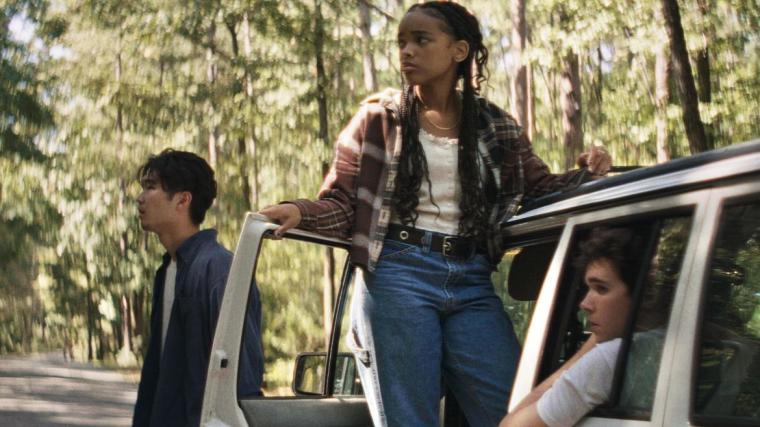
The setup couldn't be simpler. Having just graduated from college, pals James, Day, and Fisher (Phinehas Yoon, Akira Jackson, and Noah Toth) get picked up in the car of their same-age friend Tyler (Mitchell Cole), who skipped school and joined the military. Their destination is initially unclear. Yet although Tyler seems somewhat reticent and James appears on sarcasm overload, the quartet has a fair amount of fun joshing one another before they take an apparent wrong turn. (Not, unfortunately, in Albuquerque.) Thinking they've accidentally passed their intended road, Tyler turns the car around, and after a few hundred feet, finds it now strangely blocked with trees and forest – as if the road just vanished. That's when a terrifying horde emerges from the woods and desperately, violently begs to be let into the car. Our four protagonists are able to escape, but the next time they stop, again with no idea of how to get off this seemingly forever path, they're once more swarmed by forest dwellers demanding entrance. The drive continues for hours, days, weeks, none of the travelers feeling hungry or tired or needing to use a restroom, and the car never running out of gas. If No Exit's Hell is other people, It Ends' Hell is a literally endless Spring Break road trip with no Fort Lauderdale in sight.
I honestly don't know how Ullom was able to make his feature debut so riveting given such obvious (pardon the pun) roadblocks, in that the action only infrequently leaves the car and the four leads are basically the movie's only characters. There are hints, though. His funny, teasing dialogue at the start is certainly a plus – we instinctively like James, Day, Fisher, and Tyler even before we get to really know them. The actors' easy camaraderie and effortless give-and-take is another bonus, Ullom having reportedly discovered more than one cast member through Instagram. (Guess “Hollywood agent” is another one of those careers that's slowly going by the wayside.) Yet beyond Ullom proving facile with claustrophobic chills and a potential wizard with extracting stunning portrayals from largely untested screen actors, I think It Ends works as thunderously well as it does because he makes his victimized characters what they rarely are in movies of this type: hearteningly relatable, and exceedingly smart.
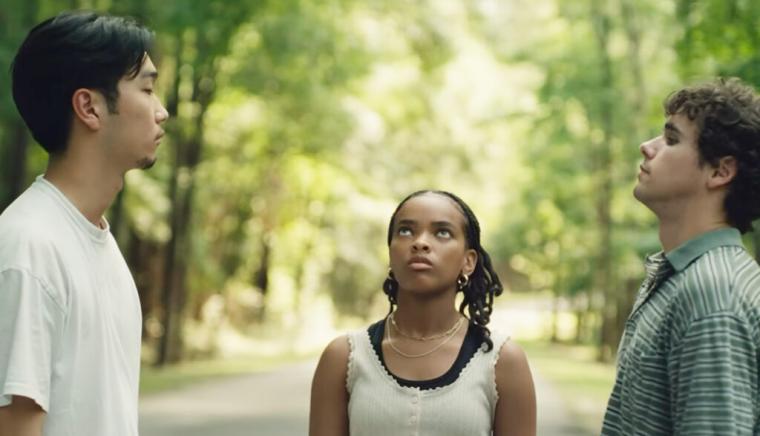
Led by the group's resident logician James, and before the film's exquisitely paced 90 minutes are even a third over, the 20-somethings begin to learn, or at least suspect, things that might conceivably be of value. They realize they can stop the car – being very careful to not turn off the ignition – for exactly 90 seconds before the forest hordes appear. They realize the woodland people only attack the car, meaning that our heroes can let two passengers explore the woods, seeking potential answers, while the vehicle backs a few hundred yards away. And almost from the start, in what I found to be It Ends' most welcome development, James posits that they might, in fact, be dead. This is the sort of non-surprising “Gasp!” moment that a lesser movie would make its protagonists wait an hour or longer (if ever) to realize, we in the audience all but screaming “You're dead, assholes!” at the screen. But not everyone in the car agrees. So they begin performing a series of rituals that, per horror films the youths might've seen, might ultimately end whatever “curse” has been placed on them. What if they all revealed their darkest, most troubling secrets? What if they all vocally apologized for some unforgivable wrongdoing from their past?
Because enduring a hopeless situation is the entire premise of Ullom's film, I don't think it's a spoiler to say that none of their tactics work, and the movie doesn't attempt to explain why. Blessedly, it doesn't try to explain anything. We're allowed to take the goings-on as metaphor or abject reality or whatever else we want. Ullom gives us his conceit, and then expands on it, and in doing so, gives us initial levity that leads to harrowing confusion and fright that leads to heartbreak that leads to unanticipated hilarity that leads to more heartbreak that leads to an unclassifiable kind of grace. After waylaying us with a one-word title card that practically made me gasp, and with half the movie left to go, this thing even fully stops being a horror film, shocking us, instead, by becoming something much richer: worthy, thoughtful, compassionate, and profound. (While all four central actors are startlingly effective, Phinehas Yoon is a particular revelation; through the subtlest of means, he pulls off emotional transitions like a Gen Z Daniel Day-Lewis.) It Ends blindsided me like no other release I've yet seen in 2026, and pound for pound, even against the magnificence of Christopher Nolan's 10-ton behemoth The Odyssey, it might be my favorite movie of the year.
BUDDY
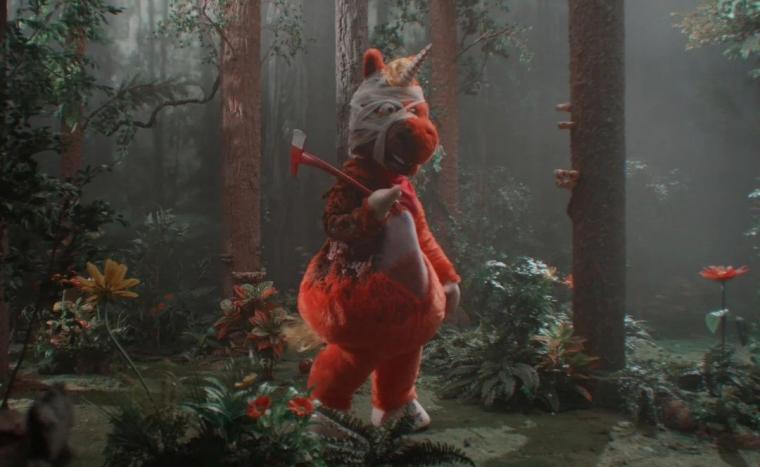
Released upon an unsuspecting public in the fall of 2014, Too Many Cooks, writer/director Casper Kelly's riotous, deeply disturbing surrealist-nightmare short for Adult Swim, immediately went viral, and for good reason: It's perfect. Running a tidy 11 minutes can help with perfection, though, and lasting roughly nine times that length, Kelly's first big-screen release Buddy delivers a solid concept, sometimes ideally presented, that wildly overstays its welcome. I'm more than a little bummed to report this, not only because I've probably watched Too Many Cooks too many times, but because a spoof of Barney & Friends that stars Cristin Milioti is like an idea I'd put in my aspirations journal, were I to have such a thing. Yet as this cheeky, gory lark went on and on and on, my interest increasingly evaporated. Even the recent box-office dud Ice Cream Man did this sort of thing better – much better. And that had Eli Roth at the helm.
Admittedly, Buddy's first half-hour is, like Too Many Cooks, pretty damned faultless. We're effectively cast as viewers of a 1999 kiddie show titled It's Buddy!, which features a group of precocious kids and an orange unicorn – a miniature plushie – that magically comes to adult-human-sized life when the kids croon, “Hey, Bu-u-u-uddy!” With the help of Pee Wee's Playhouse-esque pals such as Mr. Mailbox, Couchy the Couch, Clocky the Clock, and Strappy the Backpack (the latter voiced, unmistakably and amusingly, by Patton Oswalt), Buddy teaches the children about sharing and cleaning and bravery – all Life Lessons extolled by a certain big purple dinosaur. But when a truculent tyke named Josh doesn't want to play along, he's mysteriously gone in the next episode, replaced by a far more agreeable young'un. Our grade-school protagonist Freddy (Delaney Quinn) thinks there's something fishy about this, particularly when she notices a splash of what appears to be blood on Josh's favorite book that's been buried in the set's garbage can. Could genial, cuddly Buddy, his theme song set to “Twinkle, Twinkle, Little Star,” possibly be a psychotic killer?
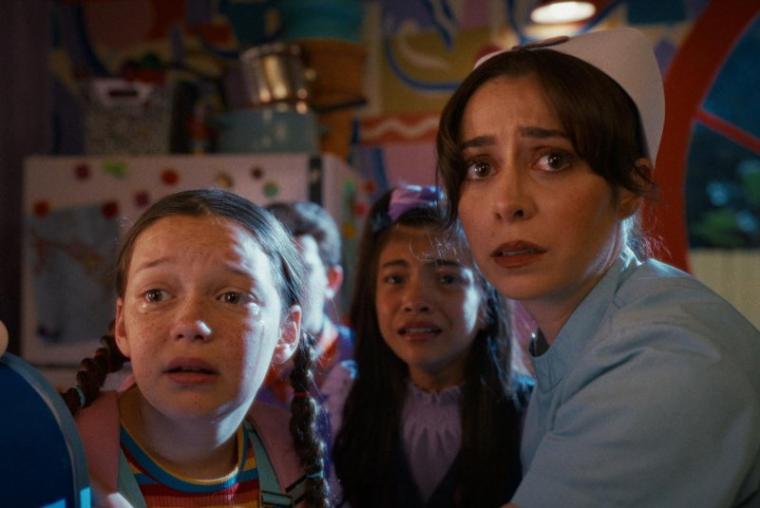
Of course he is. That's why we're there. And in Buddy's first 30 minutes, with director/co-writer Kelly (alongside co-scribe Jamie King) never extending our view of events beyond the boxy range of this chintzy TV show, the film is both formally astute and very funny. With his goofy-galumph readings as the tubby unicorn, Keegan-Michael Key makes Buddy's cheerfulness buoyant yet thrillingly destabilizing, and Kelly shoots the episodes (Josh isn't the only kid to get replaced) so they're like funhouse versions of Barney & Friends – recognizable, yet eerily wrong. You can feel that wrongness in the increasing tension of Freddy and her castmates, and as events grow more dire – Mr. Mailbox gets his lid ripped off to keep him from squealing! – Buddy's young performers become achingly affecting in their barely buried panic. And still we laugh. It's a rather stunningly executed first third for a movie, and I'm positive I'll never say this again in my life, but everything goes downhill after Cristin Milioti enters the picture.
Let me state categorically, as the fan-iest of fans, that this is not Cristin Milioti's fault. Yet after the film takes a promising swerve into the present-day Real World, with Milioti as a mom who's increasingly certain that she and her husband (Topher Grace) had more than the two kids they're currently housing, Buddy goes unfortunately off the rails. The plotting is clever, and Milioti acts her material for all it's worth. I, however, soon felt a familiar sensation: that of watching a one-joke comedy that doesn't quite know what to do when its one joke has dried up. After Milioti accidentally finds herself in TV land, Kelly's Evil Barney gag having thoroughly run its course, the peril and jokes become sadly repetitive, the laughs all but vanish, and one particularly sorry sequence finds the movie attempting to explain the unicorn's murderous condition, with Michael Shannon voicing a heavily expository marionette. We don't need this, nor do we need Buddy's grotesque bit of sexual harassment, and we certainly don't need nepo brother Clint Howard as the marionette's traveling companion. How can an actor be so consistently terrible for 50-plus years and still, evidently, have a fan base? Redundant and disappointing as it is, though, I may eventually watch Buddy again, if only for the opening third and the remarkable Delaney Quinn, who, at one point, was so forceful that I completely took my eyes off scene partner Cristin Milioti. Way to go, kid. I'm not sure that's ever happened before.
THE DOG STARS
Say this for Ridley Scott: He does have a knack for making boring movies pretty. You can find yourself lulled into near-unconsciousness by Prometheus, or zoning out from the sheer dumbness of House of Gucci, but man alive, those flicks sure do look great.
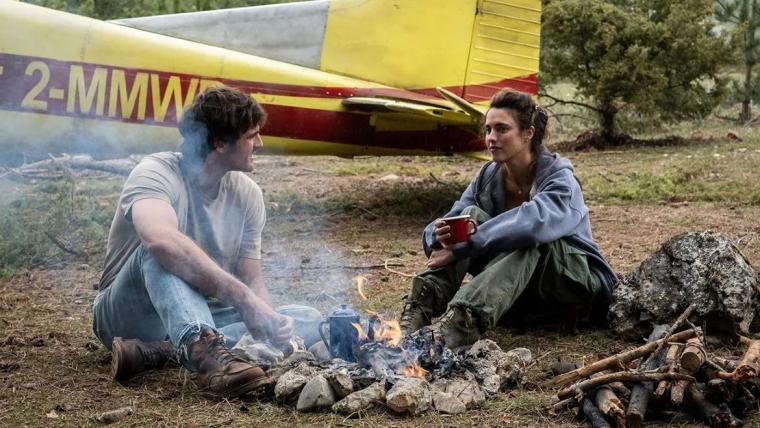
Scott latest, an adaptation of Peter Heller's 2012 novel The Dog Stars, is one of the director's more tedious recent offerings – a post-apocalyptic thriller with almost no thrills whatsoever and flat, unconvincing dialogue that appears to have been written, and sometimes performed, mid-coma. But its leads are the unfairly attractive Jacob Elordi and Margaret Qualley, there are breathtaking aerial shots of Italian countrysides (here disguised as Coloradan countrysides), and even the decimated streets of Denver – or rather “Denver” – are so beautifully, fastidiously art-directed that even the upturned cars and street debris could make the cover of Better Homes & Gardens. Everything about The Dog Stars was pushing me toward a nap, yet as photographed by cinematographer Erik Messerschmidt, the visuals (including the leads' faces) kept me watching, if in a way similar to how those eye clamps kept poor Alex watching in A Clockwork Orange.
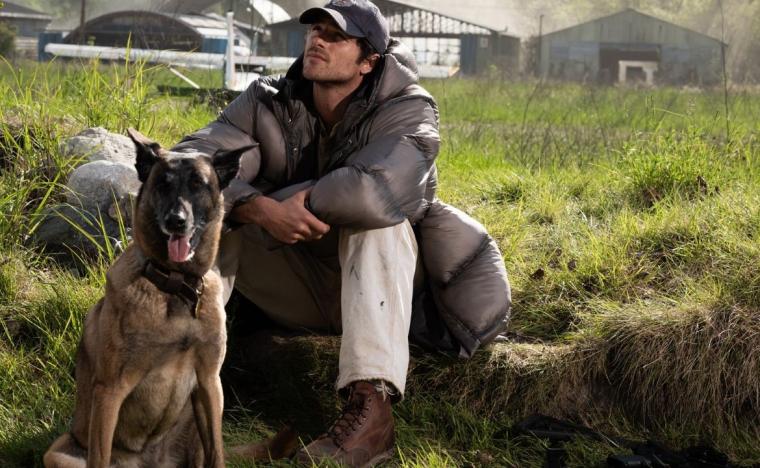
The year is 2035, and most of the world's population – at least America's, or maybe just Colorado's; it's unclear – has long been lost to a deadly flu. Among the immune living in Erie are Hig (Elordi), a widowed mechanic and amateur pilot with hopes of finding survivors in Grand Junction, and Bangley (Josh Brolin), a former Marine who'd rather pick off marauding ruffians than leave his countryside bunker. For much of its two-hour length, Scott's film is largely just these guys doing their individual things: Hig gathering fuel and supplies in abandoned Denver, and Bangley, in his fortified crow's nest, glowering at the horizon and occasionally shooting his rifle. There's an adorable German shepherd whose life you fear for immediately, There's a nearby Mennonite community (led by Benedict Wong's Aaron) wholesome enough to make the von Trapp tykes look like savages. Eventually, a former Navy SEAL (Guy Pearce) and his widowed daughter (Qualley) show up to respectively provide paranoid tension and romantic possibility. And nearly all of The Dog Stars is dreary to the point of exhaustion, with screenwriter Mark L. Smith's conversation agonizingly stilted, and the few violent outbursts staged with little of Scott's usual finesse. As much as I traditionally love them, I was grateful that this was the rare Dystopian hellscape that didn't involve zombies – or, per the 21 Days/Weeks/Years series, monstrously infected humans. It turns out, though, that bald, skinny, heavily tattooed young men who yell all the time can serve their same purpose, and are far less fun doing so.
Despite the actors' perfectly serviceable downbeat portrayals (and it was fun to see the Weapons co-stars share a scene in which Wong wasn't maniacally trying to off Brolin), the energy on display would hardly be enough to illuminate a 20-watt bulb, and in roughly 95 percent of the film, the prettiness is the only thing actively working in its favor. Thankfully, though, that other 5-ish percent is kind of a knockout. Because it's an addition not found in Heller's book, and because it lands with only about 20 minutes of movie to go, I won't spoil what happens. I will, however, say that it involves a visit to an airport, some figurative time travel back to the 1950s, and a crazy-eyed Allison Janney pouring martinis in period flight-attendant attire. The scene has little impact on the narrative, and it could've been jettisoned entirely with no loss. But for a few scant, giggly minutes, I grinned at The Dog Stars from ear to ear, not necessarily comprehending what was happening but also not wanting to be anywhere else. Had all those dully yowling, tattooed hooligans been outfitted in gored skirts and oval caps, Scott's latest might've actually been worth a watch.
TEENAGE SEX & DEATH AT CAMP MIASMA
Those seeking depth and poignancy will likely find it. But above all else, Jane Schoenbrun's Teenage Sex & Death at Camp Miasma is a big, rollicking blast of pure fun, and of filmmaking excitement, too. Like many, I adored the writer/director's admirably unstable I Saw the TV Glow from 2024, despite (for me) the film's inscrutable, even baffling climactic scenes. Schoenbrun's latest engenders no such apprehension, even if some of the comedy feels labored, and even if you're not 100-percent certain about the ending of this one, either. The highest compliment I can give the movie is that it's as ticklish as its title. That may sound like minimal praise, but hey – that's one great title.
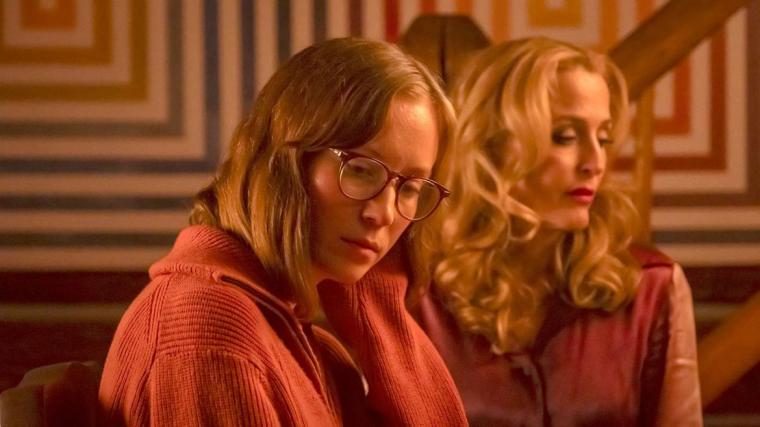
Much of what made I Saw the TV Glow hum was its leads' fanatical devotion to a very specific type of TV series – a serial in the vein of Buffy the Vampire Slayer and The X-Files – and Schoenbrun's new heroine Kris Williams (Hannah Einbinder) has her own entertainment fetish: the teens-in-the-woods slasher flicks in the (fictional) '80s/'90s Camp Miasma franchise. With the films modeled after low-rent shockers such as the original Friday the 13th, though more clearly indebted to 1983's Sleepaway Camp, Kris is such a horror aficionado that, as a filmmaker on the rise, the final third of her last project re-imaged Psycho from the viewpoint of the shower curtain. Now, she's been tagged to write and direct a Hollywood reboot of Camp Miasma, theoretically to remove the series' undeniable transphobia, and travels to the Pacific Northwest for a private audience with retired actor Billy Presley (a gloriously, comically regal Gillian Anderson ,,, from The X-Files!), the series' original “last girl standing.” Because Billy never made another film, and because she has been living in essential isolation for 35 years, Kris' polyamorous lover Mari (Jasmin Savoy Brown) teases Kris about her forthcoming meeting with “Norma Desmond.” Then Kris arrives at Billy's woodland cabin – located on the same site in which Camp Miasma was shot – and discovers that she is meeting Norma Desmond, albeit a past-her-prime diva with a dreamy Southern drawl and two freshly bought buckets of KFC.
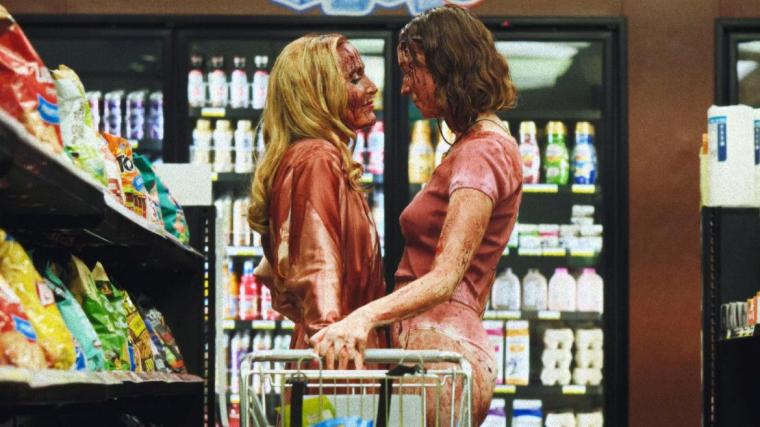
It really is the chicken, I think, that indicates how much of a good time Schoenbrun wants us to have. I mean, seriously? Two buckets, and hosts of sides, for all of two people? The image of those mountainous piles of food separating the equally slender Einbinder and Anderson is incongruously funny, and all throughout TS&DaCM, we're invited to laugh at the glorious excess: the sheer tonnage of candy and snacks Kris purchases; the ultra-sterotypical Hollywood suits who pop in for a Zoom call; the geysers of blood that erupt, Vesuvius-like, whenever a Camp Miasma counselor gets their head lopped off. (This happens a lot.) Schoenbrun's movie isn't without its serious side, and time and attention are paid to queer Kris' lifelong sexual discomfort, which seemingly originated with her viewing Camp Miasma as a very impressionable grade-schooler. Yet the tone remains resolutely playful, and Einbinder and Anderson share delicious chemistry – unmistakable heat that often morphs into a strangely tender, charming, best-pals solidarity. I may never have liked the pair more than when, watching the original Camp Miasma together, Kris whispered an aside during one of Billy's more iconic moments, and the former starlet whispered back, “Shut up.”
As Kris attempts to work out her rebooted storyline and convince Billy to be part of the project, Shoenbrun treats us to one divinely winning set piece after another, though the writer/director outdoes themself with the many re-creations of that first Camp Miasma, their compositions, earnest dialogue, overscaled performances, and hysterical grisliness making them faultless doppelgängers. (Shoenbrun's movie-within-the-movie, though, does have a stronger cast than that genre period generally gave us, the participants here including Zach Cherry, Eva Victor, Patrick Fischler, and original Kid in the Hall Kevin McDonald.) Schoenbrun may be saluting '80s-era splatter fests, but she's also subtly bettering them, giving us an unbroken take of camp-counselor revenge – Jack Haven plays the villain, Little Death – more artistically ambitious and giddily kinetic than anything we'd have seen back then outside of Sam Raimi. Teenage Sex & Death at Camp Miasma unquestionably loves its highlighted genre, and loves its leading ladies, and loves the flawed, messy process of finding yourself. It's only appropriate that we extend that love back, and hopefully convince others to share in it.