
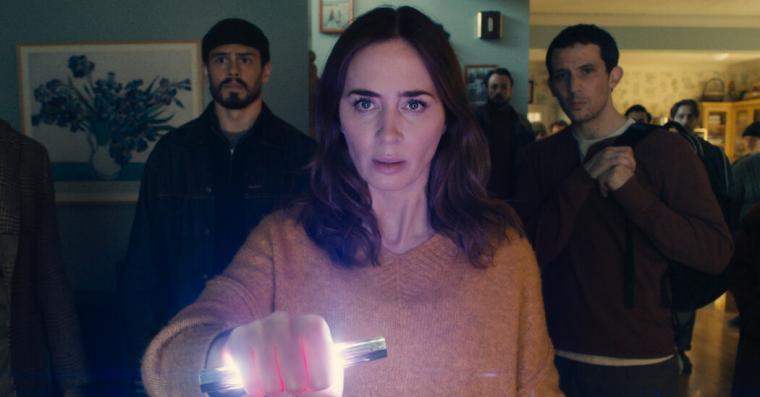
Tommy Martinez, Emily Blunt, and Josh O’Connor in Disclosure Day
DISCLOSURE DAY
Steven Spielberg's Disclosure Day is many things: a spiritual sequel to his masterpiece Close Encounters of the Third Kind; a paranoid thriller with a hearty dose of sci-fi; a stunt-heavy chase picture; a meditation on humanity, religion, and our place in the universe; even, at times, a slapstick vaguely reminiscent of Nancy Meyers' What Women Want. Primarily, though, I think Spielberg's latest is an excellent self-test determining just how jaded you've become.
Because it's a non-IP summer blockbuster directed by a true master, and because its slippery trailers have refused to divulge precisely what we'd be seeing, I really, really wanted to like Disclosure Day. Honestly, I was hoping to love it, maybe even as much as Gizmondo reviewer Germain Lussier, whose “It's Spielberg's best film in 20 years” rave has practically become the movie's tagline. How disappointing, then, to reach the end credits and decide that it wasn't even Spielberg's best film in five years. (I'm no fan of 2022's The Fabelmans, but do adore his 2021West Side Story remake.) To be sure, thought and visual craft are on display in nearly every frame, the momentum rarely lags, and Emily Bunt gives a tremendously witty, technically virtuosic comic performance before the script demands that she stop being funny. Plus, after more than a half-century of cinematic wonders, heaven knows Spielberg has earned the faith we so readily want to extend to him. He says “Believe,” and we agree to believe.
Or, you know, we don't. And unfortunately, I found myself raising a cocked eyebrow at his new release in the first five minutes, and the last five minutes, and during many of the 130 minutes in between. I bow to no one in my ardor for Close Encounters, which, on any given day, and because of Citizen Kane, is either my favorite or second-favorite movie of all time. Lord, how Spielberg's 1977 film holds up, and not just in its evocation of otherwordly awe. There are more down-to-earth elements that we shouldn't realistically buy: Richard Dreyfuss tearing apart his yard, and his neighbor's yard, without the cops getting involved; Dreyfuss and Melinda Dillon coincidentally watching the same TV broadcast about Devil's Tower; those two and Josef Sommer miraculously escaping a heavily fortified, makeshift Army base. “Come on,” you might say about any one of those examples. “No way would that happen.” Yet we go with these bits both because Spielberg's direction and storytelling are so assured – he convinces us that events need to happen this way – and because they're also plausibly human. None of those contrivances seem completely outside the realm of possibility.
Would that I could say the same for most of Disclosure Day, which aims to be a “realistic” sci-fi in the manner of Close Encounters, but which demanded more suspension of disbelief than this apparently jaded soul was willing to supply. It's a movie of near-misses and last-second escapes, and not one of them struck me as remotely plausible; the dopiest of these getaways requires dozens of armed henchmen to all be looking in the same (wrong) direction simultaneously, and to also not hear one of our heroes when he's shuffling along, not at all quietly, a mere 15 feet away. (Don't get me started on the high-speed chase sequences in which a small army of cars pursues our protagonists and not one of the drivers is able to catch up or think to shoot out the leads' tires.) But at least those are human-scaled contrivances, no worse than in any run-of-the-mill action flick. I was more annoyed that the sci-fi technology proved so maddeningly convenient, and that Spielberg's enticingly optimistic request to “Believe,” this time, led me to silently reply, “Yeah, I don't think I can.”
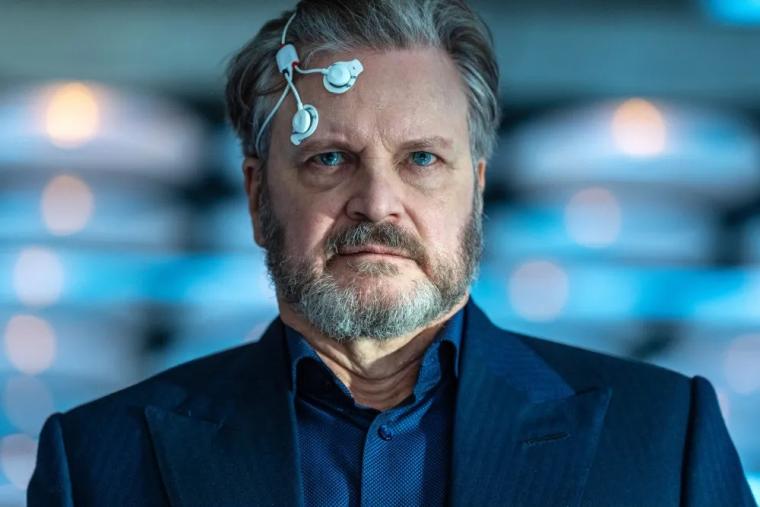
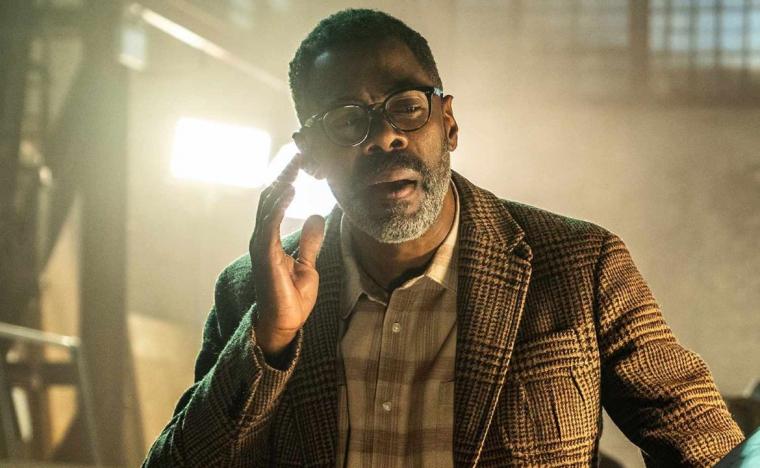
But I'm getting ahead of myself. Two individual plotlines gradually blend in David Koepp's screenplay, the story for which was developed by Spielberg in the summer of 2023. One involves planned whistle-blower Daniel Kellner (Josh O'Connor), a cybersecurity expert for the not-at-all-nefarious-sounding Wardex Corporation. His eyes recently opened to proof of extraterrestrial life and legitimate close encounters on Earth – secrets that Wardex has been hiding for 79 years – Daniel has stolen a bunch of files and high-tech flash drives and some kind of alien stress ball (more on that thing later), and he's ready to go public. Wardex CEO Noah Scanlon (Colin Firth) doesn't want that to happen. Wardex defector and former director of biological assets Hugo Wakefield (Colman Domingo) very much does.
That's Disclosure Day's conspiracy-drama angle. The conspiracy-comedy one involves Blunt's Margaret Fairchild, a TV meteorologist in Kansas City, Missouri, who longs for a more substantial career in investigative journalism. (Given the role she eventually plays in Koepp's narrative, I have to believe Margaret was modeled on Jane Fonda's Kimberly Wells from 1979's The China Syndrome – one of the all-time-great paranoid thrillers.) Dissatisfied or not, Margaret appears happy enough in her job and with her laze-about boyfriend Jackson (slacker supreme Wyatt Russell). But things take a turn for the really odd when a cardinal randomly flies into her apartment, makes a few seconds of eye contact, and flies off. Suddenly, and without her awareness, Margaret is speaking fluent Russian. She's stopped by a traffic cop on her way to work and gets out of a ticket by seeing into the officer's soul, offering a play-by-play account of the man's recent fight with his wife. She arrives at the station and effortlessly converses with a guest in Korean. And when it's time for her segment, as the trailers have prepped us for, Margaret appears to go into a kind of trance, and begins “talking” entirely in choked clicks and pops, a live-TV meltdown that quickly goes viral. Margaret has become a psychic, an empath, and, potentially, an alien translator all at once. Can a rendezvous with Daniel Kellner be far off?
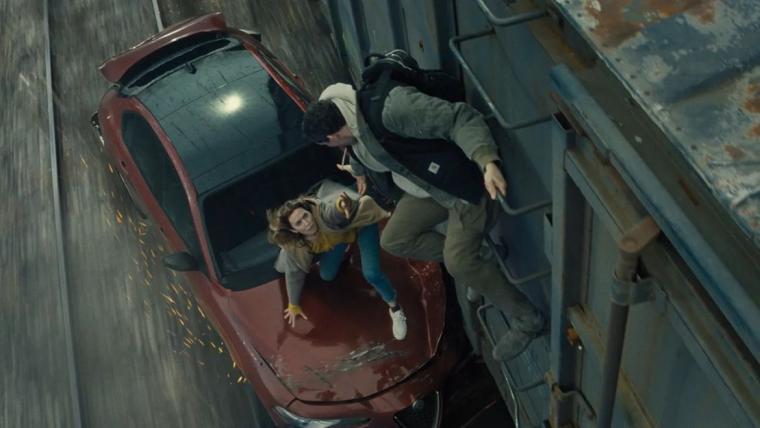
Of course not. And there is, admittedly, a lot of fun to be had as Margaret and Jackson and, on their separate trek, Daniel and his own romantic partner Jane (Eve Hewson) traverse the country in their attempts to find each other and evade the evil clutches of Wardex. There's also quite a bit of talk to be had, which is less fun. Spielberg choreographs the chases and sieges like the natural showman he is, editor Sarah Broshar adding significantly to the excitement during a particularly scary segment that finds Daniel's and Margaret's car (one of several they “borrow”) being forcibly dragged, or more accurately pushed, by a speeding locomotive. But in less manic moments, when characters are detailing our hidden knowledge of alien intelligence, or contemplating what the public reveal of extraterrestrial life will mean to the public and how it might affect their relationships to whatever god(s) they believe in, the movie becomes uncomfortably stagnant. If I must endure reams of scientific gobbledygook and theological moralizing, I'm grateful to at least have much of it presented by Colman Domingo; I could listen to that gorgeously mellifluous voice all day. Despite boasting a perfectly lovely voice of his own, though, Firth is more problematic, partly because he has to expound on so many generic evil-CEO platitudes, and partly because so much of his screen time finds Firth making dull pronouncements through the aid of that aforementioned alien stress ball.
Ugh, this thing. It might be my least-favorite prop from this whole decade of movies. Sure, let's go with the idea that advanced life forms can create phenomenal tools beyond the scope of our imaginations. Should said tools be allowed to do anything and everything? At first, the squeezable (one of several, we learn) is used so Scanlon can enter Jane's brain and help pinpoint her and Daniel's location. Okay. Then we learn it can also be used to present to Jane a holographic image of Scanlon, and to anyone else whose subconsciousness he's entered. Ummm … okay. Then we learn it can also be used for mind control, specifically so that Jane can kill Daniel on demand. O-o-o-okay.
But then we discover that if you squeeze the object too hard you get sent to some kind of alternate dimension, only to return wiped out a few seconds later. (No further details are ever given.) And then Margaret gets her mitts on one of these intergalactic gizmos, and suddenly it has the power to make people and nearby objects – even those the size of a school bus – invisible. And then she uses it to reboot an entire building's electrical system. I'm sorry, but what the eff is this device? I'm sure Sharper Image could make a fortune on it; hell, I'd buy one just to keep my Internet from requiring a reboot three times a day. But all we know for sure is that it's among the most convenient get-out-of-jail-free cards in modern movie history, and I found its employment insulting. “How do I get characters into or out of this jam?” you can imagine Koepp asking himself. “Of course! SpaceSqueezer™ to the rescue!”
There's a lot to admire in Spielberg's latest, including, among the cast's contributions, Blunt's beautifully confused yearning and knockabout comic verve; O'Connell's charming rendering of a do-gooder whose emotional age never extended beyond 10; and Elizabeth Marvel, as a monastery Abbess, giving perhaps the first Elizabeth Marvel performance I wasn't instinctively scared of. (She's a terrific actor, but that lady is intimidating.) And even though, again, I'm evidently too jaded to get wholly on-board with the notion, I have to thank Spielberg for giving his Anne Frank-like belief that people are essentially good at heart a feature-length showcase. Despite so much evidence to the contrary, it's undeniably sweet to see that he's still putting so much faith in us; I'm not sure we deserve it. I know we don't deserve the images of universally rapt amazement and unity suggested toward the end, where Spielberg's Baby Boomer can-do spirit seems almost perversely misaligned with life as we currently know it.
Your mileage on Disclosure Day's finale, however, as well on the film itself, will likely vary. But amid the plot points I can't spoil and the offhandedly divine visuals I couldn't spoil if I wanted to, this whole, messy, occasionally enthralling, ultimately disappointing outing might be worthwhile solely for the brief, late-in-the-game performance of Courtney Grace as an NBC news anchor forced to face the impossible on live television. I don't necessarily believe in the miracles this movie asks us to. But in her subdued astonishment and the slow crack of her professional demeanor, I absolutely believed that Grace's anchorwoman believed in them. And for an unknown (but hopefully not unknown for much longer) actor to steal an entire, 140-minute Spielberg picture in roughly five minutes – and with only five minutes to spare? That's a miracle in itself.
TUNER
Not that I'm complaining, mind you. But these days, we seem to be positively overrun with supremely gifted male actors and film stars, most of them GQ-cover-ready, between the ages of 21 and 35, none of whom are U.S. natives. We have the Beatles-to-be quartet of Paul Mescal, Harris Dickinson, Joseph Quinn, and Barry Keoghan. We have Tom Holland and Daryl McCormack and Joe Alwyn. We have Jacob Elordi and Nicholas Galatzine and Noah Jupe. We have Will Poulter and Kit Connor and Ben Radcliffe. And with his exceptionally sensitive, subtly exhilarating performance in director/co-writer Daniel Roher's crime caper Tuner, we can now add 29-year-old Leo Woodall – best known as the “uncle f---er” of The White Lotus' second season – to the mix. How did all of these English, Irish, and Australian talents manage to make their individual splashes at roughly the same time? Beyond that, how are they, across the board, so freaking good at American accents? No wonder Timothée Chalamet always looks at least mildly anxious in interviews and on awards shows. Damned foreigners coming over here to take his jobs … .
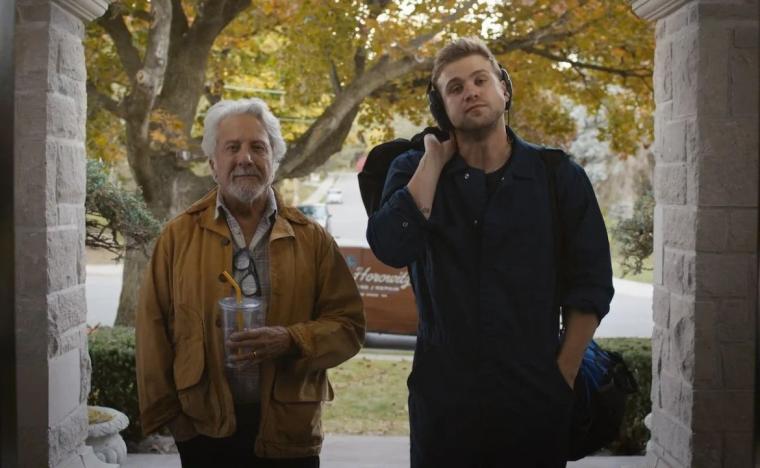
In any event, Tuner is very much the type of movie They Don't Make Anymore, meaning that it's not based on previously existing IP, and features a strong narrative conceit, an arresting plot, comprehensible and convincing stakes, literate dialogue, a leading role for a charismatic up-and-comer, and an irascible-mentor role for a Hollywood legend. English performer Woodall plays New Yorker Niki White, a kind, quiet, solitary apprentice to once-legendary piano tuner Harry Horowitz. (Dustin Hoffman, take a bow.) While his hyperacusis makes him extraordinarily sensitive to sound, Niki appears to have found an ideal gig with Harry, and barely minds – or claims he doesn't – that his condition prevented him from becoming the world-class pianist he seemed destined to be. Niki's heightened sense of hearing, however, has given him quite the ear (under the right noise-deprived conditions), and when Harry accidentally locks an item of import in his home safe, his assistant discovers a latent talent for safe-cracking. It's an ability that, for better and worse, comes in handy after Niki finds himself in need of roughly $75,000, and a trio of career burglars (led by Lior Raz's Uri) realize Niki's skill set could make all of them very, very rich.
After spending a goodly chuck of 1,800 words bemoaning Disclosure Day's lack of believability, it feels grossly hypocritical to say that I enjoyed Tuner despite it being perhaps even harder to buy than Spielberg's sci-fi opus. Without question, the coincidences in this thing are staggering. The means by which Niki first encounters the crooks; the tetchy meet-cute that jump-starts his romance with student pianist Ruthie (the marvelous Havana Rose Liu); the accidents that keep magically pushing the pair closer together; the dumb bad luck that leads Niki into one increasingly threatening situation after another; Ruthie's potentially life-altering interview with a legendary composer (Jean Reno) who just happens to have been the owner of the purloined watch that Ruthie, gifted the hot accessory by Niki, just happens to be wearing … . I came close to giving myself an aneurysm from the amount of eye rolling Tuner forced me into.

Sue me, though: I had a blast. Roher's and Robert Ramsey's screenplay may be contrived, deeply contrived, but the dialogue is sharp and funny, especially whenever Hoffman is on-screen. (Admittedly, I'm still unsure about whether it's meant to be a joke that Uri initially berates Niki for presuming that he and his partners are criminals because of their accents. They turn out to be exactly the accented criminal stereotypes of nearly every Hollywood movie ever.) Aided by editor Greg O'Bryant and some exceptional aural design and effects, the safe-cracking scenes are deliciously nerve-wracking; they're like some strange, enticing mixture of Sound of Metal and Heat. Cliché-ridden or not, the romance between Niki and Ruthie is intensely touching – two lone souls, so alike in so many ways, discovering that their mutual idiosyncrasies might make a perfect blend.
Leo Woodall, though, is the movie's chief pleasure. His interior struggle as Niki weighs the immorality of his actions against the needs of those he loves is riveting and heartbreaking, and the actor completely holds you in the intensity of his listening – which, here, proves as gripping as a kinetically staged melee in a John Wick. It took me forever to realize what older actor Woodall was reminding me of, and it finally dawned on me: Mickey Rourke. Not, for those of you who don't remember his heyday, the Rourke of The Wrestler and whatever unfortunate titles have come after. Rather the Rourke of Body Heat and Diner and Rumble Fish, when he was young and unfairly handsome and his shy, almost apologetic demeanor and gentle voice made you want to lean forward to catch every gesture and syllable. There was an electricity to Rourke's performances and presence – hushed yet potentially volatile, solicitous yet nobody's patsy – and Woodall, more than any of his contemporaries, seems to have inherited it. Tuner may not hit all the right notes. But thanks, chiefly, to its star, the movie's merits continue to echo.

STOP! THAT! TRAIN!
Stop! That! Train! is drag-queen Airplane! You have no idea how much I want to leave my critique simply at that. Really, what else is there to say? Directed by Hairspray's Adam Shankman, written by Christina Friel and Connor Wright, and boasting a largely drag-performer cast led by national treasure RuPaul Charles, this tale of a high-speed luxury locomotive – the Glamazonian Express – heading directly toward the “Stormaganza” of all time clocks about 15 jokes per minute. If even one of those 15 lands for you, and at least one per minute did for me, you'll be laughing roughly 90 times. That's 89 times more than I laughed at the new Scary Movie.
There are sight gags and verbal gags and behavioral gags, with at least one bit lifted directly from Airplane!, when a train hostess drags the conductor's dead body down the aisle and everyone else is too distracted to notice. (Chris Parnell plays said conductor, and if he's not quite as funny as his equivalent Peter Graves in Airplane!, that's only because Graves was never expected to be a comedian.) In keeping with disaster-flick norms, the passenger manifesto includes a nun and an expectant mother and a child traveling on his own, and it made all the sense in the world when, at the government HQ trying to avert the tragedy, one of the helpless dunderheads in charge turned out to be … Charo. (I wasn't altogether surprised to see this Spanish fixture of '70s talk and game shows in a disaster spoof; I was far more shocked to realize, God bless her, that she was still alive, her cascading explosion of blond hair intact.)

There's a nominal story involving besties Tess and DeeDee (the unerringly delightful Ginger Minj and Jujubee), who believe the end to their unhappiness lies in serving drinks and packaged snacks to the coast-to-coast elite, and who wind up confronted and frequently thwarted by a trio of world-class bee-yotches irresistibly enacted by Brooke Lynn Hytes, Marty Lauter, and Symone. Their situation is made even more dire by the circumstances of the train's trajectory, with the only three "safely" crashable points being a nuclear power plant, a hospital for puppies, and Laurie Metcalf's house. (I know which site I'd choose – though I'd still be concerned about the radioactive fallout.) But you can easily ignore the Stop! That! Train! “plot” and merely savor the throw-it-at-the-wall-and-see-if-it-sticks absurdity, manifested in everything from Missi Pyle's turn as a lascivious weirdo with an unhealthily large nipple to Latrice Royale's service worker who keeps popping up in one unexpected career after another. Somehow, the script even manages to (almost) one-up Airplane!'s priceless “And don't call me Shirley” routine, with government officials demanding “Tell it to me straight,” at which point they're given the information. They then demand, “Tell it to me gay.” And as those officials know, there's a world of difference between girl gay and boy gay.
What can't be ignored amid all this bighearted silliness is RuPaul, who, in his role as U.S. President Judy Gagwell, takes a bigger risk than anyone else by opting to play this material seriously. Not completely seriously, of course. That would be madness considering Gagwell's terror at dropping to an uncharted disapproval rating: “Lea Michele in 2020.” But RuPaul lends to the proceedings more than his famed mélange of caustic wit and empathy and general fabulousness. He's giving a legitimate performance. Comical, yes, and definitely satirical (you don't have to strain to see current parallels between Gagwell's leadership style and, y'know, someone else's), but a portrayal that actually takes into consideration the lunatic crisis at hand. Even when leading us into one of the president's “hot flashbacks,” RuPaul is clearly invested in this character. For all the goofy joy provided by Rachel Bloom, Matt Rogers, the routinely humiliated (in the best way) Sarah Michelle Gellar, and the rest of Stop! That! Train!'s inspired buffoons, it's RuPaul who convinces you, admirably, that you're not just at a gonzo succession of writer's-room slapstick. You're at an actual movie, and a more-than-decent one. As a placard reveals, Judy Gagwell ran for office on one pithy slogan: “She fun!” Is she ever.