
Toy Story 5
TOY STORY 5
Thirty-one years after the franchise's debut, Disney/Pixar's latest animated comedy adventure is unusual in at least one regard: It's the first Toy Story that might be more fun to think about, and argue about, than actually watch.
As directed by Andrew Stanton, Toy Story 5 is certainly enjoyable. The movie produces plenty of laughs and, in more than one sequence, some beautifully jerked tears, and you won't hear me complain about Joan Cusack's feisty, Chicago-accented cowgirl Jessie being the star of the show. Plus, despite the almost universal acknowledgment than an ideal wrap-up was found in 2010's Toy Story 3, co-screenwriters Stanton and Kenna Harris do present an admirable hook for their sequel: High tech has invaded playtime, and it's threatening our beloved toys' sole reason for being. (Of course, fear of obsolescence has been this series' running theme since the very beginning, when Woody and company presumed that Buzz Lightyear's flashing lights and outer-space appeal would lead to their extinction.) Unfortunately, though, a hook is all it remains. For reasons that I'm sure have nothing whatsoever to do with Pixar's long history as an exemplar of technological innovation, the filmmakers don't seem to know what to make of their invasive electronic villain here, or whether it even is a villain. For many, especially many parents, children's addiction to devices is something of an existential threat, and seeing Toy Story 5 address the subject with such wishy-washy indecision is disappointing, and even a little depressing.
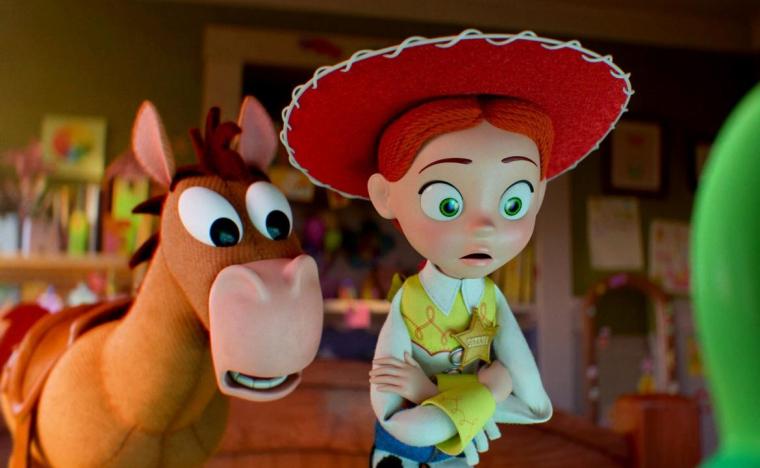
With Tom Hanks' cowpoke Woody and Annie Potts' Bo Peep roaming the land in search of discarded toys, Jessie is the new sheriff in town – more specifically, the bedroom of now-eight-year-old Bonnie (Scarlett Spears). An imaginative but shy and lonely tyke, Bonnie is rebuffed by fellow kids for still wanting to play with objects that don't require an Internet connection. Consequently, hoping to help her socialize, Bonnie's parents present their daughter with her first electronic gadget: a frog-themed tablet named Lilypad that can talk without the aid of a pull string. Bonnie is ecstatic, and spends what appears to be a full day and night on the thing before her folks, facing much resistance, finally get the girl downstairs for breakfast. Naturally, Jessie and the gang are horrified by this brainy, condescending interloper who, after 24 hours, already appears to be Bonnie's new best friend. But Lily, who believes she's the only “toy” a child could ever need, isn't about to back down. Not only does the cunning device send friend requests to kids in Bonnie's dance class – requests that are quickly accepted – but she gets Bonnie invited to her first sleepover, one that Jessie and her horse Bullseye are determined to crash.
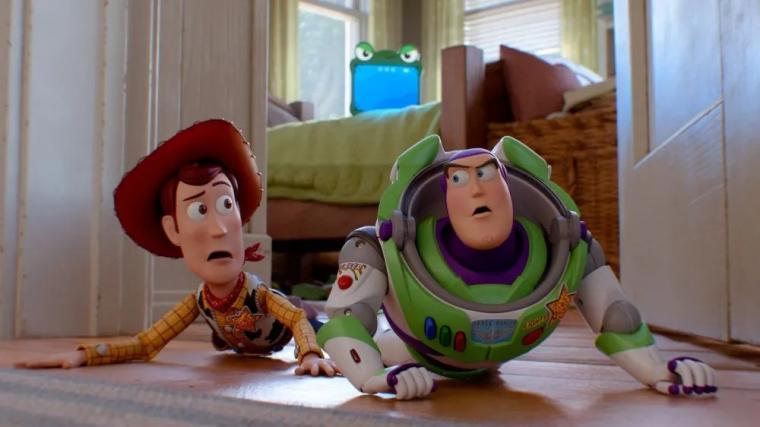
From that point on, a lot happens in Toy Story 5, and the list doesn't even include the cargo-ship crash that opens the film, sending dozens of upgraded Buzz Lightyear action figures on a planned trek to Star Command. Through delightfully Pixar-ian means, Jessie and Bullseye wind up at the home of their former owner Emily, and make the acquaintance of three solicitous electronic creatures: the GPS hippo Atlas (Craig Robinson), the toy camera Snappy (Shelby Rabara), and the toilet-training aid Smarty Pants (Conan O'Brien, who, for me and my favorite 12-year-old, was responsible for about 90 percent of our laughs). We're also introduced to a new family, the daughter Blaze (vibrantly voiced by Mykai-Michelle Harris) a potential bestie for Bonnie. Continuing her home takeover, Lily sends Bonnie's dad a message, asking him to move all her other toys to the garage. There are, as always, frenzied chases and last-second escapes. There's Tim Allen's Buzz not-so-secretly pining for Jessie. And naturally, there's the return of Woody, this time momentarily blinding his pals with his recently acquired bald spot.
Honestly, to not have fun at this movie, I think you'd have to actively try to have a bad time – which isn't to say that we didn't deserve a better one. Many of the narrative beats are overly familiar from previous Toy Storys (Toy Stories?) and unrelated Pixar outings such as the Inside Outs. (Insides Out?) Because they're so unceremoniously shuffled off to the garage and spend much of the film in a box, most of Andy's-then-Bonnie's playthings – favorites including Wallace Shawn's Rex, John Ratzenberger's Hamm, Bonnie Hunt's Dolly, and Blake Clark's (formerly Jim Varney's) Slinky Dog – have precious little to say, and even less to do. (After 2019's Toy Story 4, I was also hoping for an expanded role for Keanu Reeves' Duke Caboom – though having Ernie Hudson voice a muscle-man action figure in a pink tutu almost made up for Duke's paucity of screen time.) I really could've done without the Buzz-loves-Jessie subplot, from which nothing romantic or funny comes. And while there's no one to blame for this except Father Time, it's hard to not notice that Allen, 73, and Hanks, 70 in July, are understandably less speedy and energetic in their vocals these days. While their weathered readings absolutely make sense for aging toys – Woody, as I recall, was around in the 1950s! – the relative aural sleepiness doesn't do much to accelerate momentum. (Woody's bald spot, by the way, was a nice touch, and made practical sense from years of his Stetson being taken on and off. But how, despite it being a solid gag, does a toy develop a paunch?)
Still, the only element that truly bothered me to distraction was the film's fickle handling of that tablet, mostly because Stanton and Harris, to say nothing of topnotch vocal actor Greta Lee, did such an initially fine job of establishing Lily as the movie's antagonist. Sending unsolicited friend requests, texting Bonnie's dad messages that Bonnie herself didn't compose … . As performed by a theoretically non-sentient being, these actions are chilling, and every reason to fear the onslaught of AI. Yet because Pixar can't fully commit to the evils-of-technology motif – an honest-to-God Lilypad device for kids is apparently already in development – the filmmakers are forced to back-pedal. We probably should've seen this coming early on, when an aghast Jessie gazed at the anesthetizing glow radiating from every house in the neighborhood, children and adults alike staring into handheld screens. The image isn't scary, though, and isn't particularly threatening. It's strangely warm, almost romanticized – a peek at life in 2026 Bedford Falls. Jessie may be outraged, but the neighbors don't look like soulless automatons; they appear perfectly content, and the visual is oddly, if insidiously, soothing.
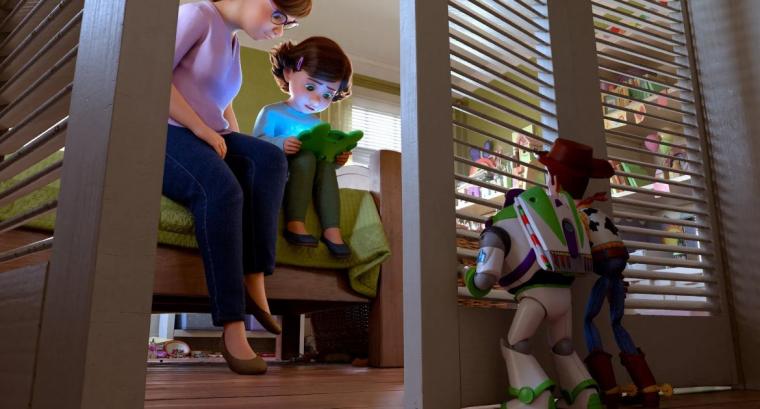
It was likely inevitable, then, that Lily would prove to not be evil at all, but simply misguided – doing what she thought was best for Bonnie out of loyalty and affection, much like the behavior of Maya Hawke's Anxiety in Inside Out 2. And of course, with high-tech gadgets not vanishing any time soon, and Lilypads to be marketed and sold to children worldwide, we're left with a squishy “all toys can get along equally” message. Let's recall, though, that Bonnie is all of eight years old. Couldn't a somewhat stronger message have been sent? What ultimately pushes Lily onto the side of good is a group chat that finds Bonnie's new “friends” cyber-bullying the girl for her insistence on playing with toys, a traumatizing event (for Bonnie and us) that almost crushes any hope of Bonnie connecting with Blaze. Upon discovering the online harassment, Bonnie's parents disable Lily's social-media function. Pointedly, however, they don't take the tablet away, and you're left with the grim realization that Bonnie's folks are just fine with their eight-year-old keeping Lily as her primary plaything – this after Dad barely questions, and certainly doesn't object to, the text command to put Bonnie's other toys in cold (garage) storage. Maybe Lily isn't the bad guy. Maybe the real villains are Bonnie's parents.
How old is too old for toys of the Woody and Buzz and Jessie variety? How young is too young for devices? For social media? How do parents successfully monitor their usage? How do they successfully get their pre-tweens to understand “not yet” in terms of what all their friends have that they don't? These are questions well worth discussing. They're also questions that Toy Story 5 is only nominally interested in exploring. Yet asking for such analysis is also asking for a different movie altogether, and the one we have is pretty darned good, and awfully damned entertaining.
I've spent much of this review detailing my disappointment. But that's primarily because so much of what's excellent is reliably excellent: the stunningly tactile animation; the cleverly choreographed action sequences; the plot turns that take you into wholly unexpected locales; the boatload of puns, wittily offhanded wisecracks, and personality revelations (I loved how playthings here sounded drunk when their battery power was low); the deeply earned sentiment – this film's gut punch being a near-match for the “When She Loved Me” scene in Toy Story 2 – that momentarily turns you into a puddle of goo; the endless, filter-free hilarity of Tony Hale's Forky; the return of Emperor Zurg, who this time arrives with some deliriously ticklish, Star Wars-y backstory. And even if the rest of Stanton's sequel went to pot, and despite not actually seeing her, I'd be nothing but grateful for the fresh, spiky, poignant Joan Cusack getting to be a film's unquestioned lead for the first time since … . Gosh, has that ever happened before? Flaws notwithstanding, Toy Story 5 is a definite treat, and if I'm not going into specifics regarding Conan O'Brien's Smarty Pants, that's completely intentional – viewers should discover how riotous that literal potty-mouth is all on their own. He's number one. And number two.
THE DEATH OF ROBIN HOOD
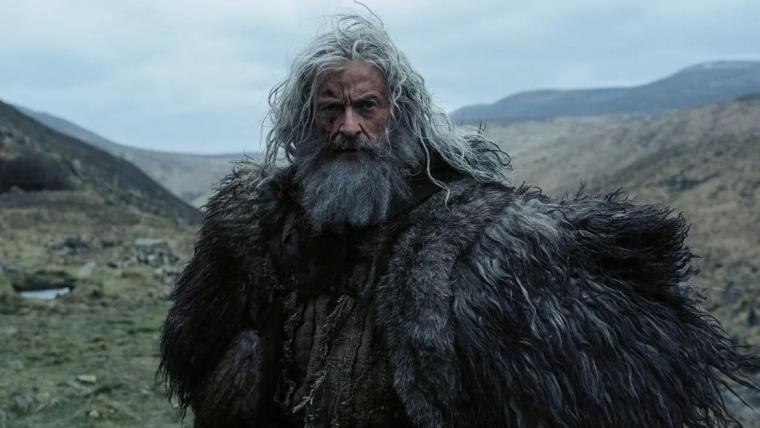
It's hard to spoil writer/director Michael Sarnoski's The Death of Robin Hood, considering that the title itself is a spoiler, if one not quite on the level of The Assassination of Jesse James by the Coward Robert Ford. But I don't want to offer spoilers so much as a warning. As a cultural figure, “Robin Hood” generally brings to mind cheeky forest adventure and robbing the rich to give to the poor and a particularly suave and wily animated fox animated by Disney. Before Sarnoski's movie is a half-hour old, we'll have witnessed Hugh Jackman's Robin and Bill Skarsgård's Little John scouring their naked bodies with soot, a number of arrows to the eyeballs, a vicious thug repeatedly stabbing a heavily pregnant woman in the stomach, a jaw forcibly ripped from its owner's face, and our titular “hero” shoving his blade into the head of a nomadic orphan girl. Kevin Costner's prince of thieves and Mel Brooks' Men in Tights this definitely ain't.
What it is, rather, is an admirably somber, ruminative, and, yes, occasionally über-violent drama inspired by an English ballad that dates back to at least the 17th century, and that suggests that this well-known, even beloved forest dweller was, in actuality, a common thug and cruel executioner – descriptions that Jackman's Robin Hood wouldn't deny. Sarnoski's film opens with Robin near the end of his days, having lived the past several solitary decades on the run from vengeance-minded relatives of those he wantonly killed. An unanticipated reunion with Little John brings him out of retirement for the obligatory One Final Mission, a plan that goes so awry so quickly that Robin is forced to mend on a secluded island nunnery under the care of renowned healer and spiritual guide Sister Brigid (Jodie Comer). Substitute the nunnery with an Amish community and the movie is a near replica of Peter Weir's 1985 Harrison Ford thriller Witness, its fish-out-of-water lead slowly discovering the simple pleasures of a hard day's work, the kindness of strangers (including a leper played by a direct, unrecognizable Murray Bartlett), a mentorship with a wide-eyed child (young heartbreaker Faith Delaney), and the love – platonic, in this case – of a good woman. Also as in Witness, our protagonist's history, in his newfound idyllic setting, is about to catch up with him.
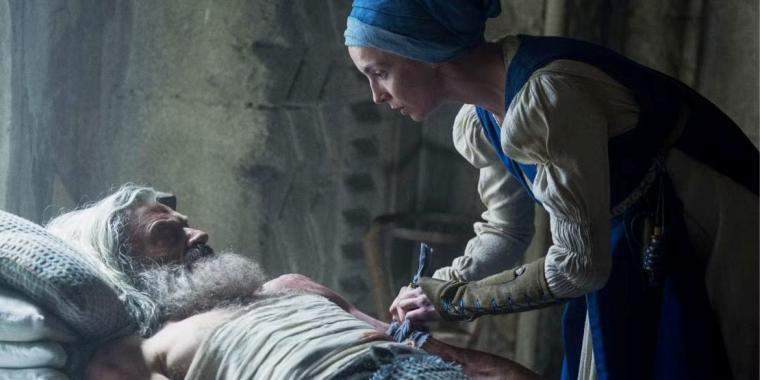
As I was reminded this past weekend when my mom watched Song Sung Blue for the first time while I did laptop work and pretended not to watch along, Hugh Jackman is so good at so many things. He can sing; he can dance; he's funny; he's charming; he can quietly break your heart. I think I like him best, though, in two particular performance modes: when he's stunningly pissed off (as in Prisoners and anything involving the adamantium-clawed Logan that isn't Deadpool & Wolverine), and when he's stunningly beatific (as in The Sheep Detectives and the latter scenes of Les Misérables). The Death of Robin Hood gives us the best of both. Despite his introspection, there is nothing remotely likable about the Robin Hood on view in the movie's first almost-half; brutally savage and unapologetic about it, Jackman's murderous thief is a fearsome creation, the actor leaning so heavily into vociferous rage that he barely seems human. All traces of Robin's bone-deep feral nature, however, vanish upon his island recuperation, where Jackman's complexly rendered sincerity convinces you that perhaps there can be salvation, even enlightenment, for the basest of souls.
To be sure, it's easier to buy this character switch with Comer around, her readings and bearing so unfussily ethereal, yet so simultaneously grounded, that she's like the physical embodiment of grace itself. That's what makes it particularly devastating when Robin, needing to purge himself, chooses to do so with a revelation that horrifies both Sister Brigid and the audience, leading you to wonder if the expected climactic confrontation might not involve the island's shifty new arrival (a sensational Noah Jupe), but the one island figure with whom Robin most deeply connects. The Death of Robin Hood's first section is unquestionably a tough sit – ugly and vile and nihilistic almost to the point of parody. (It's also challenging to hear during Jackman's and Skarsgård's olde-English conversation that's made even less comprehensible under roaring winds.) Its second section, though, delivers more-than-laudable loveliness, compassion, and hope, even as you anxiously wait for sins of a man's past to catch up with his present. This is by no means a traditional Robin Hood movie. Errol Flynn's aside, though, I'm hard-pressed to think of a finer one.
LEVITICUS
With my availability deeply compartmentalized, and not wanting to miss Toy Story 5 and the new Robin Hood, I was left with time for only one of two debuting, queer-themed indie releases this past weekend: director/co-writer Hayley Kiyoko's coming-of-age drama Girls Like Girls, and writer/director Adrian Chiarella's Australian horror film Leviticus. I'm hoping to get to Kiyoko's well-reviewed romance before it leaves the area. Genre buff that I am, though, I went with the Chiarella, which doubles down on It Follows' conceit that sex will kill you by suggesting that even thinking about sex will kill you – but only if you're gay. Happy Pride, everyone!
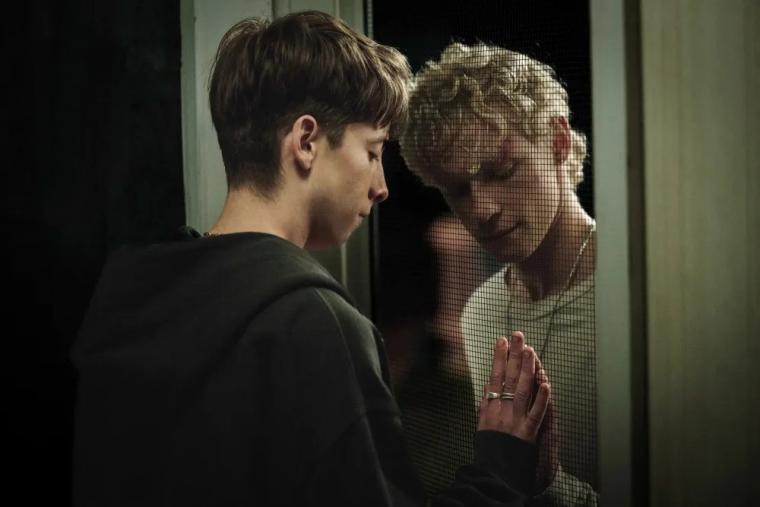
That simplistic description probably makes Leviticus sound unbearably offensive, but it's actually not at all; as supernatural shockers go, in truth, the movie is intensely sweet. With Chiarella's movie set in an economically wanting, fiercely religious community in Victoria, the opening scene introduces us to recent teen transplant Naim (Joe Bird) and high-school jock Ryan (Stacy Clausen), both deeply closeted and both, from the outset, deeply hot for each other. A few days after their makeout session in an abandoned mill, however, Naim sees Ryan kissing fellow high schooler Hunter (Jeremy Blewitt), and promptly outs the boys to Hunter's father. This, in turn, leads to a church-approved “deliverance” ritual designed to rid the youths of their homosexuality. It's less a ritual, though, than a conjuring, as from that moment on, Ryan and Hunter are hounded by invisible entities that want them dead – entities that, to the boys, look exactly like those they most desire. Hunter's malevolent spirit looks like Ryan, and it kills him. Ryan's malevolent spirit looks like Naim, and before long, Naim himself is pursued by a malevolent spirit that looks just like Ryan.
I sincerely hope that some enterprising grad-school students write thesis papers on Leviticus, because good lord is this thing rife with thematic elements deserving of in-depth exploration. A community that would rather see gay kids dead than happy. A plague that infiltrates your life the moment you acknowledge your queerness. A threat of impending death visible only to you, and in the form of the person you love most. Salvation only coming from a conscious decision to spend your romantic life monogamously. Had it been released in the mid-1980s at the height of AIDS paranoia, Chiarella's creep-out would've likely inspired about a zillion think pieces, and probably offended more people than it entertained. But after the passing of four decades, what might've previously come across as hectoring – Don't follow your instincts! Don't mess around! Don't be gay!!! – is now, blessedly and unquestionably, on the side of our protagonists. Naim and Ryan are adorable together. Those deserving of scorn are that dastardly “faith healer,” the members of his flock, and Naim's mom (former child sensation Mia Wasikowska, beguilingly brittle), who seems unduly convinced that worship services and a little black magic can pray the gay away.
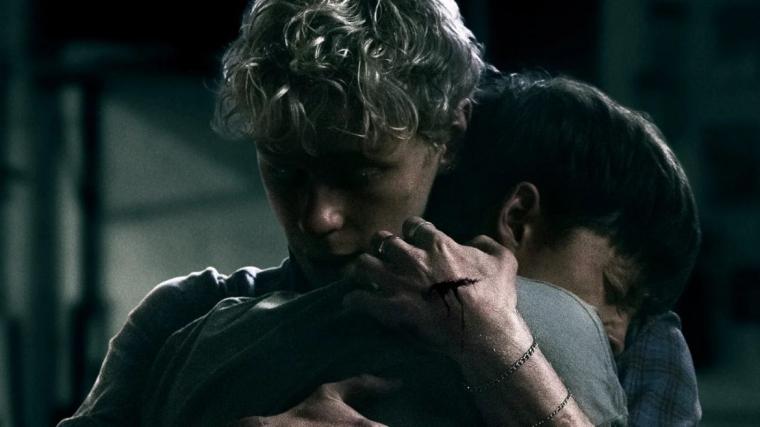
Leviticus is Chiarella's feature-length debut, and he's not yet an apparent wunderkind along the lines of Obsession's Curry Barker or Backrooms' Kane Parsons. His movie isn't frightening or arresting so much as merely unsettling, there are a number of awkward segues and tonal shifts (a meant-to-be-funny convenience-store bit is instead a weird, mood-killing misstep), and Chiarella's one nod toward a classical jump scare feels cheap – out-of-character with the rest of the film's admirable slow boil. It also would've been cool if, even once, we were allowed to see the nightmare version of Naim attacking Ryan, or another gay teen beset by what we're told is “the person you're most into,” be it a love interest or revered teacher or celebrity crush. Australian release that this is, how much nasty fun would it have been to see a kid – preferably one who deserves his fate – wooed, enticed, and slaughtered by Jacob Elordi?
Yet Chiarella already appears to be strong with the guiding of actors, Bird and Wasikowska especially, and his story's increasingly sad devolution keeps you invested even through the doldrums. He also delivers a whopper sequence of emotional manipulation – one that even this lifelong horror aficionado didn't see coming – that singlehandedly made me optimistic about this writer/director's long-term future. As many a hateful placard will tell you, the Bible's Leviticus 18:22 states: "You shall not lie with a male as with a woman; it is an abomination." Whatever. I'm personally grateful that supposed abominations such as Leviticus, and its supremely touching leads, are allowed to exist.