
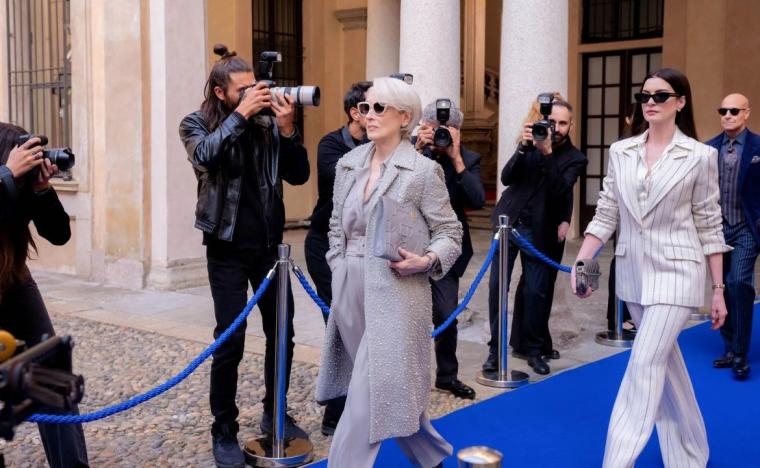
Meryl Streep and Anne Hathaway in The Devil Wears Prada 2
THE DEVIL WEARS PRADA 2
Given that the experience felt weirdly, unmistakably connected to my thoughts on The Devil Wears Prada 2, I'm going to do something unusual and begin with a few Spoilers – but they're not Spoilers for the movie. They're actually in regard to last night's episode of The Comeback, HBO Max's venerated show-biz sitcom starring national treasure Lisa Kudrow, and a series that premiered almost precisely one year before the first Devil Wears Prada hit theaters in June of 2006. If you're a fellow Comeback fan since the start and haven't watched the May 3 ep yet, please skip the following two paragraphs and move right on to “Chances are …” after the photo below.
Truth be told, I'm having a bit of a love/hate relationship with The Comback's third incarnation, but because that split is, like, 80 percent love and 20 percent hate, I barely have cause to complain. Nearly everything having to do with Mark and Billy is irritating me, and characters are being forgiven for past and present offenses, major and minor, with unconvincing, let's-get-this-over-with speed. Yet I still find myself smiling through tears with almost every new episode, primarily due to the weight of history. Has it really been more than two decades since we were first introduced to Valerie Cherish and company? The Comeback is cannily playing into our collective affection for our heroine and her world, and when, last night, Jane hauled out the hand-held camera she used to film her Oscar-winning short, and we finally learned Paulie G.'s last name (Giappino!), and Malin Akerman showed up, Juna's warmth and friendliness undiminished, to marvel at how she and Valerie have been friends for more than 20 years – and how amazing they still look! – it was all I could do not to bawl.
But there are other, more insidious notes being hit this season that also have everything to do with the passing of time. Because forget the nostalgia factor for a moment: Has the world of entertainment – the world in general – really changed so starkly that the incursion of reality TV, The Comeback's chief antagonist in 2005, now appears genuinely quaint in the face of infinitely larger, more soulless threats? It was one thing to learn, early on, that Valerie's new sitcom How's That?! was being secretly written by AI. It was quite another (or was it?) to discover, last night, that the show's own network leaked that information to the public, when Valerie herself was expressly told to not say a thing for fear of widespread outcry. Turns out the NuNet suits didn't mind people knowing about the AI. They wanted everyone to know. They just wanted that info released when it would best serve their purposes. That AI is coming after our jobs is scary. That certain individuals/companies/industries are benefiting from the mass job loss, be it from artificial intelligence or some other notion of modern-day “advancement,” and benefiting with a smile, is terrifying.
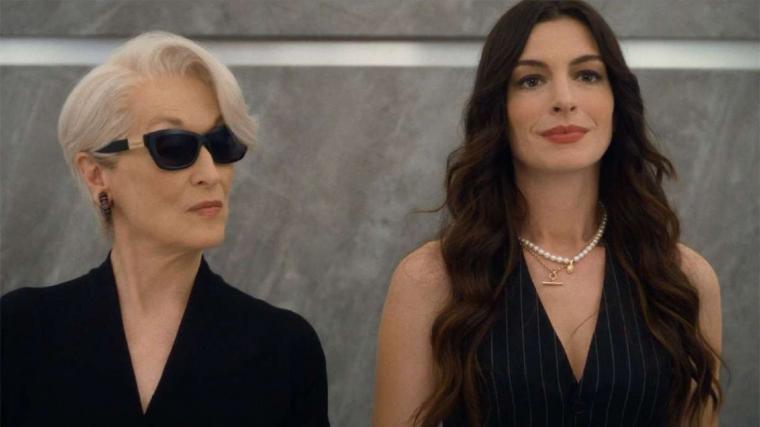
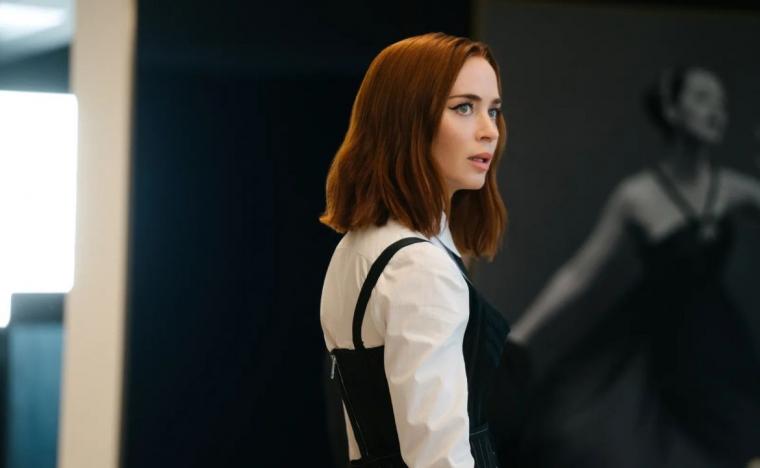
Chances are that returning director David Frankel's and returning screenwriter Aline Brosh McKenna's The Devil Wears Prada 2 would have been plenty entertaining, or at least entertaining enough, had it merely been a light, funny exercise in getting the band back together. Meryl Streep as imperious fashion editor Miranda Priestly, Anne Hathaway as plucky journalist-turned-personal-assistant Andy Sachs, Stanley Tucci as acerbic Runway mainstay Nigel Kipling, Emily Blunt as snippy ladder-climber Emily Charlton … . Who wouldn't want to watch these people, as these people, one more time? I was kind of lukewarm on TDWP1 back in the day, and even I was all but salivating at the sequel's first teaser trailer. But as with The Comeback, which has popped up like Brigadoon every decade or so, the winning, wonderful joys of nostalgia can only take you so far – there should also be a decent reason for the reunion. And to McKenna's credit, she found one, and it's one similar to the crisis being faced on the HBO Max show: People, our people, are losing their jobs, and the powers-to-be don't seem to mind.
Twenty years have passed since Andy left the Vogue-esque fashion magazine Runway for greener pastures, those pastures having led to acclaim as a New York-based reporter, a prize at a journalists' awards gala, and, seconds before accepting her tchotchke, the mass firing of Andy's entire newsroom … via text. Andy now needs a job, and Runway, it turns out, needs a life-saver, the publication currently under fire for ill-researched clickbait. (Runway's website, we learn, has all but wholly replaced the print version.) Re-enter Andy as the writer hired to save the mag's reputation. And along with Andy, re-enter the rest of the gang: Miranda forced to suffer indignities – she has to fly coach! – in order to keep her career afloat; Nigel recounting two decades of shifting workplace priorities; and, eventually, Emily, now a senior executive at Dior, potentially having an in toward saving Runway's PR and financial woes.
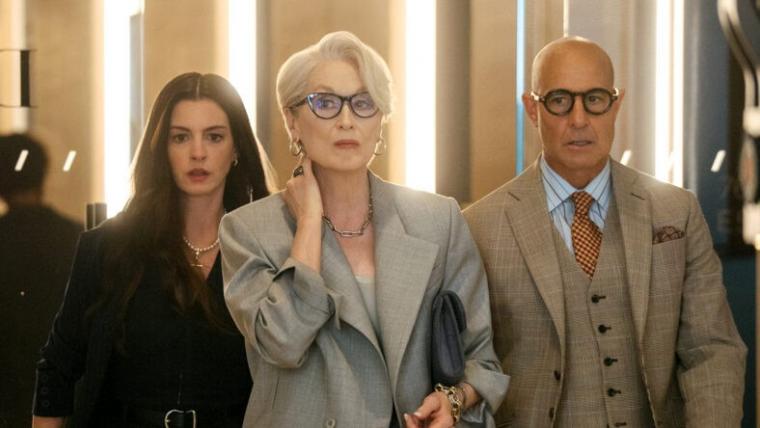
Despite our central quartet's character arcs and the introduction of a number of additionally significant figures, there really isn't much plot in The Devil Wears Prada 2, and much of what we get is borderline Muppet plotting. (As fresh and spiky as McKenna's dialogue tends to be, she's not above the employment of a deus ex machina, and the one here is predicted fairly early and easily.) Andy is also given another nominal love interest – Patrick Brammall's Peter – who, like Adrian Grenier's Nate, could've been excised with minimal loss, and perhaps should've been. (Kenneth Branagh has a similarly “Why are you even here?” role as Miranda's husband.)
And while I suspect they're some viewers' chief reasons for adoring the Prada movies in the first place, there are so very, very many shots of Miranda et al attending high-end fashion functions that I routinely, mentally vacated the proceedings entirely, the way I do during any number of interminable battles in Marvel flicks. The couture-minded will no doubt delight in the endless “Look! It's her/him/them!” cameos in which the camera lingers just a tad too long on yet another (to me) unrecognizable face. I just wanted one more shot of poor Miranda, having been schooled about her no-longer-acceptable behavior, struggling and panting as she hangs up her coat by herself, or blindly grasping for ways to say “plus-size” that won't land her a sit-down with human resources.
Tucci's Nigel, happily, is exactly as you remember him, and for the most part, so is Blunt's Emily; she's less anxious now, but just as snidely brittle, and just as hilarious. Hathaway, meanwhile, is as endearing as ever, and Andy's earned confidence looks great on her. It's Miranda who seems the most fundamentally changed, and that's somewhat surprising, because technique-wise, Streep isn't doing much that's noticeably different from 20 years prior. She still speaks sotto voce at all times; she can still evince withering disdain with a single ice-pick glare. Yet this Runway boss is clearly rattled, and Streep, that master of nuance, makes you aware of Miranda's crumbling interior through the most microscopic of adjustments.
Every time she's forced to either publicly or privately eat crap, you sense a slight twinge in Miranda's bearing – an instinctive stiffening, delivered with the tightest and tiniest of smiles, suggesting “I'll go along with this … for now.” Still, it's not escalating rage (or thoughts of revenge) that exudes so much as panic – Miranda's subtly implied realization that, at age 75, this might truly be the end of the line. Streep looks flabbergastingly beautiful in TDWP2, and when McKenna's script gives her a good line, she's funny as hell. She's also, every once in a while, fiercely moving, the way Miranda was in the first movie's famed makeup-free encounter. Streep's commitment to the underlying theme of progress at our souls' expense keeps the inherent blitheness in check.
Miranda, obviously, was the titular Devil in The Devil Wears Prada. Yet while she exhibits some occasional monstrousness in its followup, we're forced to confront the idea that even an employer as rigid and authoritarian as Miranda was nothing compared to the corporate evils that Runway – and, by extension, all of journalism – currently faces. The unseen advertisers demanding more mindless “content” and less depth. The finance-bro heir who wants to sell off the magazine for spare parts (and is so repellent he's inevitably played by B.J. Novak). The Silicon Valley billionaire (a legitimately unrecognizable Justin Theroux) who sees AI as the ultimate means to our end and is fine with that. There are loads of devils in The Devil Wears Prada 2, and for all of the frothy fun this sequel provides, their pitchforks do sting. That makes the generosity extended to our returning foursome, whose portrayers look to be having a blast together, not just welcome, but necessary. While their actions may sometimes be questionable, the characters' humanity is never is doubt, and that Frankel's film officially opened summer-blockbuster with nothing in the way of superheroes or pricey visual effects – and with excellent box office, to boot – is heartening in the extreme. Go figure: Audiences still like seeing regular ol' humans on-screen. Here's hoping Hollywood remembers the message. That's all.
HOKUM
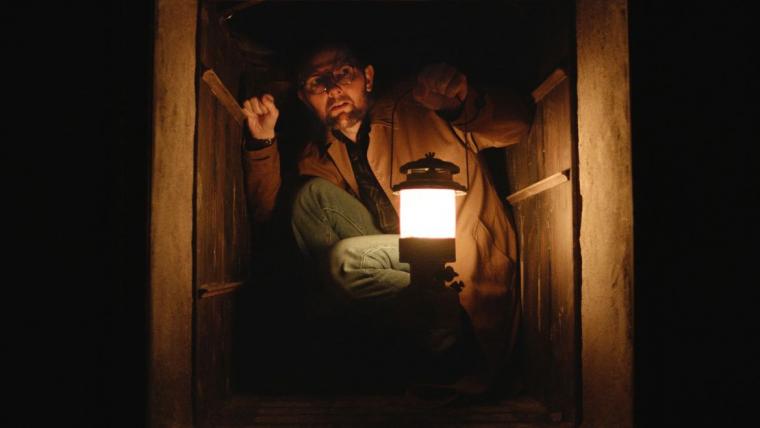
It takes a bit of nerve to title your horror movie Hokum considering that, if the movie sucks, that'll likely be the first word reviewers use to condemn it. But Damian McCarthy's simultaneously supernatural and upsettingly real-world fright film doesn't possess any of the attributes associated with that description. The Irish writer/director's edgy outitng isn't nonsense, isn't trite, and despite having loads of company in the haunted-house (in this case haunted-inn) genre, isn't terribly clichéd. Rather, it's a strong, chilling work boasting startling imagery and a first-rate Adam Scott performance, and the one and only time “hokum” is referenced on-screen is when Scott's character uses the word to pooh-pooh the whispered-about evils he's due to confront. Boy, will he learn otherwise.
Scott's novelist Ohm Bauman enters the film the way more horror-movie protagonists should: as an unmitigated sonofabitch who, you instantly feel, kind of deserves everything he's gonna get. Stuck on how to complete his most recent book and needing to deposit his late parents' ashes, Ohm travels to the rustic Irish inn where his folks honeymooned, and from the start, the man is an aggressive jerk. He chides the groundskeeper (Michael Patric) for his admittedly violent practice of keeping goats from climbing guests' cars. (This is apparently a real thing that happens with loose goats, at least in Ireland.) He insults the inn's owner (Brendan Conroy) for recounting a cautionary fable to a young guest. He demeans the desk clerk (Peter Coonan), who's also the owner's son-in-law, for his tardiness. He shoos away the inn's bellhop (Will O'Connell), himself a fledgling writer, by placing a spoon on a lit candle and burning the guy's hand with it. The only inn staffer Ohm doesn't treat abominably is the bartender Fiona (Florence Ordesh) … and it's she who, following an early surprise regarding the author's state of mind, goes missing for weeks. Ohm feels compelled to locate her, and asks whether she may be in the honeymoon suite – the one his parents booked – that has been locked for years. Oh no, he's told. No one ever goes in that room. There's a witch there. “Hokum,” says Ohm.
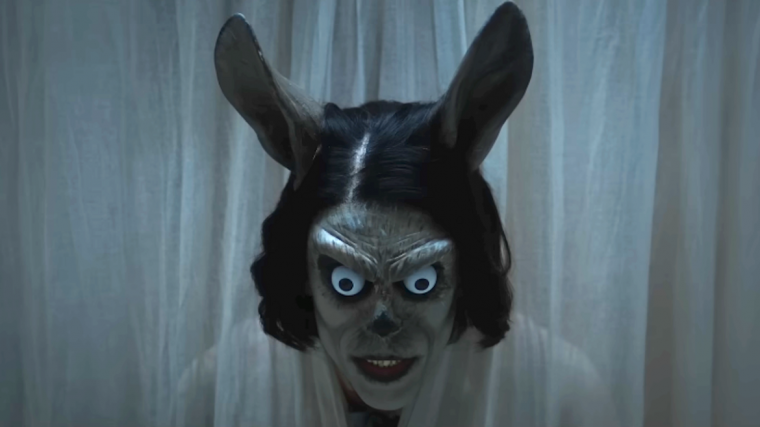
As you've likely guessed, Ohm finds his way into the suite – receiving help for the B&E from a local vagrant (David Wilmot) who reportedly murdered his wife – and from that point on, Hokum delivers both a ghost story and a sadder, more recognizable tale of banal human evil leading to horrific ends. I was quite taken with both of them. The latter, in its grubby true-crime ordinariness, completely holds together, and is affecting as a demonstration of the lengths people will go to preserve even the slightest levels of comfort and professional standing. Amazingly, though, the supernatural angle (mostly) holds together, too, at least in retrospect, and despite presenting us with fearsome apparitions, visions of the underworld, encounters with the deceased, and a half-human/half-donkey hybrid with bulging eyes that honestly creeped the bejeezus out of me. This creature, also played by O'Connell, goes by the moniker Jack the Jackass, and he's already up there with Aunt Gladys and Nicolas Cage's Longlegs weirdo as the decade's most immediately recognizable fright-flick figure. Apparently, Jack was the host of a children's show from Ohm's youth, and I'm praying that no grade-schooler was ever forced to watch that program while not in the presence of a therapist.
Because it's evidently necessary that every shocker of the last decade or so be at least peripherally about trauma, so it is with McCarthy's latest, and I might've quietly sighed when we learned that Ohm's haunted-inn experience was directly connected to his parents' deaths. (Whatever happened to randomness?) But that was really the only element of Hokum that distracted me. Scott proves not just ideally but perfectly cast – he can play bastards who, through the actor's inherent likability, you still find yourself rooting for – and while the blaring sound effects are doing perhaps too much work, the film is filled with unsettling images, jump scares, scenes of exquisitely sustained tension, and universally fine acting across the board. Although I haven't seen the writer/director's Caveat from 2020, I really enjoyed 2024's Oddity and admired this third feature even more, suggesting that “Damien McCarthy” will be a name I instantly, appreciatively remember the next time it shows up among a fright film's credits. I'll likely remember “Jack the Jackass,” as well, but I'd really prefer to not reunite with that fuzzy-eared freak ever again.
DEEP WATER
I suppose if you're an employable-enough director to have three films released over a nine-month period, at least one of them has to be fairly decent. And so we now have Renny Harlin's double-whammy survival thriller Deep Water, which is beyond cheesy, but also terrifically engaging, and immeasurably livelier than the noted schlock-meister's The Strangers: Chapter 2 (from last September) and Chapter 3 (from 12 weeks ago). A plane-crash flick that's also a rampaging-sharks flick, Harlin's new offering, with its subtitles for song lyrics and book titles as well as Chinese dialogue, probably should've been the camp spectacle of 2026, intended or otherwise. Yet there's something to be said for the man's – and his screenwriting quartet's – investment in cornball earnestness. You don't necessary care about anyone's fate. But the situations are so catastrophically grim, and so atypically well-staged, that with one spectacularly hateful exception, you don't want to see anyone perish, either.
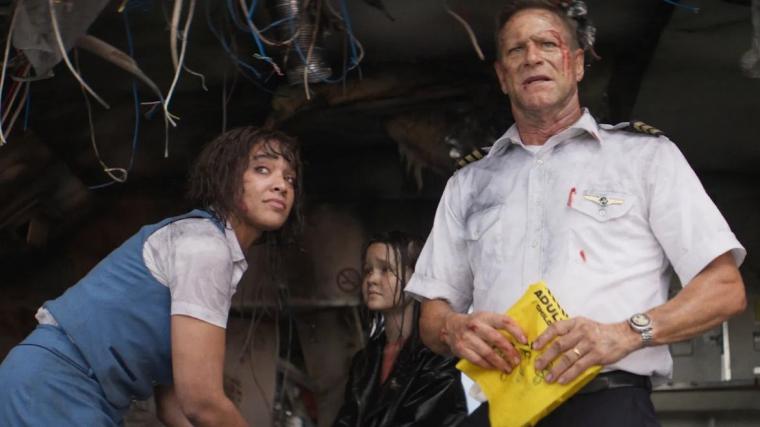
Aaron Eckhart plays Ben, first officer on a flight from Los Angeles to Shanghai, whom we know Is Hurting Inside because he's fishing for last-minute assignments to avoid spending time with his critically ill seven-year-old. Sir Ben Kingsley plays Rich, the international flight's pilot, whom we know is Dead Meat because he makes immediate mention of his incipient retirement. (Not to toss ageist shade, but considering Kingsley is 82, maybe it's time that Rich made flying more of a hobby.) In addition to the other crew members, the manifesto is a who's-who of Airport, or Airplane!, stereotypes: the tracksuited athletes, actually e-sports competitors, who continue their rivalry even after tragedy strikes; the sweet computer geek crushing on a flight attendant; the newly blended family whose pre-teens don't get along; the lonelyhearts who coyly smile at one another from across the aisle; the punchline-prone grandma. (In perhaps the script's wittiest reference, after they find themselves trapped underwater, said geek refers to said grandma as “Shelley Winters,” instantly informing us that Deep Water knows exactly what kind of movie it is.) And then there's Angus Sampson's traveling businessman Dan, who would be the screen year's most odious creation to date in a world in which Busboys didn't exist. A growling, chain-smoking lout who blames First Officer Ben for the inevitable life-threatening mess, this guy is clearly only around for the pleasure of watching him experience a particularly gruesome death scene. He gets one. I wish it had come 90 minutes sooner.
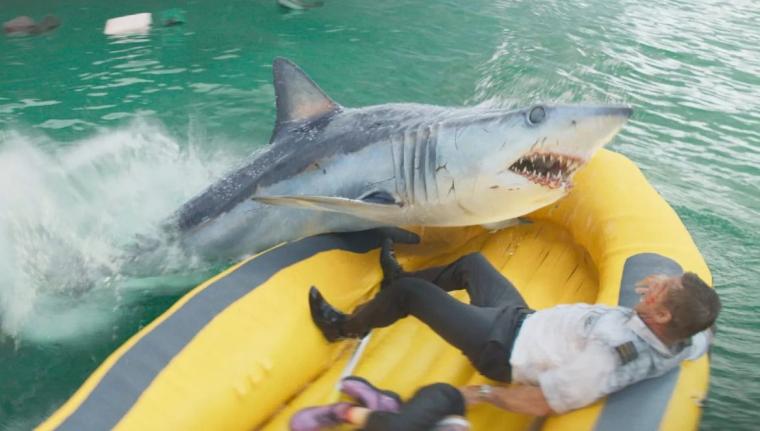
I inwardly chuckled through the introductions to all of these people, amusing myself by making mental notes on who was clearly expendable and who would no doubt reach the end credits intact. Then there was a fire/explosion in the cargo hold – one caused, naturally, by that dumb-ass Dan ignoring safety regulations – and I was no longer laughing. The plane crash into the Pacific, and the airborne traumas leading up to it, are harrowing, and go on for an achingly long time; I'd say the plot-goosing mid-air disaster lasts a full 10 minutes. There's some moderate fun in Eckhart's decision to never raise his voice above a Clint Eastwood tough-guy stage whisper even when the surrounding activity is punishingly loud. But mostly, with the actors totally selling their pain and panic, this sequence hurts, and the cast remains committed to the bit after the plane winds up broken in pieces in shark-infested waters, the creatures in no way differentiating the film's empathetic characters from its assholes. They're hungry, and they'll eat whomever they please.
It's easy to wish Deep Water were a better movie – one with more polished CGI and less thematic moralizing and no Angus Sampson. But the Deep Water we have is unexpectedly solid. Tense and scary when it needs to be, shot with more-than-occasional visual invention, unafraid to knock off blameless figures whom we quite like, and boasting greater emotional involvement than is the genre norm (with young Molly Belle Wright and Elijah Tamati particularly affecting), the film is a totally serviceable reminder that Renny Harlin isn't to be written off as a late-in-his-game hack just yet. Prior to this, my favorite movie on his résumé had long been Deep Blue Sea, the so-goofy-it's-irresistible 1999 shark thriller that found LL Cool J revealing the secret to a perfect omelet and gave Samuel L. Jackson the most memorable screen exit of his career. I'm not sure if Deep Water will ever replace that title as my Harlin high point, but one thing, now, seems evident: This director should be kept off dry land as much as possible.
ANIMAL FARM
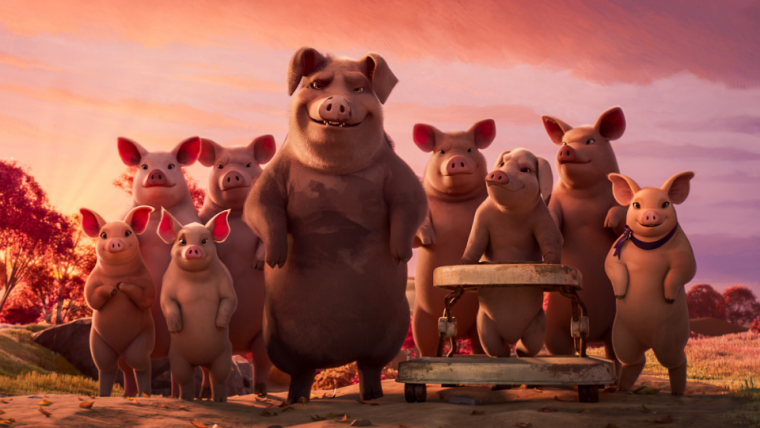
It's hard to tell who's gonna be most disappointed by director Andy Serkis' take on Animal Farm: adult fans of the George Orwell novel who won't abide changes to the material and the insertion of hip-hop numbers and fart jokes; kids who can't possibly be expecting this talking-animals animation to also be an anti-communist and/or anti-capitalist screed that kills off sympathetic creatures (albeit off-screen); viewers completely ignorant of the Orwell who likely won't make literal heads or tails of it; or anyone simply hoping for a semi-coherent take on the 1945 book that, for many of us, made required middle-school reading a legitimate pleasure. This thing is so weird. Too outlandishly fascinating to be a debacle, too presentationally ambiguous to be in any way satisfying, Serkis' and screenwriter Nicholas Stoller's Animal Farm almost feels like a genre of its own: Grad School Kiddie Lit. I largely hated it, but can't say I wasn't riveted, principally because I couldn't believe what I was witnessing.
Even the film's Angel Studios distributors – primarily known for pro-faith-, pro-outrage, pay-it-forward titles including 2023's human-trafficking smash Sound of Freedom – don't seem to know what to do with this thing, the previews and poster stating that the movie is best suited to audiences ages 11 and up, despite nearly everything on-screen suggesting a median viewing age of eight. Following the Orwell, Serkis' Animal Farm concerns the collective revolt that leads to formerly enslaved birds and beasts choosing to run things for themselves, and much of it is identifiable from its 81-year-old source. We get the litany of newly imposed edicts – no animals shall wear clothes, no animals shall kill other animals, “four legs good, two legs bad” – and witness those rules being systemically broken by the charismatic boar Napoleon (voiced by Seth Rogen) while the faithful fall dutifully, tragically, in line. It's a phenomenal literary parable, and completely ripe for a contemporary adaptation. (There have been others: a 1954 version – funded by the CIA! – designed as anti-communist propaganda, and a more milquetoast 1999 TV version for Hallmark.) But Orwell's Animal Farm is all analogy all the time – gloriously so. And because this current rendition doesn't give us any sense of what, precisely, is being attacked and largely satirized, Serkis' take just comes off as deeply confused.
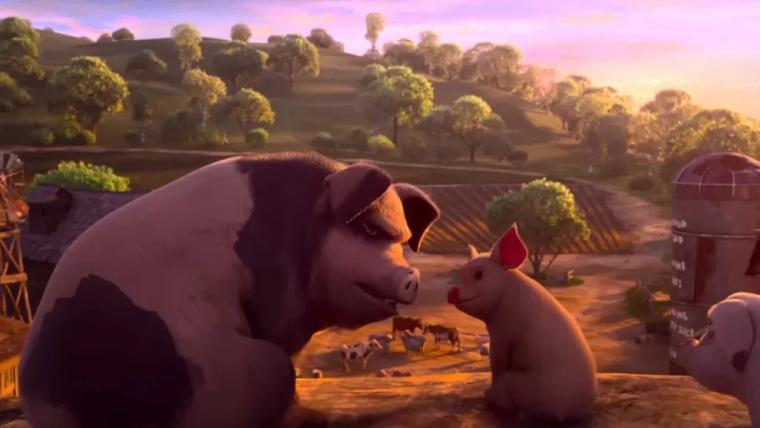
Although I really can't imagine them enjoying the film beyond the way the eight-and-under set enjoys everything, grade-schoolers might simply take the movie as evidence of how absolute power corrupts absolutely – a cautionary tale (or, per the poster, “tail”) about how Napoleon gets too big for his britches and needs to be taken down a peg or two. But Angels Studios is strongly pushing its product as an anti-communist fable, the company's Web site stating: “As the pigs consolidate control, truth is erased, dissent is crushed, and the farm descends into a ruthless dictatorship – fulfilling Orwell’s warning about the dangers of communism.” This sentiment would seem to cater to the studio's supremely vocal right-wing base. If that's the case, though, why is our chief villain so very very obviously Donald Trump? Napoleon, a corpulent worshiper at the altar of luxury, calls his rival for Animal Farm's leadership “boring” and decries his adversaries as “losers,” and shares unmistakably Trump-ian phraseology: “Everyone's saying I'm doing a really good job.” Serkis' film is anti-communist and anti-capitalist and anti-Trump to the point that you don't know what it's pro-, beyond, that is, some vaguely Disneyfied placation about how we all need to work together and be friends … but not in some sort of godless Commie way. (Stoller has even added to Orwell's tale a purely virtuous pig, Gaten Matarazzo's Lucky, for apparent “relatability.”) Mixed messaging isn't inherently a deal-breaker, but it kind of is when you're not remotely certain what messages are getting mixed.
What's particularly dispiriting about Serkis' adaptation is that he would seem to possess the right amount of ironic wit, and British wit, to do Orwell's fable justice, even if Stoller remained adamant about allowing Rogen plenty of gas-passing gags and free reign to the performer's trademark stoner-chortle. (Rogen's not not-funny here, but it's shtick without an identifiable point.) And Heaven knows the vocal cast is estimable, with various critters and humans enacted by Kieran Culkin, Woody Harrelson, Jim Parsons, Kathleen Turner, Steve Buscemi, Laverne Cox, Serkis himself, and Glenn Close, the latter of whom, as billionaire Freida Pilkington, is animated as a sleek James Bond villain with 22nd-century gadgetry yet sounds uncannily like the J.D. Vance “Mamaw” Close played in Hillbilly Elegy. Yet while the animation boasts some tactile vibrancy, this Animal Farm is still an unholy mess, and the only out-loud laugh it delivered came during the end credits when, as usual, this Angel Studios release demanded that we point our phones to the QR code placed on-screen – to one of two, actually. I didn't register the exact wording, but one of them was essentially saying “Tell us you want more movies like this!” The other was “Tell us to never release a movie like this again!” This lifelong proponent of keeping phones shut off in cineplex auditoriums prevented me from scanning either option. Being the only patron at my screening felt like statement enough.