

The Sheep Detectives
THE SHEEP DETECTIVES
The Sheep Detectives is kind of like Babe meets Paddington meets The Wild Robot meets Agatha Christie … which means, unexpectedly yet delightfully, it's also kind of perfect.
Because the premise was so bizarre and the trailer so outlandishly goofy – the sort of thing you view and immediately think “That can't possibly be a real movie, can it?” – I was hoping that this talking-animals mystery comedy would be fun. Even mildly fun yet laudably nuts would've sufficed. I certainly didn't expect profundity. For all of the material's silliness and slapstick, and we're treated to generous helpings of both, director Kyle Balda and screenwriter Craig Mazin don't shy away from serious subjects that most family entertainments wouldn't dare approach: mortality; bigotry; the necessity of grief; where lamb chops come from. But whether the filmmakers are going for poignancy or yuks, the overriding tone remains wistful, respectful, devastatingly sincere. Kids should love it. Adults likely will, too, though for different reasons. Believe me when I say that The Sheep Detectives utterly wrecked me. While I giggled a lot and smiled almost constantly, it wasn't the jokes that, for three days following my viewing, made me unable to even think about the movie without welling up.
If you're aware of the film's setup, but only its setup, such a reaction no doubt sounds insane. Night after night, in a bucolic English meadow, shepherd George Hardy (Hugh Jackman, exuding crinkly warmth) reads to his flock from a series of murder mysteries – a pre-bedtime ritual that, amusing himself, he hopes the sheep enjoy as much as he does. Little does he know that his woolly charges not only appreciate the stories, but actively follow them, bleating to one another their suspicions and predictions regarding the tales' ultimate culprits. One morning, however, George himself is discovered dead outside his trailer. And while local constable Tim Derry (an adorably dim Nicholas Braun) initially presumes a heart attack, the sheep know better: Someone has killed their beloved shepherd, and as Officer Tim is clearly unfit for the task, it's up to the flock to solve the crime.

With Mazin's adaptation based on Leonie Swann's 2005 novel Three Bags Full, this narrative is, to put it bluntly, madness. From the start, though, it's madness bursting with colorful characters. As in any whodunit worth its salt, we're given a bevy of suspects, and the locals that Tim, visiting reporter Elliot Matthews (Nicholas Galitzine), and the sheep investigate all seem potentially shady: the rival shepherd (Tosin Cole); the innkeeper (Hong Chau); the butcher (Conleth Hill); the priest (Kobna Holdbrook-Smith). Before long, there's also a newly arrived American (Molly Gordon) and her British lawyer (Emma Thompson), plus an unseen South African acquaintance only available by phone. The actors all dutifully hit their marks, even if, aside from Braun and the reliably tart Thompson, no one is given much of a showcase. For true personality, you have to turn to the sheep, and it's been years – probably since 2023's The Wild Robot – since I've been so knocked out by star-heavy vocal work that results in such rich, dyed-in-the-wool (sorry) performances.
Chief among the aural ensemble is Julia Louis-Dreyfus, who's the closest The Sheep Detectives has to a lead, and whose readings are heart-meltingly unimprovable. Playing the purportedly wisest of the flock, the one who always guessed the murder mysteries' killers before George could reveal them, her Shetland Lily is rather full of herself, and routinely sighs at the comparative empty-headedness of her neighbors: Regina Hall's beauty-obsessed Cloud; Patrick Stewart's bombastic Sir Richfield; Bella Ramsey's hyper-curious Zora; Rhys Darby's lumbering Wool-Eyes; Brett Goldstein's aggressive and twinned Norfolk Horns Reggie and Ronnie. (Goldstein is achingly hilarious in these roles; he should be cast opposite himself more often.) There's also a runt of the litter – a much-maligned “winter sheep” ignored by the others, and even refused a name, for the high crime of being born in the wrong season. Only two sheep tend to escape Lily's judgment: the Icelandic Leadersheep Sebastian (Bryan Cranston), the only member of the flock who ventured outside the meadow, and Lily's ally Mopple (Chris O'Dowd), the only one, it appears, whose memory extends beyond what the sheep choose to remember.
This detail is significant, because it's tied to what makes Balda's and Mazin's movie not just a great time, but a startlingly affecting one. Sheep are notoriously not the brightest beings in the barnyard; Lily herself tells the flock that when humans want to insult other humans who refuse to think for themselves, they refer to them as “sheep.” Here, though, the four-legged creatures aren't dumb – they're deliberately dumb, having mastered the practice of instantly forgetting (after three concentrated seconds) anything from their lives the least bit unpleasant or traumatizing. Even death, especially death, is conveniently erased from their minds, which is how George's sheep have convinced themselves that animals don't die. Death is something that happens to humans in George's whodunits. Animals simply turn into clouds when their time on Earth is over, and are therefore always still here, gazing down at Earth from above. Only Mopple, cursed with an inability to forget, knows the truth. And as The Sheep Detectives proceeds, you gradually realize that the solving of George's murder is only a pretext for what the film is actually about: Lily, and eventually the entire flock, facing the impermanence of life, and learning that, despite the pain involved, living with heartbreak is preferable to living in willful ignorance. How's that for a murder-mystery twist?

I sat through the movie's closing credits partly to dry my eyes and compose myself before hitting the lobby, and partly to relish the thumpy joys of the Proclaimers' “I'm Gonna Be (500 Miles),” which longtime friends will perhaps remember as “Mike's go-to karaoke number.” (Let's hear it, by the way, for a PG-rated family film brave enough to end with a song that references both drunkenness and adults sharing the same bed.) That's when I saw what was simultaneously the most and least surprising title card of 2026 to date: the one that listed Project Hail Mary directors Phil Lord and Christopher Miller as executive producers. Surprising because, hey, I had no idea! Unsurprising because of course they had hands in this. The Lego Movie, The Mitchells vs. the Machines, the Spider-Verse flicks … . No other Hollywood talents are currently more adept at inserting grown-up gravitas into traditional family fare, and I'm certain that the hiring of writer Craig Mazin – the Emmy winner probably best known for HBO's Chernobyl and The Last of Us (!) – was no accident, either. This isn't a movie about loss. It's about survival, and finding ways to thrive, under the shadow of loss. With, you know, crime-solving animals and Nicholas Braun doing an Inspector Clouseau.
The Sheep Detectives is often riotously funny, especially in the feisty meadow badinage and Lily's and Mopple's apoplectic terror at crossing their first paved road. (This latter bit led to a brainy visual gag that made the two-dozen folks in my auditorium, 95 percent of them adults, howl for a good 10 seconds.) Meanwhile, the effects that give the animals their remarkable believability – a blend of puppetry and high-end animation – are seamlessly executed; you accept these beings as real, full stop, the way you do with Babe the Pig and Paddington Bear. Yet if the movie endures the way I think it might, it won't necessarily be for the visual stunt or copious wit or memorable vocal portrayals, or even for the murder mystery that, semi-meaningless though it is, is pretty great. (The whodunit element plays fair in that you actually can assemble the clues and correctly guess the culprit – not that I did, mind you.) What will ultimately make The Sheep Detectives last is its faith in our intelligence – and by “our,” I mean all of “our.” The grown-ups among us aren't insulted. Kids aren't pandered to. Mazin's script and Balda's supremely sensitive direction allow everyone different avenues of entry that lead to the same place of bighearted unity. I couldn't love this film more if I tried.

BILLIE EILISH – HIT ME HARD & SOFT: THE TOUR LIVE IN 3D
Unless Chloé Zhao has an impending sequel to Hamnet that I'm unaware of, 2026 likely won't deliver more on-screen wailing and sobbing than the concert documentary Billie Eilish – Hit Me Hard & Soft: The Tour Live in 3D.
A few tears come courtesy of the star herself upon reading a best-wishes note from her brother Finneas O'Connell, Eilish admitting that her colossally successful 2024-25 tour was the first to not feature her ultra-supportive sib by her side. But most of the shrieking and weeping is reserved for the event's fans, the ones we see here attending one of Eilish's Manchester, England gigs. We're given so many shots of these kids – and, sometimes, their evidently supportive parents – that the faithful are practically the film's supporting cast, and they're endearingly, endlessly watchable. Traditionally, in concert docs, I'm annoyed when large swaths of time are devoted to the crowd's enthusiasm, wishing the movie would stick to its subject. Here, the fans are the subject. At 24, Billie Eilish is, of course, already a thunderously powerful, multi-awarded performer. In its most abjectly heartening moments, with the frequent cutaways to acolytes experiencing what might be life-changing experiences, Hit Me Hard & Soft demonstrates the responsibility behind all that power.
It demonstrates the empathetic playfulness, too. Clearly aware of what she means to her crowds of many thousands, Eilish appears ecstatic to have her admirers sing along to every single one of the movie's nearly two-dozen songs, and she encourages smart-phone flashlights throughout. The artist also knows, though, that she has such control over the amphitheater that the devoted will shut up when instructed, allowing her to produce a lyrical echoing effect in pin-dropping silence before the happy screaming again commences. And because the Hit Me Hard & Soft show itself is so devoid of typical arena-theatre niceties – no wardrobe changes, no background dancers, relatively few pyrotechnics – Eilish can instead make magic through her handheld 3D cameras, which take us through the crowd and below the stage in ways previously unimagined. In her football jersey over a T-shirt, baggy shorts, and high-top sneakers, Eilish would no doubt have delivered a performance for the ages under any circumstances. But a movie needed to be made. Enter James Cameron.

In truth, I reflectively flinched the first time I heard that Cameron was involved, and would consequently be subjecting us to yet another of his Something Never Seen Before experiments. Yes, Jim, you re-sank the Titanic and re-ignited the Alien franchise and introduced the world of Pandora – can't you leave Billie Eilish alone?! Yet I'm forced to applaud whatever cameras and whatever know-how Cameron gave the musician on their wondrous employment for Hit Me Hard & Soft, which easily make up for the stage show's otherwise relative absence of killer visual effects. Although the movie is also screening locally in 2D, I treated myself to the full bells and whistles, and while it'll likely play well regardless of presentation, I urge you to do the same. The images that Eilish captures with her hand-held 3D camera are glorious, even when they're merely sub-stage-level shots of the performer racing from one designated starting point to another. And when the (other) cameras make full use of their potential, the 3D effects are ridiculously enjoyable. Toward the finale, confetti-cannon output is so real-seeming you feel you can literally touch the streaming wisps of paper, and in the movie's first 15 minutes, a pair of on-screen waving hands at the bottom of the screen was so jolting that I immediately assumed they came from a patron sitting in the row ahead of me. Cameron's cameras work for both the concert's live audience and the film's audience.
The thing about technical marvels, though, is that you tend to forget about them after they've done their work on you for a while. Eventually, regardless of visual invention, we stopped watching Toy Story and Cameron's Avatar (and, to use a current example, The Sheep Detectives) for the visual wonders and got hooked (or not) on the stories. As a concert doc, obviously, Hit Me Hard & Soft doesn't offer much in the way of narrative; the performer's history was already well-covered in director RJ Cutler's Billie Eilish: The World's a Little Blurry in 2021, and the behind-the-scenes sequences we get here, while engaging, are hardly illuminating. (The most informative thing I got from these infrequent asides was learning that Eilish keeps a backstage room ready for tour members to play with, and potentially adopt, rescue puppies – a practice that Cameron says he'll adopt on his next movie shoot. Someone keep me posted if that actually happens, 'cuz I'm dubious.) But you don't need story with this thing. You just need amazing concert scenes, which we're treated to in abundance.
Speaking as more of a casual fan than a devotee, I enjoyed Eilish's pop, hip-hop, and techno bangers as much as her more reflective ballads that inspire so much copious on-screen bawling, and just when you're perhaps getting to used to the spectacle, there's a late-in-the-day special guest to enliven you all over again. (“Surprise!” says Eilish to the crowd, though the arrival is less a surprise than an inevitability – a wonderful one regardless.) At no time was I bored, and this despite a longtime personal disinterest in concert docs that don't have the names Jonathan Demme or David Byrne in the credits. Fans will be overjoyed and newbies should be intrigued, and Billie Eilish – Hit Me Hard & Soft: The Tour Live in 3D will likely make buckets of profit thanks to, and perhaps despite, James Cameron's involvement. In one of the film's behind-the-scenes moments, we hear the auteur state that the co-directed movie is really more Eilish's than his, and that when the finished product is released, the credits will state, per his hand signals, “DIRECTED BY BILLIE EILISH,” his own acknowledgment merely being a lowercase “... with James Cameron.” Guess what happens. Cameron gets top billing in the first end-credits title card. Probably only because of the alphabet, right?

MORTAL KOMBAT II
When I first saw the trailer for director Simon McQuoid's Mortal Kombat II, which I'm pretty sure was last July, the only thing that truly stuck about those three minutes was the “II.” When, I thought, did “I” come out? I promptly put the whole thing behind me, and after many months passed with no word on a release date, I presumed the threatened sequel was something that wound up either shelved or ignominiously dumped onto some streaming platform. But then the preview started preceding movies again a few months ago, and just last week, I was finally curious enough to visit my review archive to see if I had somehow seen the original Mortal Kombat yet had lost all memory of the experience, much the way the titular characters in The Sheep Detectives conveniently forget trauma. It turns out I did see the first one, which was also directed by McQuoid. Furthermore, I liked it. How had that 2021 video-game adaptation – a work, to quote myself, “just senseless and disgusting and profanely funny enough for me to have a great guilty-pleasure time without feeling the least bit guilty” – so completely left my brain?
I mostly blame the year. Mid-to-late-COVID was when Warner Bros. released its entire 2021 lineup – including eventual Oscar winners Dune, King Richard, and West Side Story – on HBO Max (or whatever it was called then) the same day said titles hit whichever cineplexes were open for business. Cheapskates like me tended to stay home and watch from the unmasked comforts of our couches, where it's always easier to forget what you just sat through. But while viewing Mortal Kombat II at an actual movie theater this past weekend, I realized there was likely another reason for my memory loss: There wasn't much to remember. This isn't a major ding on McQuoid's sequel, which is actually fairly decent, and didn't make this video-game non-practitioner yawn even once. (Would that the same could be said for this past January's Iron Lung.) But even the most energetic action sequences and most grisly deaths tended to fade from recollection three minutes after they landed, the functional characters generally negated even the more charismatic actors' presences, and the world-conquering narrative involving the requisite missing tchotchke, to be generous, wasn't a plot so much as an excuse. McQuoid's followup is frequently fun in the moment. In a lot of moments. It's just that the overall experience is vaporous – a contact high that vanishes with your first breath of fresh air, such as the one that hits as you walk from the auditorium to your car.
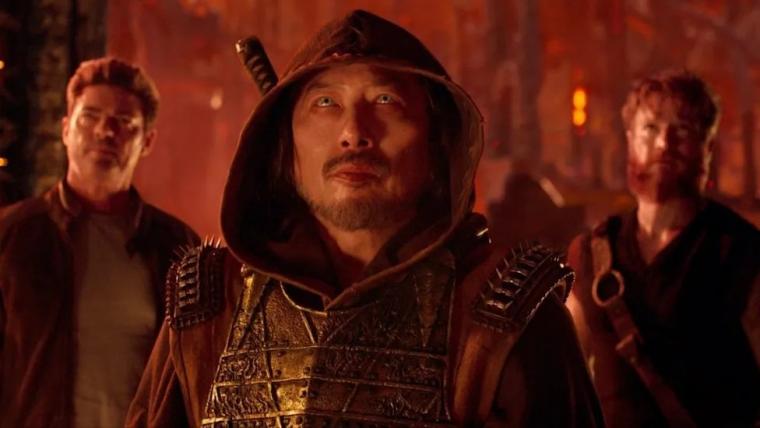
As with certain highs, however, some effects do linger. In the movie, it's Outworld v. Earthrealm time again, with the nefarious Emperor Shao Kahn (Martyn Ford) determined to vanquish faux Earth, and our heroes, improbably led by fading Hollywood icon Johnny Cage (Karl Urban), a last, seemingly hopeless chance for survival. The plot couldn't matter less, nor could whatever machinations screenwriter Jeremy Slater devises to make us, I guess, care about the people doing all the fighting and dying. His attempts, for me, didn't take, and because I'm not among the fan base that will instinctively roar with approval when someone shouts “Get over here!!!” or “Finish him!!!” in forced baritones indistinguishable from those in the 1992 video game, I found much of MKII sadly perfunctory. Had I remembered much from the 2021 film, I likely would've been additionally annoyed at there being so, so much re-spawning. Of course, that's one of the chief pleasures of many action-themed video games; you can come back to life whenever you want. Previously killed figures here, though, get resurrected with such frequency that I started resenting the film for the memories I didn't have. Why mourn, or cheer, anyone's passing if they're just gonna be revived a few years (or even minutes) later?
Yet I did enjoy the vicious mano a mano that showcased Ludi Lin's magnificent martial-arts skills, led to a devastating buzzsaw demise, and was shot with full views of the performers' entire bodies, feet included. (Bio-pic Michael Jackson would be proud.) The pop-culture references suggesting that Earthrealm was just a fancy term for “Earth” – Squid Game! Pennywise! The Saturn Awards! – were agreeably cheeky and surprisingly sharp. I didn't like so much as love the unexpected smash cut to one of Johnny Cage's early genre classics, the 1996 (and likely direct-to-video) throwaway Uncaged Fury notable for the star's middle-finger slide on his sunglasses. The whirling-dervish hats continue to do their impressively nauseating damage; Jessica McNamee, as Sonya Blade, continues to suggest a Frances McDormand who took a massive career detour; the gore continues to culminate in climactic, memorable-for-the-moment money shots, one of them involving a body slowly peeling in half. And despite my unhappiness with the re-spawning idea as a whole, I was glad that Mortal Kombat II at least gave us more time with Australian mercenary Kano, whom Josh Lawson again plays with profanely soused glee, his reasoning for saving Earthrealm essentially boiling down to the universal need for Jacks-and-Coke and unlimited breadsticks. Hard to argue with that.