
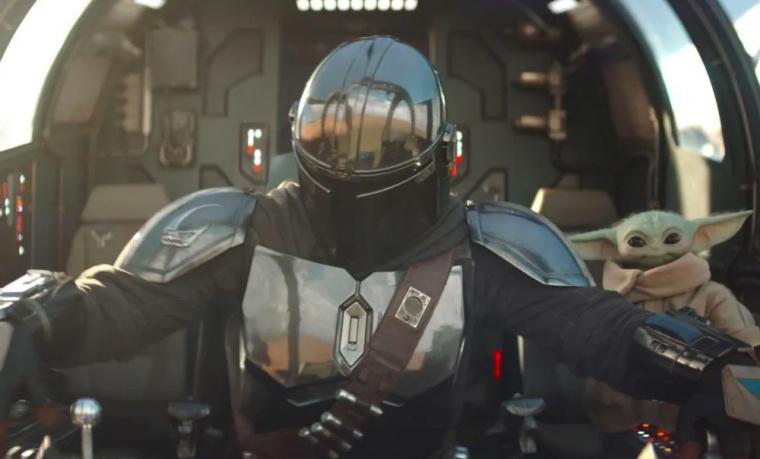
Pedro Pascal in Star Wars: The Mandalorian & Grogu
STAR WARS: THE MANDALORIAN & GROGU
Over the course of two-hours-plus, “cute” will only get you so far. But it's astounding how far it gets us in Star Wars: The Mandalorian & Grogu, which might've been an easy franchise low point if not for the diminutive cuddlebug of the title. Don't get me wrong: Director Jon Favreau's new outing is very much a low point, though having missed the varied Star Wars content on Disney+ (including the Mandalorian series), I can't judge where TM&G ranks in comparison. I can say that I was frequently bored out of my mind – except, that is, whenever our focus was allowed to rest on the Puppet Formerly Known as Baby Yoda. At one point, employing the powers of the Force, Grogu levitates a Hutt the size of a Kia Sorento. It's neither his first nor last act of heavy lifting here.
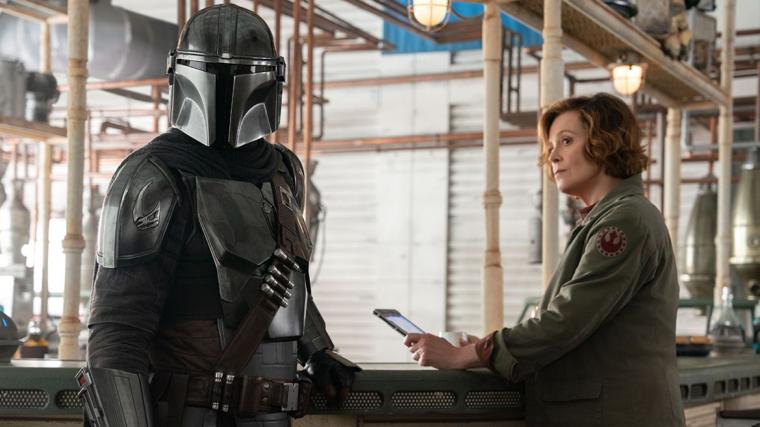
Given my unfamiliarity with Mandalorian lore, I was relieved that Favreau's big-screen continuation (scripted by Dave Filoni, Noah Kloor, and the director) was so easy to follow. Maybe too easy. After an action-heavy prelude establishing the Mandalorian as a bounty hunter with no compunction about killing and Grogu as a toddling sweetie with some of the elder Yoda's telekinetic gifts, we're thrust into the central plot: Jabba the Hutt's son Rotta has gone missing, likely at the hands of kidnappers, and our heroes are charged with returning him to his “anguished” aunt and uncle, a slimy pair referred to as the Hutt Twins. This assignment, I should mention, is given to “Mando” from his boss at the New Republic, and while it was initially cool to see Sigourney Weaver in the role, casting Peter Sarsgaard would've been more appropriate. That's an in-joke for Shattered Glass devotees, but you're all welcome to it.
Anyhoo. Considering Rotta could be anywhere on the faraway planet Shakari, I presumed that determining the creature's whereabouts would take a while - at least 20 minutes or so. Amazingly, however, with the aid of Martin Scorsese (!!!), Mando and Grogu locate the ginormous glob right away. They also discover that he has no interest in being saved, having become a beloved coliseum brawler and, speaking as the son of a universally loathed gangster, “my own man,” a point made clear by Rotta repeating that phrase several times over. Still, Mando and his sidekick have a job to do, and barring a few detours, the TM&G narrative pretty much boils down to: Our heroes find the Hutt; they lose the Hutt; they find the Hutt again; they lose the Hutt again; they find the Hutt one last time.
Because this latest Star Wars is essentially a children's entertainment – or, being generous, a “family film” – it's not a crime that it seems written for 10-year-olds. What makes the installment so routinely excruciating is that it seems to have been written by 10-year-olds. The story may be simplistic, but the dialogue is brain-meltingly banal, its almost wholly expository conversation just one blandly iterated directive after another. This is “just the facts, ma'am” screenwriting of the most hollow, Avatar-esque sort. And if it weren't for the joyously recognizable jabbering of Mr. Scorsese as a four-armed newsstand vendor (what a shock to see his name in the opening credits!), you could easily mistake TM&G as a work not only scripted by AI, but voiced by AI.
Speaking with his usual mile-a-minute gusto, Marty trips over his words and stutters and is an overall delight, providing the movie's only readings that sound remotely human. We don't get any such naturalism from Weaver, who, unlike Scorsese, is playing a human – though you wouldn't necessarily know it from her three scenes of disassociated paycheck acting. We certainly don't get it from Jeremy Allen White, whose voice, as Rotta, has been so electronically modified that any trace of the performer's normally affecting rhythms and cadences is eradicated. If you're not going to let White sound like himself, and certainly not look like himself, why bother hiring him?
As for Pedro Pascal, who plays Mando whenever body doubles Lateef Crowder and Brendan Wayne don't – and for all we know, they're covering for the star as much as 95 percent of the time – what, exactly, is he going for? Why does every listless thing the Mandalorian says sound like it was recorded three seconds after Pascal awoke from a nap? He generally has a lovely speaking voice, even when helmet-muddled the way it is here, and you can hardly blame the guy for not lending passion to fortune-cookie clunkers such as “The old protect the young, and then the young protect the old. That is the way.” (Delivered in context, a simple "Thank you" on Mando's part would've sufficed.) Yet beyond his line deliveries lulling us to sleep, Pascal and/or his doubles walk boring. Hell, they even run boring. That costume can't do much for mobility, but with the aid of F/X, surely something quicker than a mild jog could've been accomplished.
Given three seasons of backstory and incident on Disney+, I'm sure there's more to Mando than this big-screen robotic dullard. Removed from his TV context, though, the bounty hunter is among the dreariest titular figures in post-1977 sci-fi, and the heftiest unintentional laughs I got from the film came whenever the Mandalorian gazed adoringly at Grogu as the little scamp did something adorable or mischievous. My laughs came from that “gazed adoringly” presumption. Why are we momentarily stopping the film to note Mando's expression? There literally is no expression. His face is covered by a freaking helmet. (If Ludwig Göransson's score, baldly sentimental in these bits, is meant to do the emoting for Pascal, the attempt fails.)
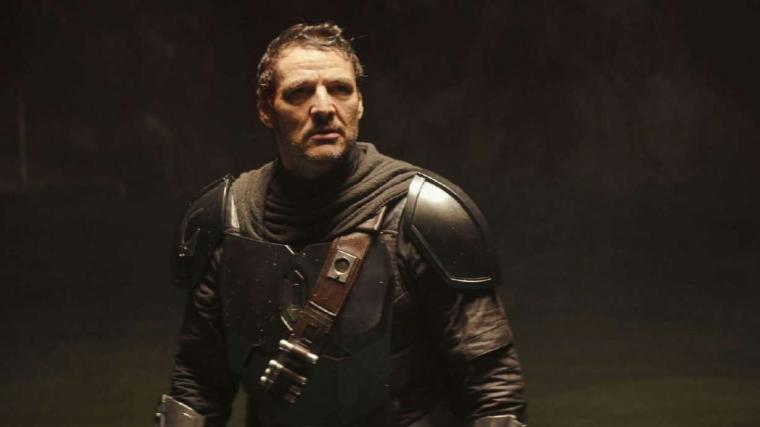
Pascal's Manolorian is, however, involved in one genuinely grand sequence – and wouldn't you know it, it's the only one in which the actor gets to show his face. Captured by the Hutt Twins and momentarily de-helmeted, Mando is thrown into a pit and forced to fight something called a Dragonsnake, which is just what it sounds like, but about 20 times bigger. I legitimately gasped at the reveal and was grateful that Pascal's mug was finally being shown, because for all of Mando's stoicism elsewhere, he appeared, in this segment, empathetically freaked out. The rest of the time, the action scenes are antic without being in any way creative or interesting.
As usual, the Stormtroopers and villainous droids can't hit the broad side of a barn, our hero can't miss, and because no one's features are seen, there's no investment in these repetitive battles; we may as well be watching Transformers mindlessly duke it out. And that's when we can see anything at all, as David Klein's cinematography is murky to the point of opacity. If I can't convince you to skip TM&G entirely, can I at least beg you to avoid the film's 3D screenings, which substantially darken already-dark proceedings? My weekend schedule, and consequent need to attend a specific showtime, dictated that I pay the extra bucks for this “premium” presentation, and the best I can say about the 3D is that it did make me feel like a Star Wars character. It was like watching the movie from behind the grim, light-shielding veil of Mando's helmet.
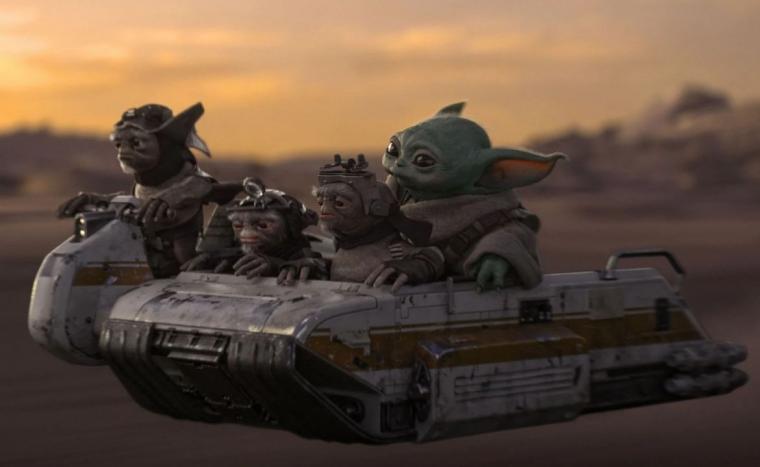
Happily, as in all Star Wars offerings, and when you can actually see them, the alien life forms here are consistently diverting. Beyond the background figures in the Cantina-adjacent sequences, we get to occasionally hang out with a helpful bayou fisherman (voiced by the reliably mellifluous Stephen McKinley Henderson), as well as a quartet of diminutive, nattering Anzellans (all four voiced, unmistakably, by Shirley no-relation-to-Stephen Henderson). Yet it's inevitably Grogu whom you want to spend your time with, and why wouldn't you? So cute! Crafted through puppetry and animatronics with just a smidge of barely detectable CGI, this crafty toddler already has a leg up on his co-stars in that he's not required to – not able to – voice any of the script's unspeakable dialogue. Grogu, though, is endearing and funny in all the right ways, whether using the Force to save a bizarrely ripped Hutt or trying, in vain, to properly man Mando's spacecraft and accidentally setting off a missile – twice. (On his second discharge, I roared for a good five seconds straight.)
It would've been nice if the filmmakers gave the non-fans among us more understanding of the leads' relationship. The bounty hunter generally treats the green-hued tyke like an infant son, but also occasionally like a buddy and fellow professional, and sometimes orders him to “stay” and “heel.” (Is Baby Yoda an adopted child? A pal? A pet?) Yet even the sight of Grogu merely waddling around is a guaranteed smile-inducer – a more high-tech variant on the Kermit-rides-a-bicycle amazement of 1979's The Muppet Movie. The single-greatest running gag involves Grogu silently leaping onto Mando's shoulder before every hasty exodus; you can imagine off-screen assistants gently lobbing the creature at Pascal, his feet sticking with Velcro.
And I wouldn't dream of spoiling the film's absolute finest section … except to say that it's roughly 20 minutes of nothing but Grogu, it unfurls almost completely non-verbally in ways to bring to mind The Black Stallion and WALL·E, and one sustained bit of attempted problem-solving inspires roughly half a minute of continuous laughter. It's a perfect extended segment in a deeply imperfect movie, and suggests just how satisfying The Mandalorian & Grogu could've been had it jettisoned its formulaic blockbuster aspirations entirely. Who needs pro forma explosions and lasers and Hutts when you've got Baby Yoda attempting to steal Sigourney Weaver's breakfast?
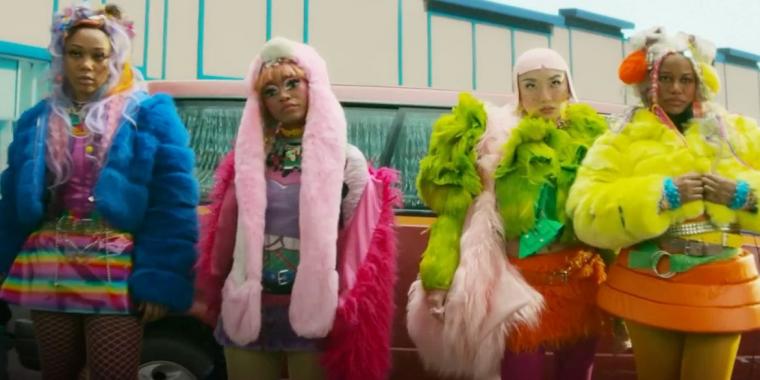
I LOVE BOOSTERS
Even to attempt a plot description for writer/director Boots Riley's fantastical comedy I Love Boosters is to risk sounding insane.
If you want to be perceived as still having your wits about you, you can go with the shorthand version, which is accurate: Led by Keke Palmer's Corvette, a trio of southern-California shoplifters – the “Velvet Gang” notorious for boosting high-end merchandise and selling it at a discount – decide to make life hell for the haughty fashionista (Demi Moore's Christie Smith) who stole one of fledgling designer Corvette's wardrobe creations. Easy peasy.
But then, if pressed further for narrative details, added information might make it sound as though you need to be hospitalized. One of Corvette's partners in crime, Naomi Ackie's Sade, is in thrall to a pyramid scheme run by a helium-voiced Don Cheadle in a fat suit. Another ally, Taylour Paige's Mariah, is able to change her complexion and pass as a light-skinned Black woman (Robin Thede) by simply holding her breath. A Chinese booster, Poppy Liu's Jianhu, arrives with a teleportation device that makes shoplifting easier, and also boasts settings for deconstructivism and dialectical materialism. A seemingly vacant retail-store employee (Eiza González) proves weirdly fluent in deconstructivism and dialectical materialism. Christie Smith works from an L.A. skyscraper that stands at a 45-degree angle, demanding an upward climb to her office door. Suits costing $100,000 are revealed to be made of both fabric and skin. A humongous rolling ball of unpaid bills routinely heads Corvette's way, demolishing everything in its path. Oh yeah, and an unnamed lothario played by LaKeith Stanfield is revealed, early on, to be a 10-foot-tall demon with a pronounced tail and penchant for literally sucking the souls out of every woman he seduces. Knowing this, Corvette's kinda into him anyway.
Welcome to the mad, mad, mad, mad world of rapper/songwriter Boots Riley, whose filmmaking style is most certainly singular, but can also be hinted at by imagining a collective, peyote-enhanced take on the oeuvres of Wes Anderson, Jordan Peele, the Coen brothers, and Chuck Jones. (When Corvette attempts to traverse Christie's slanted office, her feet spin in cartoon circles à la the Road Runner.) Riley's only previous feature was 2018's Sorry to Bother You, a surrealist comedy in which Stanfield's character successfully passed as white, and it has maybe taken him eight years for a followup because, clearly, he has so very much he wants to say.
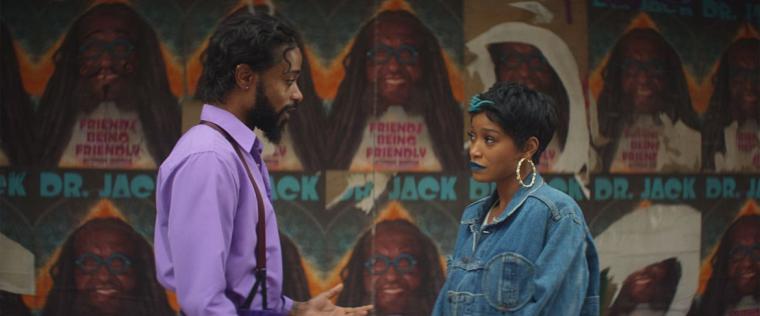
At alternating and dovetailing points, I Love Boosters is a cheeky screed against capitalism, a rallying cry for the oppressed, and a lament for noxious media stereotyping, with Is God Is' radiant, fearsomely talented Kara Young playing TV-news fixture “Crying Black Mother” who's identified as such on the chyron. It's also an unbridled slapstick in which security guards are so nonexistent that Corvette can amble out of a clothing store and no one notices that, with eight layers of purloined merch on top of her, she's shaped like the Stay Puft Marshmallow Man. Not all of this works. How could it? But the stuff that does work is sublime. The stuff that doesn't, which is mostly the 113-minute film's final 20 minutes, is merely adventurous and weird. I'll take that over safe and dull any day of the week.
I'm on record as saying that all movies would benefit from having Keke Palmer as their lead, and Riley's latest gives me no reason to capitulate. She's splendidly funny, quick-witted, and relatable, and among a peerlessly game supporting cast, Palmer gets her finest support from Ackie, who's starting to look incapable of an unengaging or unimaginative performance; Moore, spewing hilariously acidic venom; Will Poulter, riotously clueless as a condescending chain-store magnate; and Stanfield, who makes expert use of his ability to weep on demand while simultaneously self-satirizing his ability to weep on command. Cinematographer Natasha Braier does her most inventive work when the camera goes wobbly and woozy with Corvette's every eroticized, face-to-face encounter with Stanfield's credited “Pinky Ring Guy.” (The actor also elicited my biggest belly laugh with a Hitler comparison augmented by a perfectly miniaturized eye roll.)
Yet despite Palmer's presence and Riley's fabulously energized direction that keeps the action moving with breakneck velocity (the peppy, circus-like Tune-Yards score aiding immeasurably in that regard), the real stars here are the clothes. Remember that WTF?! high you felt seeing Emma Stone's cascading, blocks-long red dress in Cruella? Riley's film, and costumer Shirkey Kurata, give you dozens of similarly knockout, color-coded, I-can't-believe-what-I'm-looking-at ensembles that appear to defy common sense (and sometimes gravity) and keep you in a state of open-mouthed wonder. We really haven't seen wardrobe selections like these since Ruth E. Carter's twinned Black Panther visions, if not 1994's The Adventures of Priscilla, Queen of the Desert. The one thing all three movies have in common is an eventual Oscar for their designers, and no matter how I Love Boosters fares otherwise, I wouldn't be at all surprised to see Kurata holding a statuette of her own next March. The outfits here don't just help tell the story. They are the story.
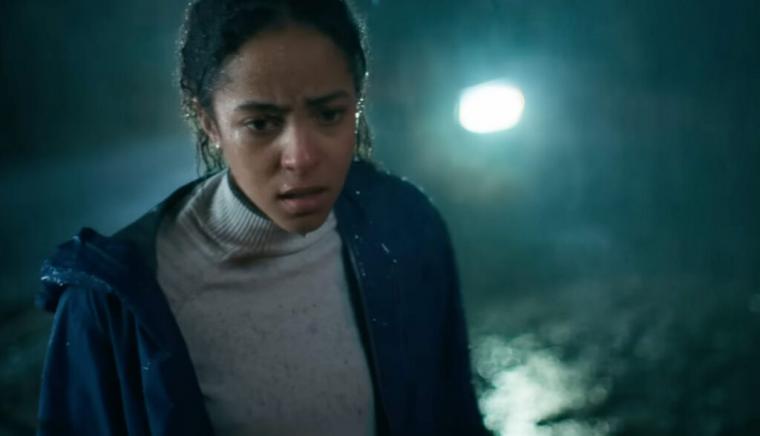
PASSENGER
In his horror thriller Passenger, director André Øvredal treats us to a presentational trick he's evidently so fond of he repeats it three or four times over: a circling 360-degree camera pan marking a potential victim's surroundings. (Look, Ma – no crew!) In the prelude that sets up the film's hitchhiker-from-hell premise, the effect is impressive but largely unimportant. In a later scene set in an expansive and largely unoccupied mall parking lot, it's truly effective, with our heroine's formerly nearby van, following the camera spin, now, nonsensically, many yards further away than before. But nothing that Øvredal and screenwriters Zachary Donohue and T.W. Burgess deliver is quite as creepy as the movie's visual coup de grâce, in which our nerves are unexpectedly shattered by … Audrey Hepburn and Gregory Peck.
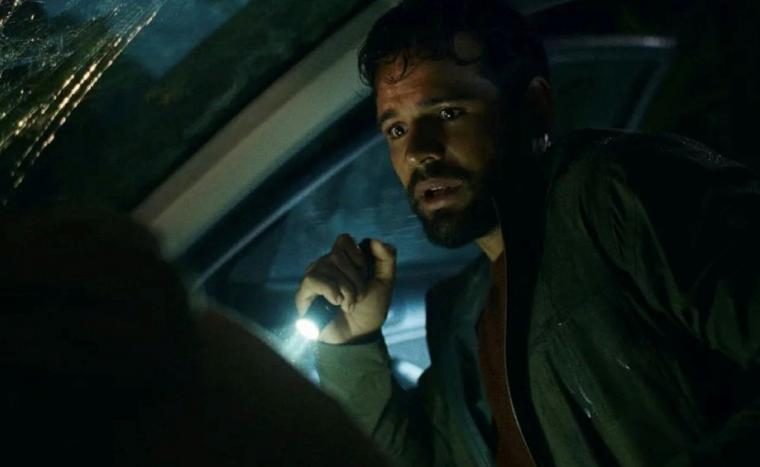
Perhaps I should explain. After quitting their Brooklyn jobs, terminating their apartment lease, and sallying forth in their custom-outfitted van whose horn blares the Hawaii 5-0 theme, Maddie (Lou Llobell) and Tyler (Jacob Scipio) hit the open road to pursue van life as a romantically nomadic couple. (Right off the bat, Passenger suggests the fright-flick equivalent of Best Picture winner Nomadland – which, for the wimpier souls among us, was its own kind of fright flick.) Weeks later, after Tyler proposes marriage and Maddie accepts, they land on a crash site whose car is marked by deep scratches on the frame, and whose sole survivor pops out of the vehicle for just a few seconds before being dragged back in the car, mauled, and murdered. Amazingly, Maddie and Tyler recover from this traumatic incident, and a few days later, are happily nestled in the woods watching a nighttime video of Roman Holiday that Tyler has projected onto a suspended sheet. That's when the new intendeds hear a strange, possibly threatening noise in the distance, and in lieu of a flashlight, they use the device that's projecting William Wyler's Oscar-winning rom-com to illuminate their surroundings.
I can't begin to tell you how well this bit works. The potential-killer-in-the-dark scenario is scary enough on its own, especially with Øvredal going appreciably light on the sound effects and Christopher Young's ominous score. We instantly know that whatever killed that victimized driver is now planning to kill the newly engaged couple, too, and our nerves are nicely shredded. But there's something additionally, comically horrifying about Maddie and Tyler scoping out their situation while fuzzy, black-and-white images of Hepburn and Peck at peak romantic ardor reflect on otherwise pitch-blackened trees and shrubs. The incongruity of it all is both hysterical and terrifying, and one great scene this dementedly original is enough to make a horror movie. That's definitely to Passenger's benefit, because despite the solid portrayals and across-the-board professionalism, that one great scene unfortunately stands alone.
To be clear, Øvredal's latest isn't bad at all. (The Norwegian helmer's previous credits include similarly not-bad-at-all titles including 2023's The Last Voyage of the Demeter and 2019's Scary Stories in the Dark, the latter a work I'm still hoping to be sequel-ized.) Llobell and Scipio are charmingly relaxed partners – they feel like a long-committed couple who would wait years to make their relationship marriage-official – and there's a lot of alternately endearing and strained camaraderie during their travels, particularly when we sense how much Tyler's dream doesn't coincide with Maddie's. A pretty decent gauge of a successful horror film lies in how interested you'd be in watching the same characters (meaning the same potential victims) in a story wholly devoid of horror. And while I'm not sure that 90 minutes on the road with Maddie and Tyler would be all that thrilling, it would almost certainly be comforting, especially if, as happens here, at least one of them gets to befriend a fellow nomad played by Melissa Leo, who's wonderfully welcome until the plot forces her to turn into a one-woman exposition drop.
Alas, that predictability lands, and we're forced to admit that Passenger is little more than a derivative, if well-executed, B-grade shocker with a supernatural entity whose motives and means change at will, whose “rules” are nonexistent and ultimately meaningless, and whose nod to nomadic history – follow the signs in the ancient Hobo Handbook! – makes only two of those dozen signs in any way relevant. Arriving at the tail end of May, however, I gratefully credit Øvredal, Donohue, and Burgess for at least giving us a 2026 screen horror that doesn't require its heroine to be beaten to a bloody pulp prior to the end credits. And I thank them, too, for the weird, unanticipated reunion with Roman Holiday, a classic I've been meaning to return to for quite some time. I'll let you know if, having seen Passenger, I'm able to build up the nerve.