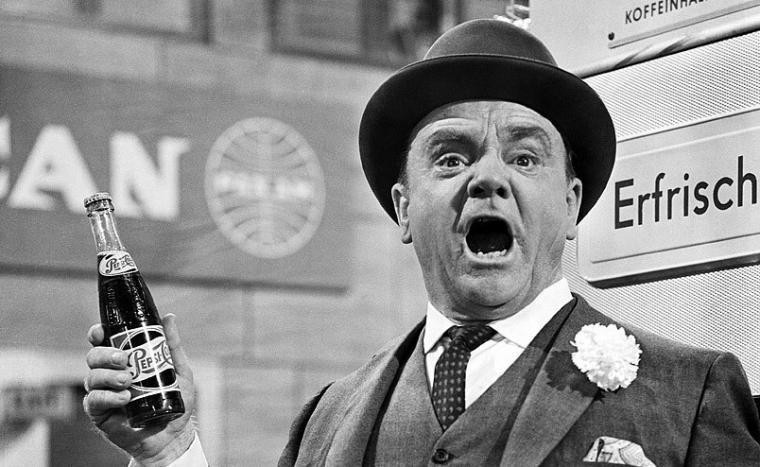
The German American Heritage Center's “The Lost Years of German Cinema: 1948-1963” Film Series at the Last Picture House -- September 2 through 30 (pictured: James Cagney in "One, Two, Three," September 23)
Wednesday, September 2, through Wednesday, September 30
The Last Picture House, 325 East Second Street, Davenport IA
With the five featured classics including Academy Award nominees, iconic entertainments, and works that have inspired no end of unforgettable scenes, Davenport's German American Heritage Center teams up with the city's The Last Picture House to present “The Lost Years of German Cinema: 1948-1963," a film-series celebration of cinematic talent and industry boasting Wednesday screenings September 2 through 30.
In "The Lost Years of German Cinema: 1948-1963," audiences are invited to discover the tension, humor, and human drama of a nation rebuilding in our film series on postwar German cinema. These films capture a Germany grappling with defeat, division, and identity through noir intrigue, sharp satire, and deeply personal stories. From the shadowy streets of The Third Man to the biting wit of One, Two, Three, each screening offers a vivid window into a transformative moment in history. Join us for this opportunity to experience these powerful films on the big screen. After each film's screening, patrons are invited to stay for optional Q&A sessions about the films and actors.
Scheduled titles for “The Lost Years of German Cinema: 1948-1963” are:
The Third Man (Wednesday, September 2, 6 p.m.): Director Carol Reed's 1949 film noir classic centers on American writer Holly Martins (Joseph Cotten), who arrives in the city to accept a job with his friend Harry Lime (Orson Welles), only to learn that he has died. Martins stays in Vienna to investigate Lime's death, becoming infatuated with Lime's girlfriend Anna Schmidt (Alida Valli). In 1999, the British Film Institute voted The Third Man the greatest British film of all time.
A Foreign Affair (Wednesday, September 9, 6 p.m.): Director Billy Wilder's 1948 film is about a United States Army captain in post-World War II Berlin, occupied by the Allies during the early days of the Cold War, who is torn between a former Nazi cafe singer and the American congresswoman investigating her. Though a comedy, the film has a serious and cynical political tone, attesting to the fascination of both Wilder and American audiences with the multiple legacies of Berlin.
Germany, Year Zero (Wednesday, September 16, 6 p.m.): Director Roberto Rossellini's 1968 drama follows the life of a 12-year-old boy in post World War II Germany. It won the Golden Leopard and the Best Director awards at the Locarno International Film Festival in 1948, and as in many neorealist films, Rossellini used mainly local, non-professional actors. The movie contains dramatic images of bombed out Berlin and of the human struggle for survival following the destruction of Nazi Germany.
One, Two, Three (Wednesday, September 23, 6 p.m.): Wilder's 1961 political comedy is based on the 1929 Hungarian one-act play Egy, kettő, három by Ferenc Molnár, with a "plot borrowed partly from" Ninotchka, a 1939 film co-written by Wilder. The film marked star James Cagney's last film appearance until 1981's Ragtime, and is primarily set in West Berlin during the Cold War, but before the construction of the Berlin Wall.
The Lost One (Wednesday, September 30, 6 p.m.): Director/co-writer Peter Lorre's 1951 West German crime drama is an art film in the noir style, and based on a true story. Post World War II, the busy doctor Neumeister (played by Lorre) meets a former colleague again in a refugee camp -- a wanted Nazi called Hösch. The down-and-out fugitive hopes for help from the camp doctor, and the film recounts their shared history during the Nazi era.
For the screenings in the German American Heritage Center's "The Lost Years of German Cinema: 1948-1963" series at The Last Picture House, guests are asked to check in at the German American Heritage Center table in the lobby upon entering the venue. Admission is $12-15 per film or $50-60 for a complete five-film pass, guests will choose their seats upon arrival, and proceeds from ticket sales will go to Heritage Center programming. For more information, call (563)322-8844 and visit GAHC.org.