
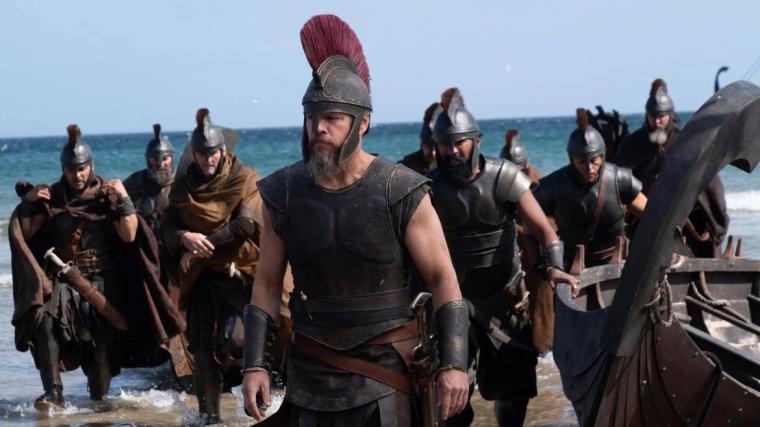
Matt Damon in The Odyssey
THE ODYSSEY
A fractured chronology. A disruption of the world order. A tortured protagonist messing with God's, or the gods', domain. The Odyssey might be Christopher Nolan's most inevitable movie yet. It's also one of his very best – a Homer adaptation of staggering grandeur and (for Nolan) considerable emotional power, and more sheer fun than anything the writer/director has delivered since The Dark Knight. Given the material's inherent gravitas and nearly three-hour running length, I won't go so far as to call the film “playful”; as both his fans and detractors will concede, Nolan is one serious dude. Here, though, he also appears seriously invested in our enjoyment, and there are many, many sequences in this grandly scaled adventure as thrilling, juicy, and ticklish as any that 2026 has thus-far produced. Those demanding fidelity to Homer are likely gonna hate it.
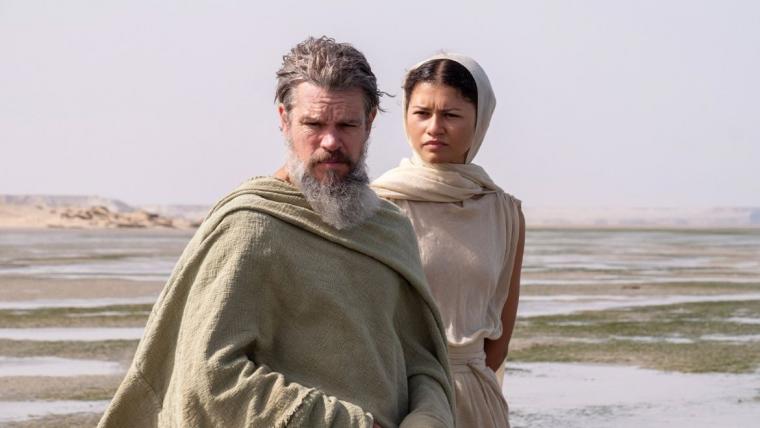
Let's begin with the gods. In Nolan's take on this ancient-Greek saga, they're not around. Or rather, they might be, and if they are, they're working solely behind the scenes. Even if you only have hazy high-school or collegiate memories of Homer's Odyssey, you probably recall that the epic poem is positively overflowing with deities: Zeus, Poseidon, Athena, Hermes, Ino … . They're all active participants in the decades-long struggle of the Greek king Odysseus (played here by Matt Damon), who spends 10 years fighting the Trojan War and another 10 trying to return to Ithica. Yet while the gods are frequently name-dropped in Nolan's rendition, none but Athena (Zendaya) are actually seen – and even she might merely be a grief-fueled hallucination. Purists may be appalled, but I, for one, found this revisionist interpretation fascinating, and deeply affecting. What if it wasn't the wrath of the gods that plundered Odysseus' ships, killed his men, and sent the king to a seven-year island purgatory with the nymph Calypso (Charlize Theron)? What if it was simply crap weather, bad decisions, worse luck, and an all-too-human refusal to face one's failings that caused so much anguish and death? That proposition is far more frightening, and way more relatable, than realizing that all your suffering is linked to having pissed off Poseidon.
Yet Nolan ups the relatability, and the modernity, further in his decision to have characters not speak in the accented, stilted prose of most historical epics. Granted, it's been more than 35 years since I last cracked open a Homer. No matter which translation you choose, through, I'm pretty sure that “f---” isn't uttered as often there as it is in Nolan's script, and that Odysseus' beloved wife Penelope (Anne Hathaway), addressing her loathsome cabal of suitors, doesn't use “party” as a verb. Hell, Nolan's movie opens with rapper Travis Scott recounting the Ithicans' victory over the Trojans in a room packed with drunken malcontents, and it might take you all of 10 seconds to realize you're at the BC equivalent of a poetry slam. The Odyssey's director leans so heavily into his verbally Americanized take on Homer's text that even the British actors – Tom Holland, Robert Pattinson, Samantha Morton, Himesh Patel – sound as 'murican as castmates Jon Bernthal, John Leguizamo, and Benny Safdie. (Of course, being gifted thespians, the English folks' regionally indistinct American dialects are flawless.) Consider me entirely on board with this deviation from Homer, too, especially in regard to how it averts potential fraudulence. Damon, Bernthal, Leguizamo, Elliot Page, Mia Goth, Corey Hawkins – though they've had their period successes, these are exquisitely contemporary performers. It's a relief to not hear them talk with any sort of awkward conversational affectation.
Once you get past the possibly literal godlessness and definite U.S.-vernacular bent, what we're left with in The Odyssey is otherwise largely Homer – albeit “best of” Homer, as some of Nolan's inclusions come from the Greek author's Iliad. (All that business with the Trojan horse and fall of Troy, meanwhile, is most famously found in Virgil's The Aeneid.) This is nothing but great news for an audience, because the evolving on-screen saga is one ripping-good yarn. It's also a frequently terrifying yarn, which was something I didn't quite recall from my previous exposures to the material. Although Nolan has never directed a legit horror movie, you can practically cross that genre off his list given certain sequences here: the cave threat of the cyclops Polyphemus (enacted by that gifted physical clown Bill Irwin) as he casually munches on Odysseus' soldiers; the attack by that horde of towering, armored Laestrygonians whose blows knock the Ithicans 40 feet in the air; the Trojans indiscriminately stabbing at the Trojan Horse's interior, leaving one man with a nearly severed arm dangling from his shoulder blade. (I'm 95-percent sure I saw this heinous sight; blessedly, the image isn't lingered on.) Scariest of all, and oddly giddiest of all, is the Greeks' encounter with Morton's witch Circe, whose island farmhouse is strangely overrun with pigs. Those who know Homer's work know why. Those who know Samantha Morton's work can also guess, correctly, that she's phenomenal in the role: abjectly horrifying, subtly hilarious, and a true wizard in her involvement with Nolan's practical effects.
Circe's segment isn't the only one in Nolan's Odyssey that I might never forget. The sequence with the Sirens, for instance, is fantastically memorable for what it doesn't show us – namely, the Sirens. As Odysseus' ship nears their island, the crew is instructed to plug their ears with wax so as to not hear the creatures' dreaded, impossible-to-resist song; only Odysseus, tightly tied to the ship's mast, will endure their call. This scene is harrowing: Odysseus suffering unbearable, screaming trauma that we never hear – and that Patel's second-in-command Eurylochus can't look away from – while several men remove their aural protection and subsequently launch themselves into the sea. Nolan no doubt could have visualized the Sirens had he wanted to, but this minimized approach worked wonders. (Plus, it would be hard to improve on the Coen brothers' rendition in their own Homer adaptation O Brother, Where Art Thou?) And the fall of Troy, when finally viewed in full toward the finale, is annihilating, a sustained explosion of violence and fire, brutally underscored by composer Ludwig Göransson, that provides every reason for Odysseus to want to block it from memory forever.
Still, it's not simply the Homer-ian (and Virgil-ian) set pieces that cling to your brain hours and days after seeing Nolan's opus. It's the faces. Damon, whose deliberately reserved portrayal of bottomless ache is almost destined to be underrated, does some of the finest non-verbal acting of his career when gauging the full measure of the Ithicans' cruelty, confronting Odysseus' backlogged pain with Calypso, and, as mentioned, barely resisting the pull of the Sirens' song. But despite the totality of her screen time not lasting two minutes, I also can't stop thinking about the double-cast Lupita Nyong'o's devastating emotionalism as (a) the scarred Helen of Troy begs Holland's Telemachus for forgiveness for unintentionally starting the Trojan War, and (b) Helen's sister Clytemnestra shrieks in victory after slitting her husband Agamemnon's throat. (Will some enterprising filmmaker, or enterprising playwright, please get to work on a full-length Clytemnestra vehicle for Nyong'o?!) After Odysseus ventures to the underworld, Elliot Page's Sinon stares at his former leader with a look of confusion and betrayal that haunts you as surely as it does the Ithican king. Theron evinces worlds of compassion and unrequited love; Leguizamo's swineherd Eumaeus movingly suggests how the blind can be all-seeing; Patel makes you comprehend every silent, conflicted feeling Eurylochus has for his commander. I've heard it argued that Nolan's supporting actors “don't do much” in this Odyssey, but that's inaccurate. They do so much. They just have to do it in limited doses.
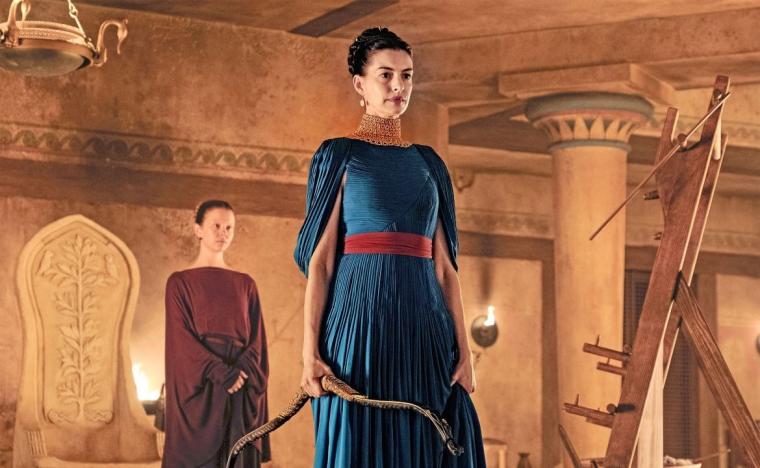
This is true even of Hathaway's Penelope, who vanishes from the movie for more than an hour while Odysseus makes his way home and their son Telemachus travels to Sparta to connect with Bernthal's Menelaus. (In a film of tremendous performances, Holland's own portrayal is mildly underwhelming – Telemachus is really only there to ask questions and look vaguely wimpy – while Bernthal's is a bit too reminiscent of any number of the actor's previous tough-talking bad-asses. The less said about Safdie's Agamemnon, the better, though he does cut an imposing figure when not required to speak.) Hathaway, though, is resplendent here, her actor's habit of lending almost too much enthusiasm to a role justified by the crushing weight of 20 years evident in her every (non-flashback) reading and expression. (She's also sensational in that pre-Trojan-War reverie, Penelope's misery about Odysseus' incipient departure suggesting that she knows a 20-year wait, at best, is in her future.) As performed, Penelope's misery is generally understated but also, at times, operatic – nearly savage – and Hathaway's fiercely conveyed devotion makes you fully understand Odysseus' need to return to her … and also why he feels he no longer deserves her.
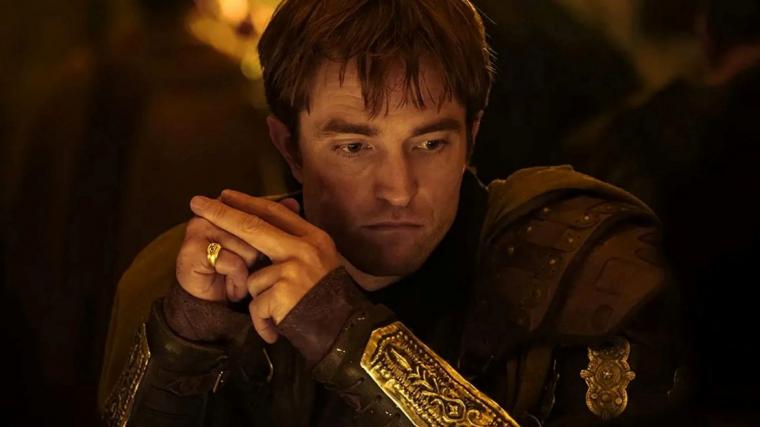
If you were one of the few who saw 2024's Homer adaptation The Return, which starred Ralph Fiennes as Odysseus and Juliette Binoche as Penelope and covered the Odyssey story from the moment the Ithican king washed up ashore and proceeded to re-claim his throne, it hasn't been long since you've seen the last half-hour of this Nolan. I could still watch this homecoming tale every two years, and in any iteration, with no complaint. Good God, is there a lot to love. Odysseus' reunion with his faithful servant Eumaeus, who doesn't realize it's Odysseus he's speaking to. Odysseus' reunion with his loyal pooch, who patiently waited two decades for his master's return and can now contentedly pass. (The friend with whom I saw Nolan's film was largely unmoved throughout but audibly touched by this classically heart-tugging moment.) Odysseus, dressed as a beggar, suffering the cruel indignities of Penelope's suitors – principally Antinous, with Pattinson executing a movie-stealing performance as this most delightfully repugnant of scoundrels. The revelation with Telemachus. The stringing of the bow. The dozen ax heads. The hellish castle free-for-all. The unexpectedly kind and just denouement.
It's all vivid and engrossing and teeming with life, richly photographed by cinematographer Hoyte van Hoytema and dazzlingly edited by Jennifer Lame – both, like Nolan and Göransson, Oscar winners for 2023's Oppenheimer. Yet as wondrous as this entertainment is, and as heartening as its opening weekend of $120-million-plus domestic will be for some time, you do have to wonder: Where does Christopher Nolan go from here? The Odyssey would seem to be any blockbuster filmmaker's natural end point, and Nolan will only be 56 as of July 30. Does he revert to something small, or small-ish – another Memento, perhaps? (If so, he's already sold at least one ticket.) Does he return to original sci-fi, embarking on the latest Inception or Interstellar or Tenet? Does he re-invigorate yet another comic-book franchise? (The second and third Dark Knights were terrific, but I'm hoping that answer is no.) Or does he go for even more unimaginable states of splendor – a page-by-page interpretation of the Old or New Testament, say, or even the whole freakin' Bible? Time will tell. It's Nolan's odyssey. I'm just happy to be along for the journey.