
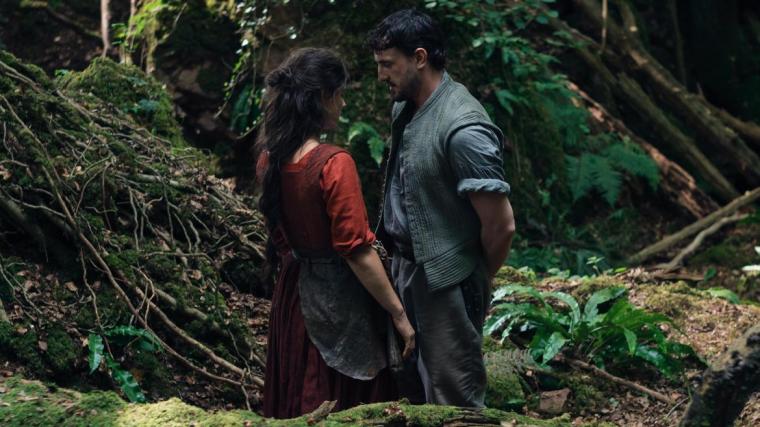
Jessie Buckley and Paul Mescal in Hamnet
HAMNET
Although the film is anchored by a ferocious Jessie Buckley and a frequently moving Paul Mescal, it might be impossible, after seeing director/co-writer Chloé Zhao's Hamnet, to reflect on the movie without the face of its titular portrayer coming instantly to mind, and potentially making you well up all over again.
Eleven years old at the time of filming, Jacobi Jupe is utterly extraordinary as the son of William Shakespeare and Anne Hathaway (re-named Agnes in the film), a child about whom history tells us precious little. In essence, the only non-speculative information we have on Hamnet is that he had an older sister named Susanna, a twin sister named Judith, and, at age 11, he died, though even the cause of his 1596 passing is unclear. Historians have suggested that Hamnet was likely a victim of the plague that raged through England during that era – an explanation both logical and employed by Zhao and co-screenwriter Maggie O'Farrell, the latter adapting her award-winning 2020 novel. Jupe, however, makes the boy so convincing and specific that it's almost as though reams of historical accounts of Hamnet were indeed available, and prior to shooting, the young actor gobbled up every word.
This isn't a case of a cute, naturalistic kid simply being cute and naturalistic. While I'm sure Jupe had plenty of assistance from Zhao, the leads, and perhaps his older brother Noah – the preternaturally gifted co-star of the first two Quiet Places who appears in Hamnet, as well – pre-teen Jacobi gives a true performance here, one of evident thought and depth. His misery at having to say goodbye to his traveling father again is unquestionable. His euphoria at play-acting one of Macbeth's weird sisters is palpable. The sacrifice Hamnet makes for his adored twin might be the single most gutting moment in all of 2025 movies. And that face. If Helen of Troy's was the one that famously launched a thousand ships, Jupe's is one that could conceivably have inspired the greatest theatrical tragedy ever written.
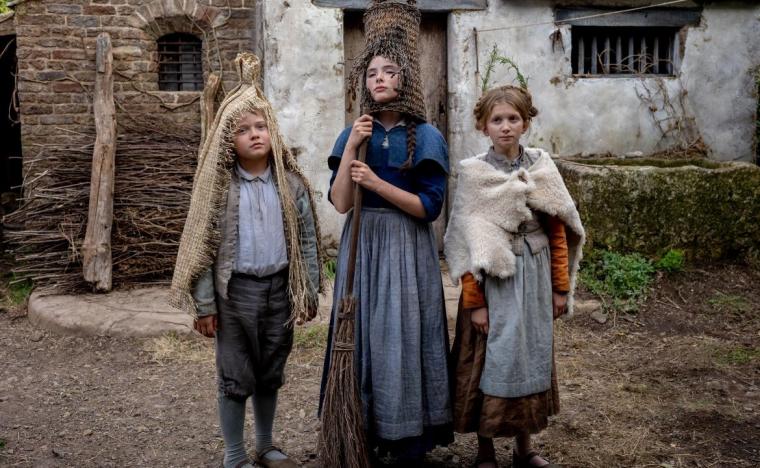
That, of course, would be Hamlet, which an introductory title card explains was a name, in 16th-century England, interchangeable with “Hamnet.” Shakespeare's masterpiece is clearly a revenge saga, as well as an interior war between action and inaction, and about two-dozen other things besides. It's Hamnet's contention that the play is also an exploration of grief directly influenced by the death of Shakespeare's son – a means through which this child who died could essentially live forever. I admired much of Zhao's movie: the superlative cast; the fittingly grubby costumes and décor; Max Richter's majestically melancholic score. (Some have taken issue with the use of Richter's “On the Nature of Daylight” composition during a pivotal moment, citing the piece's previous employment in Shutter Island, Arrival, The Last of Us, The Handmaid's Tale, et cetera. It worked for me. It always works for me.) But beyond the scenes with Jacobi Jupe, nothing about the film grabbed me by the heart and gut quite like – and this isn't a spoiler; it's Hamnet's reason for being – the climactic staging of Hamlet, the sequences we're shown allowing us to hear Shakespeare's familiar words and watch the familiar action with fresh perspective. The audience at the Globe is understandably rapt. We're more accurately exhilarated, if exhilarated through tears, witnessing the emergence of a miracle out of devastating loss.
This is probably the place to mention that Hamnet isn't always deeply sad, though it tends to be stronger whenever it is. Most of the two-hour film's first half is devoted to the relationship between Buckley's Agnes and Mescal's Will, and if the tenor of their scenes isn't precisely light, it's at least light-adjacent. A frequent forest dweller whom the townsfolk consider bizarre, if not an actual witch, Agnes is fiercely connected to the outdoors, and has been gifted some of her birth mother's talent for precognition; taking someone's hand, she sees visions of their futures. She also sees visions of her own, and after a series of tender encounters, and eventual marriage, with local Latin tutor and aspiring poet Will, Agnes foresees a life in which, at her deathbed, she'll be joined by her two children. But a few years after the birth of the Shakespeares' eldest daughter, Agnes has twins, causing her to henceforth fear for the well-being of the girl who seemed to arrive stillborn. Although years pass with Will's plays obtaining huge success and her kids – Jupe's Hamnet, Olivia Lynes' Judith, and Bodhi Rae Breathnach's Susanna – happily rambunctious, Agnes never stops worrying that Judith will be taken away from them. Then the plague comes to Stratford, and it isn't Judith who succumbs.
Over the past several months, I've barely been able to get through the Hamnet trailers without getting misty-eyed. That's why it was shocking that, until the moment of the child's passing in the full-length feature, I found myself worried I might not wind up affected at all. Zhao is nothing if not a meditative director; at recent screenings of her latest, she has actually led group meditations prior to the lights dimming. But the quiet spell she casts can quickly turn to tedium, and too much of her latest's first hour feels dramatically inert. While Buckley and Mescal are a charming, well-matched pair, their portent- and pause-laden exchanges quickly grow tiresome, and there appears to be a number of significant story strands either unexplored or forgotten. How and when does Will make his big splash as a playwright? How does Agnes react when he does? When did Will's mother (Emily Watson), who practically disowned her son for marrying a “forest witch,” have her apparent change-of-heart toward her daughter-in-law? As with many movies adapted from novels, it feels like some of the book's most important mentions, if not entire chapters, went strangely missing. And it's doubtful they were excised for pacing needs – not given the time Zhao and cinematographer Łukasz Żal spend investigating what seems like every last tree, branch, and leaf in the English countryside.

Yet even a few of the more anguished moments leave little residue. Buckley is excellent as Agnes, simultaneously ethereal and grounded, her low voice and teasingly faraway readings suggesting a woman living both on the earth and infinitely beyond it. As impressive as the feat is, though, Agnes' howls of despondence are so overwhelming that you almost have no choice but to view the spectacle clinically, as an acting exercise – Buckley emotes so we don't have to. By contrast, and despite his staggering instinctual response to the sight of Hamnet's lifeless body, Mescal initially demonstrates Will's need to sumblimate his pain by going too far into restraint and solitude. When Agnes coldly berates her husband for not being present when their child died and this wordsmith has nothing to say, it's hard to know what to make of Mescal's impassivity. Is Will feeling nothing? Everything? Mescal did astounding non-verbal work in Aftersun and All of Us Strangers. But after Hamnet passes, Will seems vexingly unreadable, even when delivering an inwardly directed recitation of the “To be or not to be” soliloquy.
Blessedly, however, Hamnet's superb finale makes up for a lot of the preceding disappointment. Not only do Buckley and Mescal rise to their most ideally calibrated emotional renderings, but the Hamlet staging itself is a delight, offering a genuine sense of how the first audience for this work might have responded. Unlike the rest of Zhao's movie, it's a party, with the all-standing patrons gasping at the ghostly visage of Hamlet's father and cheering the fight choreography and Hamlet himself (Noah Jupe) working the crowd like a WWE megastar. It's at the staging's climax that Hamlet achieves genuine transcendence, a moment recognized by the attendees, and the actors, and Agnes, and Will – a sense that immortality, for just a fleeting instant, might legitimately be within reach. By its own finale, Hamnet reaches a similar apex, leaving those who loved him – and thanks to Jacobi Jupe, this certainly includes the film's viewers – with the knowledge that a boy who was tragically lost has finally been found, and will be for centuries to come.

JAY KELLY
There have been film adaptations of books and short stories and plays and musicals and magazine articles and songs and toys. Until the arrival of director/co-writer Noah Baunach's Jay Kelly, which began its Netflix streaming this past Friday, I honestly never thought I'd see an adaptation of an acceptance speech. (Not counting, for those in the know, In & Out.) Granted, this isn't technically an adaptation; Baumbach's and Emily Mortimer's screenplay is deemed an “original.” But at the 2015 Golden Globes, George Clooney was the recipient of the Cecil B. DeMille Award for lifetime achievement. Clooney gave a self-deprecating yet sincere speech, fawning comments were made, a highlight reel was shown … . You know the drill. And Jay Kelly feels like nothing so much as a 130-minute expansion on that awards-show segment with Clooney himself in the lead, witty and heartfelt at every turn, surrounded by sycophants extolling his awesomeness – and the movie even employs a bunch of the same film clips! It's a truly disorienting experience, largely for the whiplash induced by its incessant dovetailing between melodrama and comic shtick, and might've come off as a staggering ego trip if not for its leading man's welcome and necessary breeziness.
Clooney's Jay Kelly has spent nearly 40 years inside a Hollywood bubble. An old-school Movie Star of the highest order, Kelly is rich, handsome, still wildly popular (curiously so for 2025), and travels with a coterie of trusted if regularly pissed-off assistants, among them his almost slavishly devoted manager Ron (Adam Sandler). Yet perhaps because Kelly is played by Clooney on maximum charm offensive, he's not an asshole – or rather, not an obvious asshole. The crux of Baumbach's latest finds Kelly traveling through Europe, mostly by train, as he heads to Italy for a career retrospective and Cecil B. DeMille-esque prize. Yet what it's really about is a show-biz mainstay forced to contemplate how his focus on professional success led to cracks in his personal life, with real and imagined encounters with family members, staffers, past friends, and the like teaching Kelly that he might not know himself as well as he thinks. It's Federico Fellini's 8½ (and its musical version Nine). It's Bob Fosse's All That Jazz. And it's one of the more tonally random movies I've seen in quite some time.
This is inherently a tricky sub-genre to pull off, given that it's hard to have much empathy for famous, fabulously wealthy A-listers who, from the start, have more than most of the films' viewers will have in their lifetimes. Fellini and Fosse succeeded, though, and so did Ingmar Bergman and Woody Allen in their respective Wild Strawberries and Another Woman, which put career academics in the place of entertainment icons. Baumbach and Mortimer, though, never really provide a sense of what this extended stroll down Memory Lane means for Kelly, or how much we're supposed to invest in his “plight.” True, he wasn't around for his daughters (played, as adults, by Riley Keough and Grace Edwards) as much as he should've been. But they both appear to have wound out fine, if a tad bitter. Yes, he could've been more solicitous toward Ron, but Kelly's manager also didn't have to spend decades willing to be a probably very-well-compensated doormat. With the movie, and Clooney, apparently unwilling to make a monster out of Kelly, he just seems like your average, blindly well-meaning superstar hardly worth two-plus hours of cinematic retribution. So Jay Kelly keeps throwing moods at the wall to see if any of them will stick.
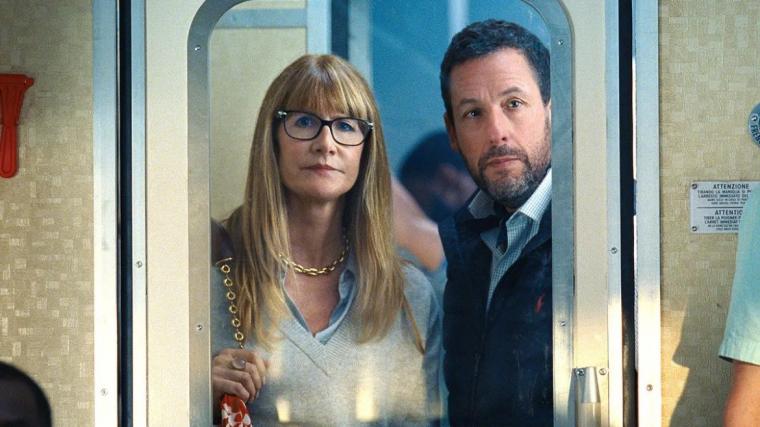
Kelly's bits with his daughters are Hallmark-level melodrama. His scenes on the train, which seem to encompass half the film, are awkward and overplayed comedy. (Every single one of the passengers is a recognizable “type,” and all of them – as with his Italian worshipers later on – appear to be reading their lines off cue cards for the first time.) His scenes with Ron alternate between sitcom banter and unconvincing melancholia. His flashbacks to his youth are self-pitying, portent-fueled artifice. Only one sequence here has the bite it should: an unexpected reunion between Kelly and his former acting-school friend Timothy, whom Billy Crudup wisely, thrillingly plays with the world's biggest chip on his shoulder. Although he greets his old friend with initial bonhomie, Timothy goes on to surgically detail how Jay Kelly ruined his life, and not only is Kelly knocked off his game – it seems, in the moment, that Clooney is, too. There's so much undisguised loathing in Timothy's tirade and Crudup's exceptionally layered hostility that Jay Kelly itself briefly roars to life, only to tumble back into emotional incoherence after Crudup leaves (too early) and we make the long, long trek toward Kelly's self-realization.
At least Baumbach's fourth project for Netflix over the past eight years isn't hard to sit through, the gratitude for which goes exclusively to the cast. Beyond the aforementioned names, the large ensemble includes Laura Dern, Jim Broadbent, Patrick Wilson, Eve Hewsom, Josh Hamilton, Isla Fisher, a well-used Stacy Keach, and Baumbach's wife and frequent collaborator Greta Gerwig. Sandler, doing his “restrained” thing, is decent enough, though if Ron affectionately called someone “puppy” even once more beyond the three-dozen-ish times he uttered the expression, I would've chucked my remote through the TV. And Clooney is Clooney, which is still plenty charming. He's hardly stretching here; he's hardly playing a character at all. (Saying them out loud, “Jay Kelly” and “George Clooney” sound mighty similar, no?) He is, though, every bit the capitalized Movie Star he's replicating, and with that comes its own benefits. You may be in underwhelming waters in Jay Kelly, but Clooney assuredly keeps the temperature warm.

MERRILY WE ROLL ALONG
On behalf of Stephen Sondheim devotees nationwide, I would like to thank Sony Pictures Classics for releasing a filmed version of 2023's Broadway revival of Merrily We Roll Along. I would also like to thank (he said, continuing his acceptance speech) production company RadicalMedia – previously responsible for the Disney+ Hamilton and Apple+ Come from Away – for literally screen-saving composer Sondheim's and book writer George Furth's show, which won clearly deserving 2024 Tony Awards for Best Revival of a Musical, Best Orchestrations, and respective lead and featured actors Jonathan Groff and Daniel Radcliffe. (The third star of this musical's platonic love triangle, previous Tony winner Lindsay Mendez, was at least nominated.) Note that this is a filmed version of Merrily, rather than a film version; for that, we'll have to wait until Richard Linklater's in-progress work debuts in 2040. What we have now is, like Hamilton and Come from Away, recorded theatre in front of a live audience, and having wanted to see this thing for the better part of two years, I'm intensely grateful that it exists. That said, couldn't we have gotten a better-directed rendition than this one?
I'm not referring to Maria Friedman's stage direction, which, over the course of Merrily's nearly two-and-a-half hours, appears smartly thought-out and beautifully realized in the rare moments we're allowed to view her production in full. I also have nothing but praise for Friedman's guidance of her cast. Beyond their individual magnificence, the chemistry displayed between Groff, Radcliffe, and Mendez could rightfully be called peerless, and featured performers Krystal Joy Brown, Katie Rose Clark, and Reg Rogers make sizable impressions against the bestie triumvirate. (A dozen others in the ensemble, including grade-school phenom Max Rackenberg, perform with energy and inventiveness.) Watching this Merrily on Broadway must've really been something, and given who's acting and singing it, it's still supremely watchable. Yet the big-screen version, which Friedman also directed, is routinely maddening, because she almost seems to be going out of her way to convince us that this isn't “merely” recorded theatre, and not just because she denies us the curtain call that her performers and their grateful viewers deserve. (Though, somewhat cruelly, she does let the sound of that curtain call play over the end credits.)
I mean, it's not like we were going to be fooled! With RadicalMedia's presentation recorded during three separate live performances in June of last year, we hear the audience's laughter and applause – some of that applause, I'm guessing, truncated for the filmed version. And despite the relative naturalism of our leads' just-heightened-enough performances here, filmed theatre is inherently artificial. We see the scene changes; the dramatic lighting shifts; the in-the-moment sweat. Only in Friedman's film record, we really don't.

For the most part, cinematographer Sam Levy goes irritatingly heavy on closeups, particularly when the ensemble sings their time-jumping refrains. As a directorial choice, I get it; Friedman so unconditionally loves her cast that she wants them all to be showcased. Yet that decision means we're not allowed to witness the scenic stage magic in this backward-moving tale of soured show-biz friendships: how a 1977 Hollywood party instantly morphs into a 1973 New York talk-show, or how an elegant 1962 soirée becomes a dingy 1960 Greenwich Village nightclub. Spencer Averick's editing choices also seem frequently behind the beat, sometimes landing on bits just one second too late – and in live theatre, of course, seconds are everything. Again and again, the timing of the cuts feels off, and the closeups deprive us the opportunity to see the whole picture we're aching to see, Not just the scene shifts, but much of the choreography and the actors' reactions to one another, which were less pronounced problems in the recorded renditions of Hamilton and Come from Away. On the occasions in which Levy's camera is right where you want it to be, it feels like we just got lucky.
Pretending her Sony Pictures Classics release is a film rather than filmed doesn't do Friedman's production any favors, nor does the weird gaslighting designed to make us think that her 145-minute show didn't have an intermission. Two hours 25 is hardly too long to sit without a break. (I'm betting James Cameron's three hours 15 for Avatar: Fire & Ash won't have one!) But a mini-respite suggesting halftime would've been appreciated, because at the 100-minute mark, I worried that Sondheim's masterpiece was, unbeknownst to me, a four-hour musical. I also worried it would mean 100-plus more minutes of not getting to see the tiny, incandescently meaningful details that in-person theatre – by virtue of allowing us to look wherever we want – invites you to see: the full scope of heartbreak as Mendez's Mary watches her love marry someone else; Radcliffe's Charley delighting in his best friend's adoration for his long-absent son; Groff's Franklin as his nearest and dearest make decisions causing their inevitable estrangement. Maybe the sufficiently grand Merrily We Roll Along shouldn't be a musical for film. (If I'm around to see his opus at age 72, Linklater may well prove me wrong.) In this rendition, at least, we're so fully connected to Sondheim's and Furth's conflicted, recognizable characters as they age in reverse that you don't want to miss one nanosecond of their unique and shared experiences based on what the camera forces you to look at.
For the record, especially if you're a Sondheim hound, this Merrily is objectively worth seeing. Hell, the score alone would make it unmissable, with classic numbers such as “Old Friends,” “Not a Day Goes By,” and the title tune, because of the backward-jumping narrative, miraculously growing more moving as their reprises become more upbeat. Furth's book is a little cornball and definitely wisecrack-dependent, but also laudably wise about the myriad ways in which “everlasting” friendships can decay through poor choices and unacknowledged advice. And Friedman's leads, all of whom are vocally spectacular, comically assured, and effortlessly moving, deliver the kind of goosebump-inducing joy that sometimes accompanies live musical-theatre performance. Mendez, who benefits most from the constant barrage of closeups, appears to portray an entire lifetime of Mary's hopes and shattered dreams. Radcliffe perfectly balances anxious agitation with unconditional (for as long as he can) devotion. And Groff not only makes a potentially loathsome figure relatable and tragic, but manages a truly singular feat: Over the course of the show, he believably de-ages 20 years through expression and cadence alone – a Benjamin Button with no need for CGI. The filmed version of Merrily We Roll Along may be wanting in significant, unignorable ways. But, God – this cast. Here's to them. Who's like them? Damn few.
FACKHAM HALL
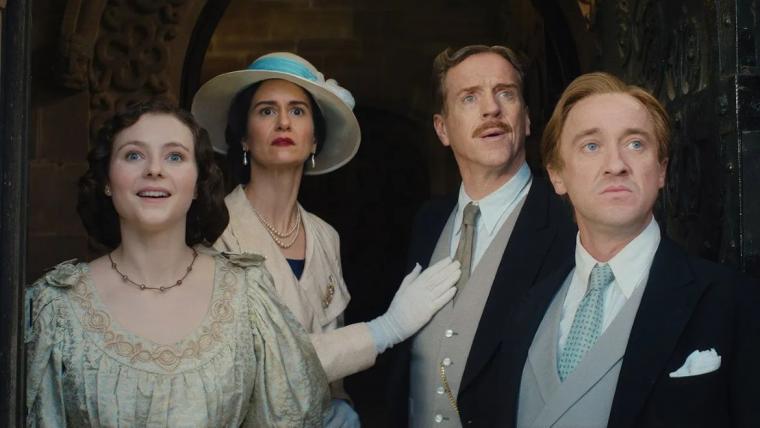
Directed by Jim O'Hanlon and written by five scribes who appear to have contributed about 100 jokes apiece, Fackham Hall is a Naked Gun take on British period melodrama. That's all it is. It's plenty.
Riffing on Downton Abbey, Brideshead Revisited, Bridgerton, Gosford Park, and any number of Jane Austens in gleefully R-rated fashion, this goofy lark, like most movies of the Airplane! variety, is decidedly hit-or-miss. The misses ultimately win out. But at my Saturday screening that found me alone in the auditorium, I smiled a lot and unleashed a good half-dozen out-loud laughs, all of them at routines I couldn't believe I was giggling at. Among these diversions were an extended visual gag involving an impossibly focused shotgun discharge, some irresistibly silly “Who's on first?” repartee, and a priest misreading his homily so badly – not being cognizant of where the punctuation should land – that the applause-worthy bit was eventually granted an encore. (English comedian Jimmy Carr plays the holy man, and Rowan Atkinson himself couldn't have done the role more justice.)
Beyond those moments, most of my grins were of recognition rather than legitimate amusement. Yet the incredibly game cast, all of them fully committed to the one-joke joke, boasts a field of winners that includes Damian Lewis, Katherine Waterston, Tom Felton, Emma Laird, Tom Goodman-Hill, Anna Maxwell Martin, Sue Johnston in the Maggie Smith role, Jason Done as JRR Tolkien (!), and the dashing Ben Radcliffe, whose blink-and-you'll-miss-it attempt to locate a fancy cocktail's straw with his tongue also landed among my six vocal chortles. And while I'm not entirely sure that having American actor Thomasin McKenzie portray the ultra-British heroine was a riff on Gwyneth Paltrow's casting in Emma, the association makes sense. Ultimately underwhelming though it is, O'Hanlon's randy parody of Fackham Hall is terrifically friendly. It's also pretty forgettable Goop.
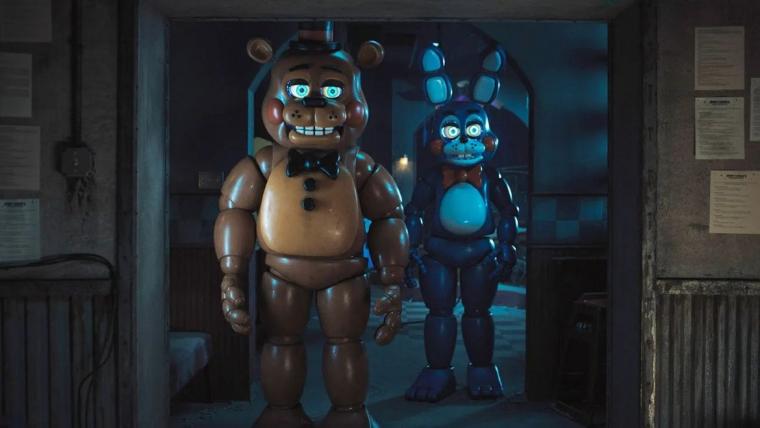
FIVE NIGHTS AT FREDDY'S 2
You know those 24-hour play festivals – the ones at which participants are given a rough idea for a concept, or sometimes merely a title, and have exactly one day to secure a cast, write the script, and rehearse the thing before it debuts for audiences? That's the experience of Five Nights at Freddy's 2, if in addition to the title and the 24 hours, director Emma Tammi and screenwriter Scott Cawthon were given a multi-million-dollar budget to get the job done.
It's not (just) that this horror-comedy sequel to 2023's video-game-inspired smash is a bad movie; it barely seems to be a movie. There's a semblance of a plot, and purported stakes are devised, and a number of acceptable-or-better actors show up: Josh Hutcherson, Elizabeth Lail, McKenna Grace, the original tag-team Scream killers Matthew Lillard and Skeet Ulrich (who, sadly, never share a scene). Yet the reasoning behind the characters' involvement is contrived beyond measure, none of the “scares” have been planned with any sense of where the camera should be placed, and even basic elements such as time and location are routinely violated. A middle-school science fair appears to begin in the early morning and end deep into the night. Hutchinson's hero Mike Schmidt is flabbergasted to discover there was an original Fazbear's Pizza restaurant beyond the franchise extension that caused him so much grief – despite the venue being so nearby that Mike's 11-year-old sister Abby (Piper Rubio) can easily ride her bike to the place.
I'm going to keep this tirade brief, because my own favorite 11-year-old – who, along with their parents, accompanied me to my screening (and previously joined me in '23) – is almost old enough to seek out my reviews online and seemingly had a blast at Five Nights at Freddy's 2. I'd rather they didn't yet know how deep my resentment for this thing goes. But Tammi's followup isn't a film so much as a flimsy excuse to get the animatronic band back together, and a pretty lousy flimsy excuse, at that. I have friends who would say the same about Spinal Tap II. I actually liked that needless continuation, though, and at least it didn't give us hulking, clunking mascots miraculously adept at “sneaking up” on their victims, or gratuitous cameos by presumably beloved series fixtures whose identities are unidentifiable, or Wayne Knight, playing cinema history's most repellent educator, pathetically crawling on the floor one inch per minute so slow-moving Chica can catch up to him. Though the execution isn't shown in this PG-13 feature perhaps best enjoyed by pre-teens, Knight's head is ultimately ripped from his body. I should've been so lucky.