
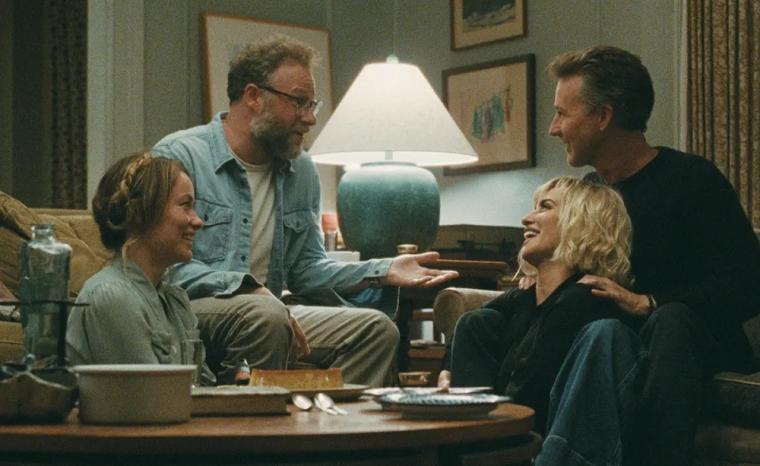
Olivia Wilde, Seth Rogen, Penélope Cruz, and Edward Norton in The Invite
THE INVITE
Masked maniacs, supernatural entities, and technology run amok are all well and good as scare tactics. Yet is anything in entertainment more potentially hair-raising – and hilarious, and devastating – than the promise/threat of two committed couples getting together for drinks, canapés, and light chit chat? Who's Afraid of Virginia Woolf?, Bob & Carol & Ted & Alice, God of Carnage, The Overnight, that priceless “Dinner Party” episode of The Office … . Their central characters may be exquisitely uncomfortable, but for those of us on the other side of the screen (or stage), that squirmy pain generally results in something closer to bliss. It turns out that watching romantic relationships crack and crumble can be enormous, if nerve-racking, fun – just so long as those breakdowns are viewed from the perspective of an auditorium, and not a mirror.
With its first previews, director/co-star Olivia Wilde's Sundance hit The Invite suggested that it could join the pantheon of superbly unsettling “double date” cringe-fests. And happily, for the most part, it does, largely because of how weirdly mismatched its assigned partners seemed from the start. Wilde and Seth Rogen? Penélope Cruz and Edward Norton? Beyond the appetizers at the Golden Globes, what could these performatively distinct people possibly have to discuss as couples, let alone among the four of them? To be sure, Wilde's Angela and Rogen's Joe appear to have run out of small talk – or at least conversation that doesn't end in insults. Their marriage of a decade-plus clearly running on fumes (and mutual fuming), Joe is a failed indie rocker now teaching music at a “not Berkeley” college in San Francisco, while Angela stays home with a meaningless post-graduate degree. (The pair also has a pre-teen daughter who, on the sole evening in which the movie takes place, is thankfully staying at a friend's house.) Clearly, Angela and Joe are past the point of standing each other: She snaps at him for not correctly folding the folding bike you sense she got him as a weight-loss motivator; he snaps at her for not allowing him to eat a pickle off the relish tray. And what the hell is a relish tray doing there anyway?
Angela reminds him that the veggies, charcuterie board, and casserole she's been slavishly preparing are for their dinner that she told him about yesterday – a first-time get-together with the upstairs neighbors that's obviously news to Joe, who's now also in trouble for “forgetting” the wine. More fighting commences, although Joe does see an upside, as this will finally allow him to confront the visitors about their nightly, decibel-bursting lovemaking sessions that keep him awake 'til all hours. Angela warns Joe to not say a thing, he says he'll say anything he damn well pleases … and then there's a knock at the door. It is, of course, invited guests Piña (Cruz) and her boyfriend Hawk (Norton), who've heard the commotion from the hallway yet have decided to forge ahead. The couples share tight smiles, awkward handshakes, more-awkward hugs, and it's quickly discovered that vegan Piña eats neither meat nor cheese. The casserole goes in the trash. Let the games begin!
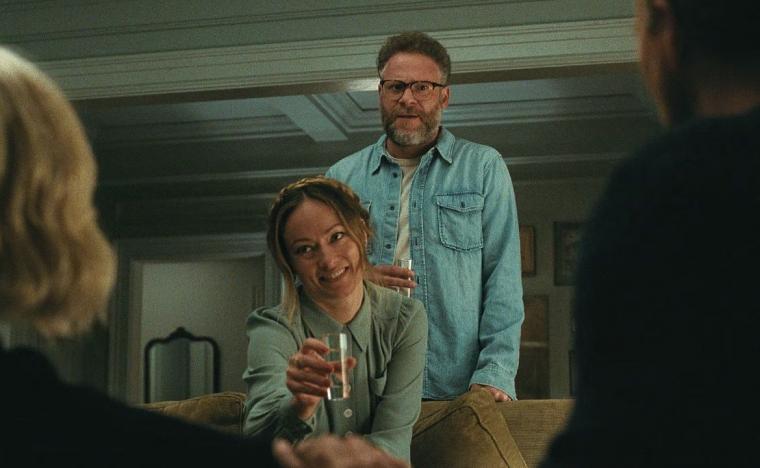
Because its script by Will McCormack and Rashida Jones (adapted from Cesc Gay's Spanish film and play The People Upstairs) is so filled with riotous, bitingly vicious dialogue and incisive character detail, I wish I could say that The Invite was enjoyable from the beginning. It's not, though; until Cruz and Norton arrive, and for a not-insignificant period after, it's more accurately irritating. Aside from an unseen, under-the-opening credits prologue in which his trademark stoner guffaws are given too obnoxious a workout, the movie's opening badness is in no way the fault of Rogen, whose crack comic timing and perpetually-put-upon persona are wonderfully employed. It's also not the fault of Wilde – as an actor, that is. Seemingly in motion even when standing still, Wilde performs so many clever variants on intensely neurotic hyperactivity that what could've, and maybe should've, been exhausting is deeply thrilling. I honestly don't think I've seen anything like it since Judy Davis' '90s turns for Woody Allen in Husbands & Wives and Deconstructing Harry, and perhaps only Wilde the director would have allowed Wilde the performer to deliver this sort of glorious big-bigger-biggest portrayal, which is unlike anything she's ever attempted before.
But what, may I ask, is director's-chair Wilde doing – or trying to do – with the score? To call composer Devonté Hynes' background music distracting would be a colossal understatement; presented in this context, it's like accompanying YouTube kitten videos to sounds of a wrecking ball mid-crash. There are horror-flick-adjacent rumbles and booms that frequently overpower the dialogue, as well as screeching violins implying that even the mildest of Joe's and Angela's arguments are taking place in Marion Crane's motel shower. The music is so poorly used, and so over-amplified, that it almost seems like a deliberate (if unfathomable) joke, and Wilde's split-screen effects and obscenely tight-focus closeups and grubby lighting choices (Adam Newport-Bera is the cinematographer) and self-conscious staging all suggest a director striving way too hard for an indie-cool aesthetic. A24 may be The Invite's distribution company, but for close to a half-hour, Wilde's outing almost seemed more like an A24 parody than the genuine article.
Blessedly, with the entrances of Cruz and Norton, the movie – or rather, the movie-making – finally begins to settle down. You'd think this a paradox given how much, in this very talky entertainment, the minimal “action” itself heats up, with tensions among the quartet rising, a number of lies and questionable behaviors revealed, and, in what can't possibly be a spoiler, Piña and Hawk posing the possibility of a four-way. (The guess-who's-coming-to-dinner angle isn't the only reason for the film's title.) Yet the invitees' casual-swinger vibe proves to be exactly the chill this cinematic dinner party needed.
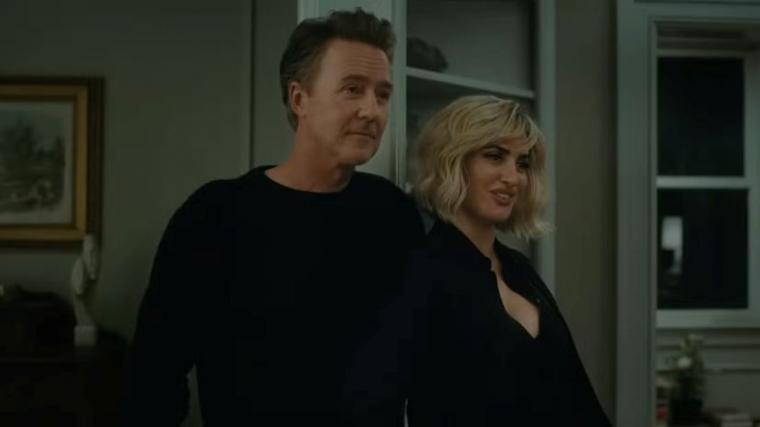
Because he exudes such untroubled calm, it initially seems like a put-on when Hank says that he's a retired firefighter; certainly Joe can't believe it. (And he almost expresses his amazement without impugning Hawk's manliness.) But Norton's lengthy monologue detailing Hawk's life trajectory – one that, reportedly, the actor himself wrote – is such a quiet heartbreaker that it forces you to reconsider both the character and Norton's performance; it's some of the most beautiful, searching work he's done in years. As for Cruz, we're accustomed to her being earthy, sensual, offhandedly ravishing. Here, playing a therapist who's also a self-proclaimed sexologist, the Oscar winner is also fearsomely intelligent, and gloriously instinctive, and, like her castmates, funny as all get out. On a number of occasions, Cruz's gentle command appears to change the pH balance of the entire apartment. Piña adds richness and texture, and it makes absolute sense when Wilde's restless camera finally stops scooting around, plunks itself in front of Cruz, and simply watches and listens. She's not simply a breath of fresh air – Cruz allows the movie itself to breathe.
Barring a few minutes spent in the outside world at the start, Cruz, Norton, Rogen, and Wilde are the only four actors through the whole of the film, and with what they're tasked to say and do, you couldn't ask for finer ones. Generally speaking, you also couldn't ask for finer dialogue writing, McCormack's and Jones' conversation continually witty, freewheeling, and tumbling over itself like cascades of notes in a slick jazz composition. It's really only that aggressively off opening quarter that kept me from loving Wilde's latest, and even that becomes something close to a distant memory by the finale, with the mood landing somewhere between pleasantly sloshed and bearably hung over. As for the director's gorgeous, moving final image, I think it would make Virginia Woolf's Mike Nichols – or even Ingmar Bergman himself – proud. Unlike with many a real-life dinner engagement, it should be no stress at all to accept this Invite. Bring your own canapés.
EVIL DEAD BURN
I get why actors, especially of the young-up-and-comer and middle-aged-workhorse varieties, would want to be cast in the 21st-century spate of Evil Dead films. After all, how many opportunities does a performer get to play both terrorized victim and Satanic victimizer, frequently while shrieking and covered in prosthetics and drenched in bloody goo? Fun!
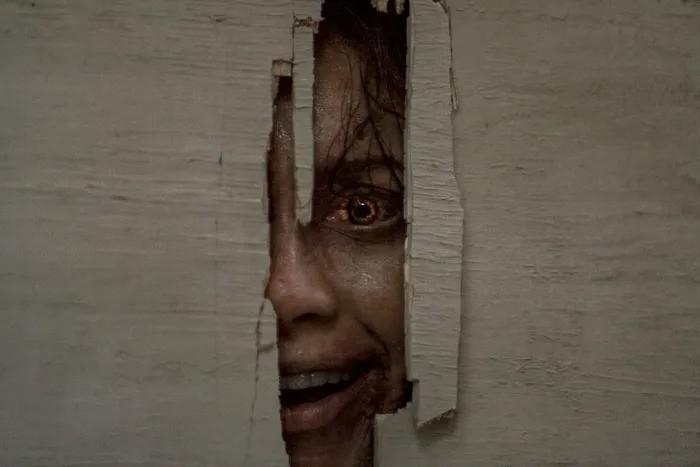
What I'm less able to understand is why audiences still want to see these things, considering that all traces of the original trilogy's prankish sense of humor – along with writer/director Sam Raimi and irreplaceable star Bruce Campbell – vanished from the franchise after 1992's Army of Darkness. Since then, it's been one endurance test after another: Fede Álvarez's 2013 Evil Dead, Lee Cronin's 2023 Evil Dead Rise, and now, Sébastien Vaniček's Evil Dead Burn. All three competently made; all three well-acted; all three full to brimming with indescribably ghastly images and effects. Yet none of them, sadly, any kind of genuine good time. And Vaniček's is the most draining entry yet, because in addition to not being fun, or even remotely funny, it denies us even one character whose survival you're invested in, and that includes the dog who gets graphically knifed to death at a dinner table. That information alone probably ensures that half of you won't bother with this thing. Now lemme work on the other half.
A dysfunctional-family saga to make August: Osage County look like The Waltons, Evil Dead Burn, early on, performs a nifty bait-and-switch regarding whom we presume to be its lead. At first, we expect it to be Joseph Price (Hunter Doohan), a bashful 20-something with a lovely girlfriend (Luciane Buchanan's Thya), a devoted brother (George Pullar's Will), and an interest in his late grandpa's research on the Necronomicon and all those troublesome series Deadites. Eventually, though, our true protagonist is revealed to be Will's wife Alice (Souheila Yacoub), who becomes a widow after her husband is killed in a Deadite-fueled car fatality, and whose in-laws, for the most part, do not like this young woman at all. She's blamed for inadvertently causing Will's demise. She wears a sweatshirt to his funeral. She's French. (Vaniček's film would've had more satiric bite had it been released in the “Freedom Fries” era of the early aughts.) Following Will's burial, all the Prices – including mom Susan (Tandi Wright), dad Edgar (Erroll Shand), and grandma Polly (Maude Davey) – and their better halves are stuck together in the same rambling farmhouse. (I'll admit to being confused when the clan entered this decaying, black-mole-abundant dwelling and said it wasn't nearly as nice as it was when Will and Alice were married there. Given the crumbling, gooey décor, when exactly did that union take place? The 1890s?!) As I probably don't have to tell you, a Deadite soon shows up, and manages to make the grieving process and hideous surroundings immeasurably worse.
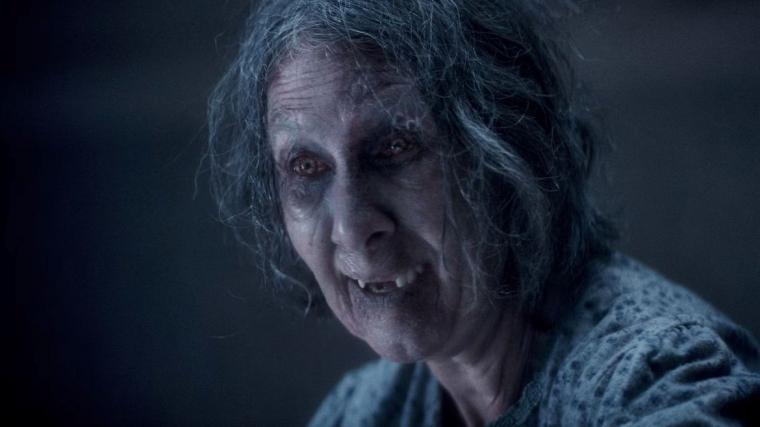
Admittedly, Vaniček and co-screenwriter Florent Bernard do have a solid germ of an idea here, equating the Price clan's interior, largely xenophobic hostility against Alice with the external, literally murderous hostility they demonstrate post-turning. (Not that the Prices, in Deadite form, have anything against butchering their own blood relations … or their pet pooch.) The problem is that, with the arguable exceptions of Alice and Thya, for whom we feel very little anyway, everyone we meet is so damned repellent. The Price parents are awful enough on their own. But Will, as we learn, was also an asshole. Joseph's initial tenderheartedness proves, instead, to be abject, loathsome wimpiness. The fishermen in the opener's obligatory gore-fest are stereotypically crude and dumb. Even Grandma isn't worth caring about, considering how grossly her dementia is employed for nonexistent laughs – though, depending on your mileage, you might get a chuckle from the sight gag involving Deadite Polly's slo-o-ow descent while strapped to a stairway chair lift.
Yet even if you're on-board with this franchise no longer being reliably funny, Vaniček's offering also commits the cardinal sin of not being frightening. Without question, its helmer has talent. He does well by his cast, a number of overhead shots are queasily effective, there's a single-shot ground-floor melee that's admirably upsetting, and Vaniček and cinematographer Philip Lozano come through with one truly excellent 180-degree camera move in which a Deadite is shown to be strangling a potential victim upside down, the creature having suspended itself from the ceiling prior to the attack. Such inspired moments, however, are depressingly few and far between. The copious gore isn't admirably revolting so much as merely exhausting, and the timing of the onslaughts is so predictable – barring one surprise bit with that newly undead pup – that my mouth never opened for a gasp, though it did open for a yawn or two (or six). Vaniček's Burn has its scattered genre pleasures. But if I'm at an Evil Dead, I want more than one decent jump scare involving a dog. I already get that every time I visit my mom and her golden retriever.
GAIL DAUGHTRY & THE CELEBRITY SEX PASS
I am so, so glad that writer/director David Wain and writer/co-star Ken Marino evidently didn't get the memo that nobody goes to cheerfully dumb comedies anymore. If they had, we wouldn't be currently treated to Gail Daughtry & the Celebrity Sex Pass, which would be easy to hail as 2026's most hysterical slapstick had RuPaul's Stop! That! Train! not been released less than a month ago.
Do cineplex crowds, these days, only feel comfortable laughing when their comedies are draped in prestige (Project Hail Mary, The Devil Wears Prada 2) or unease (Obsession) or sequel-ized animation (Toy Story 5, The Super Mario Galaxy Movie) or sequels in general (Scary Movie)? Are they simply unaware that releases such as Gail Daughtry and Stop! That! Train! – works that deserve loud, raucous, shared delight among strangers – even exist? Or is present-day America, on its own, simply too stupid to bother with entertainments that wear their stupidity as a badge of honor? Whatever the reason, this trend is depressing. So here I go, yet again, trying to explain why you should make time for a bona fide comedy with no agenda beyond making you laugh, and one that might very well have left the area by the time you finish reading this. [7/14 author's note: Gloriosky! The movie is sticking around at Moline's VIP Cinemas for another week.] But it's a losing battle I'm happy to fight. Love makes you do ridiculous things. And I'm sorry: I love Gail Daughtry & the Celebrity Sex Pass, which might be the most purely satisfying goof of its kind since 2021's already-kinda-legendary Barb & Star Go to Vista Del Mar.
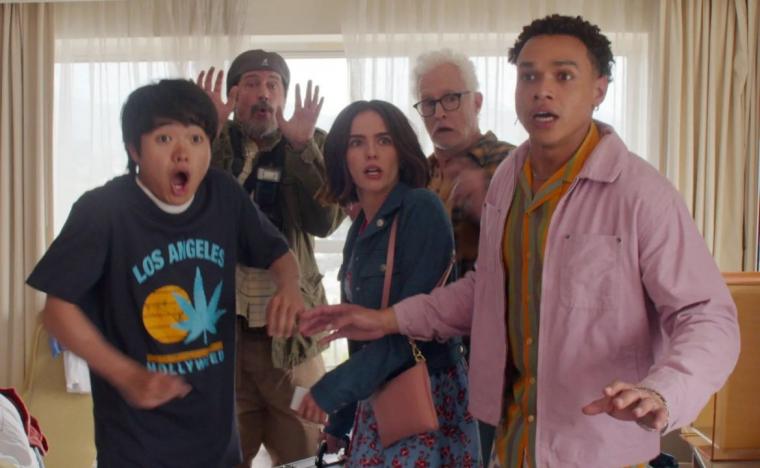
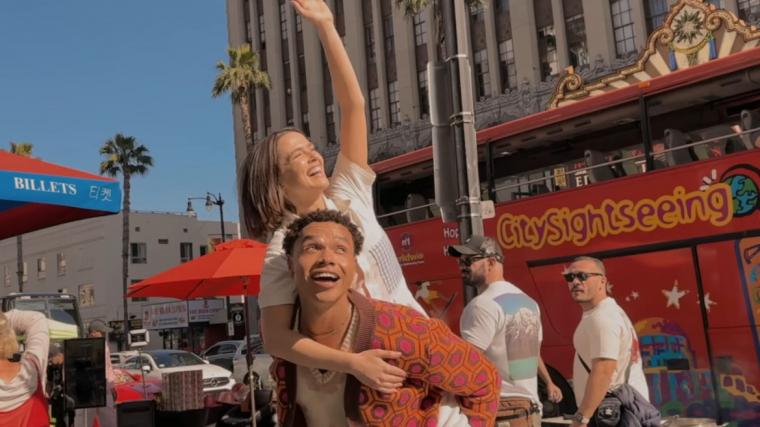
Zoey Deutch plays small-town-Kansas beautician Gail Daughtry. A relentlessly optimistic, Kimmy Schmidt type, Gail has a dim fiancé named Tom (Michael Cassidy), and together, two weeks before their wedding, they agree to mutual “celebrity sex passes” in which, per the rules, they're allowed to sleep with a mutually agreed-upon famous person should the opportunity arise, and with no hard feelings. Gail picks Jon Hamm. Tom picks Tilda Swinton. He switches to Jennifer Aniston after she arrives for a local book signing. He does have sex with Jennifer Aniston. Gail is appalled. Tom is appalled at her being appalled. And from that point, Gail, her hairdresser bestie Otto (the ceaselessly adorable Miles Gutierrez-Rley), and an assortment of newfound pals travel the streets of Los Angeles in search of the elusive Mr. Hamm, hoping to right Tom's wrong by convincing the star to act as revenge-boink. Did I mention that an identical-suitcase mix-up gets gangsters involved? That Mad Men co-star John Slattery plays himself as an unctuous has-been whose texts Hamm refuses to return? That it's all more-than-a-little-bit The Wizard of Oz, what with the winding roads and unexpected traveling companions and fulfillment of wishes and our steadfast Gail (Gale) from Kansas?
For quite a while now, Wain has been mostly conventional in his comedy-feature writing/directing projects, and perfectly pleasant though they were, Role Models, Wanderlust, and They Came Together were hardly madcap delights. Gail Daughtry is the first film in nearly 20 years to feel, to me, like a true David Wain picture – as nutty, fearless, tasteless, inventive, and gut-bustingly riotous as his iconic Wet Hot American Summer from 2001 and his even-better (yeah, I said it) The Ten from 2007. I cried with laughter at this thing, and can only imagine how much harder I might've cackled had more than three others been in my Moline auditorium for that screening.
Fred Melamed's initially soothing, ultimately unsettling surliness as our friendly-mailman narrator with serious bones to pick. Aniston's gleeful readiness to paint herself as a slut, right after she painted herself as unimaginably vacant with her cookbook Straight Forward Suppers. (Recipes include those for “instant oatmeal” and “bagel with cream cheese.”) Richard Kind as an Uber driver sharing his questionable obsession with Elizabeth Perkins – who, it should go without saying, eventually shows up in an Uber of her own. Ben Wang, beyond brilliant, as a grown-baby CAA agent-in-training. Co-scribe Marino as a celeb photographer for whom Jon Hamm remains his white whale. The gangster brigade, led by Sabrina Impacciatore, allowed to be as hilarious as the central cast. Our heroes' inability to stop punching Sabrina Impacciatore directly in the face. Henry Winkler's cameo. “Weird Al” Yankovic's cameo. Elizabeth Banks' cameo. Paul Rudd's cameo. Deutch's descent into Send Help über-violence. Slattery's largely one-sided text chain with Hamm. Jon Hamm himself, performing Olympic-level self-satire. The climactic hot-air balloon ride that puts all the Wizard of Oz-iness in perspective … and results in yet another Fred Melamed tirade.
There's a widespread aphorism about pornography that essentially goes: “I don't know how to define it, but I know it when I see it.” The same, I'd argue, could be said about David Wain's more rambunctious comedies. And Gail Daughtry & the Celebrity Sex Pass is undeniably, joyously, an old-school David Wain comedy, so crammed with beautifully constructed and sustained gags that the ones that don't land – such as the routine wherein John Slattery getting his foot slammed in a door for what feels like a full 60 seconds – aren't disappointments so much as necessary breathers. Enjoy it when you can. Admonish yourself for not enjoying it sooner.
MOANA
I really shouldn't have spent so much time at Disney's Moana remake looking for Dwayne Johnson's nipples. Not “at” – “for.”
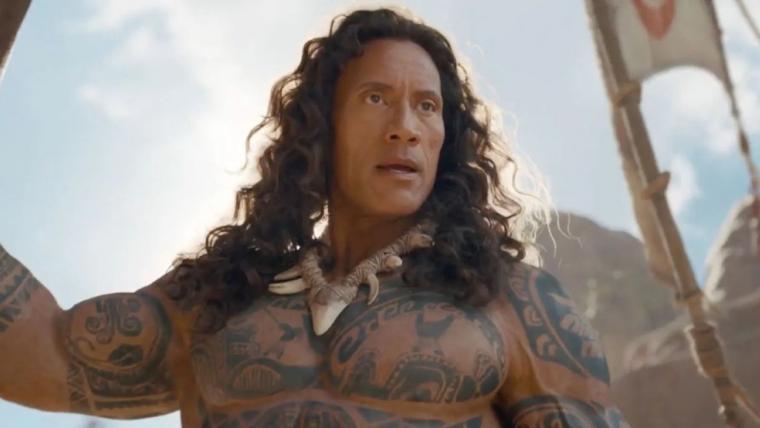
Re-creating the character he originally voiced in 2016's animated hit and returned to in 2024's even-bigger smash Moana 2, Johnson is still a huge guy, and could no doubt have played the sardonic, deliriously egocentric demigod Maui with his natural, still-amazing-for-a-54-year-old physique. But because the eight-and-under brigade would've probably whined that this Maui didn't look exactly like the other Maui – not that any of these tykes would likely be paying for their tickets – it was evidently decided that Johnson needed to be outfitted in a more recognizable Maui body suit.
Sweet Jesus, is this thing hideous. It looks like a long-sleeve, sumo-wrestler version of one of those faux-tuxedo shirts that ironic kids, like that dude in Carrie, wore to prom in the 1970s. Even the coloring is wrong, the tan of Maui's torso not matching the hue of Johnson's face and hands. All told, especially for a movie that reportedly cost some $250 million, The Rock's wardrobe looks unconscionably chintzy. Yet with the budget in place, couldn't, say, 10 grand have been spent outfitting Maui's chest with a couple of pointless nips? Given how often we watch Maui's ambulatory tattoos race around the guy's chest, I understand that the sight might've been distracting, if not legit traumatizing, for the eight-and-under set (or their pearl-clutching parents). I was so preoccupied with their absence, though, that my feature-length search caused me to blank out on several stretches of dialogue. For which I guess I have to thank this Moana, because heaven knows I wasn't finding much entertainment elsewhere.
Would that I had more to say about Disney's latest unconscionable yet sadly inevitable cash grab. As the title character, debuting Catherine Laga'aia is perfectly acceptable: big eyes, big smile, solid voice, plenty of spunk. Rena Owen is quite appealing as the girl's beloved Gramma Tala, equal parts salty and sweet, and real (or “real”) enough to make all of her endless talk about family and legacy and The Wonders of Nature borderline-bearable. The effects are okay. Barring an end-credits tune I didn't stick around for, the songs are the same ones we heard before, with only Johnson's “You're Welcome” staged to not suggest mediocre community theatre. The climax in which a potentially apocalyptic battle is sacrificed for the soothing effects of simple human-to-god understanding remains kinda touching. But having only seen the animated version one time not-quite 10 years ago, I have nothing to say regarding how director Thomas Kail's mostly live-action Moana might significantly differ from that earlier fan favorite; it was the same Moana to me. And I cared about it the same amount, meaning not at all. Perhaps, with the movie scoring a disastrous-for-its-budget $43 million on opening weekend, the mass audience is starting to share my ennui-or-worse reactions to its studio's constant pillaging of prior successes. Please, Disney: Nip this habit in the bud.