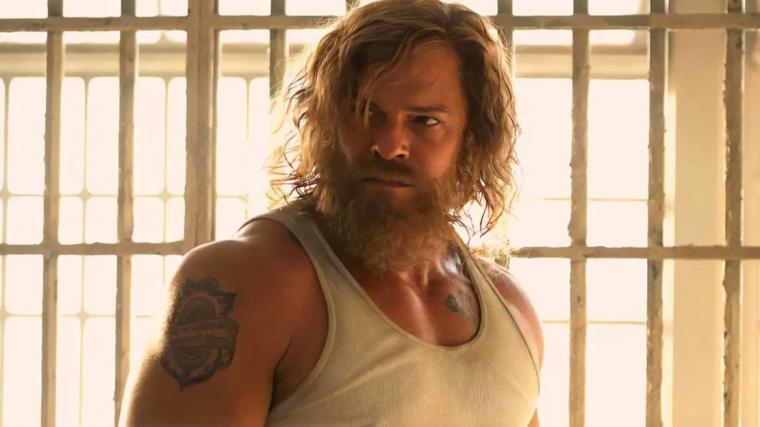
Alan Ritchson in Motor City
MOTOR CITY
In director Potsy Ponciroli's revenge thriller Motor City, a guy (a) falls in love with a gangster's girlfriend; (b) is framed by said gangster for a crime he didn't commit; (c) is sentenced to prison while the gangster marries said girlfriend; and (d) escapes prison in the hopes of killing the gangster and winning back the gangster's girlfriend who's now the gangster's wife. You know: That old plot.
And it is an old plot – or at least it reads that way, given the astonishing number of clichéd scenarios screenwriter Chad St. John delivers. Yet to its credit, Motor City does offer some mild novelty, because over the course of the film's 100 minutes, we hear, at most, two dozen words actually spoken out loud. For almost its entire running length, St. John's narrative unfurls through unheard background conversation, loaded expressions, violent beatings and gunshots, a goodly amount of grunting, and a soundtrack (including a collection of classic-rock tunes) that doesn't let up for an instant. This is an atypical presentational style, to be sure, and it does make Ponciroli's movie somewhat more interesting than the genre norm. Yet I'd be lying if I said the lack of dialogue benefited the film in any meaningful way, considering how often its “silence is golden” mantra turns Motor City into an unintentional howl.
Ponciroli's is by no means the first silent, or near-silent, live-action feature released this century. We've had Best Picture winner The Artist, of course, and the Robert Redford vehicle All Is Lost, and the comedies Sasquatch Sunset and Hundreds of Beavers, and the deeply unpleasant Ukrainian drama The Tribe. There was even another gory revenge thriller, John Woo's Silent Night, that debuted not quite three years ago. Those movies, however, all had decent reasons for being dialogue-free: They were replicating Hollywood's pre-talkies era; they focused solely on pre-verbal Homines erecti; they featured casts composed entirely of deaf performers (in the case of The Tribe) or only one performer (in the case of the Redford). Silent Night, too, made sense as work void of chatter, Joel Kinnaman's angry protagonist having lost his vocal chords in a gangland shooting. But beyond its director and writer potentially amassing cool points for their conceit, you have to wonder why Motor City was designed as a “silent” film in the first place. It's not that the characters can't talk. They just don't, or do without our being able to hear them, and that makes many of the goings-on here silly to the point of absurdity.

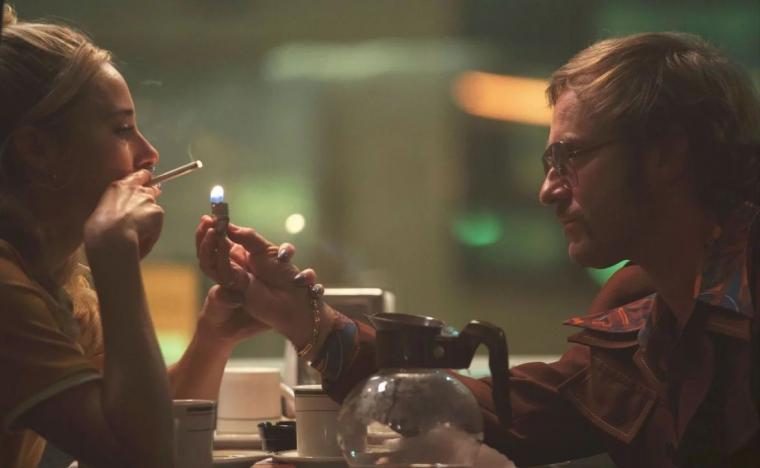
In what might be the movie's most laughable sequence, though God knows there are competitors, it's 1977 Detroit, and Shailene Woodley's Sophia is waiting tables in a downtown diner. It must be the restaurant with the big “SHHH!” sign on the door, because in your life, you've never visited a quieter, more languid eatery; this place makes Twin Peaks' Double R look like Ed Debevic's. In a dream-like stupor, Sophia comes out of the kitchen with two plates of food, places them in front of two guests, refills a coffee cup, and at no point do either the customers or their waitress make a peep, not even to say “Thank you” or “You're welcome, Sugar.” It's like the establishment demands a vow of silence before entering. But then Sophia's ex-beau Reynolds, that aforementioned gangster, shows up, and portrayer Ben Foster joins Woodley in this underwhelming Acting 101 exercise. They make eye contact. They glower. They smolder. Reynolds wordlessly requests a cuppa joe. Sophia pours one for herself instead and sits in the booth opposite him. (Is she on a break? Would her boss say anything if she wasn't?) They don't talk forever, though both clearly have something to say. However will they communicate? Through index cards? Smoke signals? Hand puppets? Finally, with maximum exertion, Woodley barely croaks out a “Hello.” Foster replies with an equally sotto voce “Hi.” And then the film cuts to a sidewalk shot, we viewers watching through the window as the pair continues to not talk.
While Motor City is filled with ludicrously, sometimes hysterically contrived situations of this sort, every once in a while the voicelessness is legitimately appropriate, and even clever. During his brief imprisonment, Alan Ritchson's brawny hero John Miller is visited by a buddy and fellow Vietnam vet (Lionel Boyce), and rather than speaking to him on the phone, John taps out an escape plan, through Morse code, on the bulletproof glass. (A smart move, because who knows who might be listening in on the call?) When Reynolds himself visits John, it's in an interrogation room with a reel-to-reel tape recorder running; obviously, no incriminating words will be uttered here. And occasionally, the presentational device is even successfully employed for comedy – intentional comedy – as when the framed John is first handcuffed and thrown to the ground, and a corrupt, smirking detective (Pablo Schreiber's Savick) raises an index finger to his lips, subtly demanding silence from the accused. Like John would have any other choice in this movie!
When he's not over-indulging in the slow-motion effects, which is around 50 percent of the time, Ponciroli (it's so tempting to refer to him as “Potsy”) also comes through with some effectively ugly, well-choreographed action sequences; the one that found John and Savick laying waste to one another in an elevator, blood constantly splattering the camera lens, was especially kinetic and giddily gruesome in the John Wick manner. Yet the movie's rare instances of invention are few and far between, and some of the stupidest and most offensive inclusions actually don't have anything to do with the absence of dialogue.
I'm thinking of John's brick-shithouse frame magically fitting into the shirt of a cop half his girth, and Sophia routinely appearing as a hallucinated vision not unlike Zendaya's Athena in The Odyssey, and the newspaper headline that announced “LOCAL MAN SENTENCED TO 25 YEARS.” (Would a major paper in Detroit – the most populated city in Michigan – really refer to one of its own simply as a “local man,” like he was a citizen of Mayberry?) I'm thinking of the riotously dumb prison getaway scored to “Nights in White Satin,” and John hand-crafting a magic bullet with an engagement ring attached, and Ben Foster's uncanny ability to overact even when deprived the power of speech. I'm thinking, alas, of the film's grossly foul treatment of Woodley, who spends one scene (silently) tantrumming with her right breast falling out of her gown … in slo-mo. Most of all, I'm thinking of poor Alan Ritchson, who not only has to don some of recent cinema's most atrocious wigs – one makes him look like Shaun Cassidy mid-Teen Beat fame; one makes him look like the Cowardly Lion – but has to ultimately endure facial prosthetics that leave him resembling the Fantastic Four's Thing, or maybe a grandpa to the Teenage Mutant Ninja Turtles. Its title is Motor City, and you have to question why so many talented people, upon realizing what they were in for, didn't motor their asses away from it.
HADESTOWN: THE MUSICAL
For the life of me, I'll never understand why more Broadway productions don't eventually get screened at the cineplex, or even on PBS and BroadwayHD. It's not like these shows aren't filmed. They're all filmed, and apparently housed quite comfortably in Manhattan's New York Public Library for the Performing Arts. But maybe the times they are a-changing, given the massive (for its specialty type) big-screen triumph of Hamilton, and last year's better-than-anticipated haul for Merrily We Roll Along, and the new debut of Hadestown: The Musical. Technically, this latter release isn't a filmed Broadway event; the show was actually recorded over three 2025 performances in London's West End, albeit with the 2019 Broadway version's five central performers reprising their roles. But did you see this past weekend's domestic box-office chart? With almost $10 million amassed (per BoxOfficeMojo.com), Hadestown came in fourth, ahead of Minions & Monsters and just a few hundred-thou short of Toy Story 5. It also boasted the weekend's second-best per-theater grosses, right behind – you guessed it – Christopher Nolan's similarly Greek-myth-themed The Odyssey. Even on a summer weekend that saw precisely zero big-studio offerings opening, those are numbers and stats worthy of attention.
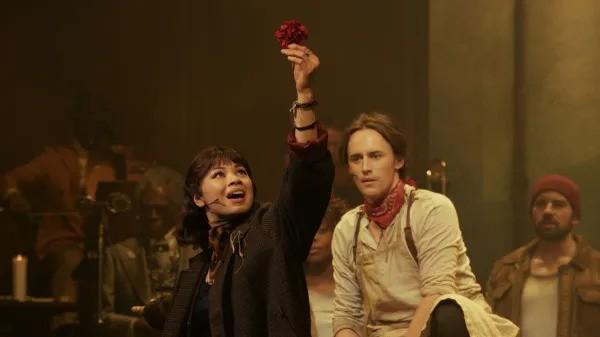
In any incarnation, Hadestown itself is certainly worthy of attention. An eight-time Tony Award winner, composer/lyricist/book writer Anaïs Mitchell's radical re-imagining and blending of the Eurydice/Orpheus and Persephone/Hades myths, with the Greek god Hermes acting as intrusive narrator, is flabbergastingly enjoyable. From its score that delectably mixes jazz, folk, blues, and traditional-show-tune stylings to its gorgeously evocative and sweaty New Orleans locale, the show is two-and-a-half hours (sans intermission) of rapturous delight. In director Brett Sullivan's filming of the musical's West End performances, it's also best-seat-in-the-house delight, the camera granting us access to sights even front-row tickets don't allow: a character being literally looked down on during a slow descent into the underworld; the single tear that descends as Eurydice recognizes the end of her earthly life. As in the filmed Hamilton, the camera crew appears to be placed in almost impossible positions throughout the live recording – “impossible” considering how you almost never see them at work – and unlike in last year's Merrily, the cameras almost never seem to be in the wrong place at the wrong time. We may have been denied the god's full figure in the moment, but the tight closeup on one of Hermes' tapping shoes before a moment of life-changing importance was the sort of heart-stopping image that live theatre, by its very nature and for all its wonders, simply can't match.
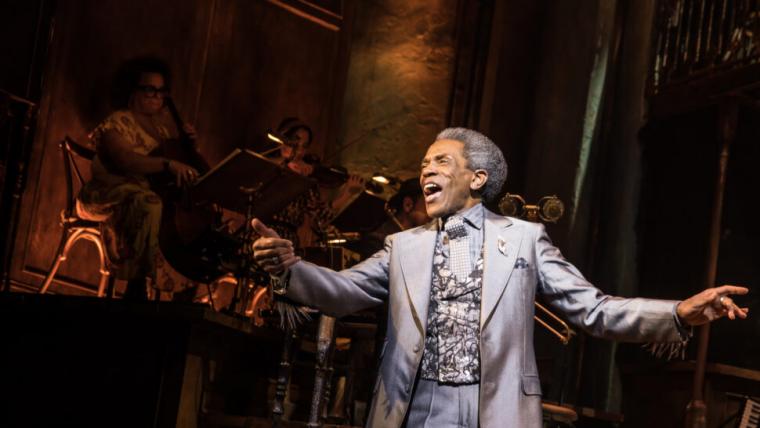
Although the entire ensemble is tremendous, I'm not sure which gods of entertainment we need to thank for this West End reuniting of Hadestown's original Broadway principals. They're certainly deserving of a hearty fruit basket or sacrificial goat or something. (Maybe not a sacrificed goat.) As Eurydice, Eva Noblezada provides crystalline vocals and constant emotional translucence. Reeve Carney, returning as Orpheus, shifts from earthy chest voice to heavenly head voice in ways that sound practically supernatural. Despite an injury causing him to perform his Hades with his foot in a significant (and quite chic) boot, Patrick Page is intimidation incarnate, hitting bass notes so soul-shakingly low that he makes Leon Redbone sound like Kristin Chenoweth. Amber Gray, my personal fave among the principals, imbues Persephone with extraordinary live-wire vitality and almost singlehandedly produces as grand an Act II opener as any musical of the last 50 years has produced. And what, by this point, can be said about André De Shields' turn as Hermes? The Tony winner (nominated again this year for playing Old Deuteronomy in the Cats revival) doesn't need wings on his feet. He has them in his soul, and there may be no grander 180 screen seconds this year than De Shields' breathtakingly deliberate introduction, his climactic flashing of a sharkskin vest a stage sight to rival the thrill of Phantom's falling chandelier.
Although I try to steer clear of them as much as possible, there are people in my life who weirdly don't appreciate stage-to-screen transfers of this sort the way I do. They don't like the artificiality – how the (mostly) unseen patrons' laughter and applause reminds them of sitcoms filmed “before a live studio audience.” They don't like the performative broadness that goes against the tradition of “subtle” screen acting. They don't like the theatricality of it all. But I'd argue, at least in Hadestown: The Musical, that the staginess is precisely what makes these recorded works exhilarating. The crowd's unmistakable aural happiness upon reaching the opening “Road to Hell” number's climax. Their huge roar of laughter when Page opens his mouth and speaks in a baritone timbre previously unimaginable. Their bottomless glee when Amber Gray effing kills it on “Our Lady of the Underground.” Their enormous, aghast gasp when (3,000-year-old Spoiler Alert!) Orpheus makes the tragic mistake of looking behind him. There were gasps in my auditorium, too, and for one glorious moment, it felt like all of us, on-stage/screen and -off, were sharing in an unreproducible moment … which is always what great theatre strives to deliver. This Hadestown was originally scheduled for a five-days-only cineplex run. Its phenomenal weekend box office, unsurprisingly, has led to an extension. Don't miss it. It's hella fun.
And speaking of Hell … .
HER PRIVATE HELL
His first big-screen venture since 2016's widely and vociferously loathed The Neon Demon (an unclassifiable provocation that, in my opinion, is really only half-terrible), Danish writer/director Nicolas Winding Refn's latest is Her Private Hell. But that seems too limiting a title. For we viewers, isn't it our collective Hell, and a public one, at that? I'm not sure how many “get out of jail free” cards we're meant to give Refn for treating us to the insane, über-chill charisma of Ryan Gosling in 2011's Drive, to say nothing of that film's Albert Brooks as a menschy scumbag and Carey Mulligan and Oscar Isaac memorably partnered long before this past spring's Beef. But while the guy's indie movies always manage to look fantastic, they've become increasingly bereft of ideas and storylines that are in any way playable, or even comprehensible.
What's going on in this new Refn? That's not a hypothetical question. I'm honesty asking. Sophie Thatcher plays Elle, a hardscrabble actor with serious daddy issues. She's apparently filming a cheesy sci-fi flick in her hotel suite – and for an apparently nonexistent director – alongside a ditz named Hunter (Kristine Froseth) and Elle's former bestie Dominique (Havana Rose Liu), who is now, despite being Sophie's age, Sophie's stepmom. Dad is Johnny Thunders (Dougray Scott), who might also be masquerading as the local serial killer The Leather Man, who tends to rip female victims in two and will evidently only be killed by having his diamond-encrusted hands cut off. Wandering amidst this incoherence, because why not, is Charles Melton as an American G.I., presumably landing directly from World War II, who is convinced that his missing young daughter has been taken to Hell. (Between The Odyssey, Hadestown, and this, movie-goers have endured a lot of treks to the underworld lately.) Did I mention that this all takes place in a mildly futuristic city engulfed by a supernatural mist? That Sophie and Dominique, and now Hunter, can communicate in wolf barks and howls? That the film somehow received a roughly 10-minute standing ovation at this past spring's Cannes Film Festival? Are you even still reading this?
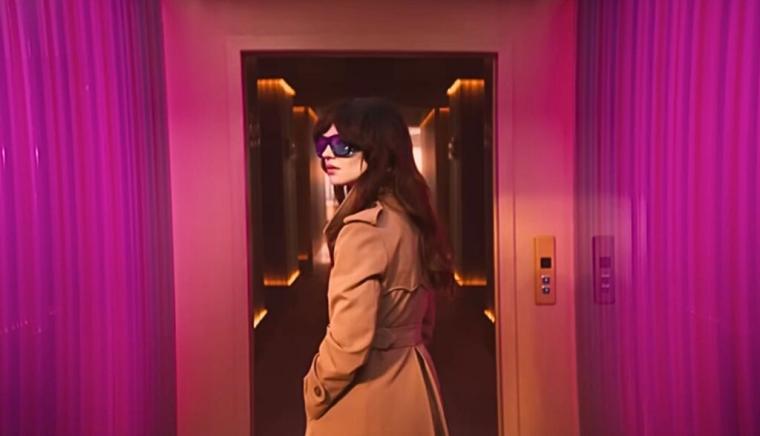
I dunno. Thatcher is a beguiling camera subject, and only appears to falter here when required to dramatically emote – which, to be fair, is in only one scene. Liu is the lone on-sie actor who sounds like an actual human being, which makes her enormously welcome, but kind of all wrong for this project. The lush, gorgeous, score by legendary composer Pino Donaggio (he did Dressed to Kill and Blow Out, among others, for Brian De Palma) is beautifully enveloping. Cinematographer Magnus Nordenhof Jønck's neon-soaked effects are oftentimes extraordinary, particularly in sequences that find the lights shifting from blue to red and consequently making characters' appearances look startlingly different from hue to hue. There's some amusing dialogue. (“How can someone so attractive be so unf---able?”) There's a lot of dreadful dialogue. (“I am a victim of the mist.”) It's nowhere near as good as Refn's Drive. It's much better than 2013's Only God Forgives. It's pretty equal to The Neon Demon. I wasn't angry about seeing Her Private Hell, and in truth, wasn't even much bothered be being so confused. I was just bored. Experiencing boredom at the movies, though, is my own private Hell.