
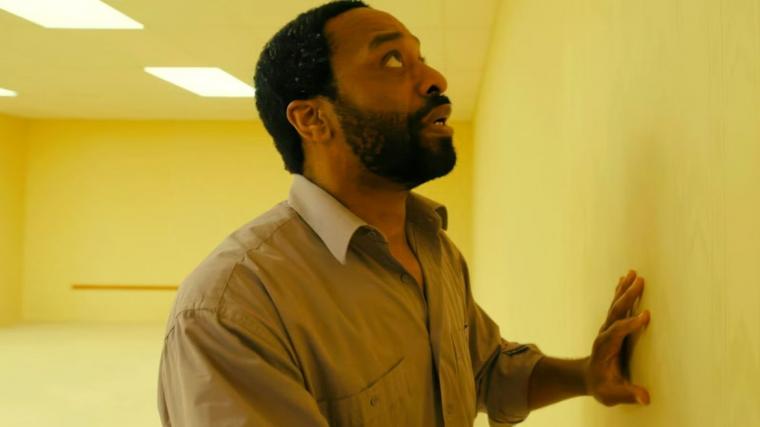
Chiwetel Ejiofor in Backrooms
BACKROOMS
I'm not sure what it says about the future of horror movies – if it says anything at all – that the year's strongest, scariest creep-out to date is directed by someone not quite old enough to drink. (He can legally celebrate his success over cocktails starting June 18.)
Backrooms, however, is a pretty miraculous achievement even beyond the fact that helmer Kane Parsons, adapting his popular YouTube series, is all of 20 years old. The imagination, confidence, and sensitivity to performance on display would be noteworthy regardless of Parsons' age, and his visual sense is so stunning, and his compositions so foreboding, that you could easily mistake images here for those of much-older masters, past and present: Kubrick; Hanecke; Tarkovsky; Lynch; the Coens; even Orson Welles, who was a comparatively ancient 25 when he unleashed upon cinema a Kane of his own. I was kept thoroughly on-edge by this debut, but more than that, I was deeply impressed. It's the sort of film you watch with escalating unease all the way to the end credits, at which point I was left with only one adequate vocal response: “Ni-i-ice.”
Parsons' aforementioned web series explores the banal terrors of liminal space through long, alternately static and tracking shots of empty or abandoned rooms and hallways, what story there is (or what story you impose on it) secondary to the buildup of unsettling dead. In other words, it's less about narrative than mood, and to borrow from the movie's Vulture review, that makes the feature-length Backrooms perhaps the first Hollywood release – certainly the first to globally cross $100 million on opening weekend – ever adapted from a vibe.
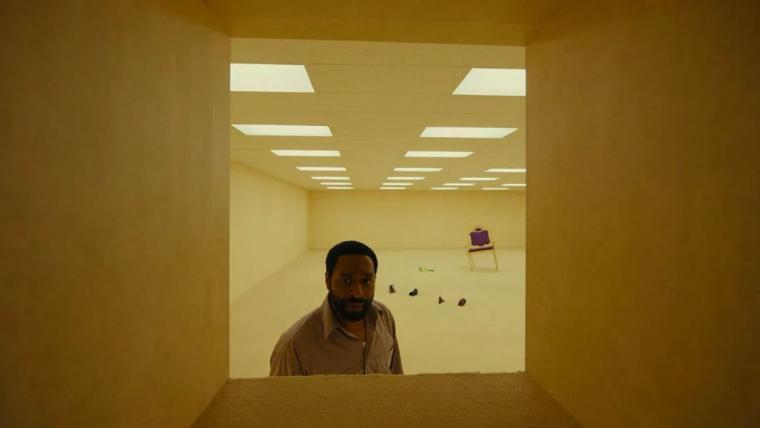
Chiwetel Ejiofor's Clark is the owner of a crummy discount-furniture store, an alcoholic, and a recently separated husband. Renate Reinsve's Dr. Mary Kline is a bestselling author, self-help guru, and Clark's therapist who tries to coax her client into taking responsibility for past actions. Temporarily living in the basement of his expansive shop whose flickering fluorescent lights emit seriously Lynchian energy, Clark notices a slender shaft of light coming from an otherwise bare wall. He discovers that a rectangular 8' x 3' section of that wall isn't a wall. It's a doorway leading to a previously unknown room, one painted a rather aggressive shade best described as “piss-yellow,” and with a massive tower of piled furniture at the center. An adjoining hallway, though, leads from this room to another, and from that room to yet another, and so forth, seemingly without end. Where is Clark? Why do the randomly scattered objects seem so unfinished or incorrectly built? What the hell is going on here?
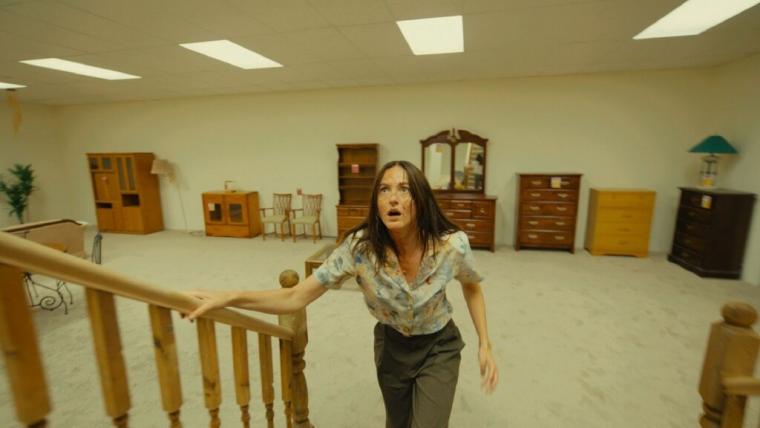
As we know from Backrooms' nerve-jangling prelude that involves amateur camcorder footage (the movie is set in 1990) and an attack by a largely unseen something-or-other, whatever's going on can't be good. Clark, however, doesn't yet realize this, and after he finds his way back to that “invisible” entrance, he keeps returning to the subterranean backrooms, venturing further and further each time. He tries explaining these bizarre excursions to Mary, who responds to Clark's ramblings with a practiced therapist smile suggesting “I am sitting opposite a complete basket case.” He also enlists his employee Kat (Lukita Maxwell) and her boyfriend Bobby (Finn Bennett) to travel into the unknown with him, Bobby manning a video camera and recording the whole time. Both are understandably freaked, Bobby particularly so when he finds, among a pile of clothes, a mirrored version – backward lettering and all – of his own anti-Apartheid half-shirt. (Oh, 1990.)
Aside from mentioning that Dr. Mary eventually enters the backrooms herself, and that Mark Duplass shows up when I least expected him (or anyone) to, this is probably where a synopsis of Parsons' and screenwriter Will Soodik's film should end. Yet it's also kind of impossible to give away the goods on Backrooms, because mood movies, as a rule, really can't be spoiled. I could, for instance, detail any number of arresting, unnerving sights: the room of everyday items embedded in the floor, only their top halves above ground; the mound of debris that, as Bobby doesn't notice but we sure do, seems to include a human head; the return appearance of the pirate costume Clark wore during a commercial shoot – but this time, inflated. Mere descriptions, though, can't convey the staggering eerieness achieved by Parsons and his collaborators, principally cinematographer Jeremy Cox and production designer Danny Vermette. (The prickly, sparingly employed score, meanwhile, is by the director and Edo Van Breeman.) As with the Overlook Hotel hallways and Twin Peaks' Red Room, as well as many liminal spaces in general, most of the locations here inspire a very specific type of silent scream: a dreamlike sense of being lost, and potentially watched, in oddly familiar surroundings. You may not be able to properly define this sensation. But you absolutely know it when you feel it, and that's the sort of subtly stomach-knotting horror Parsons and company deliver.
Rest assured that this remarkably controlled debut isn't wholly devoid of plot, or more significantly, explanations. If anything, in the final scenes, we're given maybe too many of them. Not to the extent of the insane exposition dump at the end of Psycho, but certainly some of the psychological associations we instinctively just get didn't need to be iterated through dialogue here; if you're paying attention, especially during Mary's book-on-tape readings early on, a majority of puzzle pieces fit through visual means alone. That, however, may be my biggest gripe with Backrooms, which is trenchantly acted by Ejiofor and Reinsve, oftentimes quite funny (here's hoping we see a lot more of Finn Bennett down the line), and shudder-inducing like nobody's business.
And can this old fart take a moment to publicly salute both Kane Parsons and his fellow wunderkind Curry Barker, who's currently enjoying unparalleled success with Obsession, for getting Gen Z at least momentarily stoked about movies? Famed for their respective successes in YouTube horror and web-based sketch comedy, these two directors may only have 46 years between them, but their films collectively scored $107-million-plus domestically over the last weekend in May, and with original, non-IP material, to boot. (Obsession's earnings actually increased from first to second weekend and second to third weekend.) For helmers this young, that's not simply unusual. It's historic, and all evidence indicates it's because audiences of their demographic came out in droves. Please let them keep on comin', and please, Hollywood, let Parsons and Barker and – I swallow hard saying this – even Iron Lung's Markiplier keep making whatever they want. The big-screen experience isn't going to be saved by the umpteenth lackluster Star Wars. A piss-yellow waiting room the size of an airplane hangar, though? That just might do the trick.
PRESSURE
This is by no means a comment on the actor's size. But I may as well acknowledge the elephant in the room and say that, in director Anthony Maras' World War II drama Pressure, Brendan Fraser is hopelessly bad as Dwight D. Eisenhower, though I'm willing to plea-bargain that assessment down to a more generous “thunderously miscast.”
Ignoring that the Oscar winner looks nothing like the WWII Army general and future U.S. President he's tasked to portray – because, really, who cares? – what adjectives come to mind when you think about Ike? “Commanding,” probably, and “stoic,” with “fierce,” “determined,” and “no-bullshit” likely also landing on the list. Fraser's Eisenhower is none of those things. He's certainly loud, with much of his screen time devoted to shouting at subordinates, and it must be said that Fraser can increase his volume with the best of them. But this Ike, tormented over a practice run gone tragically wrong and waffling endlessly over the planned date for D-Day, doesn't read as a hero. He's more like middle management who's been promoted far beyond his skill set and is just now realizing it. With the fate of the world resting on his shoulders, Fraser's Dwight D. moans, tantrums, kvetches, gets too teary too often … . He's the last person, you think, who should be charged with a history-making decision, and none of Fraser's legitimate performance gifts – among them his earnestness, relatability, and aw-shucks humor – have any place in Pressure's conception of the general. This Eisenhower can't believe that his future, the planet's future, is being put in the hands of two warring weathermen. We can't, either, but not because of the dichotomy between the meteorologists' opinions. It's because we don't buy into the notion that Ike was such a namby-pamby he didn't simply knock these guys' heads together and make a wartime decision on his own.
Given Maras' and co-screenwriter David Haig's presented image of Eisenhower – that of a man aghast and incredulous that his meticulously prepared attack strategy might be upended by the freaking weather – it's possible that no actor could do the role proper justice. Even the late George C. Scott at his most Patton-esque might've wound up looking like a nitwit. But Fraser's insufficiency is annoying regardless, because he's just about the only thing keeping Pressure from being absolutely first-rate.
What a wonderfully unanticipated surprise Maras' film is: a Dad Movie (even a Granddad Movie) to its teeth, but one bolstered by an engaging, elegantly delivered narrative, clear stakes, considerable tension, fascinating historical detail, and, Fraser excluded, excellent portrayals across the board. I didn't even mention that the movie clocks in at 100 minutes, end credits included, which is practically unheard of in screen entertainments of this type. Like most Dad/Granddad Movies, it's aggressively middlebrow and more than a little corny; although the composition always gooses my tear ducts, I may have reflexively rolled by eyes when Arvo Pärt's elegiac “Spiegel im Spiegel” played at a moment of particular poignancy. But I did well up at the music, and at the well-earned Allied triumph, and at the finale involving the personal triumph of Captain James Stagg, a role that would likely earn Andrew Scott an Oscar nomination if conventional period dramas with so-so box office weren't so currently out-of-favor with the Academy. Pressure is a thorough delight.
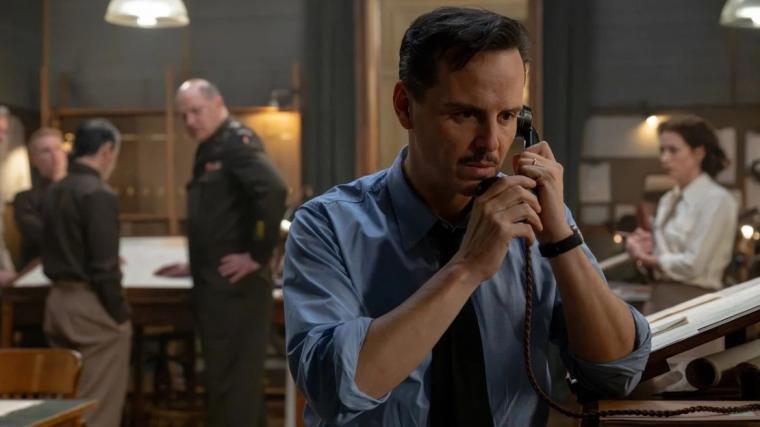
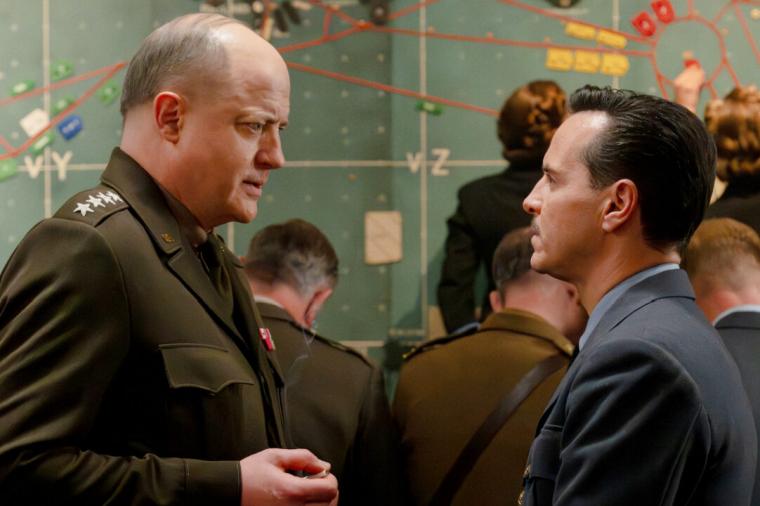
It's also, yes, a World War II saga about weathermen, with Eisenhower demanding predictions on the atmospheric conditions for June 5, 1944 – the day of the originally planned invasion of Normandy. Pointing to precedence and maps of decades past, American meteorologist Irving P. Krick (a terrific Chris Messina, riffing on his boisterous sports agent from 2023's Air) gives Ike the thumbs-up: June 5, he avers, will be sunny and mild. Scottish meteorologist Stagg thinks the polar opposite, expecting incessant rain, devastating winds, waves of more than 10 feet high, and the inevitable deaths of hundreds or thousands. It's evident which man Eisenhower would choose to believe. (Pressure shrewdly plays into the current political and culture wars between science and gut instinct.) Still, you might imagine that Maras' offering would be lacking in tension, given that even those with merely remedial WWII knowledge know that D-Day didn't occur on the fifth, but rather the sixth, of June.
Instead, the movie operates much the way an all-timer Dad/Granddad Movie – Ron Howard's Apollo 13 – did: It keeps you invested not by making you doubt your own knowledge of history, but anxious to know the background behind that specific moment in history. Krick, a chummy raconteur who brags about correctly predicting the weather for the Gone with the Wind shoot, is unquestionably certain that June 5 is the way to go … and we know the invasion didn't happen on that day. But citing atmospheric conditions and his copious reams of research, Stagg's suggestion for the ideal Normandy attack is June 18 … and we know the invasion wasn't on that day, either. Maras and Haig consequently keep us invested through our need to learn why D-Day eventually landed on June 6: Was it Krick or Stagg who was more right? The script, to be honest, makes that evident from the start, with Krick designed as a helpless braggart and suck-up and Stagg as an incorruptible figure of rectitude. (And with a nine-months-pregnant wife waiting at home!) Yet there's enormous enjoyment in their supremely hostile battles of wills, and if he doesn't provide legitimacy, Fraser at least supplies appropriate bluster as Krick and Stagg face off, one giving Ike the info he wants but doesn't fully trust, the other giving opinions Ike doesn't want and doesn't fully trust.
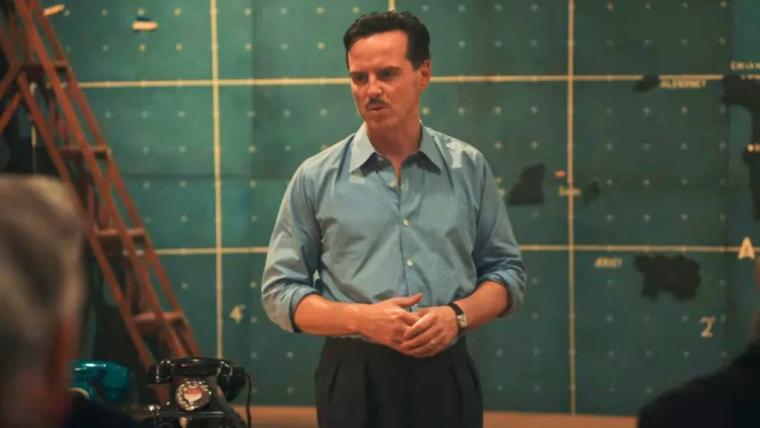
This may be the first World War II movie since the 1998 two-fer of Saving Private Ryan and The Thin Red Line that I have any interest in watching more than once. I enjoyed the period-accurate and, to modern eyes, appreciably silly sight of scientists floundering while attempting to launch the very latest in '40s-era meteorological advances. So many huge weather balloons! I admired the curt decency of Kerry Condon's Kate Summersby, Eisenhower's personal secretary, and the perfectly calibrated priggishness of Damian Lewis as British Army officer Bernard Montgomery. The pacing is swift; the threat palpable; the score by All Quiet on the Western Front Oscar winner Volker Bertelmann traditionally propulsive. (Also traditionally pushy, but I worked past that.) Most of all, though, I'll be returning for Andrew Scott, who exudes something I've only rarely witnessed on-screen: ferocious tenderness. He is granted one instance of balls-out righteousness, but that explosion aside, the drama of the actor's conception of Skagg is almost purely internal, and devastatingly moving.
After a sweet scene of marital bliss with his expectant wife (Tamsin Topolski), Stagg gets to Ike's compound, and wastes no time in coming across as a hands-off asshole to everybody: his weather-forecasting charges; Summersby; Krick; Ike himself. What keeps us in his corner, beyond the actor playing him, is that we immediately intuit that Stagg is right, and right about everything – even his own lack of knowledge. (Whenever Eisenhower asks for certainty regarding the projections, Stagg continually replies that he can't give certainty, as weather is inherently unpredictable.) Yet the more that others pile on the soft-spoken Stagg, the more we in the audience care for him, and Scott secures our empathy with a quiet, lovely scene opposite Condon in which the meteorologist explains the fundamental beauty of weather as a force that's transcendent because it's ever-changing. It's like Virginia Madsen explaining the magic of wine in Sideways, and for just a few minutes, the gorgeously well-executed nuts-and-bolts of Pressure arrives at a place of deserved restfulness, and maybe even grace. As he so frequently is, Andrew Scott is an absolute knockout. And for just over an hour-and-a-half, he becomes the best-ever reason for seeing a Dad Movie – aside from, I'd imagine, being a dad yourself.

THE BREADWINNER
Back in 1983, when Michael Keaton's economically-forced-and-not-happy-about-it stay-at-home dad couldn't change a diaper or do a load of laundry or make a simple breakfast in Mr. Mom, it was mildly amusing, and even semi-believable. At that point, after all, we were only three years past the Best Picture Oscar victory for Kramer vs. Kramer, a drama in which Dustin Hoffman's newly single parent absently left egg shells in his son's French-toast batter and tried to convince the kid that everyone likes French toast crunchy. That's why it was particularly galling to see, in director Eric Appel's family slapstick The Breadwinner, star Nate Bargatze purposefully leave egg shells in a misguided attempt at making breakfast for his own kids. Did this dude not see Kramer vs. Kramer? Did he not see, I dunno, any of the hundreds of subsequent screen and TV entertainments demonstrating that a heterosexual male father, left to his own devices, will inevitably wreak havoc on his home and children?
Honestly, few things in life would've made me happier than getting to crap all over The Breadwinner, which forces comedian Nate, playing a Toyota salesman named Nate, to supervise their three young daughters while his wife (good sport Mandy Moore) pursues success as a Shark Tank entrepreneur. Seriously, that synopsis alone qualifies Appel's comedy for all-time-worst consideration. And sweet baby Jesus is there a lot about this aggressive trifle, co-scripted by Bargatze and Dan Lagana, to detest. Miraculously, we're denied the scene of Nate (either of them) proving so inept at cleaning clothes that he floods the laundry room with soapy bubbles. I'm not sure that his decision to simply burn the kids' dirty socks and underwear and buy new is any sort of improvement, especially considering his actions lead to an unironic rallying cry for the joys of Wal-Mart, which, along with Toyota and KFC and several other brands whose logos are prominently displayed, takes product placement to almost unprecedented levels. (Based on the way they unconvincingly tried to hide what they were doing, studios used to seem vaguely embarrassed about this sort of pay-for-play, but in accordance with current national trends, the attitude here seems to be “Yeah, they gave us money for the exposure – what're you gonna do about it?!”)

Oh but there's so much more to hate. Nate missing garbage-pickup day yet again. Nate not knowing where his girls' schools are. Nate on the phone, at least three times, reassuring his faraway wife that everything's going swimmingly while the house almost literally crumbles around him. Dipstick handyman Will Forte ensuring that the house almost literally crumbles around him. Zach Cherry in an unfocused role as Nate's boss. Kumail Nanjiani determined, so soon after Over Your Dead Body, to get his (frankly ridiculous) comic-book musculature the screen time it was notoriously denied in Eternals. Everything to do with the horse. Everything to do with Colin Jost as the neighborhood's Mr. Mom 2.0. Kevin O'Leary. And the truly offensive sentimental finale in which, with loathsome predictability, Nate reveals that this harrowing period of full-time fatherhood was actually the best time of his life. We didn't witness the sight, but did that horse also kick Nate in the head before the miserable househusband made this admission?
All that being said … I laughed. Not a lot. But at least a dozen times, and out loud, and not when the idiot plot was demanding it. Bargatze, in his first non-documentary screen role, isn't anywhere close to being a polished actor. (This is something I almost never notice in movies, but here, it's achingly apparent whenever Nate walks with his head down and is clearly looking for the next mark on which he's supposed to stand.) But the practiced standup knows how to deliver a reasonably smart, offhanded observation, and a few of his reaction shots are legit funny, and he is given one topnotch tough-love sequence in which he explains to his hyper-tense middle daughter that she shouldn't get so worked up about the impending spelling bee, because spellings bees are dumb. He doesn't even offer a caveat. They're just dumb, and his sincere logic behind the competition's dumbness actually gets through to the kid. The Breadwinner should be utterly repellent, and usually is. But every once in a while, Bargatze, who's a colossally friendly screen presence, the fabulous comedian Kate Berlant, and the youth triumvirate of Stella Grace Fitzgerald, Birdie Borria, and Charlotte-Ann Tucker manage to convince you that you're actually not at an entertainment you would've booed off the screen more than 40 years ago. It's like a pile-of-poo emoji with a smiley face attached. It's not remotely human, but dammit, you get it, and it makes you giggle.