
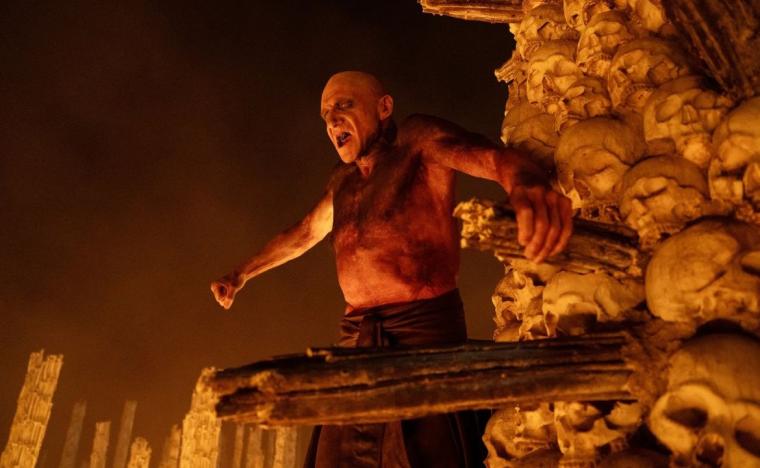
Ralph Fiennes in 28 Years Later: The Bone Temple
28 YEARS LATER: THE BONE TEMPLE
Danny Boyle's and Alex Garland's zombie-adjacent horror thriller 28 Years Later debuted last June, and because seven months can feel like an eternity these days, a brief refresher might be necessary before diving into director Nia DaCosta's sequel The Bone Temple. Not a refresher on the previous film, mind you, which initiated a franchise in the wake of 2002's 28 Days Later and 2007's 28 Weeks Later. Rather, a look back at what I thought of the 2025 outing, and what I anticipated, inaccurately, in regard to this followup.
While stating, in my review, that Boyle's affected, exposition-heavy offering – the first part of a planned trilogy – might've simply been “the two unsatisfying hours we have to endure before getting to four superior ones,” I continued, “I'm not convinced that this project will vastly improve. In truth, if its final three minutes are any indication, things are only gonna get worse.” This Negative Nancy even went further in his article's final sentence, adding, “[M]y hunch is I'm going to loathe the next one.” Well, to quote Cailee Spaeny's cellist in Wake Up Dead Man: “Dipshit moi.” Because not only is The Bone Temple not the dumpster fire I presumed it would be, it's utterly fantastic – scary, funny, moving, and gratifyingly nuts. Nearly across the board, DaCosta's and returning screenwriter Garland's continuation is a tenfold improvement on the 2025 hit, and among its host of memorable sequences, the film boasts an outdoor heavy-metal rave that will no doubt go down as the one of the year's signature set pieces. I couldn't wait for last year's 28 Years Later to end. I was disappointed when this one did, as another half-hour or so would've been totally fine by me.
Picking up what feels like mere minutes after Boyle's finale, we're reacquainted with the two congruent plot threads that will sustain us through The Bone Temple's 109 minutes. One of them, introduced around the halfway point of last June's feature, involves Ralph Fiennes' Dr. Ian Kelson, an iodine-covered loner seeking a cure for the mutant virus that began to decimate humanity, specifically Great Britain and its neighboring provinces, those long 28 years ago. Kelson, who has begun to perform experiments on a hulking Alpha infected nicknamed Samson (Chi Lewis-Parry), is also the creator of the memento mori of human remains that serves as this sequel's subtitle, one of the temple's skulls having belonged to the mother of Aflie Williams' adolescent Spike.
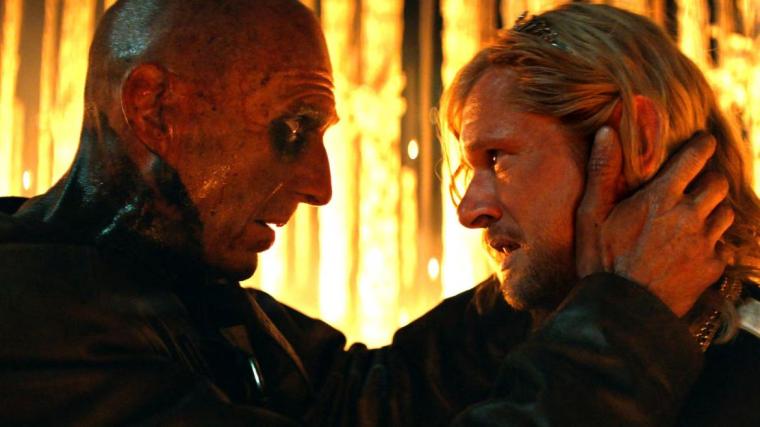
Poor Spike previously had an awful time of things, and in the final minutes seven months ago, it looked like events for this traumatized survivor were about to take a turn for the worse. Sure, the kid was saved from a murderous attack. But the people he was saved by looked more potentially menacing than the Rage-fueled hordes: cackling blond thugs in sweatpants who, with their enthusiastic Ninja Turtle moves, clearly considered it great fun to kill the infected. This group was led by a psycho modeled after the late, notorious British media personality and alleged sex predator Jimmy Savile, and consequently, it was hard to determine what about 28 Years Later's climax was most unappealing. Was it the movie's confounding swerve into Mad Max territory? The knowledge that respite for Spike wasn't coming any time soon? The Jimmy Savile of it all? Or the fact that the louts' leader Jimmy Crystal was played by Jack O'Connell, who was an outstanding vampire nemesis in Sinners, but who otherwise tends to be an insufferable over-actor when let off his leash?
Admittedly, The Bone Temple's first few scenes with this grimy Rat Pack – all of whom share the assumed name “Jimmy” and suggest more blood-happy renditions of A Clockwork Orange's droogs – had me fearing the worst. In the former public pool of an abandoned water park, Spike is initially forced to battle one of the Jimmys to the death, and not long after, the gang infiltrates the home of an uninfected family and proves their murderous leanings aren't reserved for marauding flesh-eaters. Spike's “initiation ritual” is deeply unpleasant; the unprovoked torture of that family is borderline unwatchable. Yet Garland, whose 2025 script was suffocatingly expository, manages to make these sick puppies fascinating.
When Jimmy Crystal showed up in last year's finale, it was evident from his necklace's upside-down cross that he was the 28-years-later version of the surviving child from the prelude, who saw his family and friends massacred at the start of the 2002 Rage-virus outbreak. In The Bone Temple, Garland delineates how that trauma affected Crystal's psychology. Recalling how his minister father actively welcomed the virus' spread, Jimmy now considers himself the son of Satan. The voice in his head, which is likely his father's, is believed to be Lucifer encouraging wanton violence, and Jimmy has subsequently amassed other, younger followers who, like him, don't have memories of “normal” life beyond what they remember from TV. And what they saw on TV, at that age in 2002, was Jimmy Savile … and the Teletubbies. (Seriously: The Teletubbies are referenced a lot.) Exploring stunted prepubescence as a gateway to anarchy, Garland makes the Jimmys, although undeniably cruel, also strangely pitiable: five-year-olds in the bodies of 20-somethings. It's similar to the conceit employed with the infected, who are certainly zombie-esque, but not actual zombies. In both cases, humans behave like monsters for reasons beyond their understanding, and beyond their control.
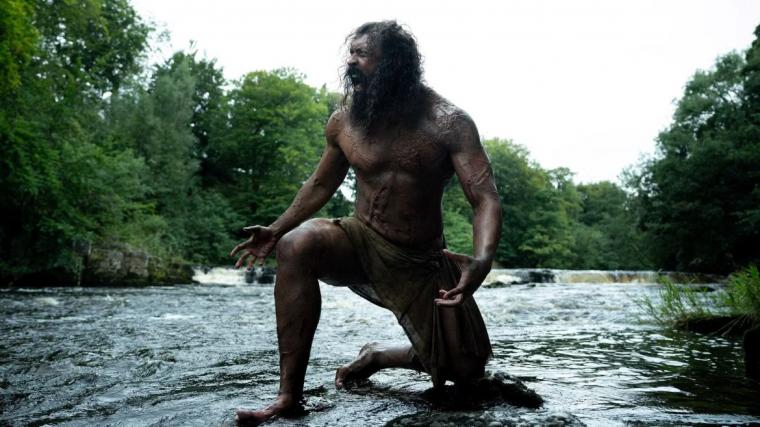
It's the Jimmys' “innocence,” their inability to process events beyond a five-year-old's perspective, that eventually causes them to believe Dr. Kelson is Satan himself: a red-skinned deity surrounded by a landscape of skulls and bones, casually unafraid of the beastly (and now morphine-addicted) Samson at his side. We know, however, that he isn't the devil. In this role, Ralph Fiennes is more accurately God – or at least a performance god. Exuding unwavering decency while also finding room for fear, fatalism, potential madness, and delightful bursts of humor – Kelson suggesting a man who learned long ago how to keep himself amused in isolation – the actor is truly remarkable here. Fiennes' scenes with Lewis-Parry, the least likely cohort we might've anticipated from 28 Years Later, are miracles of tentative bonding, with just enough of Samson's humanity left for the Alpha to appreciate the pleasures of quiet company and a moonlit dance to Duran Duran. And then Garland and DaCosta go further, presenting flashbacks to the outbreak's start that make you reconsider events and locales from the first movie, and gifting us with, among other winningly odd pleasures, a line reading that made me gasp right before I giggled.
Beyond the first-rate contributions of Garland, Fiennes, and the featured cast (with Williams as touching as before and O'Connell coming close to matching his superior Sinners turn), I have to give Nia DaCosta her appropriate flowers. Will I be drummed out of the Danny Boyle Fan Club if I suggest that Boyle stepping away from directing duties might've been the best thing to happen to this sequel? Gone is the show-offy visual trickery of the changes in film stock and freeze-frame editing; in overall look and feel, The Bone Temple is downright conventional. Yet that's fitting for a work more focused on emotional elements than shock effects – though DaCosta, whose credits include the superb 2021 remake of Candyman, is certainly no slouch in the jump-scare department. Throughout the film, she gives her performers and their harrowing situations room and time to breathe, allowing cinematographer Sean Bobbitt's camera to linger on incongruous bits of loveliness: Samson, his eyes filled with wonder and possible reflection, staring at a full moon; Kelson slowly, assuredly recognizing the eyes of one of the masked Jimmys.
And then there's The Scene. If you also caught DaCosta's movie over the weekend, you know The Scene I mean, right? The one with the DIY pyrotechnics and Iron Maiden's “The Number of the Beast” and the Jimmys being introduced to the feral exhilaration of heavy metal? What Fiennes does in this sequence is astounding. What DaCosta does in this sequence is mind-blowing, delivering a showstopper of such power and joy that you won't be wrong to harken back on Ryan Googler's “I Lied to You” barn burner from Sinners, feeling the unquestionable urge to applaud. Last June, I was disheartened to learn I'd be sitting through another 28 Years Later in seven months' time. With filming on a proposed part three not started yet, I'm now even more bummed knowing there won't be another premiering continuation this August. But I can wait. The magnificent effects of The Bone Temple will no doubt linger for a lo-o-o-ong time.
NO OTHER CHOICE
The two aren't similar in terms of story, and not terribly similar in terms of style. Yet while watching South Korean auteur Park Chan-wook's No Other Choice (currently playing at Iowa City's FilmScene), my mind kept returning to Martin Scorsese's 1985 cult classic After Hours. Both are dark slapsticks about mild-mannered professionals reaching their breaking points. Both feature seemingly inconsequential detours and expansive casts of characters designed to hinder the protagonists' sole goals. Both boast hilarious comic scenarios pulled off with wizardly visual panache and camera moves that can legitimately be called acrobatic. And with both works, there's not a lot to reflect on afterward beyond the coolness of the execution. Like the Scorsese, Park's latest finds its director in a giddy, playful fame of mind, eager to impress us with his masterful senses of composition and timing. But also like After Hours, No Other Choice is profoundly meaningless – a casual, if supremely engaging, lark from a filmmaker capable of greater things. This isn't the insult it may seem, though. We art-house fans deserve our silly fun, too.
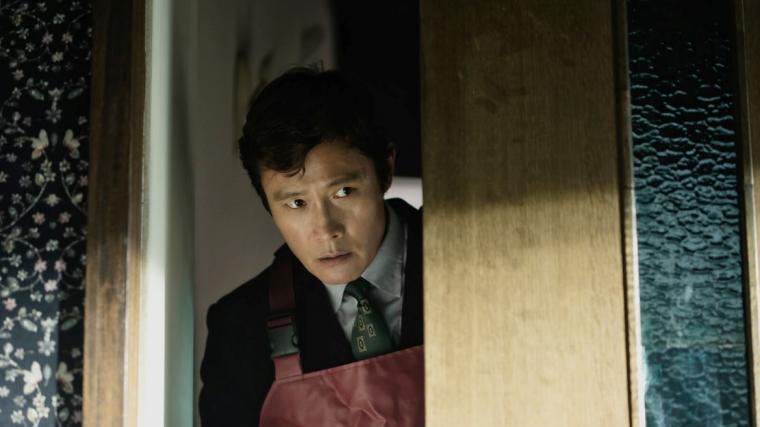
An award-winning paper manufacturer of many years with a loving spouse, two distracted children, and two adorable dogs, Yoo Man-su (Lee Byung-hun, performing expert clowning) finds himself let go from his cherished workplace after American interests buy out his company. Relegated to menial labor after 13 months, and with bill collectors threatening to take away his childhood home, Man-su learns of a job opening at a rival plant – a position for which, unfortunately, several other candidates are more qualified. Man-su's wife Ye-jim (Lee Mi-ri) offhandedly, jokingly asks why lightning couldn't strike her husband's competitors … and when she did, given Park's mischievous flourishes here, I was half-surprised the director didn't immediately have a light bulb illuminate over Man-su's head. From that moment on, the former paper-maker is obsessed with the notion of knocking off his rivals. And if Man-su initially proves to be a very inept assassin, he gets better quicker, and with less fanfare, than you might expect.
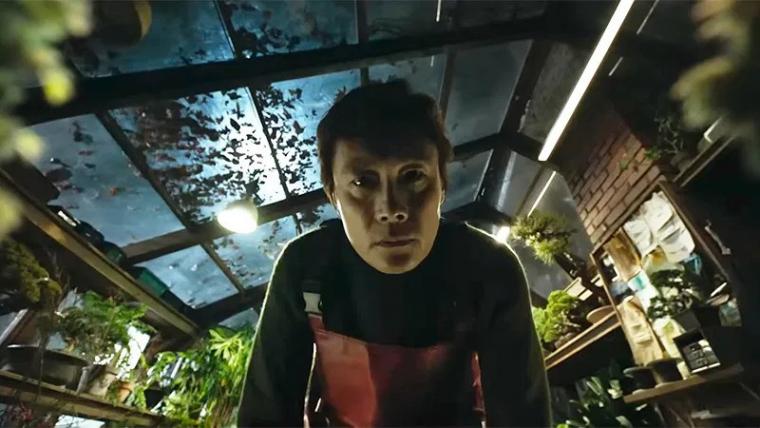
With Park's movie adapted from Donald Westlake's 1997 novel The Ax – previously filmed by Costa-Gavras as 2005's French-language The Axe – and its script by the director, Lee Kyoung-mi, Don McKellar, and Lee Ja-hya, there are obvious stabs at thematic relevance here. The effects of corporate downsizing, naturally, are addressed, and there's some late-in-the-day hand-wringing over AI insidiousness, plus fleeting acknowledgment of the destruction of the natural world. (I remain ignorant over what symbolic purpose is served by the mystery behind, and eventual discovery of, the musical abilities of Man-su's neurodivergent, fledgling-cellist daughter.) But what No Other World seems most crucially about is Park Chan-wook's dazzling artistic ingenuity, and in this context, that's plenty.
As the job impediments and corpses amass, Park keeps finding fresh ways to keep us delightfully unbalanced, tossing in a number of narrative McGuffins for good measure: the larcenous acts of Man-su's teen son (Woo Seung Kim); his wife's burgeoning fondness for her new boss (Yoo Yeon-seok); the heavily focused-on but ultimately inessential alcoholism of his chief rivals. Principally, though, and as we've come to expect, we're kept invested by Park's visual audacity – the means by which Man-su appears to be crying in advance of his first murder attempt, say, or the image of a boilermaker being consumed with the camera seemingly positioned on the underside of the glass. Winningly goofy though he is tripping over himself in waders and galoshes, I never bought Lee's embrace of homicidal tendencies, and was flummoxed by much of the illogical behavior on display. Yet No Other Choice is still mostly a kick, if one more throwaway than previous titles including Decision to Leave, The Handmaiden, and Oldboy led we Park admirers to anticipate. That's hardly an ax worth grinding.
THE RIP
For at least half of its 113-minute length, I kept waiting for The Rip to be awful. Could anyone be blamed for expecting the worst? Unless it's a movie for which the company acquired distribution rights after its premiere, as was the case with last January's Sundance breakout Train Dreams, we've long been conditioned to expect the worst from Netflix's star-studded streaming debuts – all those Electric States and Gray Mans and Adam Projects. And this particular project seemed iffier than most, because if the pairing of Matt Damon and Ben Affleck in a $100-million cop thriller is relegated to Netflix, in January of all months, just how crummy must this thing be?
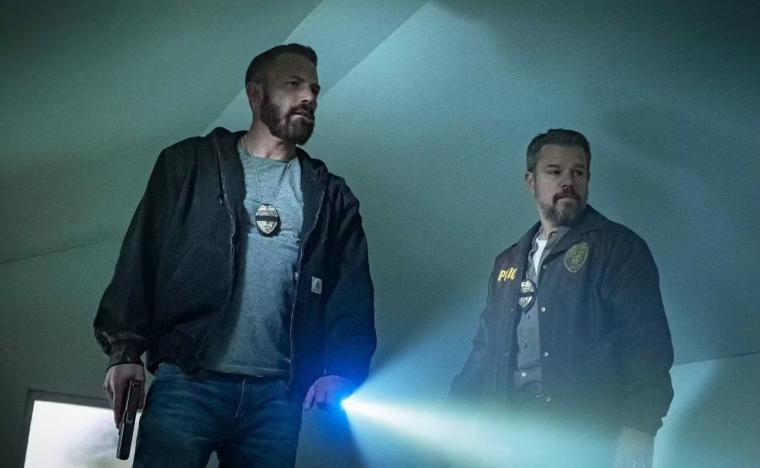
Turns out, not too crummy at all. There are clichés by the truckload and an action finale that goes on forever and a copious waste of supporting talent – this isn't exactly the followup vehicle that Teyana Taylor's team was likely hoping for in advance of her potential Oscar win. Writer/director Joe Carnahan's tale of dirty dealings among the Miami-Dade PD, though, is genuinely engrossing nonsense, filled with motivational switcheroos and watchable performers, and it plays on the decades-long-besties appeal of Matt and Ben with fiendish relish. Barring rare endeavors such as Air, in which the duo's snippiness still fell far short of loathing, we never get to see the actors as outright on-screen adversaries. The Rip almost wholly makes up for the fun we've been missing.
For full enjoyment, I'd recommend entering Carnahan's entertainment as blind as I was, knowing only that it was a Matt-and-Ben concerning Affleck's suspicion that longtime partner (in the cop sense) Damon planned to steal $20 million in cash from a theoretically abandoned drug house. Affleck is wonderfully aggrieved, demonstrating some of the self-righteous fury and woe-is-me defeatism that powered his career-best Gone Girl performance. Damon is sensational, rekindling memories of his atypical villainous turn in The Departed, and keeping you guessing as to whether his lieutenant's procedural explanations are evidence of exemplary lying or terrible lying. The profane dialogue has admirable bite. Cinematographer Juan Miguel Azpiroz lends his images clarity and, in the exteriors, eye-popping color. In addition to the underused Taylor, the supporting cast includes Oscar nominees Steven Yeun and Catalina Sandino Moreno, plus Emmy winners Kyle Chandler and, for one whole scene, Néstor Carbonell. (Talk about underused.) Carnahan, meanwhile, directs the twisty proceedings with swiftness and confidence, only dropping the ball in that extended, pro forma chase-and-shoot-out that his close-to-real-time narrative easily could've done without. What can I say? It's junk. Totally enjoyable watch-it-while-absent-mindedly-scrolling junk. Let 'er Rip.