
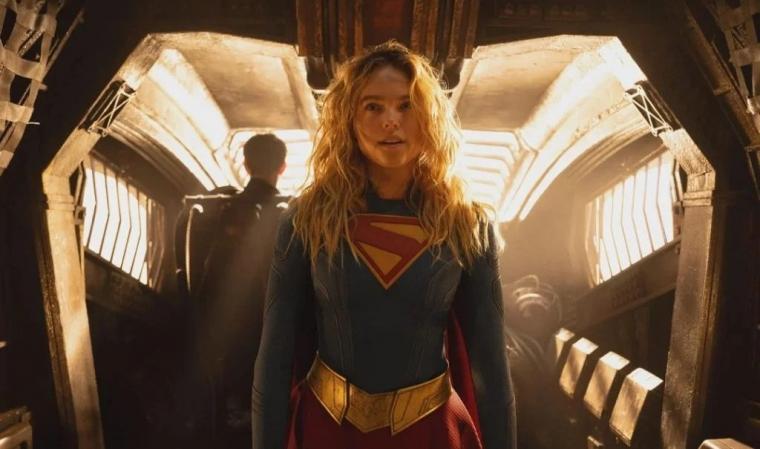
Milly Alcock in Supergirl
SUPERGIRL
Given how bored I've been at so many cinematic superhero origin stories over the decades, I feel silly for actually feeling and writing this. But I really wish director Craig Gillespie's Supergirl had merely been a superhero origin story.
I mean, come on. This isn't Superman or Batman or Spider-Man, whose beginnings were already popular lore (exploded Krypton, murdered parents, radioactive arachnid) before their geneses became the subjects of movies – even more than one movie apiece. We're talking about Supergirl, and unless you're a devoted comic-book hound or remember the 1984 Helen Slater/Faye Dunaway film way better than I do, you'll likely be mostly in the dark about this first cousin of Kal-El – Milly Alcock's Kara Zor-El – who boasts the same otherworldly gifts as Superman but relatively little in terms of mass public awareness.
Did you know that a portion of Krypton, the portion Kara and her folks (and adopted pooch Krypto) were on, survived for close to two decades before everyone on it died from radiation poisoning? That this sealed bunker was where that dreaded Kryptonite came from? That pre-Supergirl was already in her teens before she made her way to Earth and she and Krypto were found by Kal-El/Superman/Clark Kent with no one understanding each other's language? That Kara subsequently built an empathetic hatred of Earth, and preferred to wallow in misery on faraway planets with red suns – orbs that would negate her Earthly superpowers and allow her to get mercifully drunk? I sure didn't, and if you also haven't read the comic-book mini-series that Gillespie's and screenwriter Anna Nogueira's Supergirl is based on – Tom King's and Bilquis Evely's 2021-22 Supergirl: Woman of Tomorrow – you probably didn't, either.
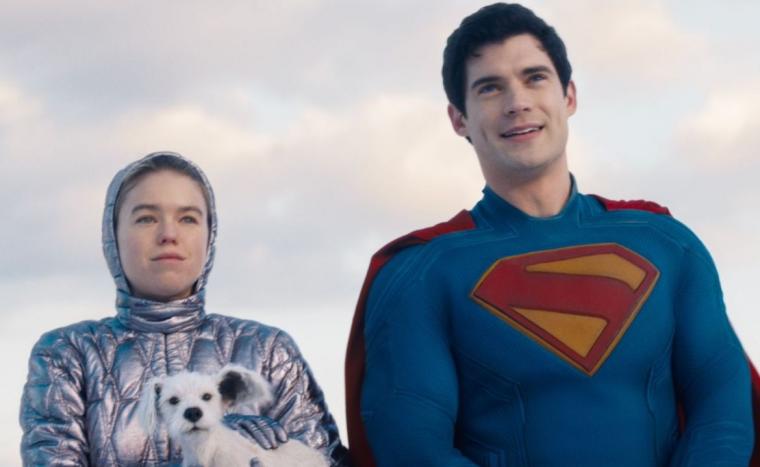
But I loved this backstory that I wish had lasted a full two hours, and as acted and directed, the flashback sequences we're treated to made me love it all the more. The eternally underrated David Krumholtz, speaking in subtitled Kryptonian tongue, is deeply affecting as Kara's dad, who blames himself for the scientific miracle that initially saved his fellow bubble-bound citizens yet simultaneously doomed them. I felt for Kara, and her marvelous portrayer Alcock, whose demand that she die alongside her parents (Enily Beecham plays Kara's mom) is denied in favor of imposed exile on Earth. I grinned huge, and even audibly chuckled a couple times, when Kara was greeted by her tights-wearing Boy Scout cousin (the unimpeachable David Corenswet) who just kept talking, and talking louder, even after he realized they couldn't understand each other. (A perfectly reasonable question asked by Kara to Krypto: “Why is he in his underwear?”) In Gillespie's and Nogueira's presentation, everything to do with Supergirl's origin story is fantastic. It's also so good that it invariably cheapens the rest of the picture, which, I'm sorry to say, constitutes about 85 percent of Supergirl's 108-minute running length.
None of the blame for the film's weaknesses should fall on Alcock, who's as wonderfully distinctive in her superhero interpretation as Corenswet is in his. Despite the tenor of its trailers, Supergirl doesn't spend much of her movie drunk. She spends it recovering from drunk, or maybe just in that place of blasé, who-gives-an-eff cynicism that's inseparable from a particularly irksome hangover. Yet Krumholtz is so forceful in his brief scenes – Marlon Brando without the imposed pomposity – and Beecham so maternally tender that you wholly buy that Alcock's hot mess would forever strive to Do Good even though the idea conflicts with her post-exodus nature. Kara certainly has a lower mercy threshold than her cousin; for one thing, she isn't beyond killing people who (perhaps only tangentially) deserve their fates. But while I'm getting a little tired of trauma being an excuse for everything in modern superhero movies (and movies is general), Alcock does a superb job of indicating that Kara's barely-hidden rage and grief are things she needs to move past – circumstances stymieing her true purpose on Earth, and perhaps in the universe. I should also mention that Alcock is really funny. Nogueira doesn't always give her the lines as she deserves, but the actor's sardonic readings have snap, crackle, and pop – the whole Rice Krispies package.
If only Alcock had a more engaging narrative backing her. As in Woman of Tomorrow, I presume, Supergirl's plot is essentially a comic-book True Grit, with feisty whippersnapper Ruthye (Eve Ridley) employing Kara's drunken reprobate on a mission to kill her family's murderer Krem (a facially bedazzled Matthias Schoenaerts, clearly having more fun with the role than we have with him). The film's meat, meanwhile, is all Dystopian George Miller, involving the sex trafficking of young girls as unwilling “brides,” grim hellscapes lit especially dimly by cinematographer Rob Hardy, and Jason Momoa, for purposes unknown, as a swarthy, bike-riding wisecrack-tosser who smokes stogies and calls Kara “Tits.”
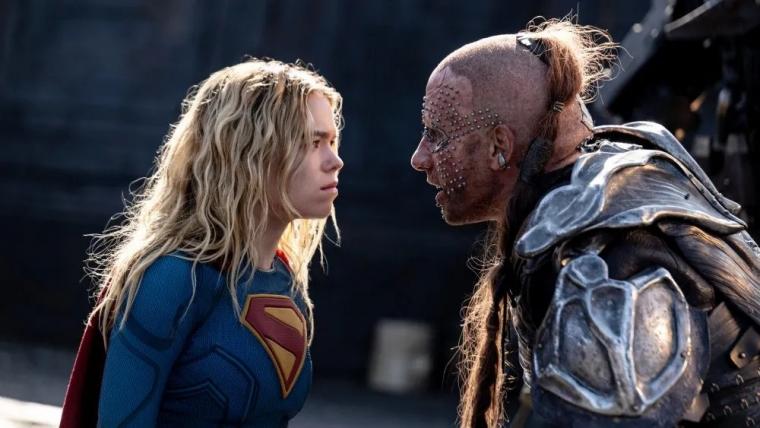
It's all oppressively tedious; Ridley might've been worth caring about had Ruthye not spoken with a clipped, earnest prissiness that, unlike Hailee Steinfeld's incongruously adult chatter in the Coens' True Grit, isn't employed for laughs. And while we dutifully wait to find out whether Ruthye will avenge her clan, Kara will fulfill her heroic potential, and Krypto will get the life-saving antidote to his poisoning (Spoiler Alerts: she will, she will, and he will), Supergirl boasts plenty of bum scenes to fill the time. Having been clocking movies' brutal beatings of women since the beginning of 2026, I'd like to say that Krem's ugly fistfight with Kara is the movie's low point. That offense, however, would undermine the annoying, unfunny vocal employment of Seth Rogen as a sarcastic troll doll who serves as an airplane co-pilot, as well as the James-Gunn-at-his-laziest needle drops and the interplanetary lounge that still finds it necessary to regurgitate “The Girl from Ipanema.” (I was also peeved when Ruthye asked Kara why she was called a “Supergirl” while her cousin was a “Superman,” and the subsequent, incoherently staged action deprived Alcock of a response.)
My goodness, though, those flashback sequences are terrific. And with a streamlined chronology and some added material, you can easily see how Gillespie's outing, considering its print inspiration, might've inspired not only one first-rate DC-superhero flick but two: the first devoted to Kara's and Krypto's origin story, and the second continuing that story through her mission aiding a similarly orphaned girl who also endured the demise of everyone and everything she loved. (As it stands, given its debut-weekend box office, we might never get a part two.) Millie Alcock is great. But Supergirl itself feels like a hugely missed opportunity, because nothing that happens is as giddily enjoyable as what happens in your imagination. How, you wonder, did that unflappable straight-arrow Clark Kent not only teach his cousin English and the routinely ignored rules of “polite society,” but get the gal and her woefully untrained dog, blessedly, out of his apartment?
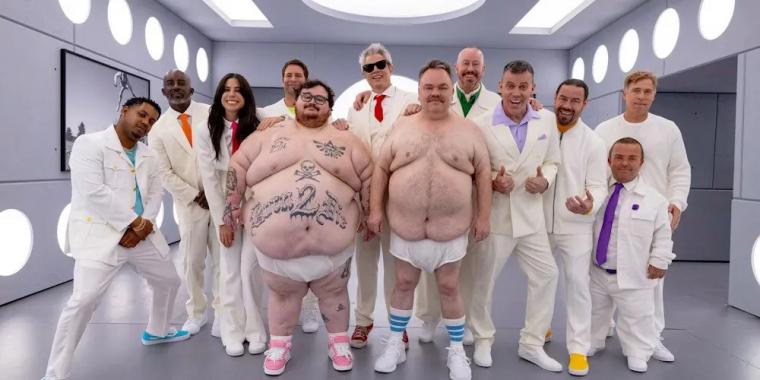
JACKASS: BEST & LAST
Beginning in 1964, the acclaimed run of British Up films, shepherded by the late Michael Apted, documented the lives of 10 boys and four girls from ages seven and beyond, checking in on these kids-turned-adults every seven years from Seven Up! to 2019's 63 Up. (Directed by Asif Kapadia, 70 Up is scheduled for release later this year.) As a long-running treat for cinephiles, it's a spectacularly sweet, affecting, endlessly revealing look at real lives lived over significant stretches of time. How long will I have to stay in Film Critic Jail if I posit that Johnny Knoxville's Jackass quintet, despite not encompassing half of the Up films' 62 years, has become nearly as moving as Apted's venerated series, albeit with 99-percent more laughs and Steve-O enduring a rectal exam from a robotic claw?
We've been here before. Previously, lead jackass Johnny Knoxville publicly stated that 2022's Jackass Forever – the franchise's fourth and finest installment – would be the comedy troupe's big-screen farewell, its favored recipe of extreme stunts, feces-related humiliations, and many, many, many hits to the crotch perhaps unbecoming for dudes approaching or past 50. Astoundingly, however, their nuts remain intact. (I haven't done a thoroughly deep dive, but Knoxville, at least, has fathered three children,) And long-running series director Jeff Tremaine's Jackass: Best & Last is a fitting adieu.
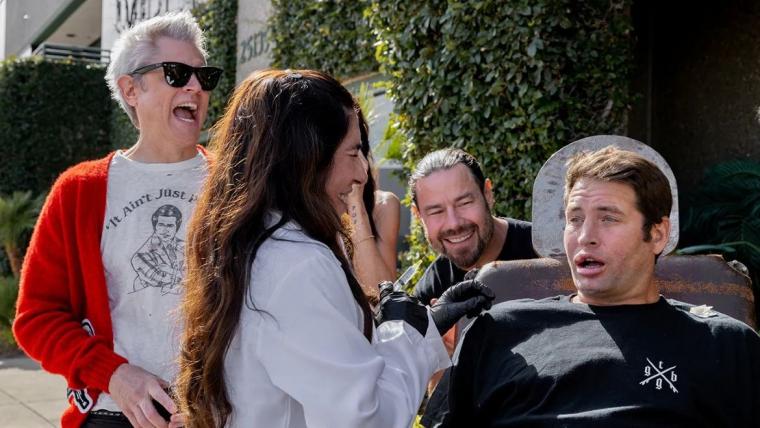
It's a traditional “clip show,” to be sure, as probably half of the material has previously been seen. Yet the movie boasts just enough that's refreshing and deliriously upsetting that you easily forgive its frequent navel-gazing, though that's not the body part the guys (and one barely-there gal) are most prone to look at. The clips from past escapades remind us that, due to whatever divination Fate allowed, these delightful dipsticks survived, and the new bits demonstrate that 49 isn't too old to be hit by a charging bull and spun airborne into a 360-degree circle and wind up with only a mild concussion to show for it. “Don't try this at home” the movie warns us at the start, at the end, and at least once in between. I promise, I won't. But watching people just a few years younger than me attempting these stunts, and living to tell about them, and laughing all the while wasn't merely rewarding. It was inspiring – an ecstatic, collective middle finger to aging and chronic pain and death. Not a world I want to live in, mind you, but one I'm always delighted to visit.
So what's new in this particular Jackass? Not as much as you might hope, as most of the “new” bits – such as Knoxville's aerial adventure with that bull – are updated versions of past stunts. We do get Knoxville in an oversize electric chair, and an office party hosted by a surly ram, and Sean Patrick “Poopies” McInerney undergoing a lip-injection treatment that, for some of us, brings to mind nothing so much as Barbara Hershey in Beaches. There's Poopies, an electric device attached to his privates, trying to traverse a balance beam, and the gents contending with a particularly cruel escape room, and Chris Pontius doing … something … that requires the career nudist to show off his penis the way Olympic rhythmic gymnasts show off their ribbons. And beyond Steve-O's pseudo-colonoscopy performed by that robot and with the aid (???) of crunchy peanut butter, Best & Last features a legitimate colonoscopy-themed segment, with four of our dudes downing that dreaded Prep Day laxative and launching into competitive Twister with no bathroom breaks. Thank God for small favors, as they're allowed to wear pants, if transparent plastic ones. But this is easily the film's vilest, most hysterical segment – and forgive the too-much information, but witnessing this routine some 24 hours after my own colonoscopy did make the experience all the more triggering.

Beyond the admirably artful opening-credits sequence involving what appears to be a conveyor-belt floor, most of the rest of the movie is a best-of package, and there are plenty of bests highlighted. My all-time favorite segment, the elaborate night-vision “The Silence of the Lambs” spectacle from 2022's Jackass Forever, made the cut, as did Steve-O's “Poo Cocktail Supreme” torture and the wonderfully built gags extending from late cast member Ryan Dunn inserting a toy car into his sphincter. (This sketch reminds you that in addition to being brave, Dunn was this cabal's finest deadpan comedian.) Yet even the replayed bits that are only so-so are intensely charming in the context of this purported wrap-up, because wow – look how young they all are! Look how endlessly supportive they are, and how much they obviously adore each other! If you've similarly spent more than a quarter-century loving the Jackasses, if sometimes hating yourself for loving them, Best & Last is sensational fun and disarmingly touching besides – though I'll admit that its first, pre-credits sequence did manage to scare the crap out of me. (Figuratively, that is: I wasn't also playing Twister on a liquid-laxative bender.)
What we witness is a never-before-shown Knoxville stunt performed in the late '90s, before there ever was a Jackass. In tandem with his writing an article about self-defense equipment, the man decided to try out some gear for himself, and after donning a bulletproof vest (stuffing it with copies of Hustler for added protection), Knoxville proceeds to aim a handgun at his chest and shoot at point-blank range. Upon squeezing the trigger, no bullet is fired. Another attempt, no bullet. A third attempt – still no bullet. As their horrified comments and pleas to stop the madness make clear, the guy behind the video camera and another nearby ally can barely stand the pressure. Neither can we. Finally, the gun does indeed fire, and though it knocks Knoxville back a tad, the bulletproof vest and those Hustlers thankfully did their job. The guys race to the car and speed away, checking to see if the noise alerted any policemen in the area, and our last image before the scene's fade-out is Knoxville in the back seat, laughing uproariously and looking as happy as anyone has ever looked. Such a dumb stunt. Such a joyously dumb stunt. So thank you, Knoxville and company. You've managed, miraculously, to turn stunted adolescence into an absolute state of grace.