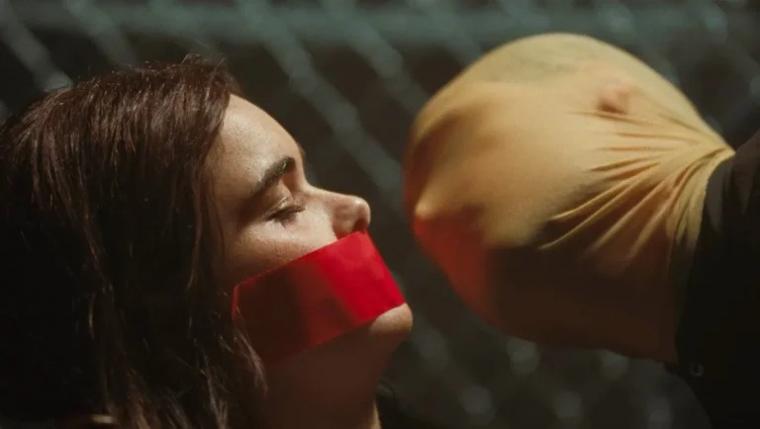
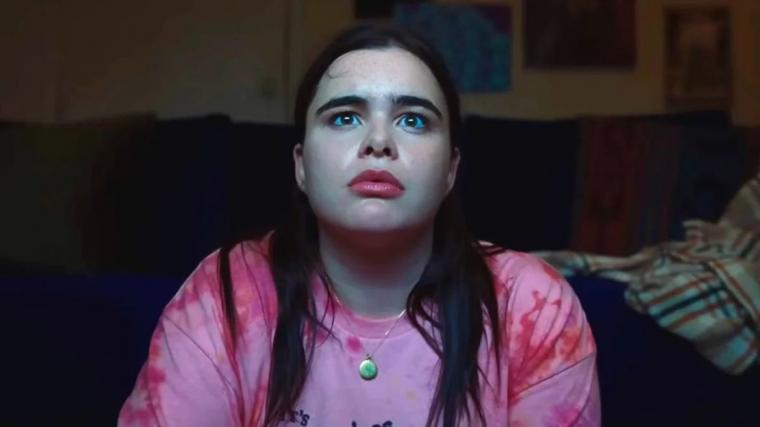
Barbie Ferreira and Dacre Montgomery in Faces of Death
FACES OF DEATH
For some of us who came of age during the VHS boom, the 1978 “documentary” Faces of Death wasn't a movie; it was a rite of passage.
To set the scene for my personal exposure to this grisly cult classic, it's the 1987-88 school year at Augustana College in Rock Island, Illinois. There was one designated party house for our core group of theatre-nerd friends. That house had a VCR. And every once in a while, a bunch of us would gather to watch something our parents would steadfastly disapprove of, which was usually a low-budget shocker so gory that it bypassed the Motion Picture Association's rating board entirely. We were particular fans of mondo horror – exploitative (and stunningly un-PC) docs that featured savage, purportedly for-real violence and seemed of particular interest to sardonic, unduly privileged college kids. Yet there was one whispered-about mondo flick, a near-mythic challenge titled Faces of Death, that we were forever unable to get our hands on.
Back in the day, Rock Island had two video retailers in walking distance from Augustana: Hogan's Video on 38th Street, and Hilltop Video on 30th. Hogan's was where you went for new releases and mainstream titles. Hilltop was where you went for the fringe stuff: Eraserhead and Caligula and Mondo Magic. (If you walked up a few stairs, there was also an intimidating selection of VHS porn … not that, you know, I ever visited that section or anything … .) But because Hilltop only had one copy of most everything it carried, Faces of Death was our white whale: a compilation of apparently legit killings, accidental deaths, and autopsies – according to the box, “banned in 46 countries”! – so heinous and popular that it was never in stock. Until, one night, it magically was.
I haven't seen writer/director John Alan Schwartz's 1978 feature in nearly 40 years, and the film certainly isn't the gruesome cause célèbre today that it was then, mostly because so much of its advertised authenticity – the electric-chair bit, the firing-squad bit, the cannibalism bit – was long ago revealed as fake. It sure as hell didn't seem fake to us, though. (And to be fair, despite the gross appropriation of its airplane-fatality and Holocaust images, about 60 percent of the movie is composed of actual documentary footage.) Watching Faces of Death at that party house, we winced at the viscera, and cringed at the mutilated corpses, and shielded our eyes from the sight of well-to-do dinner guests clubbing a Capuchin with mallets before feasting on its brain. Some scenes were more upsetting than others. Some seemed unusually well-staged for “found footage.” Yet at no point, to my recollection, did any of the sweetly naïve late-teens and early-20-somethings among us question the veracity of this “documentary.” What we were seeing was promoted as real, and it looked real (enough), so why wouldn't it be real?
Cut to the present day, and it's the absolute right time for director/co-writer Daniel Goldhaber's new Faces of Death, a tight, scary, unexpectedly crafty meta-commentary built on the notion that we can no longer instinctively believe anything we're shown on-screen. On any screen. Our heroine is Margot (Barbie Ferreira), who has one of those careers that wasn't even a thing 20 years ago. She's a content manager for the TikTok-esque app Kino, and her job is to act as moderator for the short videos uploaded by its users: approving them, flagging them for violent or sexual material, or, only very rarely, refusing to upload them. It looks like the worst gig on earth – early on, Margot leads her co-workers in a seminar on burnout – and we watch as the clearly drained Margot scans one piece of vacuous crap after another. But then she lands on a video, complete with stentorian voice-over, that appears to show a genuine beheading. The flagged content is soon followed by another video boasting the same “narrator,” this one showing a man being electrocuted, and then another, with a man's head pummeled by mallets before his scalp is peeled and his brain is eaten. Margot is reasonably sure the videos are real. Her boss (Jermaine Fowler) disagrees, saying everything is faked nowadays. So Margot secretly uploads the videos in a chat room to get the opinions of others, and one poster delivers an on-point question in return: “Do these videos remind anyone else of Faces of Death?”
Like the meta-horror standard bearer Wes Craven's New Nightmare, that 1994 sequel in which Nightmare on Elm Street lead Heather Langenkamp was tormented in Real Life by the actual Freddy Kruger, this Faces of Death acknowledges its inspiration as a movie that exists in the same world as the movie we're currently watching. It's less confusing than that sounds. Essentially, thanks to the expansive VHS collection of her genre-fan roommate (Aaron Holliday), Margot discovers that whomever is sending those harrowing Kino videos is modeling the deaths, real or faked, on the 1978 FoD. (The posts even have the same voice-over narration provided by Michael Carr as “pathologist” Francis B. Gröss … whose surname should've been all we needed to realize the film was a con job.) It's consequently up to Margot, who knows a thing or two about computer hackery and social-media infamy, to find the identity of the video poster and alert the authorities, if they'll even bother to believe her. What we know that she doesn't is that her instincts are on the money: The murders, and their perpetrator, are very real indeed.
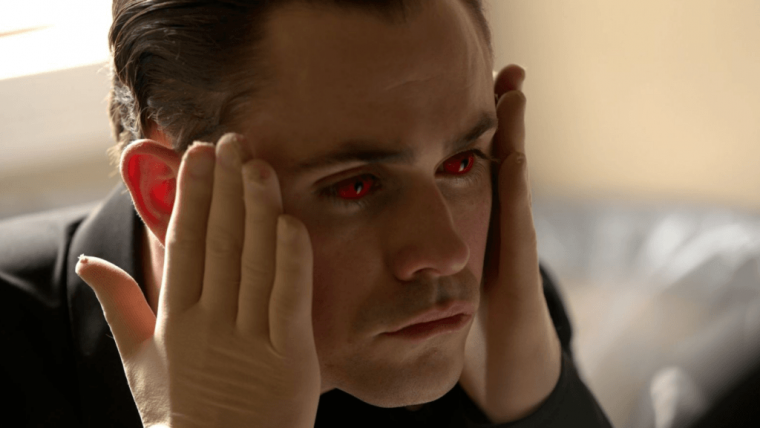
Because the adversaries in most modern fright flicks are either supernatural entities or kept as long-delayed mysteries (as in the Scream franchise), it felt almost quaint – like a throwback to '90s thrillers of the Copycat variety – for this Faces of Death to reveal its monster's identity before the movie was a half-hour old. But Dacre Montgomery, in a truly ballsy performance as the serial killer Arthur, is a lunatic pleasure to have around. There's nothing subtle about this psycho: he pops his eyes; he rants; he shrieks; he emits untrustworthy vibes by the bucketful. (In one of the film's few unpersuasive scenarios, a pair of cops opt not to check out Arthur's home despite the twitchy guy stammering at the front door like the guiltiest of suspects.) He's also a recognizably, almost touchingly human sociopath. Over decades of horror fandom, I've never witnessed anything quite like Arthur's practice of physically and mentally preparing for an attack – psyching himself into serial-killer character like Glen Powell did in Hit Man. (Amazingly, the moment here is similarly funny.) Arthur's motives, which are unsurprisingly tied to his yearning for Internet fame, are too fuzzy, and the dialogue given to him by Goldhaber and co-screenwriter Isa Massei leads to some obvious, unwelcome soapbox moralizing. Yet Montgomery is hypnotic regardless, and his hysteria eventually matches Ferreira's beautifully – they're characters pushed to extremes by actors admirably unafraid to revel in those extremes.
Running an ideal 98 minutes that are sharply paced yet generous enough to allow for nonessential moments of levity – including a small role for Charli XCX, whose presence is so sparingly employed that I barely recognized her – this Faces of Death boasts strong visual composition and a nervy, synth-heavy Gavin Brivik score, and also acts as an effective primer on the behind-the-scenes machinations of social-media platforms. (I deeply hope that people like Margot, who legitimately want to keep certain content away from the public, actually exist in this field.) It's also deeply frightening, though perhaps not always in the intended ways. To be sure, the violence is copious and bloody, and Goldhaber stages several abductions and assaults with unsettling skill. Nothing, however, put me more on edge than the split-screen sequence that found both Margot and Arthur frantically typing away on their laptops in the hopes of uncovering one another's identities – missions accomplished with a clarity of purpose and speed that practically made my jaw drop. Running into a madman with a butcher's knife isn't the sort of thing I spend time dreading. Someone amassing every tidbit of your personal information and life history in the time it takes to order a pizza? Now that's scary.

YOU, ME & TUSCANY
In his review of director Kat Coiro's new film, Vulture author Bilge Ebiri's last sentence caught me off-guard with its candor: “The world was a better place when rom-coms ruled the land.” A corny sentiment, no doubt. Honestly, though – wasn't it?
It's hard to not see the parallel: As romantic comedies have gradually been erased from our big-screen diets, so have, on a broad scale, our leanings toward civility, toward kindness, toward hope. I won't pretend I had these thoughts while watching You, Me & Tuscany, Coiro's sunny, goofy lark with a script by Ryan Engle that appears to have never met a rom-com cliché it didn't like. But I was aware that this was the first Hollywood release in nearly a year that I felt confident in bringing my 84-year-old mom to without fear of her hating it. Mom likes nice movies. She also really needs nice movies right now, and I'd argue that she's not alone. A traditional, blandly amusing genre exercise to its teeth, YM&T isn't in any way unexpected, or thought-provoking, or even, in all truth, recognizably human. But for 105 minutes, I could barely care less. Look at those Tuscan sunrises! Look at the endearing smiles shared by Halle Bailey and Regé-Jean Page! Look at that sumptuous food! While I may not have wanted to spend more than our allotted time with the film's story, I would've happily soaked in its prettiness, and undemanding niceness, for days.
A culinary-school dropout and recently fired (by rom-com mainstay Nia Vardalos!) housesitter, Bailey's Anna is jobless and homeless when she meets Italian charmer Matteo (Lorenzo de Moor), who shows her, during a drunken flirtation, photos of the Tuscan villa he owns but doesn't currently inhabit. Through the aid of rom-com contrivance, Anna winds up squatting in that very villa while its owner stays in America, and it's not long before the guy's family – fooled by the engagement ring Anna sports (don't ask) – is convinced that the young woman is their estranged Matteo's finacè, an assumption she runs with. You can likely guess what happens from there … and if you correctly predicted that Matteo would have a cousin who's regarded as a brother who's played by the hottie from the first season of Bridgerton, you get a million bonus points for divination.
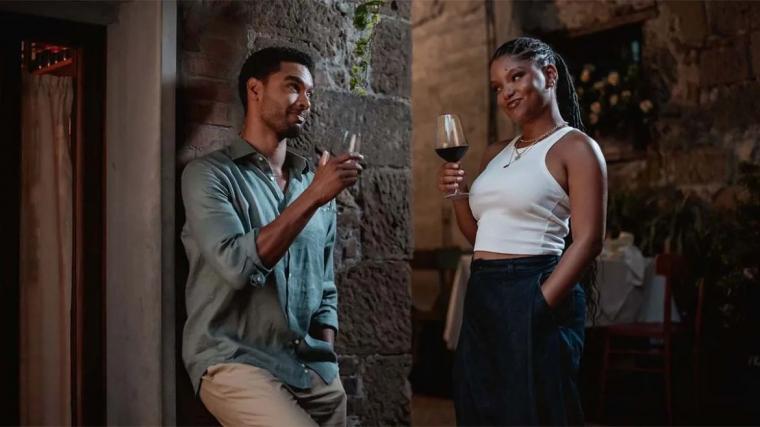
Complaining about niceties such as realism and logic in movies of this ilk is like complaining that water is wet. So you'll be getting no screeds from me about how of course Matteo's family runs a cute little Tuscan restaurant at which Anna can demonstrate her cooking talents, and how of course Page's Michael is an unmarried foodie with a decent singing voice and an eight-pack, and how of course the whole Tuscan clans falls instantly in love with Anna except for Matteo's instantly judgmental grandma (who's of course nicer than she lets on). Can I at least complain that You, Me & Tuscany isn't funny? Admittedly, it goes through the motions of funny. Bailey and Page deliver the requisite I-hate-you-but-not-really banter, Marco Calvani (a hoot opposite Colman Domingo on Netflix's The Four Seasons reboot) routinely pops up as an aggressively chipper Uber driver, and Aziza Scott gets one in-person scene as Anna's bestie Claire before literally phoning in her sass-spewing role for the remainder of the film. None of them, nor any of the Matteo-clan stereotypes, made me laugh, and the only chuckle I got came from a pair of tour-bus day players who, in the closing credits' blooper reel, had the wit to reference Under the Tuscan Sun, Eat Pray Love, and even Bridgerton. I don't necessarily want a sequel to Coiro's feature, but if those gals landed one, I wouldn't bitch,
I also wished that Bailey was more of a natural comedian. She appears game for her tasks here and is undeniably endearing; Bailey's sincerity and warmth, along with her gorgeous singing voice, made her the perfect Ariel in Disney's otherwise quite imperfect 2023 Little Mermaid remake. But even though the role kind of demands it, she isn't yet adept at slapstick, verbal or physical, and it's maybe unfair that Bailey is partnered with Page, who's so stunningly confident and polished that he seems less like a rom-com match than a performance mentor. What you sense Bailey routinely striving for – authority, finesse, star presence – are things Page already has in abundance, and the dichotomy between their on-screen comfort levels means that the necessary genre fireworks never ignite. Anna and Michael clearly like each other a lot, but unless cinematographer Danny Ruhlmann's camera is ogling Page's abs in slow-motion, not much that transpires between the movie's leads evinces even rudimentary heat.
Little matter, because a bona fide friendly movie in 2026 – at least one not geared toward kids – is nothing to instinctively sniff at. I enjoyed watching Bailey and Page play rom-com dress-up together. I enjoyed the over-calculated plotting that kept reminding me of other, better movies (specifically the 1995 Sandra Bullock hit While You Were Sleeping). I loved how the blindingly bright lighting made all those tomatoes and peppers and glasses of red pop off the screen. Hell, I even enjoyed that cheerful scalawag Matteo, who keeps getting opportunities to be a dick – succumbing to a few of them – yet proves somewhat deserving of empathy. You, Me & Tuscany is pure formula, and often uninspired formula. Here's hoping we get more releases just like it.
MR. NOBODY AGAINST PUTIN
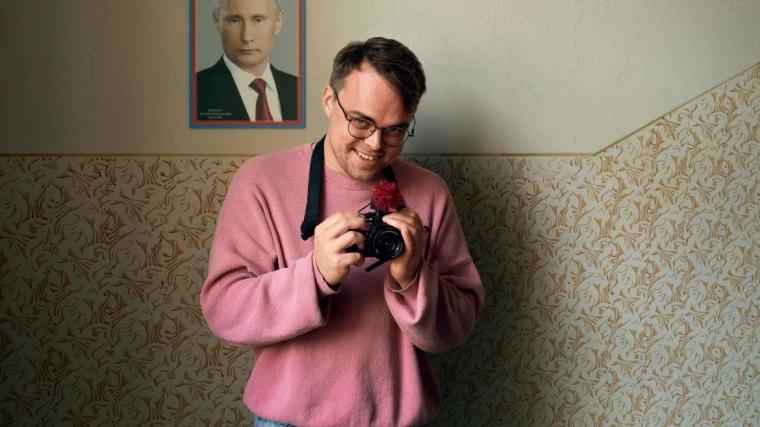
It took longer than anticipated, and because it's not yet streaming gratis, it cost me a whopping $5.99 just to rent the thing through Amazon. (Pity not my bank account; I had a gift card.) But I finally caught up with this year's Oscar winner for Best Documentary Feature Film, directors David Borenstein's and Pavel Talankin's Mr. Nobody Against Putin, and it kind of wrecked me. The movie has certainly been edited for maximum emotion, and even abject manipulation; an introductory nighttime shot of Talankin, the film's protagonist, shoveling outside a fenced-in area is presented as a tense bit of resistance when the act is later revealed to be utterly benign. But it's something of a miracle that this doc even exists. Considering the footage, it's less miraculous – it's inevitable, really – that it utterly breaks your heart.
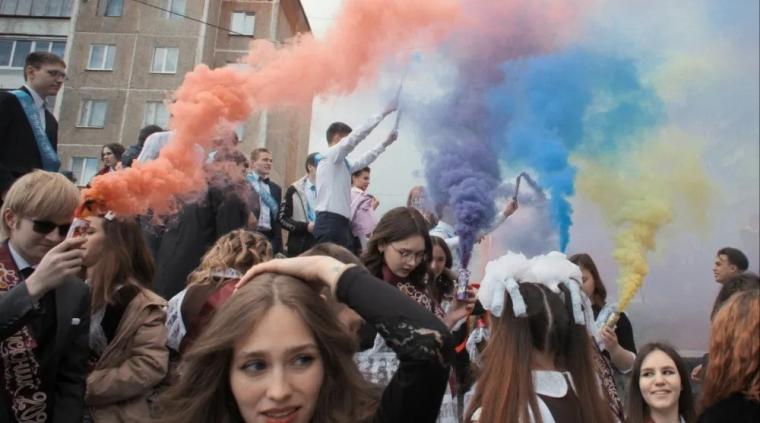
Filmed over the course of two-and-a-half years from 2022 through 2024, Mr. Nobody Against Putin allows us a 90-minute audience with Pavel “Pasha” Talankin, the official events coordinator and videographer for a primary school in Karabash, a small town in Chelyabinsk Oblast, Russia. Considered one of the most air-polluted places on Earth, Karabash is notorious for its high death rates and environmental-health concerns. It's also, as seen through the perspective of Pasha's camera, just like any small town anywhere, with kids initially laughing, joshing, and generally enjoying themselves inside and outside of school. That's in early 2022, however. Not long after, Vladimir Putin and his government instigated the Russian invasion of Ukraine, which led to schools being required to take part in “patriotic displays” and assemblies on subjects such as war preparation and firearms. In his role as videographer, Pasha was required to film his school's adherence to the new laws – including teachers acting as mouthpieces for the Russian government – as evidence of their complicity. The man turned in his resignation. Then American documentarian Bornestein, having read about Pasha's plight through (not-public) social media, got in touch, and suggested to Pasha that there might be a movie in this. Pasha rescinded his resignation. And what we see is consequently what he shot – evidence of Russian youths, through two hard years, relinquishing their initial bonhomie under the crushing weight of authoritarian control.
Despite the documentary's largely unassuming, sometimes even irreverent tone that suggests you may have wandered into a Michael Moore by mistake, the movie is a tough watch, but not because of anything overtly horrific or terrifying. There are no beatings, no imprisonments, not even much in the way of shunning. And while the digression of Pasha – who, if/when a Hollywood remake rolls around, needs to be played by an accented Cooper Hoffman – from cheery primary-school life force to secretive, occasionally disruptive malcontent is affecting, we aren't suffocated with fear for his well-being. At one point, instead of the Russian national anthem, Pasha plays Lady Gaga's rendition of the American national anthem on the school's loudspeaker, and gets only a minimal dressing-down for it. (Obviously, viewing the work post-Oscars, there's even less direct fear, because we just saw the newly minted Academy Award winner give a moving acceptance speech.)
But Mr. Nobody Against Putin still hurts, and hurts bad, for the sight of so many kids, grade-schoolers and teens alike, so thoroughly losing their spirit. Primary-school students who were previously boisterous become solemn and stoic. A teen graduate of Pasha's school, who once appeared fun-loving and gregarious, resorts to silence and tears when his head is shaved and friends hug him before his mandatory army tenure. An especially bright, vivacious student slips into guarded apathy after her brother goes off to combat in Ukraine and is subsequently killed. Because everything we see is shot through Pasha's camera, the film's look is understandably unremarkable. It boasts heartbreaking images, though, that might haunt you forever, including one of a pre-adolescent student – he can't be more than 11 – taking hold of an automatic rifle and aiming the weapon, and his sturdy gaze, directly at us. Eager and willing nationalists, this remarkable filmed document implies, don't come about overnight. They come through slow, persistent grooming, to the point that citizens, primarily our youngest ones, don't even realize a shift is happening. Mr. Nobody Against Putin is more than an Oscar-lauded documentary. It's an unmistakable warning.