
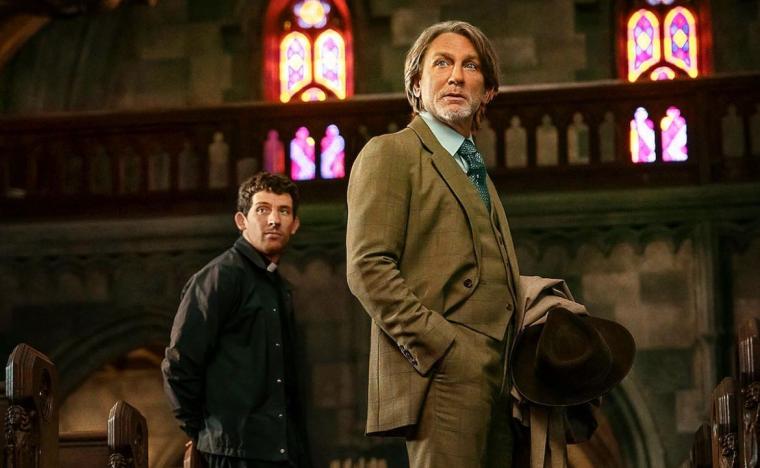
Josh O'Connor and Daniel Craig in Wake Up Dead Man: A Knives Out Mystery
WAKE UP DEAD MAN: A KNIVES OUT MYSTERY
So long as Rian Johnson keeps writing them and Daniel Craig keeps starring in them, there probably won't ever be a truly bad Benoit Blanc movie. Given the casts that director/author Johnson continues to assemble for his cheeky murder mysteries, there probably also won't be one that isn't wholly watchable regardless of quality. In what other film series, after all, could you find Josh Brolin as a venom-spewing priest, Mila Kunis as a gruff cop, Jeremy Renner as a drunk physician, and the great Jeffrey Wright in a role evidently small enough to keep the actor's name off the poster?
That being said, I found Wake Up Dead Man: A Knives Out Mystery – which I saw at Iowa City's FilmScene and which debuts on Netflix December 12 – to be a bumpier affair than its predecessors. As 2019's Knives Out and 2022's Glass Onion did, the film supplies an intriguing central whodunit augmented by several peripheral puzzlers. It's unabashedly political, with religious fundamentalists and their acolytes getting the skewing here previously delivered to the MAGA right, the performatively woke left, billionaire tech bros, vapid influencers, and men's-rights activists. Bless him, Craig is back, long-haired and less involved than usual, as genius detective and haughty Southern dandy Benoit Blanc. And once again, the sleuth is given an initially unwitting accomplice to assist in solving the crimes, Josh O'Connor taking over the reigns formerly held by Ana de Armas and Janelle Monáe. All the proper ingredients for one of Johnson's juicy, delectable Knives Out entertainments are accounted for. Yet something seems to have gone wrong in the mix. At least after a first viewing, the resolutions to the many mysteries don't hold together the way they have in the past, the themes are routinely expressed with distracting pushiness, and, in a true rarity for this series, more than a few portrayals simply don't work. While Wake Up Dead Man remains fun, it's mildly underwhelming fun – like that three-minute roller-coaster ride you realize wasn't worth the half-hour you waited in line for it.
Johnson does earn props for shaking up his proven formula while remaining faithful to its essentials, and nowhere is this more evident than in Brolin's Monsignor Jefferson Wicks, who's a first in the Knives Out canon: a legitimately deserving murder victim. (Hard to believe, but every character who died in the first two movies was at least mildly sympathetic. Not so here.) At the Our Lady of Perpetual Fortitude church wherein he preaches, Wicks shouts hateful harangues against whatever is pissing him off any particular Sunday, most of his bile reserved for “heathen” single mothers. (Because Wake Up Dead Man is intended as a comedy, if a far darker one than we're used to from Johnson, we learn that Wicks' sermons have also had themes such as “There's G-O-D in DOGE.”)

Consequently, his flock in upstate New York has been steadily lessening, and Wicks is left with a mere seven dedicated parishioners: brittle lawyer Vera Draven (Kerry Washington); her adopted son, the wannabe politician and relentless YouTuber Cy Draven (Daryl McCormack); cuckolded doctor Nat Sharp (Renner); flailing sci-fi author Lee Ross (Andrew Scott); disabled cellist Simone Vivane (Cailee Spaeny); faithful church assistant Martha Delacroix (Glenn Close); and groundskeeper and recovering alcoholic Samson Holt (Thomas Haden Church). The only one at Our Lady who isn't in thrall to Wicks' vile messaging, and the only honestly kind individual in sight, is the recently appointed Reverend Jud Duplenticy (O'Connor). His are the fingerprints found, on Good Friday, on the knife that winds up in Wicks' back.
It seems apparent (or is it?) that the good reverend can't be the killer. But because Wicks was stabbed in an otherwise empty vestibule he had just walked into, mere feet from where Jud was preaching to the mini-congregation, it doesn't appear that anyone else could be the killer, either. Enter Benoit Blanc. Or rather, enter Benoit Blanc finally, because it takes roughly 40 minutes for him to properly join the proceedings. This isn't necessarily a complaint. O'Connor, who's more the film's lead than Craig is, makes Jud a wonderfully sincere, complicated, funny protagonist, this boxer-turned-priest unassailable in his beliefs yet not above slugging someone who really deserves it. It's Jud who effectively interviews our suspects and continues to unearth clues; for much of the movie, Blanc himself is intensely dapper window dressing. That's why it's especially disappointing to see that when he is given focus, Blanc has little purpose beyond continually serving as the agnostic dark to Jud's devout shimmer, a point Johnson makes crushingly obvious in the sleuth's introductory scene that finds the church suffused with gloom when he speaks yet bathed in sunlight when Jud does. We get the visual metaphors – lord how we get them – but their clumsily unsubtle execution just makes it seem as though the continuity editor momentarily left the building.
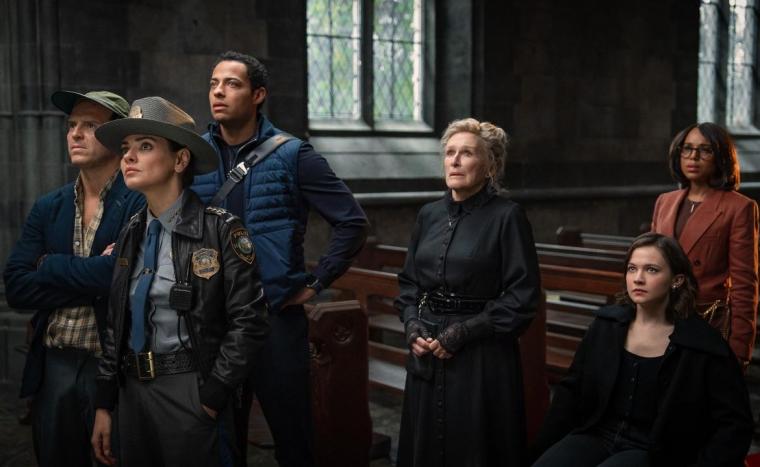
Obviously, I'm not going to indulge in spoilers. And that poses a problem, because most of what I didn't care for in Wake Up Dead Man had to do with things I can't, in good conscience, reveal: the lack of believable character motivation during events leading to the crimes (and yes, as in all the Knives Outs, more than one prominent figure is offed); the credibility-straining means by which electronics are involved; the acting in the penultimate scenes that turns what was otherwise a rather dour wrap-up into camp spectacle. I can say, however, that while I'm never unhappy to see Kunis, she's bizarrely miscast as the town's grouchy police chief who, based on the evidence, is heading the dumbest, least professional police force in the U.S. northeast. Washington has been giving this same performance – edgy, strident, humorless – for the better part of a decade now, and the wear is beginning to show. And not for nothing, but as a friend rightly noted, isn't it a touch strange that Renner is even in this thing? Benoit Blanc is nothing if not fiercely observant. So why didn't he notice that the town doc looks uncannily like the Oscar-nominated actor who smiled at him from that bottle of Glass Onion hot sauce?
Yet there's more than enough that's appealing about Wake Up Dead Man: A Knives Out Mystery to make Johnson's latest worth a watch, or maybe of couple watches. Close's first out-of-nowhere appearance. McCormack's endless litany of FOX News talking points that still couldn't get Cy elected. Scott's reptilian charisma and his struggling writer's moat. The flashbacks involving Wicks' mother (Annie Hamilton) that are rightfully re-evaluated when repeated. Series good-luck charm Noah Segen – the awed Trooper Wagner in Knives Out and stoned Darol in Glass Onion – as a garrulous bar owner. Johnson's inventive (if highly questionable) plotting and continued dedication to a sadly vanishing genre. And, of course, the delightful comfort of Benoit Blanc … though after crooning a Follies song in the first film and playing Among Us with Sondheim in the second, it was surprising – shocking! – to see the show-tune lover lean so heavily into Andrew Lloyd Webber this time around. Traitor.
SENTIMENTAL VALUE
Directed by Joaquim Trier and written by the Norwegian auteur alongside frequent collaborator Eskil Vogt, Sentimental Value is, for me, something truly unusual: a gorgeously acted, smartly written and directed family-angst tearjerker that never succeeded in choking me up.
On one level, this was a relief; Trier doesn't stoop to melodramatic button-pushing effects, and there are no overt histrionics on display. On another level, though … shouldn't I have unleashed a tear or two? As I seem to iterate every few weeks, I'm the world's easiest crier at the movies. I recall getting misty-eyed at Predator: Badlands, for Pete's sake. But I don't think it was Trier's delicate emotional reserve or the cast's laudable subtlety that failed to get me weepy at this truly first-rate, largely foreign-language drama that boasts moments of genuine hilarity. The problem was the film's familial situation, which is so dependent on timeworn tropes regarding artists and their art, and who suffers because of them, that I felt I'd seen Sentimental Value long before I ever did (at Iowa City's FilmScene). Don't get me wrong: This latest work by the creators of 2021's Oscar-nominated The Worst Person in the World – another Trier that other reviewers liked more than I did – is a worthy, occasionally heady experience. It just never grabbed me by the heart.
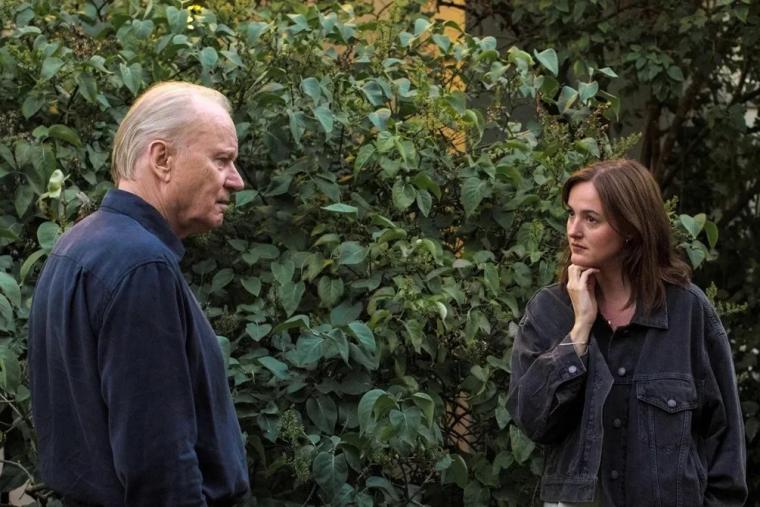
The movie's storyline, at least, is certainly grabby. Worst Person star Renate Reinsve plays Nora Borg, an acclaimed TV and stage actor whose long-absent father, Stellan Skarsgård's Gustav, approaches her about playing the lead in his next project. A legendary film director who hasn't helmed a feature in 15 years, Gustav's proposed movie is not-so-loosely based on the life of his mother who committed suicide, and Nora, wanting nothing to do with either her dad who abandoned the family or portraying a veiled version of her late grandmother, speedily refuses the offer. But after Gustav, attending a retrospective of his works, meets American starlet Rachel Kemp (Elle Fanning), the project becomes a well-funded go. Rachel is taking on the role meant for Nora, and the director is planning to shoot the majority of the film in the house he shared with his late wife and his daughters Nora and Agnes (Inga Ibsdotter Lilleaas), the latter of whom, long retired from acting, starred in one of Gustav's signature works when she was a child. So much potential discord! So many avenues for recrimination and regret! So little that's honestly fresh!
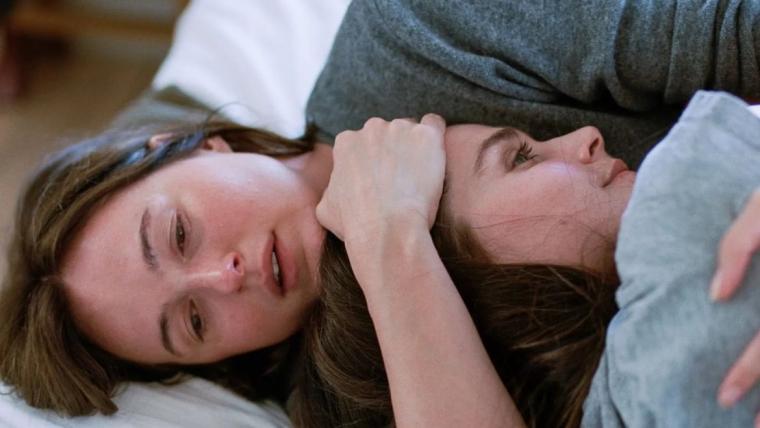
Let's begin with Nora, because like her namesake from fellow Norwegian Henrik Ibsen's A Doll's House, she is, shall we say, a lot. Our first scene with her finds the celebrated performer preparing to make her entrance in a modernized classical drama at Oslo's National Theatre, the portentousness of which is pronounced by the introductory music being the Krzysztof Penderecki refrain used for the opening credits of The Shining. Apparently in the midst of some sort of panic attack, Nora refuses to go on stage after the curtain is raised, and proceeds to make life momentary hell for the director, stage manager, and backstage team trying their best to coax the woman into doing her job. Even though I've (only very rarely) witnessed this sort of behavior in real life, I pretty much gave up on Nora right away, because f--- whatever personal trauma you're going through, lady; hundreds of paying customers are waiting for a show.
I might've been more sympathetic had Sentimental Value in any way revealed or explored what was instigating Nora's stage fright, as well as the general neurosis that causes her, as the star of a later National Theatre production of Hamlet, to call in sick the day after Gustav misses her opening night. But despite Reinsve's wounded, sensitive performance, the actor frequently and beautifully conveying pain without words, Nora comes off as a grade-A diva whose melancholy toward her father and consequent lack of professionalism are based solely on him (a) being a workaholic; (b) being a drunk; (c) being an adulterer; and (d) leaving the family. To be sure, those are absolutely valid reasons for not wanting your father in your life. They're also clichéd, threadbare excuses unworthy of the emotional commitment Reinsve exudes. The suffering-at-the-hands-of-a-genius-bastard trope was already overused when Scandinavian icon Ingmar Bergman employed it 50 years ago, and Trier doesn't find any way to revitalize it here. His directorial finesse and Reinsve's quietly passionate performance help convince you otherwise, but this is still a traditional Daddy Issues movie, and with pretty rudimentary Issues, to boot.
As for Sarsgård, he's thunderously good as the fallen paterfamilias, but it might say something about the actor's role that Gustav's most memorable bits are also his most comedic ones. There's a wonderfully funny scene in which, on a press tour with Rachel, an interviewer asks if his forthcoming Netflix film is going to appear on the big screen and Gustav replies “Of course!” … clearly unaware of that streaming service's general release strategy. And while I chuckled, fellow audience members positively roared when Gustav presented his grandson Erik (the terrific Øyvind Hesjedal Loven) with a collection of colossally inappropriate DVDs for his ninth birthday, among them Michael Haneke's The Piano Teacher and Gaspar Noé's Irréversible. (FilmScene regulars are nothing if not movie-savvy and proud to show it.) But as with Reinsve, Sarsgård has too many too-familiar notes to play in Sentimental Value, and while it's refreshing to hear the actor speak in his native Swedish tongue after so many decades of playing heavily accented heavies in Hollywood fare, Gustav's crises remain somewhat rote. I loved watching his scenes, and particularly his scenes with Reinsve. It's just that I was rarely moved by them, although there is a big caveat in Gustav's reunion with his former cinematographer (Lars Väringer), an offhandedly wrenching sequence that hints at the incisive heartbreaker the movie could've been if all of it were graced with an equal amount of specificity.
Happily, similarly lovely sequences are sprinkled throughout Trier's latest, most of them concerning the wondrously lived-in house in which Gustav plans to shoot his magnum opus. As with Netflix's stupendous recent release Train Dreams, an omniscient narrator (Bente Børsum) provides detail on what the main narrative doesn't explore – principally, here, history on the Kemp home in the decades before Nora and Agnes were born. They're reveries hauntingly photographed by cinematographer Kasper Tuxen, and they lend the movie a larger thematic scope than what we're given in the frankly tired (if gratefully underplayed) soap-opera dynamics of Nora's and Gustav's relationship. But even when Trier veers away from the Nora/Gustav dysfunction, the effects tend to be rather stagnant. Lilleaas is supremely charming and sad as neglected sister Agnes, but isn't given enough backstory to make the woman's buried resentment toward either Gustav or Nora anything beyond surface-level touching. And Trier badly overplays his hand with an unnecessarily showy visual morphing of the faces of Nora, Gustav, and Agnes as they bleed into and out of one another suggesting that – guess what! – they're irrevocably bound together. Thanks, Joaquim. Nearly 60 years ago, in Persona, Bergman did the same thing without high-tech trickery, but it's nice to know you're stealing from the best.
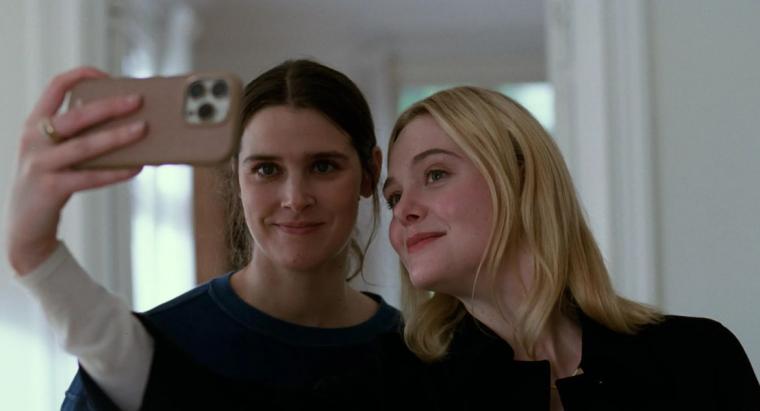
Is it heresy to say that the most affecting performance in Sentimental Value, most of whose dialogue is delivered in Norwegian, is given by Elle Fanning? Hey, I didn't expect that, either. But while Reinsve, Sarsgård, and Lilleaas are playing familiar archetypes – tortured artiste, tortured artiste, long-suffering sister/daughter – Fanning is playing someone excitingly unfamiliar: a privileged A-lister who slowly realizes she's the absolute wrong actor for a role. I wish we had spent more time with Rachel's sycophantic assistants (Cory Michael Smith and Catherine Cohen) whose continued presence might've lent more texture, and added more comedy, to the Borg-family turmoil. But Fanning herself is plenty, suggesting Rachel's reigning celebrity through ideally calibrated vocal and physical choices, and breaking your heart as her dream of transitioning into “meaningful” movies slips away from her, with Gustav sadly unable to recognize it. Fanning deserves an Oscar nomination for this. She deserves one even more for Predator: Badlands. But I'll take her acknowledgment wherever I can get it.
ETERNITY
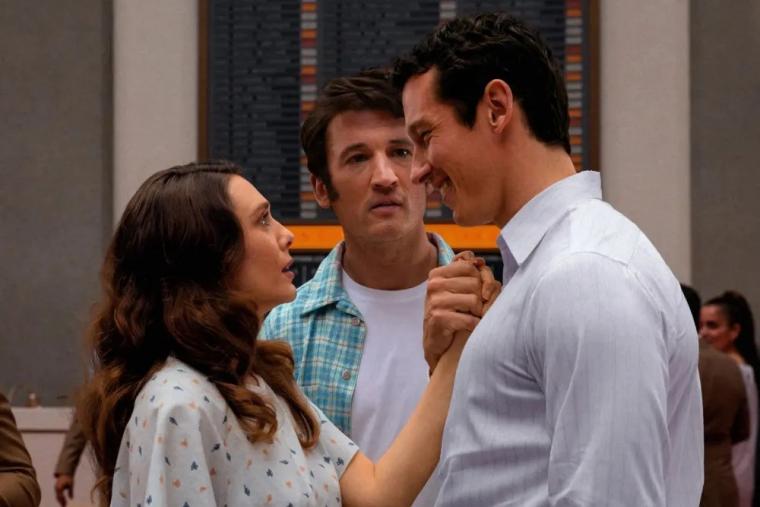
Miles Teller and Elizabeth Olsen share perfectly appropriate chemistry in the romantic comedy Eternity, because in their first moments on-screen together, and during much that happens after, they seem barely able to stand one another. I don't mean this in the cutesy hate-at-first-sight way of, say, The Proposal, where the hostility between Sandra Bullock and Ryan Reynolds was so aggressively snippy that you instantly knew they'd fall in love. The rapport between Teller's Larry and Olsen's Joan isn't “I loathe you” so much as “Eh … it's you.” And that dynamic is actually ideal for director/co-writer David Freyne's afterlife rom-com, given that the movie's 30-something leads aren't playing 30-somethings, but rather 80-somethings who have already spent 65 years in each other's company. It's kind of hard to blame them for being reunited post-death and giving off vibes that frequently imply “Here we go again.”
We first meet Larry and Joan when they're on Earth in their in-the-flesh 80s and played by Barry Primus and Betty Buckley. After fatally choking on a pretzel, Larry is sent to the Great Beyond, and is now played by Teller. (Following your passing, we're told, you become the age at which you were the happiest.) More specifically, Larry is sent to the Afterlife Junction, a busy, evidently under-staffed train station where new arrivals have one week to determine where, and how, they'd like to spend their forevers. The seemingly limitless options being hawked include Capitalist World, Nudist World, Paris World, Smokers World (“because cancer can't kill you twice!”), and Man-Free World – which, it turns out, is filled to capacity. Larry thinks Beach World sounds nice, but first he has to wait for Joan to arrive, so they can go together. Due to her terminal cancer on Earth, Joan, now played by Olsen, does soon show up, and while she's grateful to see Larry, she's not so sure about Beach World. Nor, it turns out, is she all that sure about Larry considering who else in the Junction: Joan's first husband Luke (Callum Turner), who perished in the Korean War, and has been patiently waiting 67 years for his wife to arrive. (We learn that you can stay in the Junction longer than a week as long as you procure a job, so Luke took a gig as a bartender while waiting for Joan, and … . It's a long story.)
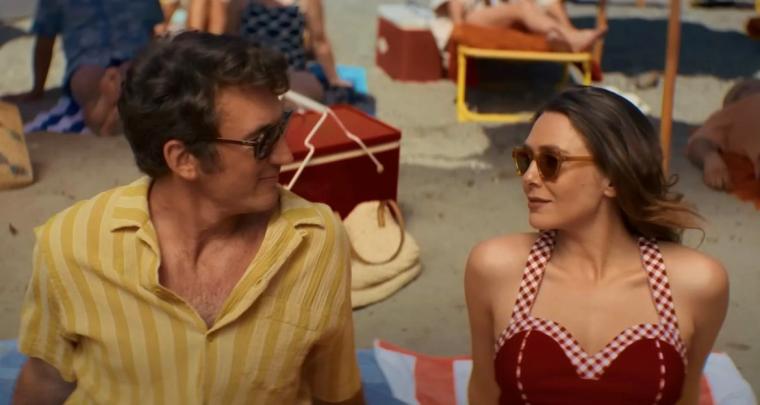
Obviously, the driving conceit of Freyne's and co-screenwriter Pat Cunnane's Eternity focuses on who Elizabeth will choose to spend forever with: the first husband, and love of Elizabeth's life, who died too soon, or the second husband with whom she spent 65 years and built a family. Really, it's not much of a contest. The movie's Manhattan-based distributing studio A24 may be anti-Hollywood, but it's still pretty Hollywood, and no way will an upbeat, joke-heavy rom-com end with its heroine ditching the man who stood by her for 65 years in favor of a hot young replacement. Further simplifying matters is that “hot young replacement” is basically where Luke's appeal ends – and some of us may even argue with that “hot” business. Sure, Turner's a good-looking guy, and I'm aware that he was a fashion model before he became an actor, and attractiveness is subjective anyway. All throughout the film, though, so many, many characters comment on how devastatingly handsome Luke is that I was forced to ask, “Is he?” I suppose Turner is striking enough; he's basically who you'd get if Challengers co-stars Josh O'Connor and Mike Faist procreated. But it's not like Luke is being played by, I dunno, Jacob Elordi (again – subjective!), and in truth, Turner looks enough like Miles Teller for the point of his handsomeness to be a non-issue. He's certainly duller than Teller, just as Luke is duller than Larry, and when it comes to rom-coms, equilateral love triangles are always preferable to isosceles ones.
Its lack of a truly engaging romantic threat aside, Eternity is a charmer, even though I did leave my screening less eager to see the movie again than to watch Albert Brooks' Defending Your Life for the zillionth time. Beyond those hysterical final-destination options – and it might be worth giving the film another look just to clock all of them, because there are dozens – big laughs are provided by Da'Vine Joy Randolph and John Early as our leads' afterlife coordinators, sparring partners who suggest randier versions of DYL's Rip Torn and Lee Grant. There are several lovely sentimental detours for Joan as she visits roads traveled and roads merely considered – scenes that Olsen pulls off with warmth and emotional complexity. But the best reason to see Freyne's film is Teller, who rarely gets to demonstrate this sort of quick wit and lightness of touch. What's most appealing about his performance is that the actor never lets you forget that inside his mid-30s physique is a cranky, deeply devoted octogenarian, a man who loves his newfound ability to do deep knee bends but can't fathom how his beloved wife could even consider not spending the rest of her post-life with him. Teller, here, is awfully funny – shockingly so when he razzes Luke for not dying in one of the “important” wars. But he's also surreptitiously moving, as when he makes a sacrifice you hadn't expected this curmudgeon to ever make. In the end, Teller proves himself very much worth spending Eternity with,
ZOOTOPIA 2
For my money, Disney's Zootopia 2 is almost as great as 2016's Zootopia one, which makes it almost one of the sharpest, wittiest, funniest comedies of its decade.
Naturally, much of the novelty is gone; you don't watch the scenes of specifically customized metropolitan life among carnivores and herbivores with the jaw-dropped fascination that accompanied the first go-'round. But the animation remains stunning, the animal-themed visual gags are still priceless, the action moves at a speedy yet never hyperactive clip, and directors Jared Bush (who also wrote the script) and Byron Howard consistently find clever ways to reintroduce unforgettable peripheral figures from '16, such as Maurice LaMarche's Brando-inspired shrew Mr. Big and Raymond S. Persi's sports-car-driving sloth Flash. The more recognizable names among the vocal cast also provide enormous fun, among them welcome returnees Idris Elba, Jenny Slate, Tommy Chong, Bonnie Hunt, and Shakira. Quinta Brunson, as a chipper therapist, makes her series debut, as do Andy Samberg, Patrick Warburton, David Strathairn, Macaulay Culkin, and Danny Trejo. And a post-screening scan of the sequel's dozens of aural participants means that, with absolutely no complaints, I'll eventually have to watch this thing again simply to appreciate the ones I initially missed. Tig Notaro as an imprisoned bear? Cecily Strong as Mr. Big's granddaughter? Michael J. Fox as a fox named Michael J.? You're killin' me, Zootopias.

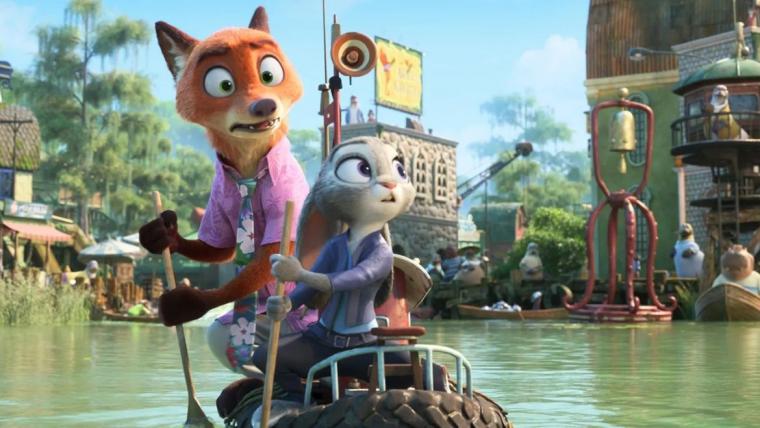
For the record, there is a plot, and it's a satisfyingly twisty one involving the unwanted appearance of a reptile (Ke Huy Quan's Gary De'Snake) and a family of lynxes hell-bent – er, heck-bent – on putting it down. Yet even though the narrative leads to a flabbergasting character reversal and hopeless-seeming climactic peril both straight out of Toy Story 3 (plus a brilliantly not-brief nod to The Shining clearly intended for parents only), it's hard to imagine that most viewers will care too much about it. All that most of us, even little kids, will likely be obsessed with is a question only mildly teased nine years ago: When are Ginnifer Goodwin's excitable rabbit Judy Hopps and Jason Bateman's sly fox Nick Wilde, now partners in the Zootopia Police Department, going to admit they're into each other?
Okay, granted, little kids are probably more than happy thinking them just good friends. But come on, it's just so obvious. Their first case together in Zootopia 2 finds Judy and Nick is disguise as spouses – and pushing their faux baby in a stroller, no less! They go on to infiltrate a swank cocktail gathering, allowing both of them, as in hundreds of rom-coms, the chance to gape as they see one another in fancy clothes for the first time. But between sharing constant Hepburn-and-Tracy banter and attending couples therapy together and choking up when revealing their deepest feelings – to say nothing of the post-credits kicker that finds Judy swooning over a gift Nick gave her – this is a love story to its bared teeth, and here's hoping the inevitable part three actually explores (in PG-rated fashion, of course) what an inter-species romantic pairing would mean in Zootopia, and to Zootopia. Here's also hoping Disney isn't too squeamish about the potential childhood trauma in Going There. When we were young, after all, fellow Gen X-ers and I witnessed Kermit the Frog and Miss Piggy getting married in The Muppets Take Manhattan, and we turned out fine! Ish.