

Miguel Torres Umba(-ish) in Primate
PRIMATE
One can only hope that director/co-writer Johannes Roberts' Primate remains the worst 2026 horror flick to feature a previous Oscar winner. It should be said, however, that Troy Kotsur, who earned a deserved Best Supporting Actor trophy for 2021's CODA, is the finest thing that could've happened to a dopey, rather repugnant shocker about a chimp gone ape.
It's impossible to begrudge Kotsur's participation, given that regardless of Academy Awards history, major-studio opportunities for 57-year-old deaf performers can't be overwhelming. Plus, beyond his considerable dramatic chops, the man brings welcome gravitas, humanity, and easy humor to his role as an in-demand novelist who's out of town when his family's pet chimpanzee goes on a rabies-fueled rampage. But Kotsur's presence benefits the film in other ways, too. With his writer Adam speaking only in sign language, there's a sense of genuine connection is his scenes with the initially adorable, ultimately feral Ben, who, like Kotsur, doesn't communicate vocally. (The monkey role is physicalized, with the unquestionable aid of CGI, by human portrayer Miguel Torres Umba.) And after Adam returns to the Hawaii house that's been through simian-fueled hell in his absence, even the image of Kotsur quietly walking through the house unaware of the nearby murderer is given added resonance by Roberts opting to eliminate sound from the scene. Adam isn't aware of the panting, hulking killer standing mere feet behind him, but it's not because he's oblivious – it's because he can't hear him. He can't hear.
This sound-elimination conceit is such a clever touch – and given the casting of Adam, so sensible – that you wish Roberts and co-screenwriter Ernest Riera had found reason to keep Kotsur around longer at the start, or to make more of his screen time following his return. Then again, I'm not sure what the scribes were thinking when they crafted Primate. In general outline, it's just a slightly better-looking, far grislier take on any ol' animal-amok thriller, complete with a host of generically interchangeable 20-somethings to act as unwilling chew toys. But Ben isn't a villain; he's a pitiable creature, much loved by his adoptive family, who had the bad luck to be bitten by a rabid mongoose. (That event is never shown on-screen, and given the crummy lighting, it's barely possible to even see the bite mark.) Yet he's not quite a tragic figure, either, considering Ben's enthusiasm – or is it Johannes Roberts'? – when tearing someone's face off and ripping out another's jawbone. We're meant to be anxious when rabid Ben is around and terrified when he attacks, and these unnerving, gory encounters do pack some punch. But our actual feelings toward the beast are more complicated than traditional “Gotcha!” punches allow – and there's hardly room for "complicated" in a movie this stupid.

Regular readers of these reviews will likely recall that when I spend time in Chicagoland, as I did this past weekend, I frequently hit the cineplex along my lifelong friend Angie, who has accidentally accompanied me to some of the worst movies we've ever seen. (She was right there with me for the Priyanka Chopra rom-com howler Love Again in 2023 … and I don't think any additional examples are required.) Once we realized that Roberts' dipstick shocker was indeed going to be unsalvageable – a mutual recognition that transpired after about 20 of the film's 85 minutes – we went to town on this thing.
What kind of maniacal architect designs an in-ground swimming pool to be built on the edge of a cliff? Why does Erin (Gia Hunter), the pigtailed baby sister of our theoretical heroine Lucy (Johnny Sequoyah), throw such a fit about her sibling “abandoning” her for college when the younger girl is clearly in her teens, or pretending not to be? (As we discover, somebody was watching a TV station hosting episodes of Dora the Explorer.) Why do both sisters recoil at their dad leaving them for a meeting with a Hollywood mogul who wants to turn one of Adam's books into a film? Isn't it his success that's paying for this crazy-chic Hawaii house with the insane views and swimming pool on the cliff? Why is such a big, closeup-heavy deal made of the matching broken-heart necklaces worn by Lucy and her bestie Erin (Victoria Wyant) considering the jewelry never comes into play as a plot device? Why, after witnessing a girl's hair being literally pulled from its scalp by Ben, do a pair of horny collegiate randos (Charlie Mann and Tienne Simon) still show up at the house – not with the police, but with a conceivable breaking-and-entering violation while stealing beers and damaging property? (It's one of these idiots who gets his jawbone yanked out … and good for Ben, I say.)
Why does Adam sabotage his filmmaking deal without giving his hosts an explanation for his exodus? Why is the veterinarian he contacts such an asshole? Who keeps a TV's remote control by a power outlet 10 feet away from the set? Does the “happy ending,” complete with relieved smiles all around, come with anyone's awareness that the lawsuits and likely jail time accompanying this party weekend are gonna be massive? How did Hawaii, a state famed for its absence of rabid animals, come to house a rabid mongoose in the first place? And above everything else, why aren't we given more time with pre-rabies Ben at the beginning – perhaps through home-movie footage – so there would be more at stake in his eventual turn? Primate isn't in any way fun – unless you can cajole a pal, or a whole group of them, into making adjoining, commentary-track fun of it. If you can? By all means, go bananas.
IS THIS THING ON?
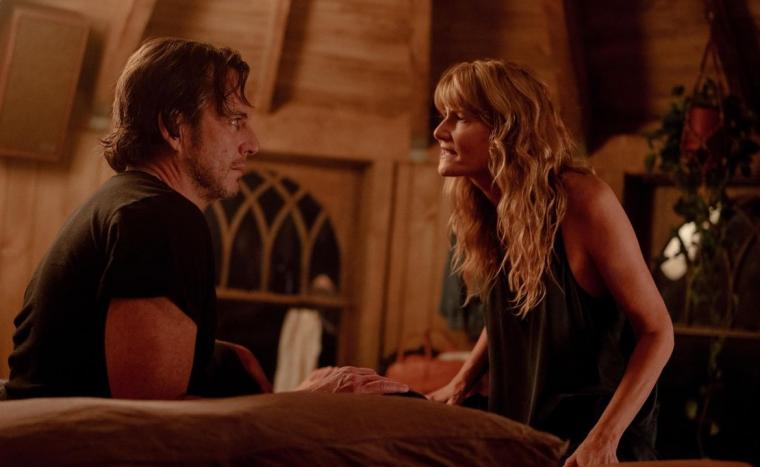
Is This Thing On? is both the title of Bradley Cooper's third film as a director/co-writer/co-star (after 2018's A Star Is Born remake and 2023's Maestro) and the hackneyed rhetorical question that second-rate comedians employ with live audiences when gags don't land. It's also, in this sweet, contrived offering co-written by Mark Chappell and Will Arnett, a legitimate query asked, always in their own heads, by Arnett as fledgling comic Alex Novak and Laura Dern as his soon-to-be-ex-wife Tess. While the movie boasts wholly credible, better-than-the-norm scenes involving the NYC open-mic circuit, it doesn't seem overtly interested in dramatizing the pursuit, and that might be a good thing. I'd imagine actual standups would be slightly offended by the film's suggestion that all it takes to be a hit with crowds are real-time analyses of your crumbling marriage and what one fellow comic succinctly describes as “heart.” Is This Thing On?, though, works much better as a marital dramedy for middle-aged partners who still aren't entirely sure why they broke up, and while there are sitcom contrivances (and figures, and passages) galore, the scrappy, indie-style filmmaking and truthful performances make the experience, if not novel, at least continually pleasurable.
Befitting a movie whose title is a question, Cooper's latest also opens with one: “Should we call it?” This is asked by Tess, who's brushing her teeth right after Adam comes out of the shower, and the “it” refers to their marriage, which both have evidently agreed has run its course. The question's answer appears to be “yes.” But what prompted this decision is unclear from the start. Adam and Tess aren't acrimonious. They're still able to present theirs as a happy union during a dinner party the following day – or many days or weeks later. (Cooper's movie is distractingly unspecific about the passage of time.) They both fiercely love their 10-year-old sons – Blake Kane and Calvin Knegten, a pair of funny, naturalistic charmers – and, with Adam living in an apartment across town, have obviously figured out an acceptable shared-custody situation without getting lawyers involved … which might actually make the film more offensive to divorced parents than to standup comedians. The Novaks just don't feel the way they used to about each other, or themselves, and have decided to “call it.” It's not until Adam finds himself, in downtown Manhattan, alone, slightly high, evidently broke, and willing to try open-mic standup in lieu of paying a $15 cover that either partner begins to see a road ahead.
As in my Primate tirade, I'm left with a question or two. Or a few. Did Adam and Tess not consider therapy? Did they not check out a book or podcast on the subject of their marital dissatisfaction? Did they not previously reach out to any friends or family members? (Is This Thing On? gives us several who could've lent an ear: the delightfully cast Christine Ebersole and Ciarán Hinds as Adam's folks; real-life spouses Sean Hayes and Scott Icenogle as occasional hangs Stephen and Geoffrey; Andra Day and Cooper himself as the Novaks' married besties Christine and, honest to God, Balls.) Why doesn't Adam have the $15 for the door fee even though he has a career in finance – a job at which we never see him work, and which doesn't seem at all affected by Adam's nights at every open mic in town? And if Adam was lying about not having the money, which he says during an early comedy set, why did his mind go so quickly to “Sure … I'll try standup instead”? We don't need all these answers, just as we don't necessarily need to know, from the outset, the cause of the Novaks' separation. But in refusing to give us any answers, the script merely delivers narrative shortcutting to get from points A to B and beyond, and the performers' emotional specificity winds up dangling.
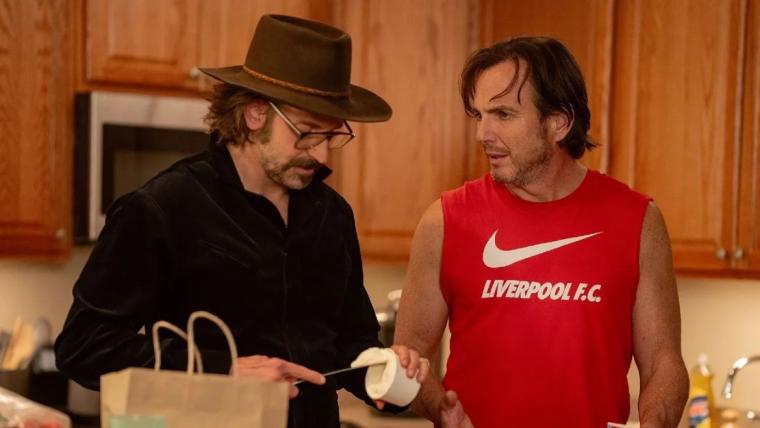
The narrative blueprint is also uncomfortably contrived, yet it says something that the movie's most contrived sequence, landing at roughly the halfway point, is simultaneously its most illuminating one. Following a one-night-stand with a fellow comedian, Adam finally gets a full 10-minute slot as a last-minute comedy-night replacement. And wouldn't you know it, Adam's performance happens to occur on the same night that Tess – completely accidentally – enters the club with her first date (Peyton Manning!) since their separation. This is the ultimate in groan-worthy happenstance. Yet the strangest thing happens. Cinematographer Matthew Libatique, as has been the case throughout the film, keeps his camera honed in on a closeup when Adam tells the crowd, including (without his knowledge) Tess. about his hookup. But then Libatique shifts his perspective to a closeup on Tess' reaction to her ex's routine, and what Dern does in that moment is extraordinary: astonishment leading to anger leading to fascination leading to a strange kind of pride leading to arousal as she watches Adam finish his set. Dern has forever been a master of show-don't-tell acting. And in combination with Cooper's gift for trusting wordless communication, this public confessional is revealed as exhilarating for Adam's performer and Tess' audience member alike – as well as those of us witnessing both sides of this thorny situation.
Events get both more complicated and sillier from there, But I love that Arnett, though a bit forced in his effects, find so much painful self-loathing in Adam's plight, as well as so much legitimate abandon when finding what may have always been the man's true professional calling. I love that Dern, who's as beguiling and magnetic as ever, isn't relegated to playing second fiddle, with her former volleyball-playing Olympian Tess receiving her own independent story arc with hardships and triumphs of its own. I love the Novak kids' obsession in rehearsing “Under Pressure” for their talent show until it's just right; and the backstage banter with the endlessly supportive and one-upping comedians; and the early-morning weekend-getaway harmonizing, led by chanteuse supreme Andra Day, on “Amazing Grace.” And I not only adored that Cooper, with Is This Thing On?, was giving himself an awards-season breather by delivering a lovely little relationship saga in lieu of another prospective Oscars run, but that he cast himself as a full-fledged comic goof, his Balls (!!!) earning the lion's share of laughs and making his entrance with pricelessly messy slapstick. Another Star Is Born would be great. For now, another rendezvous with the Hangover star and Licorice Pizza scene stealer is more than welcome.
FATHER MOTHER SISTER BROTHER
The deadpan comedies of Jim Jarmusch tend to be an acquired taste, and I generally find them tastier when served as appetizers rather than full meals. Broken Flowers, Only Lovers Left Alive, his 1984 breakout Stranger Than Paradise, and other works are all perfectly pleasant at feature length – “pleasant,” with Jarmusch titles, being an adjective employed far more often than “exciting.” But I strongly prefer the short-film anthologies that have more variety and require less sustained investment in their melancholic eccentricity: Mystery Train, Night on Earth, Coffee & Cigarettes, and now, Father Mother Sister Brother, currently playing at Iowa City's FilmScene. Winner of the Golden Lion at this past fall's Venice Film Festival, the movie is delicate even by Jarmusch standards; you feel the indie stalwart's images might disintegrate if you so much as sneeze. Yet its three funny-sad vignettes of roughly 30-35 minutes apiece are beautifully performed and cast a haunting spell, and by the finale, you may be surprised by how surreptitiously moved you are.
If there's a consistent theme in this trio of familial encounters, it lies in how children, even as adults, can never fully know their parents, and the anthology's opening segment “Father” delivers a great unsolvable mystery in the form of Tom Waits' unnamed patriarch. Reclusive, grizzled (a Waits specialty), and on the apparent edge of ruin, Father is first seen tidying up his dilapidated woodland home in New Jersey, preparing for a visit with his kids Jeff (Adam Driver) and Emily (Miyam Bialik), with whom he's been long estranged. He's clearly antsy about seeing them; their drive to the house indicates that Jeff and Emily feel the same, especially given the spectacle that their father, years ago, made of himself at their mother's funeral. All things considered, though, the visit is friendly and serene – and the segment itself remains so even after Jarmusch delivers his kicker, demonstrating how little Jeff, Emily, and the audience understood about Dad's actual situation.
There's so much to unpack in Father Mother Sister Brother's first mini-movie that I wanted to watch it again the moment it ended. Driver and Bialik, wholly believable as siblings with barely hidden resentments, perform admirably restrained, economical anxiety, wordlessly expressing how Jeff's and Emily's complicated feelings about their dad stem from very different sources. And Waits, with his gorgeously gravelly voice, fashions a sweetly heartbreaking figure through Father's attempts to be a genial, generous host, his only beverage option water until Emily finds some tea stashed in a cupboard. Although the reunion is awkward and tense, and downright scary when Waits spends a little too much time holding an ax, it's also ticklish, especially when Dad delivers a litany of the drugs he's not taking. In other words, particulars excepted, it's like many real-life family get-togethers, where you might find yourself annoyed that your sib so brazenly buys his way into “favorite” status, and wonder how a destitute relation could afford that pricey Rolex. (The watch brand is a recurring motif in Jarmusch's triptych, and beyond the matching, color-coded wardrobe selections, each entry features stylized overhead shots of table settings and the question of whether it's okay to toast with water.) All told, “Father” is a continual smile that ends in a giggly grin, and just about perfect for its length.
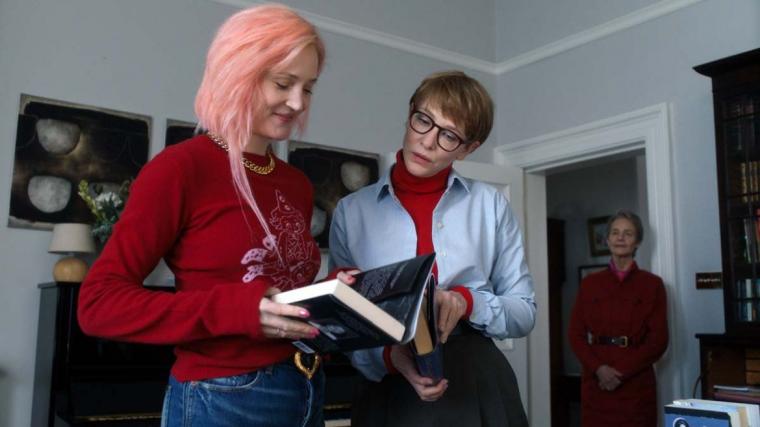
I was hoping for similar results from Father Mother Sister Brother's second vignette, but its pleasures were more on the surface. With this tale set in upper-middle-class Dublin, “Mother”'s premise is largely similar to “Father”'s, as Charlotte Rampling's successful author hosts a tea-and-cakes afternoon with daughters Lilith (Vicky Krieps) and Timothea (Cate Blanchett), who only meet together once a year. If Jarmusch's first segment is ultimately about the kids not knowing their pop, its followup, from the start, is about three relations refusing to let themselves be known to one another. Mom won't discuss her books or her life outside of writing. Lilith lies about her nonexistent career and shaky finances, disguising herself as the model of über-chic wealth. Timothea won't reveal how, despite her janky car and mousy demeanor, she's actually awfully happy. In other words, there's not much for this trio to talk about – at least nothing real to talk about – and “Mother” passes by in quiet, deliberately static, slightly tedious fashion. Still, these three effortlessly charismatic actors make the most of their mildly comedic, tension-filled silence, and pink-haired Krieps exudes the languid charm of a Tootsie-era Jessica Lange.
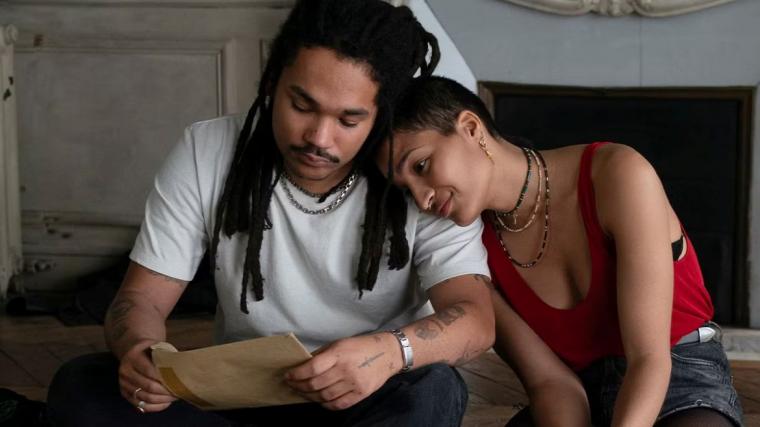
Saving the best for last, Jarmusch climaxes his anthology with “Sister Brother,” which, if possible, has even less recognizable plot than its predecessors. In it, devoted adult twins Skye (Indya Moore) and Billy (Luka Sabbat) reunite in Paris to sort out the effects, and visit the old apartment, of their parents – adventurers who recently perished in a plane crash. (With Mom the private plane's pilot, she and her husband were the only fatalities.) Not much happens in the vignette: the grown kids meet for coffee; they pore over family photos and personal items; they walk through the home of their upbringing; they marvel at the packed confines of a storage facility. But in “Sister Brother,” nothing happens in the warmest, most elucidating ways possible, every interaction between the siblings suggesting unimaginably deep love, as well as utter fascination that the people who raised them could, in death, somehow continue to be consummate enigmas. Performing their graceful pas de deux with unimpeachable honesty and compassion, Moore and Sabbat end Father Mother Sister Brother on a note of wistful yet clear-eyed acceptance that expands during the closing credits and on your drive home. While this tender, unconventional Jarmusch may not be enough to make you want to hug your more distant family members, it might just inspire you to give them a call. Or shoot them a text. Or think about shooting them a text. Depends on the family, I suppose.