

Ryan Gosling in Project Hail Mary
PROJECT HAIL MARY
Having not read the Andy Weir novel on which their film is based, it's hard to tell if Phil Lord and Christopher Miller were the right directors for the science-fiction adventure Project Hail Mary, or – for the book's many admirers, and maybe a few of us newbies – the absolute wrong ones.
For the record, I had a mostly great time at this big-budget charmer that's essentially a buddy comedy set in space. Ryan Gosling is at peak charisma; our resident alien, the Ollie to Gosling's Stan, is endearing as all get out; the cinematography (by Greig Fraser), production design, and visual effects are topnotch; Sandra Hüller sings karaoke, and sings it well. Mere hours after seeing the movie, though, I was starting to get a nagging sensation in my gut, the kind you experience after a delicious, decadent fast-food binge that you know is gonna haunt you later. Lord's and Miller's sci-fi outing is a lot of fun, to be sure. But given its scenario, should it have been? By which I mean: Is the focus on humor, which at times lapses into pure shtick, more hindrance than help?
This is hardly the film's fault, but that question became more pressing after re-watching The Martian the evening of my Thursday-afternoon Project Hail Mary screening. My intentions, I thought, were good. I was on such a contact high from the Lord/Miller that I wanted to keep the vibes going with Ridley Scott's 2015 hit, which I hadn't seen in years, and which was also an Andy Weir adaptation by PHM screenwriter Drew Goddard. Perhaps Scott's most thoroughly likable achievement over a half-century, the movie remains stellar in all aspects. But what I think even we admirers underrated 11 years ago was its near-perfect blend of tones. The Martian is very funny, and truly exciting, yet also incredibly practical-minded – a gripping procedural on how to stay alive under seemingly impossible circumstances. You wanted Matt Damon's Mars-stranded botanist Mark Watney to make it, because you knew how afraid he was of dying, and how guilty his NASA team felt for abandoning him, and the extraordinary lengths everyone was going to in order to get Mark safely back to Earth. Scott's film had stakes, and genuinely moving ones, despite being “only” about the survival of one man. Project Hail Mary is about the survival of everyone on Earth (and beyond), and its stakes feel close to nonexistent.

That's because, I'd argue, Lord and Miller, and Goddard to an extent, and perhaps even novelist Weir, put so much stock in the material's comedy that they lost track of the bigger picture, which involves not just global but galaxy-wide annihilation. Maybe there's no way to confront such unimaginable existential threat except through jokes. Yet for all of Gosling's tears and Hüller's buried panic – and theirs are pretty much the only human characters we get to know – whether the universe will survive its onslaught by sun-devouring entities seems like a minor concern. Lord and Miller seem infinitely more comfortable delivering verbal and visual slapstick than dread, and given their previous quartet of feature-length credits as directors (the animated comedies Cloudy with a Chance of Meatballs and The Lego Movie, the live-action 21 and 22 Jump Streets), that probably shouldn't be surprising. It's still disappointing. Project Hail Mary is on solid footing, even if its hero isn't, whenever Gosling's Dr. Ryland Grace battles zero-gravity conditions, makes self-amused quips, or banters with the ambulatory rock mass who becomes his best friend. These unlikely pals, I'll admit, are a winning, memorable team – the loveliest pairing of their type since Tom Hanks and Wilson. (And they volleyball couldn't talk back.) I grinned, and occasionally chuckled, all throughout this latest Lord/Miller. My effectively manipulated watery eyes notwithstanding, though, the relentless blitheness prevented me from ever truly caring about it.
If I've gone overly long without direct mention of Project Hail Mary's plot, that's partly due to the narrative being so weirdly easy to forget about. A professionally shunned molecular biologist turned contended middle-school science teacher, Ryland Grace is recruited by cagey government agent Eva Stratt (Hüller) to join a space mission, one designed to determine why the universe's suns are being extinguished, and why Earth is roughly 30 years away from billions perishing through global cooling. Sent to determine the cause and hopefully find a solution, his two shipmates having died en route, Grace makes the acquaintance of a blocky, five-legged alien on a similar mission, and much of the rest of the film concerns their extended getting-to-know-you as the biologist and the nicknamed “Rocky” attempt to save their respective worlds. The getting-to-know-you is the fun part.
As in Denis Villeneuve's 2016 Arrival, our human protagonist has to learn how to communicate with an alien visitor. Also as in Arrival, the process here proves almost ridiculously easy – or rather, so complicated that most of it zips by in montage form. (Lord and Miller don't appear to have much patience for technical ins and outs.) Before long, Grace's spacecraft is translating Rocky's otherworldly grunts into broken English on a computer screen, and not long after, a machine translator gives the alien the excitable, mildly robotic, sweetly childlike voice of James Ortiz, who also serves, off-screen, as the creature's lead puppeteer. The employment of puppetry is a big win for Project Hail Mary, giving Rocky a tactile, believably awkward physicality that's augmented, for laughs, when he enters Grace's ship in a rolling plastic ball that allows him to breathe. It's in Ortiz's vocals, though, that the movie becomes almost inarguably endearing, both to its benefit and detriment.
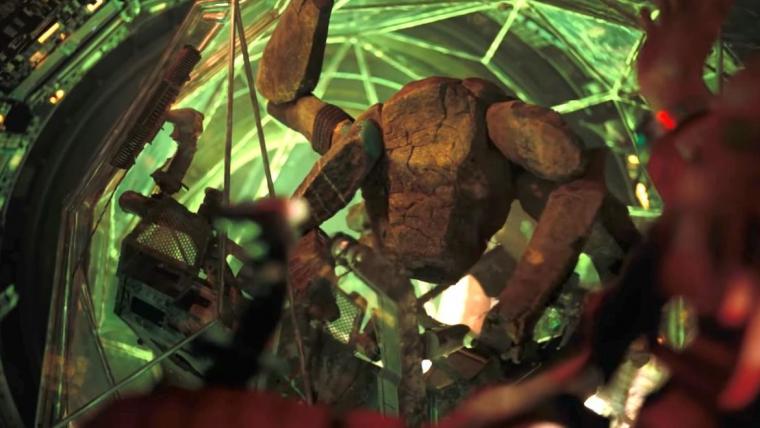
Finally having someone to verbally communicate with (his recordings to NASA being one-way missives), the naturally talkative Grace becomes even chattier than usual, and the odd-couple dynamics of his and Rocky's burgeoning acquaintance are amusing and occasionally quite affecting. They so thoroughly become the movie's crux, though, that the mission itself becomes almost incidental, and the question of “Will the galaxy endure?” gets lost in favor of “Will our heroes' friendship endure?” That isn't a huge complaint; I was invested in Grace's and Rocky's survival, too. Yet Lord/Miller's comic tone remains so cheeky and optimistic that a Happily Ever After is never in doubt, even when, in the manner of so many family films, potentially fatal crises arise. (Project Hail Mary is perfectly appropriate for tweens, even though they may not understand all the science stuff – this grown-up didn't, either.)
So between the über-cute Grace-and-Rocky shenanigans, the images of Gosling spinning in zero gravity and accidentally puking on himself, and the heavy jokiness of the flashbacks on Earth pre-space exploration, I suppose my question is: Did the prevailing mood have to be this light? Grace is, after all, on a suicide mission – we learn early on that there's enough fuel to get the astronauts to deep space, but not enough to get them back. Even if a solution to Earth's crisis is found, many years will have passed on the increasingly chilly planet before NASA gets word from Grace on how to rectify matters. Won't immeasurable environmental damage has been done in the meantime? And when it begins to look like Grace and Rocky have indeed figured out a way to save their home planets, it might take a few minutes before you realize they have no plan whatsoever for saving any of the galaxy's other planets. (The potential denizens of those orbs, I guess, are on their own.) There's an inherent grimness to Project Hail Mary that Lord and Miller seem fundamentally uninterested in, as evidenced by the directors quickly undermining or scooting past the bummers whenever Goddard's script implies or directly references the severity. I get it; they want to keep us laughing, as they have so successfully in the past. But the laughs, I think, would've been heartier if they came as relief to the on-screen tension, not as substitute for it.
All this might make me sound down on the movie, but I'm honestly not – or at least, not so down that I don't want to eventually see the movie again. Project Hail Mary is terrifically entertaining. I loved the frequently detonating charm bomb that is Ryan Gosling, who has only rarely enjoyed roles that have catered this expansively to his wide-ranging talents. Although I was never entirely certain whether the flashback structure was solely for the audience's benefit or used to suggest Grace's gradually returning memories following years of hyper-sleep, the Earth scenes were dynamic and thoughtful … if also loaded with more scientific gobbledygook than the directors satisfyingly explore. Hüller, that master of emotional inscrutability, is dryly funny and subtly anguished and performs a rather knockout rendition of Harry Styles' “Sign of the Times.” And Rocky is a total hoot, as are James Ortiz's accompanying computerized vocals. Given the film's keep-the-yuks-coming bent, though, it might've been a kicky treat – one teased upon hearing voice-simulator options – had Meryl Streep indeed voiced Rocky for a scene or two before Grace decided to put a kibosh on the experiment, not wanting a pile of moving rocks to upstage him in the cadence and class departments. Dude's got enough problems.

READY OR NOT 2: HERE I COME
I've been a longtime proponent of more horror-flick characters going splat!, whether as a result of being flattened by heavy objects, getting hit by speeding vehicles, or, in the case of 2019's Ready or Not, simply spontaneously combusting. That grisly scare comedy by directors Matt Bettinelli-Olpin and Tyler Gillett (of the Radio Silence collective) climaxed with such a cavalcade of gooey, hysterical splat! deaths that you just knew the effect would be repeated if the movie ever inspired a continuation. Beginning about 15 minutes in, the filmmakers' Ready or Not 2: Here I Come boasts so many of these funny/shocking demises that, for sick souls such as myself, the sequel is almost irresistible. Yet I hasten to stress that “almost,” because RoN2:HIC, sadly, proves all-too resistible, its biggest shock being the leads' inability to just shut the hell up and enjoy the demented ride.
If you recall, as seven years is an awfully long time to wait for a followup these days, the first film's bride Grace MacCaullay (the hardworking Samara Weaving) was unhappily astounded to learn that her new in-laws, the Le Domas clan, were Satanists, and that the only way to keep their riches intact was to execute Grace before sunrise. The intrepid gal prevailed, naturally, and the devil got his due: One by one, he made the bad guys blow up. Here I Come starts right where we left Grace in 2019, smoking a cigarette outside the Le Domas mansion, and we quickly discover that the “game” she endured had a clause. With the expected sacrifice an unexpected survivor, four other families are now tasked with hunting Grace down to gain Satan's favor, and once they have it, they'll have complete global control. (This isn't exaggeration – they get to control the entire world. We witness a patriarch played by genre icon David Cronenberg stopping an overseas war with a phone call.) You'd feel bad for Grace, who has to suffer through the whole evading-and-killing-psychopaths brouhaha again right after the worst night of her life. But this time she has an ally: her estranged younger sister Faith (Kathryn Newton), who has been roped into this mess, too. That just makes you feel really bad for Grace.
In following the more-is-more rule of sequels, much of Here I Come is reasonably diverting, and in many respects, an improvement over its predecessor, which I didn't much care for until the imploding commenced. Although the appeal of co-star Shawn Hatosy (a '90s screen teen who won an Emmy for his guest turn on The Pitt) might be forever lost on me, the rest of the villainous supporting cast is first-rate, with particular praise going to Sarah Michelle Gellar as an acerbic overlord-in-waiting, Néstor Carbonell as a rifleman who can't hit the broad side of a barn, Juan Pablo Romero as Carbonell's too-avidly-murderous-for-a-prepubescent son, and Elijah Wood, enticingly suave and sinister as the devil's right-hand man who apparently passed the bar. There's also an upsettingly hilarious killing involving an industrial-size washing machine, and Varun Saranga's stoned wimp exuding serious Aziz Ansari energy, and a memorable bit of solo slapstick in which Grace and a homicidal rival attempt to punch each other but keep missing, both having recently been maced in the eyes. The script by Guy Busick and R. Christopher Murphy, meanwhile, is way too heavy on the exposition, but the John Wick-esque narrative niceties do a surprisingly sturdy job of world-building. And, you know, there are all those splat!s. I had a decent time.

I would've had a much better one if we hadn't been forced to sit through quite so much verbalized sibling-rivalry petulance. From the moment Newton's Fath enters, all peevish and pissy about some injustice from the sisters' shared past, you know exactly where Bettinelli-Olpin's and Gullett's gory opus is heading: right into Sentimental Valley, where constant attacks by brutal strangers will reinforce the initially hostile sibs' familial bond and allow them to walk hand and hand into the sunrise. (This isn't a spoiler: It's AI screenwriting 101.) Yet it becomes downright laughable when every time Grace and Faith get a respite from the mayhem, their instinct isn't to formulate a plan or nap, but rather to repeat, ad nauseam, the reasons they haven't spoken in years. Weaving is a tremendously solid actor, and wholly sells Grace's victimization and profound sense of self-preservation. She can't, however, salvage the teen bickering that commences whenever Faith opens her yap, the character's anger stemming from the fact that Grace, as an 18-year-old, didn't take 15-year-old Faith along with her – and out of foster care – when she left for New York to pursue a better life for the pair.
Ummm … . I'm sorry. Why should Grace have brought Faith along? Newton, never the strongest of screen partners, plays bitchy indignation to the hilt. But the logic behind Faith's exhausting crankiness doesn't hold water (especially when it's revealed that the foster-care parents were actually nice), and Grace's reasoning for not wanting to be an 18-year-old caring for a 15-year-old sibling on her own makes valid sense – certainly more than enough sense to justify dropping the momentum-killing arguments in favor of more gross encounters with warring clan members. This should've been a minor issue I had with Ready or Not 2: Here I Come. The incessant returns to this minor issue, however, had the unfortunate effect of making it a major issue, and while I unhappily winced every time Hatosy punched Weaving in the face or kicked her in the stomach, those expressions were nothing compared to the displeasure I expressed whenever it was time for another Grace-and-Faith heart-to-heart that could've/should've been lost in the editing room. I can easily name one more character in this thing who deserved to go splat!.

THE POUT-POUT FISH
Which would you consider more mortifying: Being a late-middle-aged man viewing an animated kiddie comedy on his own while surrounded by excitable children, or being a late-middle-aged man viewing an animated kiddie comedy on his own, full stop? I had hoped to never personally know. But on Saturday, I attended a 10:30 a.m. screening of director Ricard Cussó's The Pout-Pout Fish at the Moline cineplex, and was both jazzed and embarrassed to realize I was the only one there. Jazzed because hey, at least no one but the ticket sellers knew I was seeing it. Embarrassed because, y'know … . Sheesh. If no one else bothered to show up (on a Saturday morning!) for a family flick whose large cardboard lobby display implied it had some public awareness, what the hell was I doing there?!
Truthfully, it was because that display featured an image of the grumpiest cartoon fish you've ever seen – an ocean pout, which is a real thing! – with Nick Offerman's name at the top, and I could barely fathom such an ideal melding of vocal performer and animated counterpart. (It was also a kick to see, in addition to Offerman and Jordin Sparks, Amy Sedaris among the display's promoted cast; I'm not sure this comic genius has been highlighted in movie advertising since the Strangers with Candy poster in 1999.) To answer the opening query, though, I think I would've rather sat solo among family crowds, and looked like a potential Person of Interest, than watch The Pout-Pout Fish wholly on my own. Because without the reactions of other, younger patrons to guide me, I have absolutely no idea how this thing might work for them. I smiled on occasion; I winced a bit; I yawned more. But for viewers a half-century younger than my 57 years – and seven seems the appropriate age for full enjoyment – will they have a terrific time at this aquatic adventure, or will they remain as quiet as I was, only breaking the silence to ask, “Mommy, isn't this just Finding Nemo, but not as good?”
Based on Deborah Diesen's acclaimed children's book, Cussó's movie set in Australian waters finds Offerman's grim-faced Mr. Fish joining Nina Oyama's hyperactive sea dragon Pip on a quest to find Sparks' Shimmer, a glowing Siamese fighting fish whose mythologized magical powers might give our heroes desperately needed new homes. In other words, it casts Offerman as a more constipated version of Albert Brooks' anxious clownfish, Oyama as a less witty version of Ellen DeGeneres' Dory, and Sparks as the missing Nemo, with about 90-percent less in genuine emotion and nearly 100-percent less in the way of threat. (For her part, Sedaris voices a trio of pink dolphins who serve exactly the same purpose as the Great White and his Finding Nemo support group, and the film's purported villain – a cuddlefish voiced by Miranda Otto – both looks and sounds almost insultingly docile.)
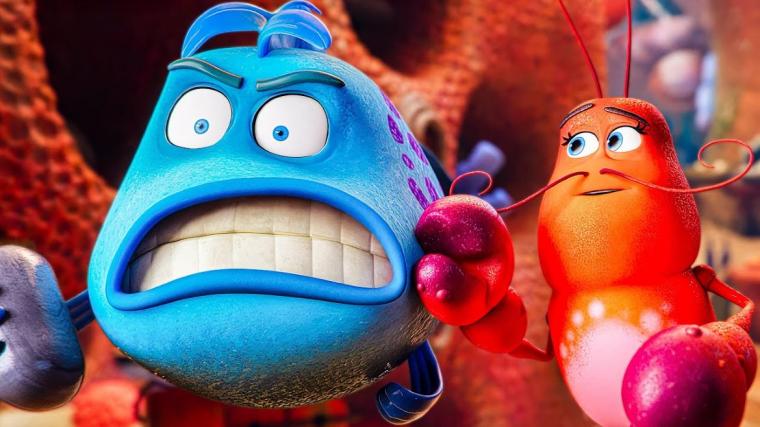
Overall, the animation is fine, the dialects add regional flavor, and Elise Allen's and Elie Choufany's screenplay does boast admirable verbal and visual gags of the SpongeBob SquarePants variety; I liked that oceanic beauty-parlor customers were reading copies of The New Orca and Cosmopollock. Yet while Mr. Fish's character turnaround was never in doubt, it would've been preferable if Offerman's crank didn't become a smiling do-gooder – with an extraordinarily on-point sentimental monologue – before this 90-minute trifle was even an hour old. After that, the movie seems to go out of its way to present peril where none really needed to exist, and the obligatory grade-school life lessons – including, but not limited to, Help Others, Be Optimistic, and, weirdly, Trust Strangers Every Once in a While – combine for a finale that any halfway-cognizant seven-year-old will likely see coming a mile away.
I've seen far worse animated comedies than this co-production by the U.S.'s Viva Pictures and Australia's Maslow Entertainment, many of them by Disney and/or Pixar. And even though beats following punchlines are often held a tad too long, implying that the film actually is taking place underwater, there's enough color and incident and earnestness to make it a painless sit. I still can't begrudge family audiences who take a half-second to consider The Pout-Pout Fish before instead choosing on a first, second, or third viewing of Hoppers or GOAT. I would've recruited my favorite movie-going companion to prevent me from seeing this one on my own, but I just couldn't bring myself to ask. Eleven-year-olds are way too sophisticated for such nonsense.