
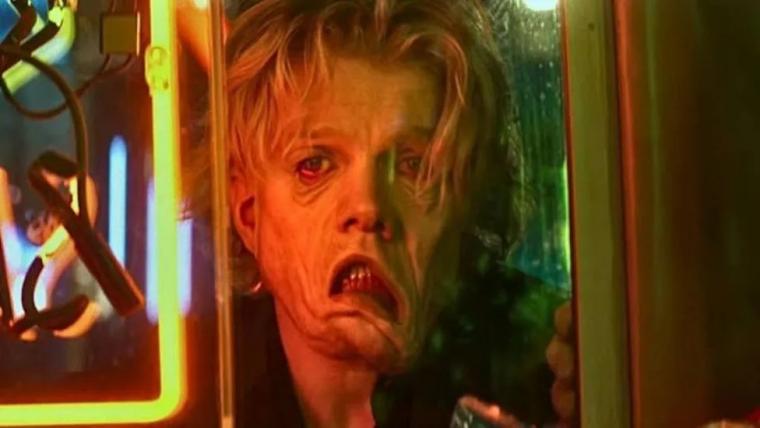
Tom Rhys Harries in Clayface
CLAYFACE
I had an unusual experience – not unusual-weird, just unusual in terms of not often happening – upon leaving my Sunday-afternoon screening of Clayface.
Exiting the auditorium around the same time as two fellow patrons, one assisting the other in a wheelchair, I did the barest minimum in helping prop open the door, for which they thanked me, and I said no problem. One of the pair asked, “Did you like the movie?” And honestly, it had been so long since a stranger sought my opinion mere seconds after a film ended that I was slightly taken aback. As directed by James Watkins and written by Mike Flanagan and Hossein Amini, this third outing under the recent DC Studios re-branding shepherded by James Gunn – a showcase for one of Batman's lesser yet more visually memorable villains – was too uneven to inspire an immediate “Absolutely!” or “Not so much” response. After a pause that probably lasted four seconds but felt interminable, I weakly offered, “I did like it … but didn't love it.” The woman who had asked the question simply smiled and said, “We liked it, too,” and we said our goodbyes.
That was the most instinctive movie review I've offered in ages, and for this particular film, maybe the only one truly necessary. (Not that I won't continue prattling on for a few hundred words more.) Clayface is a good time, if an undeniably vicious good time. To be sure, it's underwhelming in many ways traditional to its genre: the scope of our protagonist's powers is hazy; the laws of time and space are routinely violated; the comic-strip-balloon dialogue is frequently painful. (Though I did chuckle, albeit inappropriately, when a gangster's moll shrieked to her beau, “Call one of your mob doctors!”) Yet Watkins, Flanagan, and Amini don't dawdle, setting up their premise with admirable economy and keeping the plot progression zipping along nicely through a tight 105 minutes. And while this is hardly what we may have anticipated from Gunn's DC following 2025's Superman and this past summer's Supergirl, Clayface is oftentimes thrillingly gross, as well as pretty darned clever after our anti-hero discovers his remarkable (if kinda confounding) shape-shifting abilities. I may not have been wowed by the movie, but it's hardly a disappointment, and also a decent amount of fun.

Admittedly, I'll almost always be in the tank for entertainments whose crises are caused by hubris, particularly when it's an actor's hubris. Assuming an all-purpose-American accent with just a touch of Noo Yawk, Welsh performer Tom Rhys Harries plays Matt Hagen, an aspiring film star from one of Gotham City's less friendly boroughs. Despite living a life of luxury and being newly nominated for a Best Actor Oscar, Matt is doing his best to stay grounded with the help of his lifelong best bud Corey (Joshua James). Yet the perks and temptations of fame are enormous, and while in a Gotham dance club one night, Matt ignores Corey's warnings and actively flirts with Mia Torrez (Joana Ribeiro), girlfriend of local mobster Markos Szabo (David Dencik). Markos, unsurprisingly, doesn't take kindly to this, and after he and his goons confront Matt and Mia the following morning, they exact revenge on the pretty boy by thoroughly carving his face with knives – the horrifying sight of which we're not remotely spared. Having lost his ticket to movie stardom following an unsuccessful lawsuit, a carefully orchestrated smear campaign, and ineffective attempts at facial reconstruction, Matt spirals ever downward. Until, that is, he reads about a doctor, Naomi Ackie's Caitlyn Corr, who's practicing a radical form of nanoscience designed to regenerate damaged skin tissue. Might she, perhaps, be willing to help?
Of course she might, and for a while, the nano-treatments work; Matt gets his A-lister looks back. But our ancient-Greek pal hubris isn't done with Matt quite yet, and foolishly presuming he can rejoin elite society like nothing ever happened, a tense red-carpet encounter causes the actor's features to ever-so-slightly melt. (Clayface boasts a bunch of outstanding practical effects only mildly augmented by CGI, if at all.) Suffice it to say that in the manner of so many man-turns-to-monster tales, Matt subsequently shoots himself up with waaaay too much of Caitlyn's nano-serum, and a future Caped Crusader nemesis is born – one hell-bent on revenge against the gangsters who scarred him, miraculously able to self-heal and stretch his physique at will, and capable of perfectly replicating any human being he chooses.
I'm not certain how, precisely, Clayface is able to successfully replicate other people's clothes, unless it's actually – insert shudder here – Matt's nano-boosted skin extravagantly molded and colored to merely look like clothes. And I definitely needed more than an early example of Matt's thespian ease with a British accent to buy his flawless mimicking of other people's voices. (At least I presume the mimicry is a Matt talent rather than a superpower, given that when he disguises himself as women, he chooses not to speak at all.) All told, the “rules” regarding what Clayface can and can't do are awfully fuzzy, which is one of the few detriments to the movie's brisk run time; the audience is barely introduced to the extent of Matt's shape-shifting skills before he starts behaving like he was born with them. Still, it's a juicy, impressively sustainable conceit that serves as the full-body version of Tom Cruise's latex-mask gotchas in the Mission: Impossible series, and it gives a bunch of supporting actors – among them Joshua James, Will Coban, and Eddie Marsan – the chance to essentially play Matt Hagen themselves, frequently to comic effect. When infiltrating the mob disguised as Coban's bruiser Bones, Matt gobbles a handful of cashews before an aghast friend reminds Bones of the hood's nut allergy – a brief, rare display of second-act Matt unconvincingly winging it, and the type of funny “Oops!” moment you wish had been attempted more often.

Generally speaking, DC Studios' latest is stronger on a scene-by-scene basis than as a whole, particularly in terms of its awkward telegraphing. Upon his introduction, Matt is having such a hard time finding the right motivation behind a scripted “I love you” that you just know he's gonna nail the reading by the movie's end, Matt falling helplessly in love with Caitlyn providing the ideal opportunity. And a throwaway line involving the doctor's Gotham-detective fiancé (a sensational Max Minghella) misplacing his nose-hair trimmers is obviously there just so that, when Matt's eyelids become welded shut on a bumpy plane ride, no one watching has to ask, “What are those teeny-tiny scissors and why does Matt have them in his carry-on?” The movie is perhaps also too vague about how much empathy the guy deserves. You can hardly argue that Matt should've been repeatedly sliced open for one night of drunken adultery. Yet the script gives us so little idea of who he is from the start – A sweet kid who let fame go to his head? A schemer only play-acting the nice guy? – that it's hard to either mourn or applaud his metamorphosis. And then there's the more philosophical question behind his transformation to Clayface: Are the nanobots directly causing Matt's increasingly deranged activity, or his Matt himself becoming increasingly deranged and the 'bots are merely doing his unconscious bidding? Even by the finale, we don't really know our protagonist well enough to offer an educated guess.
Still, despite the film working only intermittently, it does work. For all of the gory prosthetic kicks – one shot makes the movie's resemblance to The Substance almost uncanny – the most enjoyably upsetting deaths are less visualized than suggested, as when Matt's fist rummages around a character's innards, or when another victim's head is pulled into Matt's stomach so that the guy's nose pokes out of Matt's back. (Truly a sight I never thought I'd see.) While Watkins' Gotham City isn't as distinctly grimy as the ones fashioned by Christopher Nolan and Matt Reeves or on HBO's The Penguin, cinematographer Rob Hardy does a fine job of establishing soul-sucking rot with flashes of neon. The performances, meanwhile, are solid across the board, with the tender, tentative Ackie continuing to imply that she's incapable of dullness, and Harries consistently engaging, and sometimes even moving, no matter how much he's slathered in facial goo. He also looks a lot like Heated Rivalry's Connor Storrie, which became unmistakable when one of Markos' henchmen took his knife and gave Matt a Joker smile – just like the one Storrie gave himself at the end of Joker: Folie à Deux. The moment was one of Clayface's few overt mistakes. Who the hell wants to be reminded of that movie?
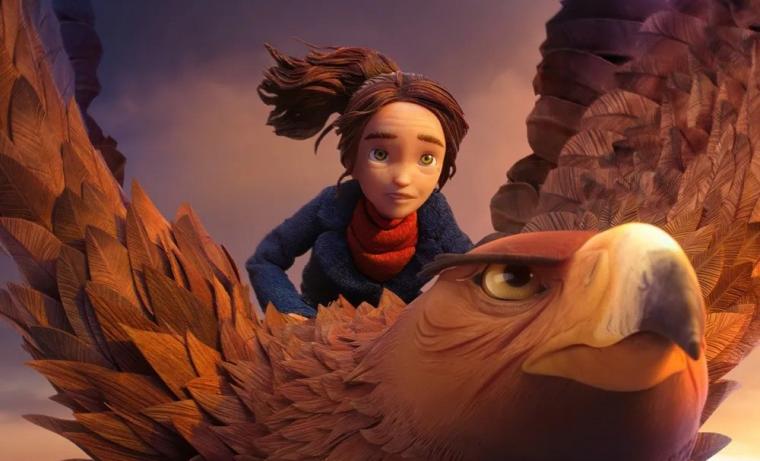
WILDWOOD
As the son of parents in their mid-80s, I know there are far more upsetting signs of aging. But as a 58-year-old who feels in moderately good health despite reflexively grunting every time I pick up something I dropped, I find that one of the most irritating aspects of growing older is my increasing impatience – nay, my anger – with what I perceive as a lack of on-screen civility. By which I mean my tendency, at the movies, to assume a holier-than-thou attitude of “You can't do that!” During the first five months of 2026, my ire was directed at the prolonged assault on women; barely two weeks seemed to pass in which one of our cineplex heroines didn't get the crap kicked out of her. And now I find myself distracted by the off-putting discomfort of Wildwood, even knowing full well that the movie's PG-13 rating might signify the targeted demographic being, you know, viewers over 13.
Directed by Travis Knight and adapted (from the Colin Meloy and Carson Ellis novel) by screenwriter Chris Butler, Laika's stop-motion-animated adventure about a teenage girl's magical quest is terrifically watchable, frequently exciting, and astoundingly well-crafted. I'm almost positive it'll win the Academy Award for Best Animated Feature, and you won't hear me complain if it does; the Portland-based studio's six features to date including Coraline, The Boxtrolls, Kubo & the Two Strings, Missing Link, and my beloved ParaNorman, Laika has deserved its day in the sun for ages. Yet this new release also brought many of my most noxious grumpy-old-man attitudes to the fore, and while I think the film has a few significant problems independent of my reaction, I'll cop to my lukewarm response being primarily personal. You know the breakup phrase “It's not you; it's me”? As of this writing, Wildwood is sitting with a 99-percent critical “freshness” rating on Rotten Tomatoes and a 97-percent audience score. I still left feeling conflicted and not entirely happy. But it's not the movie. It's me. I think.
With Wildwood lasting an astounding-for-animation two hours and 20 minutes, its heroine is 13-year-old Prue McKeel (voiced by Peyton Elizabeth Lee), the daughter of loving hippie parents (Jake Johnson and Maya Erskine) and big sister to infant Mac. For reasons initially unknown, Prue's folks demand that Mac be kept inside at all times, and when left for an afternoon of babysitting, Prue wastes no time in securing baby bro in a wagon and traveling throughout downtown Portland. There she runs into nerdy schoolmate Curtis (Jacob Tremblay), who is clearly harboring a serious crush. It's also there that, on a playground, an apparently malevolent murder of crows gathers on the jungle gym, à la Hitchcock's The Birds, before assaulting the McKeel youths and carrying the weeping Mac away in their talons. Prue and Curtis consequently give chase, and wind up at the entry to a wooded locale the kids had been forever forbidden to cross. In the hopes of retrieving Mac, cross they do, and subsequently encounter talking animals, warring factions, and a perverse dowager countess (Carey Mulligan) convinced that executing Max will result in the reincarnation of her own dead son.

Okay, so … . Wait. What?! This lady is gonna sacrifice a baby to the forces of dark magic in the hopes of some unholy Pet Sematary reunion? Jesus, that's grim. And it's certainly allowed to be. Ralph Bakshi's Fritz the Cat, after all, debuted almost 55 years ago, and between that and Heavy Traffic and the 1978 Lord of the Rings and Watership Down and South Park and Family Guy and Big Mouth and et cetera et cetera and so forth, we've long known that animation isn't just for the tykes. But I do blanch a bit when, like Wildwood, the entertainment in question appears actively aimed toward the tykes, as the previews for Laika's latest unmistakably seemed to be. They showcased chatty critters and a spunky teen lead and rousing adventure for the whole family.
Here, however, is what those trailers don't advertise. A mournful prelude in which a prepubescent boy, in the nude, commits suicide by throwing himself off a high balcony. (The child turns out to be mechanical, but still … .) A coyote practically torn to pieces by after muttering that his boss is a “son of a bitch.” A gargantuan golden eagle bloodily shot in the heart at the moment of her greatest heroism. A climactic battle royale suggesting both the final installment of Peter Jackson's Lord of the Rings trilogy and, more gruesomely, Mel Gibson's Braveheart, complete with hundreds of fatalities and unmistakably lopped-off heads. And through it all, a child, likely not even a year old, consistently screaming and sobbing in traumatized terror. Hey, a large part of me says “Fun!” to all of this. It was decidedly less fun in the moment, considering that the tenor of the film's previews was far more The Wild Robot than Ridley Scott's Napoleon.
Yet the fact that the advertising team, in three-minute form, could make this Laika even mildly resemble that Dreamworks hit hints at how tonally all-over-the-map Wildwood is. Legitimately trenchant insight into growing up and finding yourself sits beside corny jokes and obvious punchlines. Awkwafina's and Charlie Day's (admittedly enjoyable) gag-filled readings fight for prominence against Mulligan's tortured melancholy and Angela Bassett's imperiousness. Some of the violence – and some of it, I thought, decidedly R-rated – is played for anguish and some of it for slapstick giggles. Baby Mac is in true emotional turmoil throughout … unless a scene requires that the infant suddenly find his surroundings and captors adorable. I practically had whiplash trying to determine what Wildwood made me want to feel and why. And despite the movie's considerable stop-motion artistry and estimable vocal cast (previously unmentioned participants including Mahershala Ali, Tom Waits, Richard E. Grant, Rob Delaney, Jemaine Clement, Len Cariou, Amandla Stenberg, and the peerless Blythe Danner), I was frankly relieved when this frequent visual and verbal astonishment ended. There's a fine line between overpowering and draining, and for me, Laika's latest crossed it.

WICKER
Just how good is Olivia Colman? So good that, in writer/directors Alex Huston Fischer's and Eleanor Wilson's delightfully biting comedy Wicker, she's not only convincing as someone who finds orgasmic joy and domestic fulfillment with an ambulatory tree, but someone who's wholly deserving of being that walking fire hazard's sole object of affection. From the debut of this period comedy's first trailers to this past weekend, which found a friend texting to ask about the threat of splinters, the overriding question behind the film's whole “Olivia Colman f---s a woven dude” scenario has been based on practical matters. I'm happy to report that practicality, here, is of no interest to Fischer and Wilson. So to answer the lingering query: No, there are no reports of splinters. (Though mold does need to be tended to.) In truth, just about everyone on-screen starts fantasizing about a wicker companion of their own, as this hand-crafted companion isn't merely magical; he's aspirational. That the literalized stick figure is portrayed by Alexander Skarsgärd is, I'm sure, completely coincidental.
Adapted from Ursula Wills' “The Wicker Husband” and yet another argument for more big-screen renditions of short stories (see also Rear Window, Arrival, Brokeback Mountain, Drive My Car …), Wicker is set in an unspecified, vaguely medieval English hamlet in which everyone is known solely by their profession or, if they're female, their relation to that profession. We meet, for instance, the Baker (Ben Ashenden) and the Bottlewasher (Gustav Lindh), as well as the Tailor's Wife (the phenomenal Elizabeth Debicki) and the Tailor's Wife's Sister (Marli Siu). And then there's the Fisherwoman (Colman), whom the town's other residents disdain for her fishy aroma, coarseness, and apparently absolute disinterest in landing a husband. After a wedding game cites her as the next local to marry, causing the townsfolk to erupt in incredulous mockery, the Fisherwoman essentially says “F--- this,” and knocks on the door of the Basket Weaver (Peter Dinklage), requesting that he make her a husband. The intrigued man gives the matter all of three seconds' thought before replying “Be at the church in a month,” at which point he'll have a groom for the proudly uncouth yet miserably lonely Fisherwoman to stand beside.
Can I take a moment to express just how beautiful Dinklage is in this role? He's not on-screen much – or rather, not as much as you might want. But in his two scenes as the Basket Weaver contemplates making living, breathing people out of pliable fiber (and yes, Skarsgärd's eventual Wicker Husband won't be the only wood-based being around), Fischer and Wilson give Dinklage a pair of stunning, searching, sweetly hilarious soliloquies that take full advantage of the actor's long stage history as an acclaimed Shakespeare interpreter. There's no question as to the Basket Weaver's ability to pull off the impossible; both he and we take that skill for granted. But as he contemplates the morality and ramifications of giving life to the inanimate, Dinklage's wistful questioning and planning are both grounded and riotously nuts, much like Wicker itself. In truth and in retrospect, I was half-sad that the actor didn't break the fourth wall completely and deliver these wondrously elocuted asides to us directly. Given the proceedings, it wouldn't have been out of line.
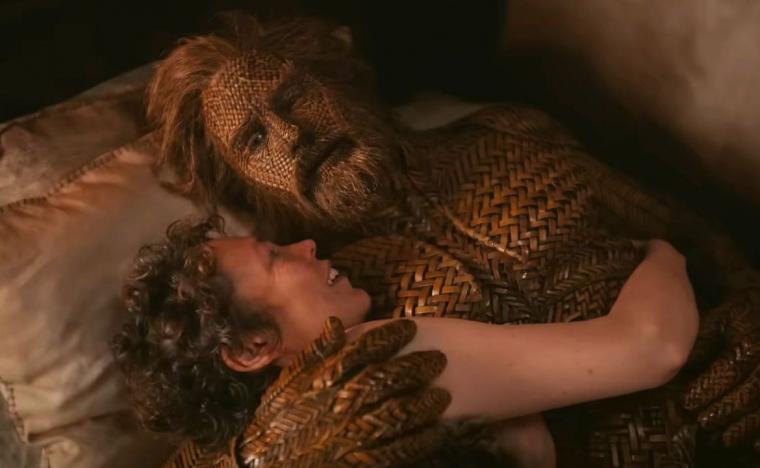
In any event, after knocking on neighbors' doors and bashfully requesting a suit and pair of shoes, the Wicker Husband does indeed show up at the church on time, and for a long time afterward, the Fisherwoman is in utter bliss. Partly it's because she has snared a spouse who is, and I mean this literally, constantly wood-ready. (The creaky sound effects as Skarsgärd moves his wicker joints are a fabulous running gag, one that reaches its apex when Wicker Husband achieves his first off-screen erection.) But it's mostly because the faux man is sincerely nice to her. More than that, he's deeply in love with her, and is fully satisfied knowing that he exists only to make the Fisherwoman happy, whether by fixing her leaky roof or mending the bed that their nighttime activities routinely demolish. The female citizenry, needless to say, is beyond jealous. The male citizenry, equally needless to say, is beyond pissed.
You might think it too soon, after this past winter's Pillion, for Skarsgärd to again be playing a remote romantic fetish object. Amazingly, however, very little actually connects his leather-clad biker to his wicker spouse, the miraculous costume and makeup design credited to Tóth András Dániel and Attila Godena-Juhász. In Pillion, Skarsgärd's Ray was intentionally unrevealing. Because he doesn't need to, Wicker Husband doesn't hide a thing, and is so sincere in his selfless devotion to the Fisherwoman that simply asking “Do you love your wife?” to one of the hamlet's incensed men is enough to make the burly brute sob in recognition of his failings. Soft-spoken and unfailingly kind, his eyes radiating nothing but unconditional love, Skarsgärd shares heartbreakingly honest, divinely horny chemistry with Colman, whose Fisherwoman melts in his presence right up until nefarious forces, led by the Tailor's Wife, begin sowing seeds of distrust. From that point on, as an audience, we become acutely aware of Wicker Husband's reference to himself as “quite flammable,” and wonder under whose hands a possible conflagration may occur.
Because of how endearing Skarsgärd is and how much we come to adore Wicker Husband, I almost wished that Fischer's and Wilson's adaptation didn't come laced with quite so much dread. It's hard to properly enjoy a romance, even one as twisted as Wicker's, when you spend most of the movie waiting for the other shoe to drop. Yet the filmmakers (and, I'm assuming, original author Wills) are blessedly ahead of us. While they don't shy away from the material's more unpleasant scenarios, they also don't seem interested in making us suffer, at least not for long. The movie opens on a note of anything-can-happen wonder and retains it by the finale, and along the way we're treated to giddy sauciness, comic intrigue, reams of quotable dialogue, a riotously dangerous wedding-reception game involving a strategically placed carrot, and a deliriously blotto cameo by Richard E. Grant. Plus, of course, the magical pairing of Olivia Colman and Alexander Skarsgärd. A match made in incendiary Heaven.

A TALENT FOR MURDER
Author Patricia Highsmith's most famous literary creation, sociopathic schemer extraordinaire Tom Ripley, has been personified by a number of actors over the decades, among them Matt Damon in The Talented Mr. Ripley, John Malkovich in Ripley's Game, and Andrew Scott in Netflix's limited series Ripley. (Damon, Malkovich, and Scott, by the way, are likely the three top candidates for Best Actor recognition at next year's Oscars, for The Odyssey, Wild Horse Nine, and Elsinore, respectively – a confluence of circumstance and fate worthy of Highsmith herself.) Into that esteemed company we now need to add the name of Alden Ehrenreich, who, in director Anton Corbijn's A Talent for Murder, plays Tom Ripley in a hypothetical sequel for the anti-hero, as well as the unassuming book editor, Edward Ridgeway, wanting to make that literary fantasy a reality. In either case, Ehrenreich's twinned figures may have met their match, because even a grifter as malevolent as Tom and a grind as persistent as Edward never before faced the force of nature that is Dame Helen Mirren.
In screenwriter Joanna Murray-Smith's adaptation of her 2014 play Switzerland, Mirren is cast as Highsmith, and her introductory shot finds the woman sitting in the shadows and looking so dowdy, pinched, and angry – so un-Dame-like – that the talkative elder gentleman sitting a few rows away stage-whispered to his companion, “That's not Helen Mirren … I don't know who it is, but it's not Helen Mirren.” (Oh but it is, and she's glorious.) The year is 1995, and Ehrenreich's Edward Ridgeway is traveling by train to Highsmith's Swiss estate in order to convince the reclusive author to pen a sixth, potentially final Tom Ripley novel. As Edward tells his new train acquaintance Clementine Balfour (Olivia Cooke), the pitch won't be an easy one, given that Highsmith is notoriously cranky, particularly in regard to publishing houses, and the last editor sent to woo her promptly and mysteriously vanished. When he finally arrives at chez Highsmith, though, Edward doesn't find the writer cranky. He finds her awful – rude, drunk, profane, racist, and determined to send her visitor immediately back to New York. Yet Edward remains undeterred, and reveals just enough about his unhappy past as an orphan to lift Highsmith's eyebrow. Could this sweet-faced kid be the key to crafting her grandest Ripley yet?

What follows in A Talent for Murder is a three-tiered saga in which (a) Highsmith and Edward warily circle one another while considering the possibly of Ripley's return; (b) Edward fortuitously reunites with Clementine, who's in line for a vast family fortune; and (c) a blend of Highsmith's fiction and Edward's real-life experiences casts Edward as Tom Ripley, and Clementine as his latest planned conquest, in a proposed thriller about a young woman in line for a vast family fortune. This may sound confusing. It plays as absolutely comprehensible and intensely inspired. With Highsmith narrating the action, we watch while Edward-as-Tom sets his slithery gaze on Clementine, determining precisely how to seduce the young woman and make her his wife, and precisely who he needs to kill, and how, to inherit her bounty. Murray-Smith's is a ripping-good potboiler plot that one might imagine would make the late Highsmith proud. (Though chances are about 100 percent it wouldn't.) It gets incrementally juicier, however, when Highsmith's musings and Edward's collaboration seemingly lights a bulb over the editor's head, leading him to wonder just how much Tom Ripley he might be able to get away with himself.
In purely cinematic terms, nothing about Corbijn's perfectly presentable feature is extraordinary. Robbie Ryan's cinematography is fine, composer Dickon Hinchliffe's score is fine, Andrew Hulme's editing choices are fine; there's nothing in this cozy chamber thriller to rock anyone's boat. I still devoured it with both hands, reminded as I was by the simple pleasures of a really good story really well told. A more expansive supporting cast would've been welcome, and there are a few narrative strings that get strangely sidelined. I'm reasonably sure, for instance, that the question of the first visiting editor's odd disappearance is never resolved, though I'd have to give the movie another look to be sure. But once it starts streaming, I will more than happily give A Talent for Murder another look – for its enticingly gripping tale; for Ehrenreich's thrillingly distinct and cagey portrayal(s); for Cooke's gorgeously naturalistic ingenuousness; and for Mirren, as blunt, funny, threatening, and tragic as she's been in a decade or more. This may not be a five-course meal, but it's exquisite cineplex comfort food. Try to eat around the arsenic.