
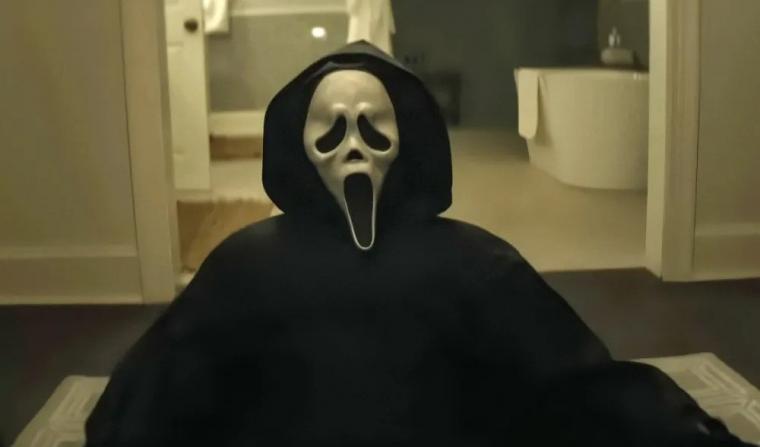
????? in Scream VII
SCREAM 7
As a slasher flick with comedic leanings, director/co-writer Kevin Williamson's Scream 7 is pretty weak. As a half-dozenth sequel so steeped in callbacks and meta-commentary that nostalgia is practically its plot, it's exhausting. And as a statement on big-studio moviegoing practices and habits with a quarter of the 21st century behind us, it's depressing as hell, because this preposterous, frequently insulting continuation – easily the series' low point – also netted the Scream franchise its highest opening-weekend grosses to date. A $64 million haul for these stale goods is hardly impetus for Paramount to try anything novel the next time around; the inevitable Scream VIII might just as well be the entirety of 7 with an updated number and marketing pitch. Would audiences notice? Or care?
Following tradition, this Scream's finest scene is its prelude, and I suppose Williamson and co-scribe Gary Busick deserve credit for at least being up-front about their minimal ambitions: This latest installment will clearly be a feature-length trip down Memory Lane. With the Woodsboro, California house of the first film's murders now doubling as an Airbnb – one that boasts tasteless crime-scene outlines of where teens were murdered – the opener finds vacationing couple Scott and Madison (Jimmy Tatro and Michelle Randolph) wandering this tourist trap while essentially recounting the Scream narrative in full. Scott, a major fan of the movie-within-the-movie Stab series (let's not even go there …), name-checks Stu Macher and Billy Loomis, and acknowledges the closet that Sidney Prescott hid in, and before long, naturally, there's a phone call. “Do you like scary movies?” asks the electronically augmented voice. And we're off to the races. Because this was Scream 7's only truly enjoyable sequence, despite it being more unpleasant than necessary, I won't spoil the particulars. Suffice it to say that a new Ghostface shows up and causes his/her usual mayhem, and the prelude ends with the Macher home awash in flames – a sight that I mistakenly thought was signaling a fresh start. But what do Williamson and Busick do after symbolically burning this long-in-the-tooth franchise to the ground? They rebuild it to look exactly like the original.
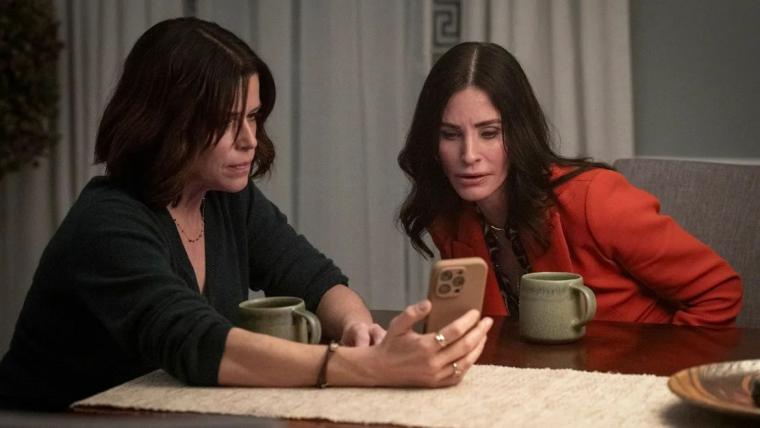
Series heroine Sidney (Neve Campbell, who has appeared in all the Screams expect for VI) is now living in Pine Grove, Indiana – a town she evidently chose, for reasons passing understanding, for its uncanny likeness to Woodsboro. (It, too, is a tree-lined, retro-suburban sprawl with one Main Street, plus one single-screen movie theater showing, of course, The Texas Chain Saw Massacre.) Sidney now has a husband (Joel McHale) and a teen daughter (Isabel May's Tatum), as well as two grade-school tykes who are blessedly spending the weekend at grandma's. Tatum, in turn, has a bunch of pals assuredly meant to invoke original-Scream victims and killers, though the interchangeably bland kids here don't possess half of their predecessors' personality. We're just getting through all this “Haven't we been here before?” familiarity when Sidney's phone rings, and still not having learned to never pick up for unidentified callers, she answers. It's Ghostface. This time, however, the loon in the Munch mask requests a video call, and reveals himself to be a 30-years-later version of Stu Macher, now heavily scarred yet obviously still crazy. I should mention that it's maybe Stu Macher, as a chief plot point involves AI deep-fakery being potentially responsible for this unlikely resurrection. One way or another, though, it's definitely Matthew Lillard at his most enthusiastically feral, and for a few seconds, Scream 7 crackles with the possibility that anything-goes madness will ensue.
It doesn't. What ensues instead is everything this series has conditioned us to expect. Another early round of gory Ghostface executions. Another sequence in which, reiterating the “rules” of horror movies for the umpteenth time, the remaining teens detail how any one of them could be Ghostface. Another late-in-the-game return for Courtney Cox's relentless F-bomb dropper Gale Weathers, who, after careers as an author and talk-show host, is somehow still a network-TV field reporter eager for the limelight. More vaguely weird adults who show up briefly to add to the suspect count. (A couple of them are played by recognizable actors, which generally means you should suspect them first.) More callbacks and re-introductions to previously established figures. More scenes of Sidney and, this time, her daughter barely escaping Ghostface's knife, almost always in badly under-lit rooms that make the action as murky as the cinematography.
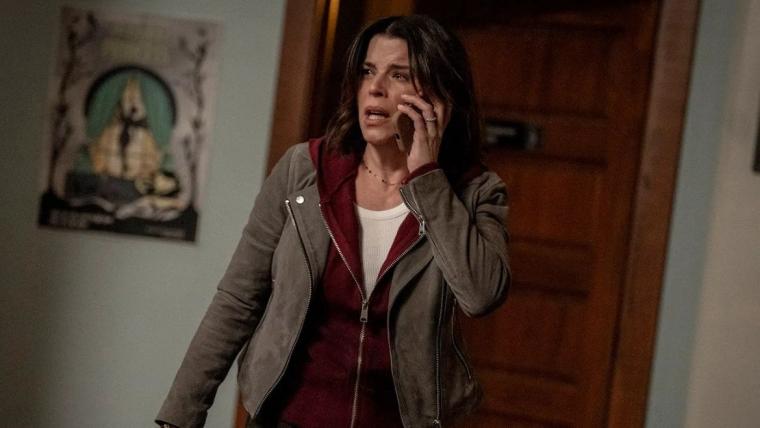
And so much self-referencing in this thing! I honestly lost track of the number of times we were reminded that Sidney – meaning Neve Campbell – chose to sit out 2023's Scream VI, and as that was one of the series' more effective and atypical entries, it felt a little cruel when Gale made a not-subtle-enough inside-baseball dig at its quality. There are also cracks about Campbell being a bit too, shall we say, mature for Last Gal Standing status, and distracting fan-service cameos that will only mean anything to Scream acolytes, and out-of-character retorts that merely show that the actors know that we know this is a sixth sequel, so there's no point in taking any of it seriously. I've rarely seen this kind of “Who cares?” demonstrated as nakedly as when Gale first arrives in a moment of astounding contrivance, and none of the onlookers, nor Gale herself, appear suitably surprised by the impossibly timed event. The movie needed to get Gale there, and she got there, and the lunatic manner in which she did is of no consequence. Move along, folks. Nothing to see here.
Scream VII really outdoes itself, though, with the unmasking of its killers. (Let's not continue the teasing charade of whether there's one or more than one Ghostface. As the movie keeps reminding us, there's always more than one.) Obviously, I won't spoil the finale. Yet I will say that for a series so dedicated to its Scooby-Doo reveals, the identities and motivations offered here reach a new apex of eye-rolling ridiculousness; for all the sense they make, the murderers could've just as well been the folks who served you your popcorn and soda before you entered the auditorium. With $64 million domestic already in the bank, the Scream franchise clearly isn't gonna end any time soon, even if this indifferently acted, largely unfunny, rarely scary offering does suggest a kind of death knell. Williamson's film is making a killing. Too bad that what it's most aggressively killing is time.
PILLION
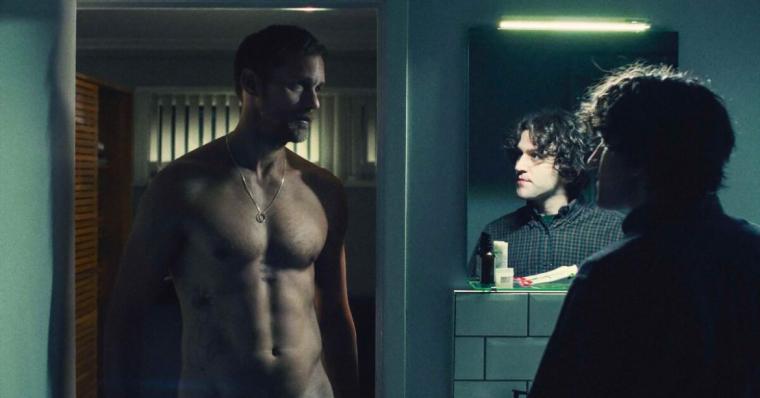
Written and directed, in a remarkably confident big-screen debut, by Harry Lighton, Pillion is undoubtedly the sweetest movie you'll ever see in which the protagonist is made to wear a chain-link collar with a padlock and the only key is held by his gay biker boyfriend. That “boyfriend” mention, though, should probably come with quote marks, because you're never entirely sure that timid, unexceptional Colin (Harry Melling) and the unreasonably handsome Ray (Alexander Skarsgård) are “boyfriends” of any kind. What they're engaged in, to both men's initial satisfaction, is a BDSM relationship in which Ray gives the orders and Colin readily accepts them, and this frank, funny, unexpectedly tenderhearted film is wonderfully non-judgmental about what both partners get from the experience.
A British introvert who has only recently come out as gay, his outsider status signaled by his job as a loathed parking-enforcement officer and his joy at singing with a barbershop quartet, Colin's first scene finds him set up on a blind date arranged by his cancer-afflicted mom (the sublime Lesley Sharp). The guy at the bar who really captures Colin's interest, however, is Ray, whose chiseled features and intimidating stare instantly mark him as a capitalized Unobtainable. Astonishingly, however, Ray hands Colin a napkin with his phone number written on it, and the men eventually meet in a nearby shopping district, and if Ray's neck-to-toe black-leather ensemble weren't enough of a giveaway, Colin quickly learns – in a back alley not quite far-enough away from passersby – that the biker puts the “Dominant” in BDSM. Pillion consequently explores the initial rush and delight that Colin takes after Ray invites him into his apartment, and where he'll stay so long as he cooks, cleans, sleeps at the foot of the bed, and caters to Ray's every servile and sexual whim. It also (and this is what makes Lighton's movie so endearing) explores Colin's growing sense that, as in love Ray as he is, he might be deserving of more … or maybe more of the same, just nicer.
Fans of the Harry Potter movies likely adore Melling for playing Dudley Dursley. I adore Melling for playing the gifted orator Harrison in the Coen brothers' The Ballad of Buster Scruggs segment “Meal Ticket” – the armless and legless young man who proved more of a nuisance to Liam Neeson than a chicken who could do arithmetic. For more than half of Pillion's 107 minutes, Colin is much like Harrison: grateful for the scraps of attention he gets for doing the thing he loves. (Or, in Colin's case, being done by the thing he loves.) Yet Lighton, adapting Adam Mars-Jones' 2020 novel Box Hill, doesn't view Colin as pathetic, or suffocatingly needy, or potentially insane. He's a romantic, if an intensely specific type of romantic, and despite a few admittedly rough sexual encounters in this unrated film, there's little to suggest that Ray is cruelly mistreating Colin. (Truth be told, Ray is at his meanest when saying that Colin's cooking skills are wanting except for his ability to almost make a proper omelet.) Colin isn't merely happy in his subordinate position(s). He's ecstatic. He worships Ray, in some cases nearly literally, and feels genuinely fulfilled in his role in their relationship. Until he doesn't, at which point the unassuming light comedy morphs into something more trenchant and painful, and Melling's beautiful comedic performance transforms into a portrayal so soul-baring that it stings.
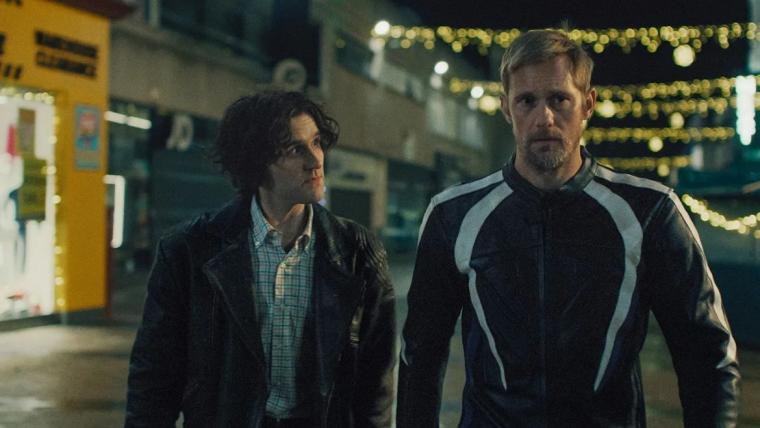
Marvelous as Melling is, though, I'm not sure the film would work without Alexander Skarsgård, who's absurdly well-cast. He's almost like fan fiction: Who would you most want to see play a hot, gay, leather-clad biker for nearly two hours? Yet like Ray himself, Skarsgård transcends the stereotype. Ray comes with no end of question marks attached, and we aren't given answers to any of the questions. What's his backstory? What does he do for a living? Why are the names of three women tattooed on his chest? Yet Skarsgård also makes this inscrutable, borderline-bullying man smart and kind (in his way) and completely collected about who he is and what he wants. Pillion's most agonizing scene finds Ray grudgingly agreeing to a meal with Colin and his parents. (The sensational Douglas Hodge plays Colin's dad.) And although the event goes south the way you imagine it will, Ray is unruffled by the confusion and anger of Colin's mom, who's certain that this gorgeous mystery man is abusing her boy. Very quietly and assuredly, Ray counters that her views are examples of backward thinking. Yet somehow, miraculously, you don't hate Ray for his confrontation with the dying woman. He's someone who fully, unconditionally accepts himself, and Skarsgård's supremely clever, layered performance is particularly affecting in the later scenes, when Ray makes the mistake of honestly dropping his guard. The scene in which he employs a wrestling move to roll on his back and lift Melling into the air, meanwhile, should be immediately preserved in the Library of Congress.
Obviously, Pillion's subject matter won't make it a movie for everyone. (What a tired, pointless cliché that is – how many legitimately great movies are made for everyone?) But I was knocked out by its candor and humanity and pair of exquisitely matched leads, and applaud the schedulers at Davenport venue The Last Picture House for booking this niche offering that, incredibly, might just tickle traditional rom-com fans, too. When Collin can't hide his massive grin after showing Ray's photo to a co-worker, or when Ray treats Colin to a “day off” in which their BDSM takes a momentary break, you're no longer watching an acclaimed British indie with a sadomasochist bent. You're watching When Harry Met freaking Sally.
EPIC: ELVIS PRESLEY IN CONCERT
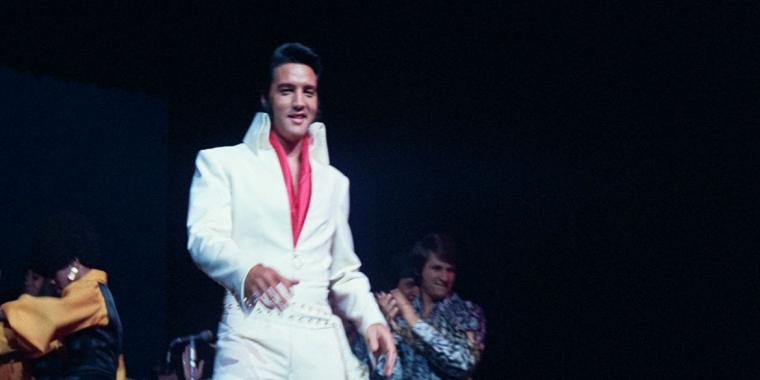
As much as I enjoyed director Baz Luhrmann's EPiC: Elvis Presley in Concert (“EPiC” being an acronym for its subtitle, which slow-witted me didn't get until the opening credits), and I very much did enjoy it, I can't say the experience was more interesting than the means by which the documentary was created.
While conducting archival research for his 2022 bio-musical on The King, Luhrmann learned that there was a treasure trove of previously unseen and unheard footage: some 69 boxes of 35- and 16-millimeter film that its owners at Warner Bros. were preserving in an underground salt mine in Kansas. (True story, and according to Luhrmann's interview in the New York Times, it cost $100,000 simply for someone to be sent down looking for the footage.) What Luhrmann and his team found were reams of concert and behind-the-scenes Presley magic, but also a considerable obstacle. Considering that the films' visuals and sound were recorded and archived separately, they had to be manually synced together – after, that is, the dedicated restoration artists figured out which pictures went with which sounds. There's more to the story than that, and I hardly know where to begin in imagining such an arduous, time-consuming chore. But at the end of the day, the work led to EPiC, and the results seems absolutely worth the effort.
What can I say? This thing is glorious. For starters, it's narrated by Elvis himself, Luhrmann having landed on a previously unreleased, 45-minute interview in which the legend is willing to tell his side of the story. He sounds genial and relaxed – the movie doesn't cover any of Presley's life or performances post-1970 – and what most comes across in the doc footage is how playful its subject is. Beyond the remarkable musicianship on display, there's no end of goofing-off moments in EPiC, both in rehearsal and his Las Vegas concerts. In one of the latter segments, we watch as Elvis cheekily hits on one of his background singers mid-song, then turns away before delivering a sprightly jump scare at the woman, who practically falls over in surprise and glee. Presley laughs so much in this doc's footage that, in weird instances of incongruity, I legitimately got teary-eyed reflecting on how this bright a star flamed out so unnecessarily quickly.
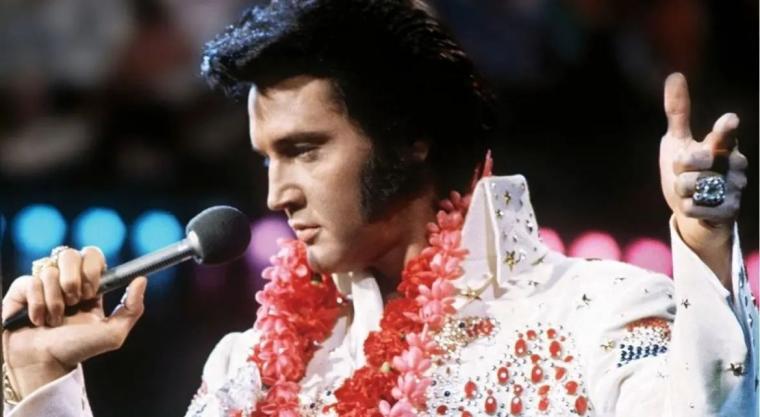
Baz being Baz, you could never mistake his documentary for being the work of any other director. There are loads of brash editing choices and tricky echo effects on the soundtrack, as well as more than a hint of Luhrmann's traditional “yeah we get it” humor, such as the montage of Colonel Tom Parker footage that's accompanied by “Devil in Disguise.” But good God is this movie fun. There are well-assembled segments devoted to Elvis' early TV spots and military tenure, plus an especially delightful passage documenting how many women he kissed in his myriad movies, as well as how many times he was filmed driving cars against cheesy green-screen backgrounds. (In his narration, Presley is particularly insightful about his disappointment with the trajectory of his film career … and as viewers of those films know, for understandable reason.)
It's in the concert scenes, though, that true transcendence is found. Whether he's covering the Beatles and Simon & Garfunkel, or doing beautiful justice to any number of Leiber & Stoller hits, or absolutely effing slaying a Vegas rendition of “Suspicious Minds” (which was also Austin Butler's performance highlight in 2022's Elvis), the artist reminds you that he was legendary for good reason – a miraculous, dyed-in-the-wool entertainer who brought previously unimaginable happiness to admirers worldwide. The most moving moments in EPiC: Elvis Presley in Concert actually aren't shots of The King at all. They're shots of his fans, most (but not exclusively) female and well past teendom, so shaking with excitement at seeing, meeting, or – OMG!!! – kissing their idol that they quite literally can't control themselves. These women weep, Elvis sweats, and tickets to Luhrmann's latest should almost come with an accompanying hand towel. It's a truly grand spectacle, and at 97 minutes, surely one of the director's most succinct projects to date. Thank you, Baz. Thankyouverymuch.