
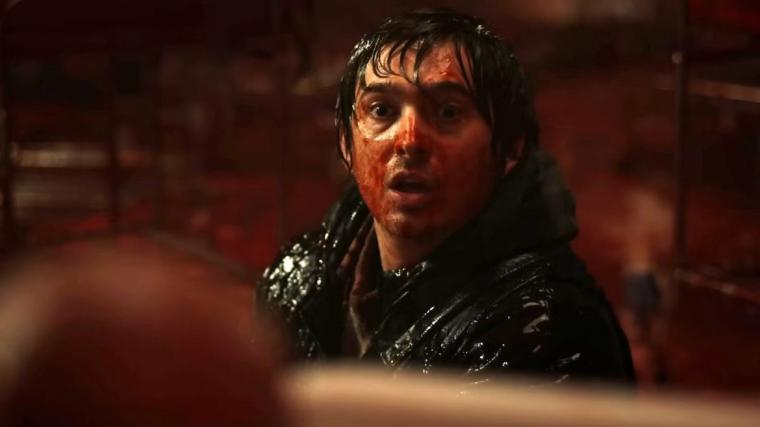
Austin Abrams in Resident Evil
RESIDENT EVIL
More often than not, characters in horror movies behave as though they've never before seen a horror movie; that's why it's so easy to laugh at these people. In Zach Cregger's take on Resident Evil, our hero Bryan has obviously watched plenty of fright flicks. Not only that, but he has definitely played plenty of scary video games – and his familiarity with the medium, combined with his general inability to properly employ that familiarity, makes Bryan even funnier than his genre-ignorant brethren. For every example of a hasty action succeeding, as when he dispatches a horde of mutants with a triumphant “Yeah!Video games!!!”, we're given four or five in which Bryan, hilariously, can't get his act together despite knowing precisely what to do. Failing to shoot a door open despite standing five feet away from it, Bryan morosely mumbles, “I suck at guns.” That made me laugh out loud, and largely in empathy. When playing games that require shooting, I've said the exact same thing.
As performed with winning sweetness and spectacular comic timing by Austin Abrams (the not-completely-zonked druggie of Cregger's Weapons), Bryan is a 20-something medical courier who, at the film's start, agrees to transport what he thinks is a human organ to a hospital in neighboring Raccoon City. We perceive immediately that he accepts the challenge of driving at night through unfamiliar terrain during a snowstorm because it's conceivably less hazardous, at least emotionally, than returning home to his girlfriend Michelle, who has recently revealed that she's pregnant. Though he tries his best to be supportive, their phone conversation strongly implies that man-child Bryan wants nothing to do with such grown-up responsibility. But Bryan's dilemma is about to get knottier. En route to Raccoon City, skidding along a snow-covered road, he accidentally hits a woman who seems to have beelined directly from the woods to Bryan's front bumper. Stricken and scared shitless, but clearly a decent guy, Bryan gets out of the car and follows a blood trail to the woman, who's amazingly still alive. Or, you know, is she? This is, after all, a Resident Evil, whether Bryan realizes it or not. Eventually, he just might.
In quick order, Bryan gets the woman, who's clad only in a house dress (no shoes), into his car; gets stopped by the county sheriff for swerving on the road; follows the sheriff and the woman toward the Raccoon City hospital; faces two corpses, one of them still ambulatory, after yet another car accident; and walks, dazed and confused, with courier package in tow, toward a lit farmhouse in the distance. We're roughly 20 minutes into Cregger's 90-minute movie at this point, and this is when the film's title finally appears on-screen, the blocky, blood-red lettering gradually disintegrating into unrecognizable goo. It's an apt visual given what will transpire over the next hour-plus.
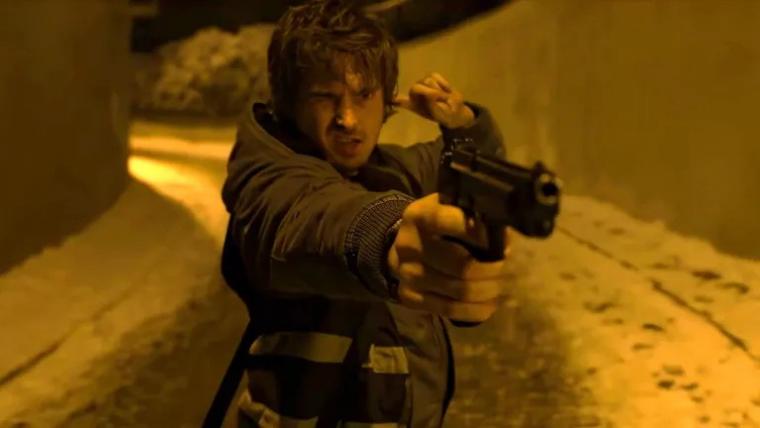
This Resident Evil is, of course, inspired by the wildly popular video-game series that itself inspired no fewer than seven feature films, most of which starred Milla Jovovich as fearsome zombie killer Alice. Abrams' Bryan, in a massive understatement, is nowhere near as bad-ass. He's barely able to load a firearm, let alone hold one without the thing accidentally discharging, and when he shrieks at whatever new monstrosity attacks him, it's most assuredly a shriek. I honestly didn't know an adult male voice could reach such ear-piecing decibels. (Like Abrams' overall portrayal, his screams are hysterical.) In Bryan's defense, though, Alice only had to confront zombified humans and the occasional zombified dog. The pooch poor Bryan encounters doesn't just snarl and bite – its face violently splits open as squishy tentacles shoot out. In such a situation, try not shrieking.
Although Cregger's and co-screenwriter Shay Hatten's Resident Evil is “adapted” from the video games, not much appears to connect the film to that franchise beyond the basic escape/kill-the-undead premise, Raccoon City, and occasional mentions of the sinister Umbrella Corporation that unleashed the series' mutating virus. Its direct influences lean more toward John Carpenter's The Thing and body horror such as David Cronenberg's The Fly, with an added, healthy dose of the Alien flicks. (One of the creatures vomits acidic puke just like Sigourney Weaver's xenomorph.) What's extraordinary about Cregger's achievement, though, is how thoroughly the experience of watching it feels like playing a video game.
Blessedly, I don't mean this in the manner of, say, Hardcore Harry, where the motion-sickness-inducing, first-person-shooter perspective is enough to make you lose your lunch. There's also only the barest minimum of shaky, handheld camerawork, which was starting to seem like a prerequisite for this genre. Dariusz Wolski's cinematography is instead sleek and elegant, his camera, like the movement of video-game avatars, gently gliding from location to location – and, imperatively, around corners to see what new threats await. Wolski won't receive the praise he deserves for Resident Evil. But for all of the film's inherent ugliness, its cinematography is gorgeous, particularly the nighttime shots illuminated only by vibrant red tail lights and headlights on snow. It's like B-movie Caravaggio.
Cregger and Wolski also do a sensational job of establishing geography. A character-based video game, naturally, allows you to back up and retrace your steps, and oftentimes enables you to see how far you have to travel to reach your next designated adventure point. Here, the compositions routinely indicate the precise distances Bryan has covered and how much driving or, more frequently, walking lies ahead. Beginning with the stunning shot of Bryan staring at the farmhouse while an overturned car lays hundreds of yards behind him and another kaput car lays hundreds of yards behind that, we always know where we are in regard to the unfolding apocalypse, and the specificity has the effect of being daunting, overwhelming, and very, very funny. A slow pan up the exterior of a Raccoon City skyscraper unmistakably tells us, and tells Bryan, just how high in the air 28 stories actually is … and makes us empathize when, after being vehemently told not to, our hero ends his stair-walking trek on the fourth floor and opts for the elevator. (This proves to be a colossally bad idea, but hey, I get it.)

Those who play video games more often than I do – by which I mean more than once a year – will no doubt roar harder than I did at the fantastically witty collection of emerging motifs. The subtle highlighting of a room's weapons and sources of character “fuel.” (Bravo to Cregger for the refrigerator jump cut.) The succession of bigger and more impenetrable padlocks that hapless Bryan has to blast open, his attempts cleverly augmented by composers Hays and Ryan Holladay inserting literal drum rolls into their score. The assignment that proves so dangerous and so stupid – this one involving the procurement of a set of keys – that it's consequently, wisely abandoned. The map that displays a sensible path and a less time-consuming path, and woe to those who choose the “easier” way forward. The impressive plethora of horror-game settings: the gleaming white tech lab; the dank sewer system; the barn; the tunnel; the abandoned downtown thoroughfare. Even the non-obsessives among us should get a giggly tingle from the references, and with Cregger being an evident super-fan, this is almost undeniably the sharpest, finest video-game movie yet crafted.
Among Cregger's three features to date, it's also my favorite. Resident Evil may not boast the “WTF?!” thrill that accompanied 2022's Barbarian, and it's certainly less sprawling and ambitious than last summer's Weapons. (It also doesn't have an Amy Madigan, despite featuring a trio of ideally employed supporting aces in Paul Walter Hauser, Kali Reis, and Zach Cherry.) For my money, however, and in its more narrowly conceived way, it holds together far better than either of Cregger's previous outings, and that's largely because of Bryan. Barbarian and Weapons required a lot of purportedly smart characters to act in distractingly dumb ways, or at least required that they suffer through imposed dumbness. (In Weapons, how did Julia Garner's schoolteacher, to say nothing of investigators, not notice the kids' names removed from their cubbies? Why was the house whose windows were covered with newspapers not an immediate red flag? Where was the media during all this?) But lovable lunkhead Bryan isn't smart. I'm not convinced he's altogether there. So when this dopey, kindhearted dude accidentally shoots a bullet through his car's engine, and totals another vehicle when trying to ram a locked gate, and takes that ill-advised elevator ride up to Hell, you don't groan at the contrivances. You sympathize, because under the circumstances, this terrified nitwit is likely doing what you'd be doing, too.
While my mentions of The Thing, The Fly, and the Alien franchise no doubt suggested it, I haven't yet explicitly stated that Cregger's latest is gross. It is. It's really really gross. There are decapitations and bodies disgustingly fused together and rooftop suicides that end in gory splats. There's a humongous, nightmarish sewer baby that explodes into rats, and a maternity ward that's like a beached whale's more active interior. There's an adorable little girl with a foot that looks like an octopus. (Bryan's deadpan response upon seeing this atrocity? “Damn.”) And through all of this figuratively and literally juicy viscera, Abrams is careful to keep Bryan a flesh-and-blood human being – one who reacts to the increasingly unimaginable goings-on with either numbed shock or screeching panic – while never being less than tremendously funny and deeply yet almost accidentally touching. It may be the end of the world as we know it in Cregger's Resident Evil, but for an hour-and-a-half, with Austin Abrams around, I felt more than fine.
THE WEIGHT
It isn't often that you see a movie whose tone is apparent only in the closing credits. All throughout director Padraic McKinley's period heist thriller The Weight, I imagine my expression would best be described as “scrunchy”: eyes narrowed to slits, face puckered, my mouth a grimace as I silently asked “Why is this Sundance Film Festival hit so bad?” But after nearly two hours passed and that old-timey title card “THE END” appeared, the credits accompanied by images of actors generally smiling and laughing to upbeat bluegrass accompaniment, it finally dawned on me: This thing was intended to be a comedy. Or maybe not a comedy so much as a caper – some lightweight trifle, in the style of Ocean's Eleven, we were meant to be tickled by but not take all that seriously. “O-o-o-hhh,” I thought. “So that's why nobody in this 1933 setting seems to be honestly living through the Depression, and why characters are such aggressive stereotypes, and why I barely bought a single thing in it. This was a lark! A caper!” I just wish someone had informed the film's star Ethan Hawke of this, From the start, Hawke, in his committed portrayal, made us presume we were in for an intense, high-stakes drama about blighted have-nots in which no single soul would be granted a Happy Ending. Putting it mildly, that's not what transpires. Among Depression-era tales, McKinley's is just slightly less harrowing than Paper Moon.
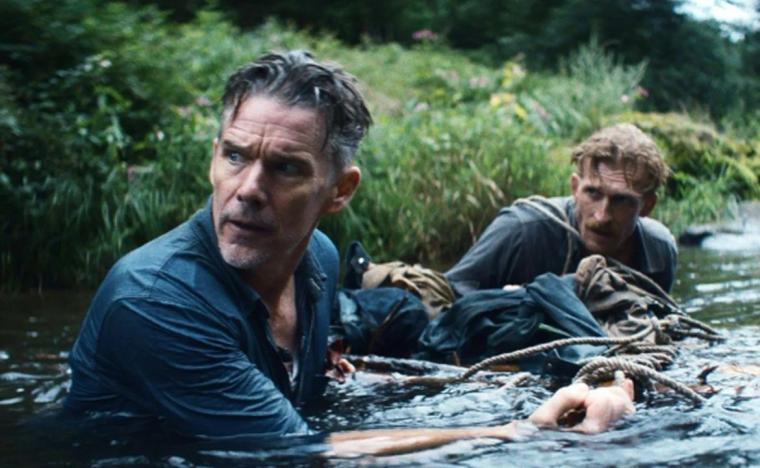
After his beloved young daughter Penny (Avy Berry) is taken from his custody following a mild public scuffle, Hawke's unemployed, homeless Samuel Murphy is sent to a work camp where his problem-solving know-how captures the attention of Russell Crowe's Warden Clancy. Impressed with Murphy's smarts and stoicism, Clancy makes the prisoner an offer: If he and a trio of fellow convicts agree to smuggle dozens of gold bars out of a neighboring mining encampment – one that FDR wants closed with its treasures confiscated – the men's release papers will be signed pronto. Should they lose or misplace a single bar, however, they'll be killed on the spot. What follows finds Murphy and company, plus two designated work-camp stooges and an eventual Native American tag-along (Julia Jones' Anna), traversing 50 miles of wilderness with their knapsacks bursting with gold, and confronted by harsh river rapids, vagrant mercenaries, and the requisite wooden rope bridge. Nice and simple. Also total b.s.
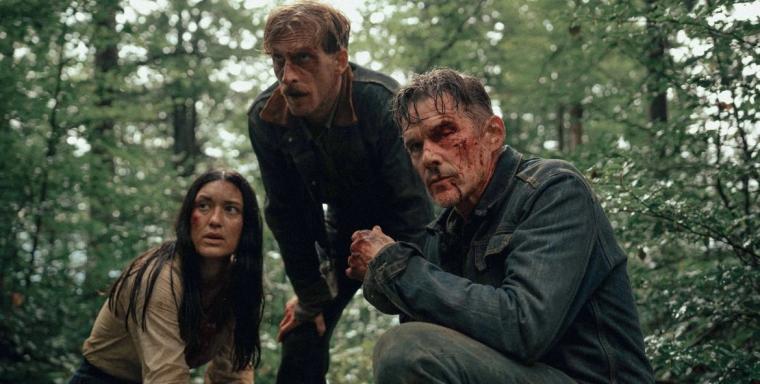
I gave up on The Weight fairly early, when it was decided that the bags of gold were too heavy to carry across that untrustworthy bridge. This led to one of the dopiest movie scenes I've endured all year, with Murphy mid-bridge while a guy at one end hurled a gold brick at him, Murphy caught it, and then he, in turn, hurled the brick at someone on the other side of the expanse. Wouldn't the force of even one of those things landing in Murphy's hands be enough to break that rickety passageway and send both man and gold plummeting? Not here, and the script by Matthew Booi and Shelby Gaines kept forcing my eyes to roll further, with every character allowed one personality trait apiece, if that, and Austin Amelio's prisoner Rankin fulfilling his description, per another of the travelers, as “the most annoying man I've ever met.” (As he has proven even in such wonderful Richard Linklater comedies as Hit Man and Everybody Wants Some!!, Amelio is best experienced in limited doses.) The excitement isn't terribly exciting, the threat is weirdly limited – after those nefarious prospectors vanish halfway through, they never once reappear – and even Matteo Cosco's cinematography, serviceable though it is, doesn't appear to take proper advantage of the Pacific Northwest surroundings. I didn't find any of Cosco's shots particularly arresting, though they did make me want to revisit Train Dreams posthaste.
It should be said that the gruff, anguished Hawke is in unimpeachable form, even if, like the rest of the cast, he doesn't seem to be living in 1933 so much as air-dropped into the period from the mid-2020s. And as has traditionally been the case since he let out his gut and stopped being a prototypical leading man, Crowe looks to be having a lot of fun, his demonstration of Clancy's swinishness a subtle hoot. These topnotch talents still aren't enough to prevent the picture from feeling terminally formulaic and empty, and the only time my audience audibly reacted – and there was a surprisingly hefty number of patrons at my Sunday-afternoon screening – was when a moderately sympathetic figure collapsed and conked his head on a rock. Their collective gasp was immediate and pronounced, and certainly louder than my own shock when the film's final, unhinted-at 10 minutes tried to convince us that we'd secretly been at the feel-good, screw-the-one-percenters entertainment of the year. Had I known that earlier, I might've recalibrated and not found McKinley's feature such underwhelming dead Weight.
SHAUN THE SHEEP: THE BEAST OF MOSSY BOTTOM
This is my third time giving it a whirl over a dozen years, and I've come to realize that I never want to review a Shaun the Sheep movie. I just want to catalog the jokes.
Aardman Animation's latest, Shaun the Sheep: The Beast of Mossy Bottom, is, like 2015's Shaun the Sheep Movie and 2020's A Shaun the Sheep Movie: Farmageddon, a largely wordless affair. None of the many barnyard characters speak, nor does the loyal farm dog Bitzer, nor do any humans, the race here represented by our unnamed Farmer, his unnamed veterinarian, and throngs of townsfolk who only converse in indecipherable gibberish. (What identifiable words we do hear come solely from occasional radio transmissions and a bevy of thematically appropriate pop tunes.) This means that even non-verbal toddlers can effectively glean what's going on, though scene for scene, the humor in directors Steve Cox's and Matthew Walker's stop-motion-animated slapstick is far more sophisticated than what toddlers would appreciate. This 58-year-old, for instance, howled in recognition when a rushed, panicked Bitzer yanked and yanked on his seat belt that refused to give until he finally chose to pause and take a breath, after which he calmly slid the belt down and it fastened immediately.
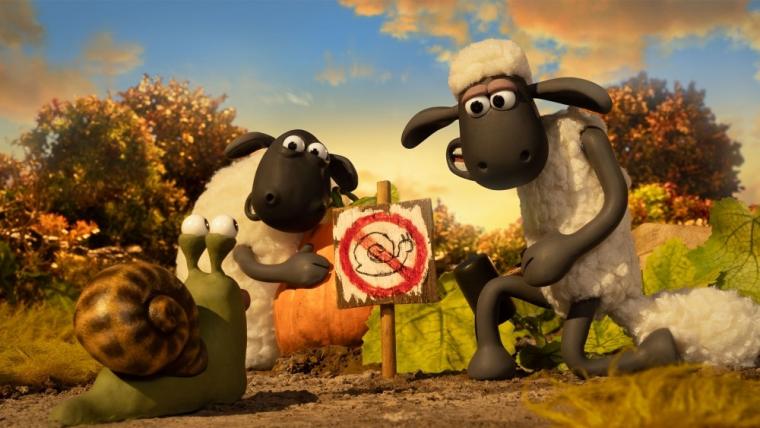
Are the Aardman adventures, however, perhaps too sophisticated, at least for American audiences? Barring 2000's Chicken Run and including the Wallace & Gromit outings, none of these things make notable money in the states, and this past weekend, despite playing on 600-plus more screens, Mossy Bottom missed the domestic top 10 in favor of the fourth weekend of splatter comedy Buddy. Essentially, over three days, the latest Aardman grossed about as much as Toy Story 5 made in its first two hours of release. That just ain't right, because this thing is 81 minutes (including end credits!) of absolute pleasure. You may not leave the auditorium remembering much about its plot, which finds industrious Shaun creating a miracle-grow formula for pumpkins that the Farmer mistakenly uses as a hair tonic. But you're almost sure to laugh loudly and consistently. At the unmissable nods to Frankenstein, Dracula, The Wolf Man, and other products of Universal's early horror days. At the employment of Bernard Herrmann's screeching Psycho violins, here the result of some badly timed dental flossing. At the influencer who races in terror from scenes of havoc, but not before getting the perfect selfie. At the Amazon deliveryman who, similarly, hastily drops off a crushed package, and then remembers to take a front-step photo for proof of delivery.
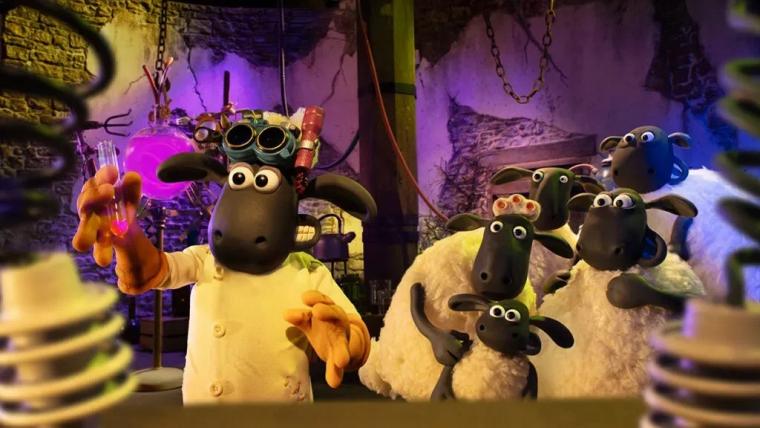
I'd love to report that this gloriously eccentric, visually riotous family comedy held my interest all the way through. Unfortunately, though, even while having fun, I'll admit to momentarily checking out a few times toward the finale, as I was mentally composing a post-screening shopping list while the harried barnyard denizens tried to rescue their owner from the confines of a cargo ship. (The repetitive shenanigans didn't help, but I mostly blame the locale, as too many generic action flicks set aboard cargo ships have led to my immediate disinterest.) But I still wouldn't have skipped Shaun the Sheep: The Beast of Mossy Bottom for anything. And I'm glad to have not missed Shaun behaving as a mad scientist à la Gene Wilder's Frederick Frankenstein, and that townsperson so focused on his iPhone that he was completely unaware of the nearby mayhem, and the sheep, early in the morning, groggily waking up while instinctively performing dance moves from Michael Jackson's “Thriller.” Others could attest that I roared at these bits. Accent that “could,” though. At my screening, sadly, I was the only one there.