
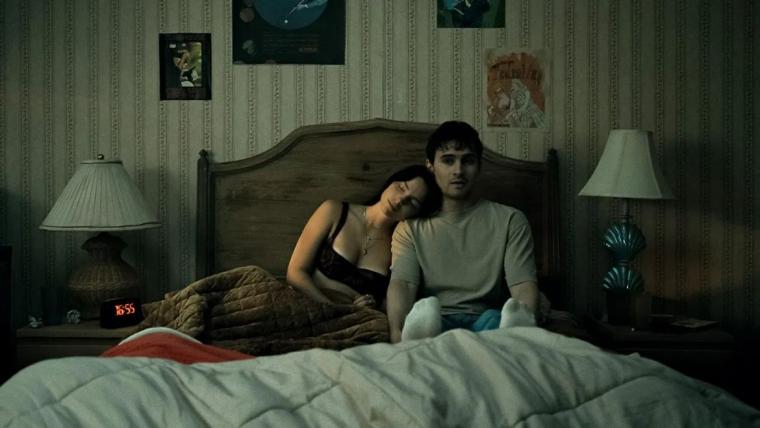
Inde Navarrette and Michael Johnston in Obsession
OBSESSION
There are so many smart, promising ideas floating around in the comedic horror of Obsession that it almost doesn't matter that few of them feel properly explored, and that writer/director/editor Curry Barker doesn't seem to have entirely figured out either his principal characters or his film's overall tone. Despite its super-low budget (reportedly $1 million tops) and no-star cast (depending on how major a celeb you consider Andy Richter), this is a true swing for the fences – Barker's chance to give Gen Z a Fatal Attraction of its very own. And if his movie doesn't wholly succeed … . Well, Adrian Lyne's 1987 smash had major problems, too. They didn't prevent it from turning into the sort of generational cautionary tale you can easily imaging Obsession becoming.
Demonstrating that some genre tropes are sustainable more than a century after their debuts, W.W. Jacobs' 1902 short story “The Monkey's Paw,” this time, gets a workout through the debilitating fears of one Baron “Bear” Bailey. Played by Michael Johnston with initially touching sweetness, early-20-something Bear has been secretly, desperately in love with best friend Nikki (Inde Navarrette) since childhood. Inevitably, she loves the timid, self-effacing guy like a brother. Bear finally decides to share the truth, and wanting to give Nikki a gift to accompany his reveal, he finds a mystic-shop novelty called “One Wish Willow”: a series of twined sticks that, when snapped, will grant the holder their heart's desire. (For only $6.99!) But when the time comes to confess – when Nikki literally asks him whether he has romantic feelings for her – Bear chickens out, and instead breaks the One Wish Willow himself, wishing that Nikki would love him more than anyone else in the world. Oh, Bear. You shoulda boned up on your W.W. Jacobs.
What happens, of course, is that Nikki does begin loving Bear with be-careful-what-you-wish-for fervor, and before Obsession turns gruesome and harrowing the way you expect it will, Barker does a rather sensational job of mapping its villain/victim's trajectory toward Full Glenn Close. Snapping those twigs may have made Nikki fall immediately in love. Yet that doesn't mean Nikki knows that Bear loves her back, and I'm betting loads of viewers will wince, or maybe involuntarily shudder, when the young woman – mere seconds after Bear makes his wish – begins to initiate subtly unmissable seduction tactics. Can she please stay at Bear's tonight? She's depressed. She's wasted. She doesn't want to be alone. (This isn't gross gender-stereotyping, by the way – men do this shit, too.) After Bear relents, deeply confused about Nikki's turnaround yet in no way unhappy about it, can she please join him in the bed? They can just lie together. This leads to cuddling. This leads to kissing. And this, with everything thus far working out great for Bear, leads to screaming, as Nikki interrupts their makeout session with a horrified shriek and no clue about how she got there. Neither of them understand what's going on, but in that instant, we sure do. Although Nikki now magically loves Bear, there's another Nikki, the real Nikki, inside, and all this is happening without her consent.
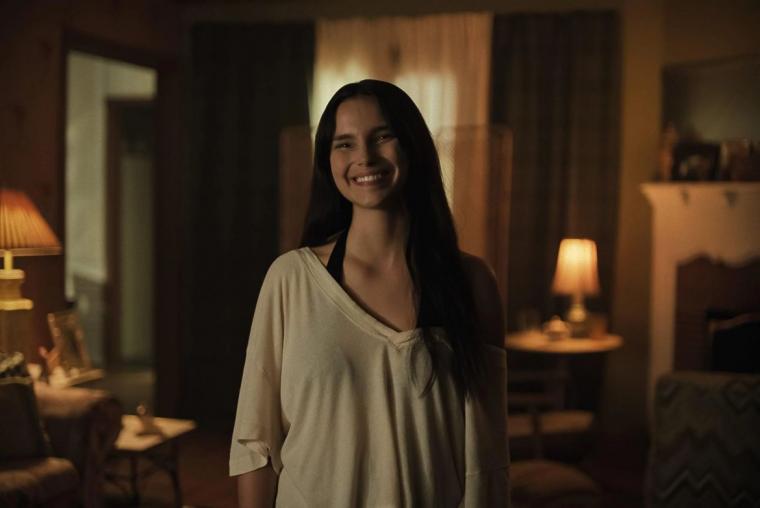
As you can probably imagine, that puts Barker and Obsession in a tricky situation – more than one, actually. With their first night's weirdness shaken off, a montage shows Bear's and Nikki's next few days of being blissfully, hungrily in love, much to the disbelief of pals and fellow music-store employees Sarah (Megan Lawless) and Ian (Cooper Tomlinson, who writes and performs with Barker as the YouTube sketch-comedy duo “that's a bad idea”). Not long after, Nikki devolves from needy and clingy to late-stage psychopath, miraculously managing to one-up Fatal Attraction's mistreatment of animals by doing to a (deceased) cat arguably worse than Alex Forrest did to that bunny. Yet no matter how nightmarish her actions, we can't hate Nikki, or even be all that terrified of her, because the knowledge of her essential imprisonment, the sadness of it, lingers. “Sunken Place Nikki,” as she should perhaps be referred to, is the true victim here – not the hapless Bear, who's determined to make the best of things way past the points of empathy and rationality.
On that note, just how sympathetic is Bear meant to be? He may be a lovable loser at the start, but as Ian points out in one of Barker's more astutely written scenes, Bear's choice to ignore the warning signs when Nikki clearly needs psychiatric or medicated help makes him look like a monster taking pathetic advantage of a sick young woman. Johnston's earnestness and emotionalism keep us in Bear's corner for an awfully long time. Yet Obsession appears unwilling to acknowledge Bear's inherent loathsomeness. He certainly didn't expect the One Wish Willow to actually work. After its supernatural power becomes undeniable, though, the guy performs all manner of moral and ethical acrobatics to keep the good times – the affection, the attention, the sex – rolling. It's not until we're deep into the movie, and Nikki's increasingly unhinged behavior, that Bear thinks to call the Willow box's helpline for advice. (The dryly annoyed, unsettlingly funny customer-service rep is voiced by Barker himself.) And even then Bear doesn't immediately ask for his wish to be taken away. He still wants Nikki as his girlfriend-slash-slave. He just wants her to be nicer.
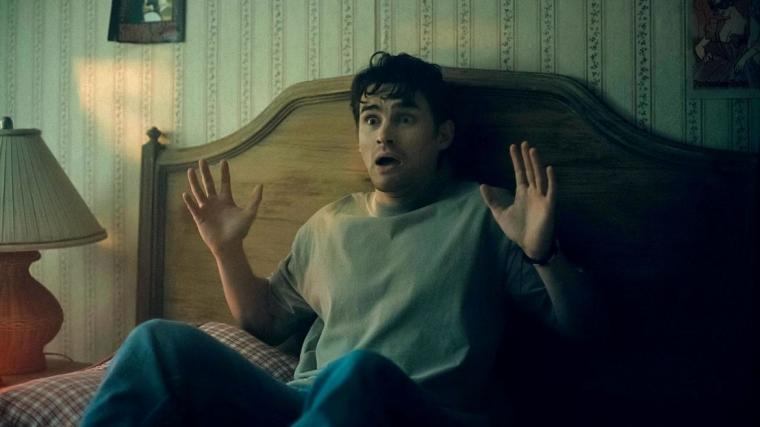
Because Barker doesn't fully commit to recognizing either Bear's cruelty or Nikki's tragedy, Obsession exists in a strange kind of purgatory wherein you don't quite know how to respond. Are we meant to laugh at Bear's escalating troubles considering he brought them on himself? Feel anguished for him given that he didn't mean for bad things to happen? (He definitely wanted that wish to come true, though.) And there are other, equally confounding questions, most of them tied to bits that appear included only for momentary, audience-goosing effect. Why does Nikki occasionally vibrate spasmodically and ferociously dart about like a woman demonically possessed? Is that what's going on here? How much agency does “Sunken Place Nikki” retain? (A few moments of self-mutilation suggest “quite a bit.”) Is the enactment of wishes freed from earthbound realism, as suggested by a late-film rainfall that delivers a laugh but makes no physical-reality sense? How can the kitty shenanigans possibly be tied to Bear's wish? Like the films of Zach Cregger, who similarly transitioned from sketch comedy to horror comedy, Barker's sophomore feature (following his 60-minute Milk & Serial from 2024) is routinely undone by lapses in logic or notions only halfway thought-through – bits that are minor in the moment but have annoyingly overpowering cumulative effect.
Still, I can't pretend that this confident indie doesn't boast more than its share of pleasures. Despite a tendency to overact Bear's mortification, Johnston is one of them, and Navarrette is undeniably another, pulling off even Barker's more obvious routines – including Nikki screeching at top volume before instantaneously turning demure – like a seasoned pro used to tackling impossible tasks. There are a number of superior, darkly hilarious set pieces: the handling of the duct-taped door; the drunken game of Jenga; that helpline phone call that climaxes in a whole new realm of supernatural possibility. And even though the budgetary deficiencies are occasionally on display – two among the final tally of corpses look distractingly like props – Barker's movie has a professional look and an excellent Rock Burwell score, and the helmer clearly knows how to sustain dark-comic tension. Let's also hear it for Barker getting one thing right that movies rarely do, in that his four main characters, all of whom hang out even on off-work nights, are all employed at the same place. (Usually, for the sake of variety, one works at a mall, one at a service station, et cetera.) This is a truth rarely shown on-screen: It's oftentimes because of shared jobs that recent high-school grads become friends. I may not be antsy to see Obsession again. But back in the early '90s, when we were employed together and the age of the film's leads, my movie-theater besties and I likely would've likely watched Barker's feature a dozen times over.

IS GOD IS
Written and directed, in her feature debut, by Aleshea Harris, and adapted from her acclaimed 2018 off-Broadway hit, Is God Is is a mostly phenomenal piece of work. Part revenge thriller, part road-trip comedy, part biblical and classical-Greek allegory, and part playful display of magical realism and presentational effrontery, this is a miraculously cast, absolutely singular work of imagination and love. I can't fathom how a film version was ever green-lit. But then again, maybe I can. Because in keeping with the year's apparent theme, this bold, beautiful movie, as numerous other 2026 titles have, features some of the most repellent images of bloody violence perpetrated against women that I never wanted to see and keep hoping to never see again. I promise to get off this “Enough already!” soapbox if three weeks manage to pass with no new releases that turn women into brutally, gruesomely maligned punching bags. We're more than halfway through May. I'll letcha know if we get a reprieve.
In the meantime, I spent the first three-fourths of Harris' 100-minute debut almost ridiculously happy, which might sound nuts given the narrative circumstances. As close as siblings can be, fraternal twins Racine and Anaia were literally scarred for life when, as children of about five, their father attempted to burn their mother alive and the kids attempted to put out the fire, leaving Racine with scars on her arms and back and Anaia latticed with burns on her face and neck. Now 21, after years of abuse in the foster-case system and from anyone visibly off-put by their injuries, the young women (Kara Young as Racine, Mallori Johnson as Anaia) learn that their long-presumed-dead mother (Viveca A. Fox) is indeed alive, and has requested a visit to her deathbed in the Deep South. Upon their arrival, mama Ruby has but one request: “Make your daddy dead. Real dead.” Is God Is consequently follows the twins' path to first find the man (a walking nightmare credited only as Man, and played, initially only by the nose down, by Sterling K. Brown) and then execute him. It's like Shakespeare meets Sophocles meets Sergio Leone meets Quentin Tarantino … with the added wink that Viveca A. Fox played Vernita Green in both volumes of Kill Bill.
Long before any acts of vengeance, or potential vengeance, come to pass, Is God Is is fabulously entertaining, and entertaining without accompanying pity. An early, sepia-toned flashback immediately informs us that our protagonists aren't to be trifled with, a playground insult, via Racine and a nearly bat, turning into what sounds like a savage and justified beating. (That this violence occurs off-screen strengthens the material's classical-Greek bona fides.) But beyond letting you know that melancholy won't be on her agenda, Harris ensures you that playfulness certainly will be. She has Racine and Anaia routinely speak in subtitled telepathy while brushing their teeth, or in other instances in which speech is unadvised, and when they're able to legitimately converse, Young's and Johnson's repartee is so frank and funny, and the actors' chemistry so electrifying, that you almost wish the revenge plot never arose. While Young is already something of a New York stage legend (four Tony nominations in consecutive years, consecutive wins in 2024 and '25), I'd only before seen her, in a role I don't recall, in 2022's After Yang. I'd never before seen Johnson in anything. Going forward, I hope to be first in line for every movie they make. They're flabbergastingly good.
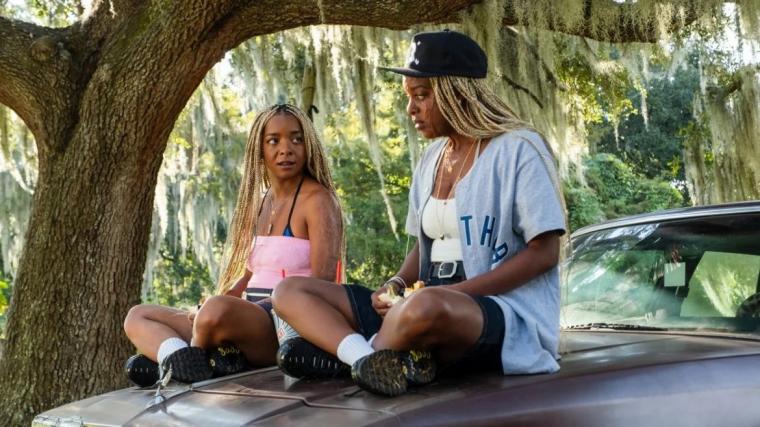
So are their co-stars. Confined to her character's bed and a face mask until a particularly terrifying flashback lets us see her in full, Fox is fierce, magisterial, and supremely authoritative – this is easily the strongest screen work I've yet seen from her. (Fox also makes you wholly understand why Ruby's kids refer to her as God: She created them, after all, and every word from her mouth sounds like stone-set scripture.) But the performance riches keep coming after the twins hit the road. Erika Alexander is the riotous yet deeply scary evangelist who eagerly awaits the return of the Man who impregnated her and quickly ran off; Mykelti Williamson is moving and appreciably weird as the lawyer with access to Man's whereabouts; Janelle Monáe, who really needs to be a more-frequent big-screen presence, is touching and pathetic as Man's new wife. All of their portrayals would be impressive enough on their own. Harris, though, lets several of her Is God Is figures introduce themselves with first-person voice-over perspectives, enriching the devastating personal history and, especially in Monáe's case, exacerbating the ultimate heartbreak.
Truly, I loved all of this, and also loved the arresting, sun-bleached yet wildly colorful images provided by cinematographer Alexander Dynan – not that Young's and Johnson's chemistry would've been less impressive under more drab visually circumstances. Yet I felt a twinge, a mild foreboding, when Racine and Anaia first encountered the pair of twins (Xavier Mills and Justen Ross, both excellent) that Man fathered years after setting Ruby on fire, and realized the meeting was going to lead to the young women acting as strippers for their unaware half-brothers. A Greek-tragedy setup for sure, as well as something of a slapstick-sitcom one, but a bit that I wish Harris had shot with a little less time-killing lasciviousness.
And then, more than 45 minutes after Racine first held a rock-filled sock in ways to suggest both Cain and Goliath's David, we finally meet the Man outside of flashback. As he traditionally is, Sterling K. Brown is great in the role, and particularly so for Man's protracted act of deflection, causing us to wonder whether Ruby's story entirely holds water. But while it's hardly the film's fault that it follows, like, a dozen 2026 titles in climaxing with women getting the unholy crap kicked out of them – regardless of whether they emerge ultimately victorious – Harris' debut still left me with the sourest of tastes in my mouth, wishing for literally any other resolution beyond the bloodbath that commenced. It's absolutely biblical, and classically Greek, and Leone, and Tarantino. And Is God Is deserves, maybe even demands, to be seen. But I'm sorry. I continue to be well-past fed up with the persistent, insistent violence that this year's releases – perhaps especially the honestly worthy ones – are forcing us to see.
IN THE GREY
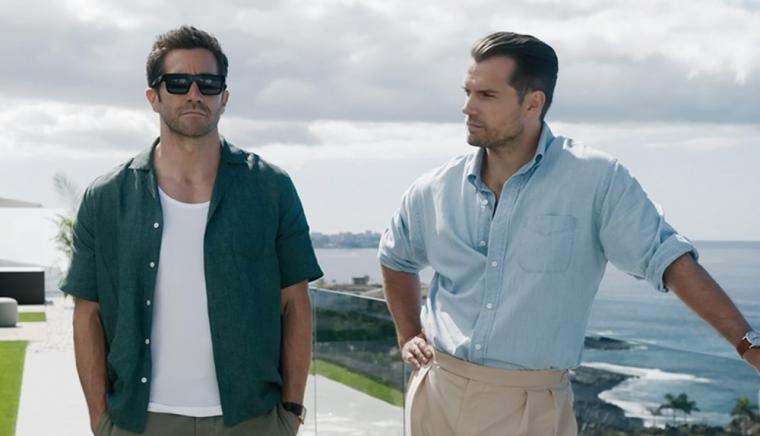
Guy Ritchie's frustratingly generic action thriller In the Grey is an hour-long smirk followed by a 30-minute grimace, and I can't remember the last time I was this exhausted by such professionally assembled output. It's tough to explain why I so thoroughly regretted my time spent at this film that wants to accomplish nothing – literally nothing – beyond amusing us with good-looking stars and better-looking clothes while we marvel at gorgeous vistas and witness hyperactive chase scenes and watch a bunch of things go boom. But the basic problem with the writer/director's latest isn't that it's boring for us; it seems fundamentally bored with itself.
I get why. This movie is incomprehensible. In general terms, I could follow the plot: A professional fixer (Eiza González's Rachel) is contracted to reclaim $1 billion in debt from a foreign tyrant (Carlos Bardem), and the only ones able to retrieve it are a pair of mercenaries (Jake Gyllenhaal's Bronco and Henry Cavill's Sid) willing to go to any lengths to secure the loan's return. Fair enough. And simple enough, right? Oh, not in Ritchie's telling, it ain't. The reams of corporate and espionage gobbledygook are so excessively, inscrutably wordy that not only can I not believe González and company delivered them without the aid of teleprompters, but even the exposition itself is revealed with cutesy visual flourishes designed to make you forget what you've just heard. A lengthy recitation from Bronco on the artillery his team will need is accompanied by an on-screen listing of every single weapon he references, including what some of his technical terms mean, plus a menion of their rider requests. (That would be beer.) In the midst of yet another interminable monologue, the on-screen text gives us an ingredient-by-ingredient account of the drink Rachel is preparing: a stovetop negroni svegliato. For the love of God, why? Are we supposed to be taking notes in case the beverage looks so delicious that we want to make one the instant we get home?
Guy Ritchie makes precisely three types of movies. There are the funny, down-and-dirty British crime flicks (Snatch, RocknRolla) that are the best ones. There are the Hollywood-paycheck reboots (Aladdin, the Robert Downey Jr. Sherlock Holmeses) that are the worst ones. And there are the sleek, lightweight, modestly engaging thrillers (The Man from U.N.C.L.E., The Ministry of Ungentlemanly Warfare) that are the most forgettable ones. Ritchie's latest falls in the latter category, but it's also somehow the worst. Beyond the disappointing drudgery of the inexplicably convoluted preparation and indifferently staged mayhem, no one except Fisher Stevens appears to be saying their lines for the first time. Gyllenhall and Cavill may as well be on their eighth month of a national theatre tour neither wanted in the first place, and González is on such depressing autopilot during her “I'm cooler than you, bitch” recitations that it made total sense when this ice princess, after being kidnapped, was given no dialogue at all for more than 20 on-screen minutes. Why on earth would Rachel verbally express herself if she couldn't be smug and superior? These are beautiful people wearing unspeakably beautiful outfits. But I've seen faith-based dramas, and truly moving ones, that didn't inspire me to pray the way In the Grey had me praying for it to end.
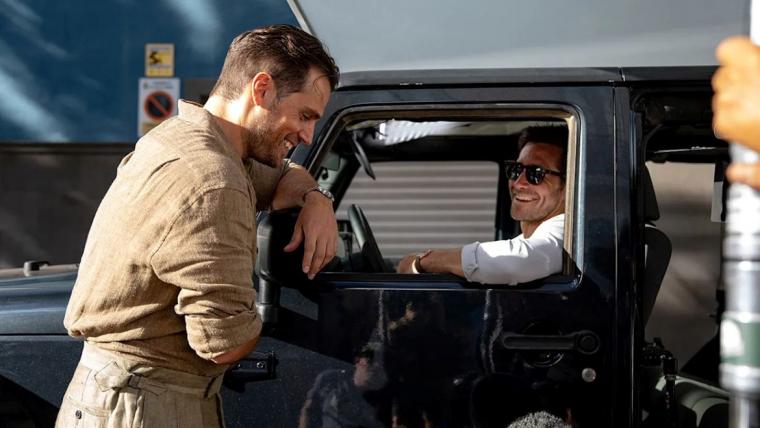
And yet. For all of its considerable flaws, I did become somewhat invested, considering this might be the first Hollywood action thriller I've seen in which I was convinced that its male leads were lovers. Not Gyllenhaal and Cavill, mind you, but rather Bronco and Sid. Of course, homoerotic teasing has been a staple in buddy-based action pics at least since Butch Cassidy & the Sundance Kid, and a staple of thrillers at least since Alfred Hitchcock's 1940s heyday. So when Bronco's and Sid's early badinage seemed mildly, comically flirtatious, I took it as par for the course. When their looks and entendre felt more than a bit overt – in the way, for instance, that Robert Pattinson's Tenet character appeared unusually into John David Washington's – I paid a bit more attention, registering the sly grin on Cavill's face when Gyllenhaal mentioned how his shirt and bedsheets were made from the same fabric. But the gay undercurrents in In the Grey turn out to not merely be subtext; they're legitimate text.
At one point, when detailing to his team where and when they should be positioned during a getaway, Bronco makes casual mention to where “my husband” will be, obviously meaning Sid. It's a quick remark that might easily go unnoticed. What can't be ignored is the way, before sending his partner on a personally dicey mission (“It's your turn”), Bronco tells Sid “I love you” with such earnestness and warmth that it catches you off-guard, and seems to catch Sid off-guard, as well; Sid simply smiles, says nothing, and goes about his dangerous business. Are Bronco and Sid in a relationship? Are they husbands? Are Gyllenhaal and Cavill simply amusing themselves, which would be colossally understandable given this otherwise-unamusing enterprise? In the Grey never says, and following that instance of tenderness, you're hard-pressed to find more examples of the pair's possible off-screen romantic lives than the fleeting ones we're given. The unexpectedly charged “Maybe … ?” of it all is still more interesting than anything else that happens in In the Grey. Yet like just about every other element in Ritchie's tired and soon-to-be-forgotten bummer, this, too, made me angry. Why not make this Hollywood's first action thriller with openly gay heroes? No one was gonna see it anyway!
MARTY, LIFE IS SHORT
While viewing Marty, Life Is Short, a celebrity-approved documentary that debuted on Netflix earlier this week, I kept thinking, “Where has he been?” Not the film's subject Martin Short, mind you. We know where he's been; we can't get rid of him. I'm referring, rather, to director Lawrence Kasdan, who was a huge deal in the early '80s for co-writing The Empire Strikes Back, Raiders of the Lost Ark, and Return of the Jedi, and whose writing/directing credits include Body Heat and the Oscar-nominated The Big Chill, Silverado, The Accidental Tourist, and Grand Canyon. This guy was a major force back in the day, yet beyond vaguely remembering him as the helmer of that godawful 2003 Stephen King adaptation Dreamcatcher, I couldn't remember the last time I saw his name on a movie's credits. A Wikipedia search tells me he assisted in the writing of Star Wars: The Force Awakens and Solo: A Star Wars Story. The Netflix doc gives me a better sense of what Kasdan has been doing over nearly a quarter-century: being friends with Martin Short.
I'm not sure what there is to say about this “inside look” that, per the norm, gives us so little that's new to look at. Is it fun? Sure. There are clips galore, and conceivably every character you've ever loved from Martin Short over the past near-half-century is accounted for. (A hardly exhaustive list: Oliver Putnam; Ed Grimley; Jiminy Glick; defensive 60 Minutes guest Nathan Thurm; Father of the Bride's Franck Eggelhoffer; Three Amigos!'s Ned Nederlander; The Big Picture's Neil Sussman; Arrested Development's “Uncle” Jack Dorso; Clifford … though that one may only be for true devotees.) Is it filled with legendary comedians as talking heads? You bet: presumed best friend Steve Martin; actual best friend Eugene Levy; John Mulaney; Andrea Martin; Catherine O'Hara in one of her last film appearances. Are there home-movie inclusions from Short's youth? Of course. Are there scenes from his Tony-nominated/winning Broadway appearances? You bet. Is there personal strife? Absolutely: Short has endured the loss of both parents, his wife, and his beloved eldest brother. (His 42-year-old daughter Katherine also passed this past February, which – for understandable production reasons – isn't mentioned here.)
But is Kasdan's documentary on his decades-long buddy at all illuminating? Nope. We're treated to the same biographical tidbits you'd get watching any of the comic actor's innumerable talk-show appearances over the years. Is it insightful? Nuh-uh, not considering the subject's steadfast refusal to dive into his performance process or professional choices or relationships in any meaningful way. It it moving? Not really, considering how far Short goes, even in discussing the deaths of loved ones, to not give the camera even a microsecond of emotional transparency. I'm not judging the man for this; let him be as private as he wants. But beyond being packages for priceless clips, these celebrity bios should give us something else. Eddie Murphy's was, on occasion, a fascinating peek into star reticence and self-idolatry. Lorne Michaels' attempted to explore an inscrutable enigma. John Candy's at least gave us friends who felt comfortable in speaking about the subject honestly after his passing. What we get in Marty, Life Is Short is an account of a good guy, who has evidently always been a good guy, who smiles equally through triumph and tragedy, who remains unassailably optimistic, whose friends and family continue adore him. The clips are killer. Martin Short himself, here, proves a stunningly dull biopic subject. I must say.