Minions & Monsters
MINIONS & MONSTERS
Films designed as “love letters” to the movies have been around nearly as long as movies themselves. In truth, there have been so many of these things – 2022 found eventual Oscar nominees The Fabelmans, Empire of Light, and Babylon released over a span of four weeks – that I'm kinda longing for a “Dear John letter” to the movies, just for variety's sake.
Still, it's hard to think of a more ticklish recent ode to cinema than Minions & Monsters, which would've been just about perfect if its monsters were ditched entirely. Directed and co-written by Pierre Coffin, who has also voiced the squat yellow sidekicks since their 2010 Despicable Me debut, Illumination's animated slapstick is a mostly joyous blend of irresistible lowbrow yuks and divinely highbrow (or at least film-savvy) references, and it's likely as close as we'll ever get to a Minion-led remake of Zelig. That I'm even mentioning that Woody Allen curio in conjunction with this seventh franchise installment is maybe all you need to know.
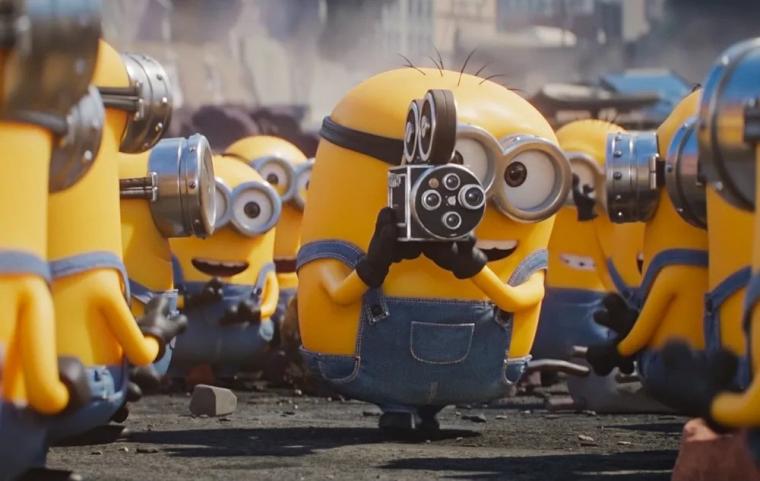
Nothing if not ambitious, Coffin's and co-screenwriter Brian Lynch's narrative encompasses life on Earth from prehistoric times – cue the Minions coming awfully close to killing their caveman leader – to the present day. It's in the now that a film-museum tour guide voiced by Allison Janney (one of three Oscar winners in the cast, alongside Christoph Waltz and Jeff Bridges) extols the cinematic influence of Tinseltown pioneers Henry and James, besties in the manner of the previous movies' Kevin, Stuart, Bob, and Otto. Like all good Minions, Henry and James want to serve the nastiest bad guy or gal imaginable. But the Minions & Monsters pals are of a more artistic-minded spirit than their brethren, and with their film primarily set in the Hollywood Golden Age of the 1920s and '30s (though it samples from other decades, too), they also want to make movies.
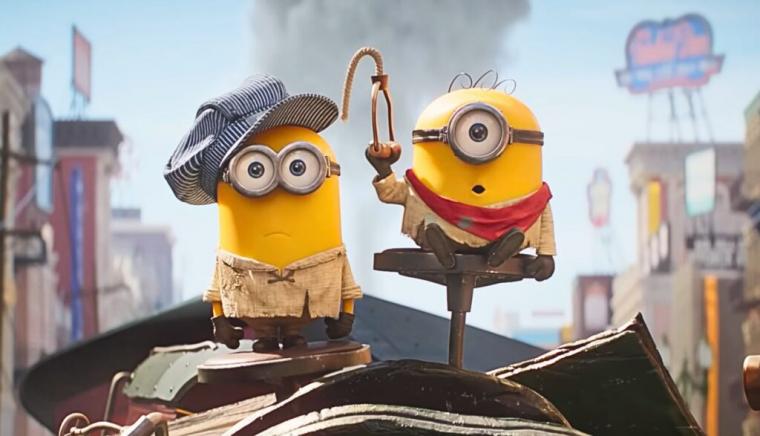
It's probably better if I don't detail how the Minions' interruption of a faux train robbery leads to the babbling critters becoming big-screen stars, and how that leads to them becoming casualties of the early sound era, and how that leads to Henry's and James' plans for the self-produced sci-fi-horror spectacle Minions y Monstras. (Needless to say, their originally planned title gets Americanized.) Suffice it to say that until the generically overblown action climax, the Minions' latest vehicle is positively lousy with jokes, and terrific ones. And there's another reason the movie is currently sitting with a 91-percent “freshness” rating on Rotten Tomatoes, because for the first time in the series' history, the targeted demographic isn't kids of all ages. It's film critics of all ages.
Certainly, you don't need a master's in cinema to cackle when Minions lay waste to a cabal of brawny Vikings, or when a magic spell conjures a purportedly terrifying creature (unmistakably voiced by Trey Parker) half the size of the Minions themselves, or when Marie Antoinette gets beheaded long before reaching the guillotine. (This was easily Minions & Monsters' grossest gag … as well as the one that made me and my favorite 12-year-old laugh the hardest.) Yet beginning with that opening museum tour, which provides a priceless cameo for George Lucas, there are so many smart, savvy nods to early silver-screen history that, upon watching the movie, you could easily ace your Introduction to Film 101 final without ever cracking a book. Hell, even the Universal Pictures acknowledgment at the start inspires decades of memories, the recognizable logo of today cleverly morphing into the studio's pre-opening-credits appearances from the aughts to the '80s to the '60s to the '40s to the 20th-century teens. I've seen lauded, six-part documentaries on the history of celluloid that didn't demonstrate the passing of time with such elegance.
Right away, all movie buffs worth their salt will realize we're in very good hands with Coffin, his opening credits inserting Minions, Zelig-like, into a number of familiar black-and-white silent shorts, including that famed moving image of the horseback rider – the one resurrected in Jordan Peele's Nope – and several experiments by the Lumière brothers. (You'd better believe this homage ends with a Minion-specific take on Méliès' A Trip to the Moon.) Not five minutes in, and I was already sporting a mile-wide grin. My smile turned into gobsmacked awe, however, during the chase scene that initiates the Minions' Hollywood celebrity. Over the span of roughly two minutes, Coffin shows how the capsule-shaped babblers indirectly led to the creation of indelible silent-slapstick routines: Charlie Chaplin and the Modern Times conveyor belt; Steamboat Bill, Jr.'s house facade falling on Buster Keaton; Harold Lloyd dangling from the skyscraper clock in Safety Last! The timing and framing of these re-imagined bits are nothing short of exquisite, and as we move into the sound era, the “lighting” that re-creates the shadow play of black-and-white classics is flabbergasting. Seeing a Minion take on the gumshoe role in a James M. Cain-style detective yarn was both hysterical and oddly moving, if not quite a match for the perfection of the Citizen Kane spoof that found another banana-colored henchman cast in Orson Welles' role, leaving this planet with one dying word. It ain't “Rosebud.”

Hopefully you're not too hung up on the “Why Citizen Kane?” of it all, considering that Welles' masterpiece debuted in 1941 and the Minions become Hollywood pariahs for not being able to transition to talkies in the late '20s. (Turns out they can't follow cue cards, and no one understands them when they speak.) I really can't explain it. I also can't explain how another tribe of Minions, at this same point in time, begins to follow an alien-robot parody of The Day the Earth Stood Still's Gort from 1951, or why that character falls in love with a Suffragette (Zoey Deutch) demanding voting rights for women, which were granted in 1919. It's best not to dwell on the chronological weirdness, especially considering how much exhilarating weirdness Minions & Monsters delivers.
I wouldn't, for instance, have traded Jesse Eisenberg's vocal performance as self-proclaimed intergalactic visitor Dort for anything. This guy is already a pretty brilliant concept; despite much evidence to the contrary, chiefly the shabby studio apartment he shares with a laze-about roommate, Dort really, really seems to believe he's from outer space. But Eisenberg's recognizably ironic, neurotic cadences add immeasurable comic spin – this might be the funniest screen role the actor has yet had – and the Minions' barely questioned devotion to this hapless conqueror makes Dort's saga the rare Minions B-plot that's just as riotous as the main storyline. With his helium-voiced Cartman readings, Trey Parker's pint-sized Cthulhu monster Goomie (full name: Gary Orkam Oliver Magma Ichabod the Deceiver) is similarly strange and endearing, and would've been more so had the narrative not required him to become a prototypical (lightweight) heavy. For all of its stunning animation, the movie's The Blob-esque apocalyptic finish is a letdown, particularly given the brainy kicks that preceded it. But even this swerve into the expected comes with a blissfully nutty flourish, as James winds up driving an old-timey automobile into the Blob to rescue his dearest buddy.
Much was made in the press about Coffin's new entry having the franchise's lowest-grossing opening weekend by a huge margin; four summers ago, Minions: The Rise of Gru landed $107 million domestic, while this one topped out at around $38.6. Yeah, that's a ginormous drop. Let's consider, though. This was the weekend of America 250 celebrations, with the Fourth of July itself falling on Saturday – generally the busiest moviegoing day of the week. The box-office behemoth Toy Story 5, meanwhile, is still gobbling up screens. So please don't take the precipitous attendance decline as any sign of a long-running series merely spinning its wheels. This latest Minions adventure is its finest by a wide margin – it's also finer than all four Despicable Mes – and even if Coffin's offering doesn't come close to matching its predecessors' global cash haul, we're given nothing here to suggest creative fatigue. Imaginative, inspired, gloriously goofy, deceptively wise, steeped in tradition yet visionary in approach … . Minions & Monsters is a love letter, all right. But what it appears to love even more than the movies is us.
YOUNG WASHINGTON
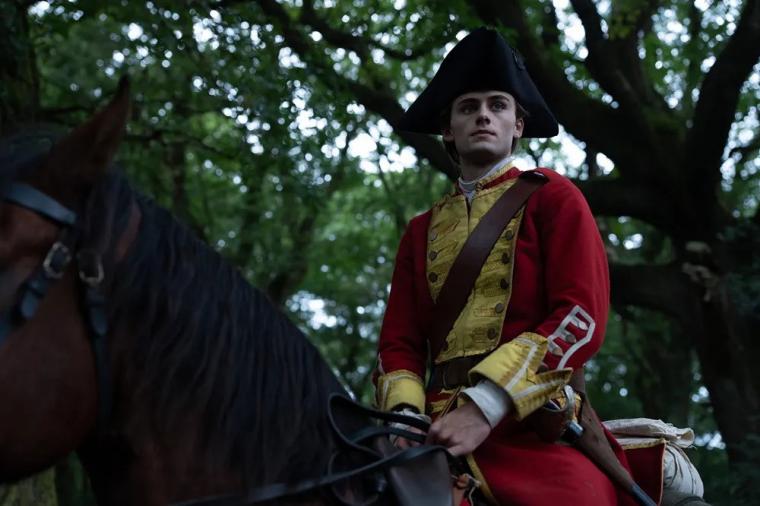
Playing the future Father of Our Country as a strapping 22-year-old, Young Washington star William Franklyn-Miller is almost ridiculously attractive. It's not just that the actor boasts GQ-cover-ready good looks and the sorts of highly defined cheekbones that could conceivably cut glass. When this George Washington talks earnestly about duty and sacrifice and devotion (to the Brits, but whatever), you sincerely believe him, and it becomes hard to imagine a historical spearhead whom domestic audiences might be more in need of these days. Patriotism aside, it's been difficult for many of us to get properly amped about America 250 – especially those of us old enough to remember what genuine, seemingly unequivocal nationwide pride felt like during the Bicentennial. (And that was a mere two years after Nixon's resignation!) To be sure, I'm letting my memories as an eight-year-old cloud the issue. But as a people, we appear to be currently, desperately desirous of a true American hero to root for, and for all of the film's squareness and late-in-the-day silliness, writer/director Jon Erwin, his subtly magnetic lead, and his deeply impressive supporting ensemble deliver one.
“Squareness,” I should mention, isn't entirely a pejorative in this case; Erwin's movie may be traditional to its teeth, but it's never dull. Following a battleground flash-forward and a few scenes with George as a tyke following the death of his father, the crux of Young Washington unfurls during the French and Indian War of 1753-55, with Franklyn-Miller's George desperate to join the British Army and help eradicate the French in Ohio. This is a cinematic origin story I can totally get behind, because beyond our first-president-to-be chopping down that cherry tree – a fabled bit of minutiae Erwin amusingly alludes to – what else do most of us know about pre-1776 Washington? Here, we learn a lot: that he was denied a formal education as a child; that his older half-brother Lawrence (John Foss) schooled him in the art of land surveying; that he fell in love with a woman (Mia Rodgers' Sally Cary) who would ultimately break his heart; that he found a trusted mentor in Thomas Fairfax (Kelsey Grammer). And none of that includes George's many struggles on the battlefield after he becomes a colonel in the British Army, a tenure that, given the crises and tragedies that result, Erwin and co-screenwriters Tom Provost and Diederik Hoogstraten have the good sense not to lionize.
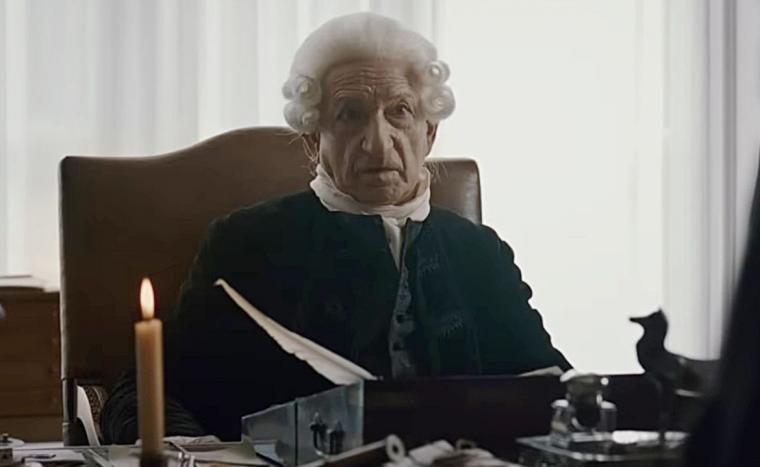
For American-history buffs, none of this will likely come as a surprise – though even they might be astonished by the sight of George leading his horse into a violent skirmish and riding the creature on its left flank so as not to be visible to the French. (John Wayne himself would've blanched at the stunt.) But this largely history-ignorant viewer was, if not exactly mesmerized, at least consistently engaged by the presentation. Best known for rock-solid, faith-based entertainments such as I Can Only Imagine and Jesus Revolution, Erwin demonstrates an unexpected facility for large-scale battle sequences that are immersive and affecting without threatening the PG-13 rating. He's even better with scenes of low-key, emotionally tense conversation, the finest involving Ben Kingsley, as army administrator Robert Dinwiddle, and Mary-Louise Parker, for only three significant scenes, as George's grieving mother Mary. I've read reviews that refer to Parker's role as “thankless,” but I found it the opposite – despite her minimal screen time, I was thankful for this reminder of what a powerful, cinematically under-served performer Parker continues to be.
Because Erwin's feature is so intentionally light on laughs – though Kingsley definitely scores some through Dinwiddle's amazement at the bullet holes in George's coat and hat that didn't kill him – it's occasionally awkward to realize you're giggling and shouldn't be. Just about everything said by the heavily accented French scoundrels and stuffy British twits, one of them played by Andy Serkis, is like parody played straight, but not straight enough. And Washington's climactic rebirth as a stereotypical he-man action stud complete with slow-motion effects and impossible marksmanship and an obnoxious, ultra-rousing score composed by no fewer than three Kiners (Kevin, Sean, and Deana) comes close to trashing the worthy 100 minutes that preceded it. Yet Young Washington remains a sturdy, engrossing history lesson that's enjoyable besides, plus a first-rate calling card for William Franklyn-Miller as this most honorably American of recent movie protagonists. I probably shouldn't dampen the mood by mentioning that the actor is British. Folks still haven't gotten over Henry Cavill's casting as Superman.