
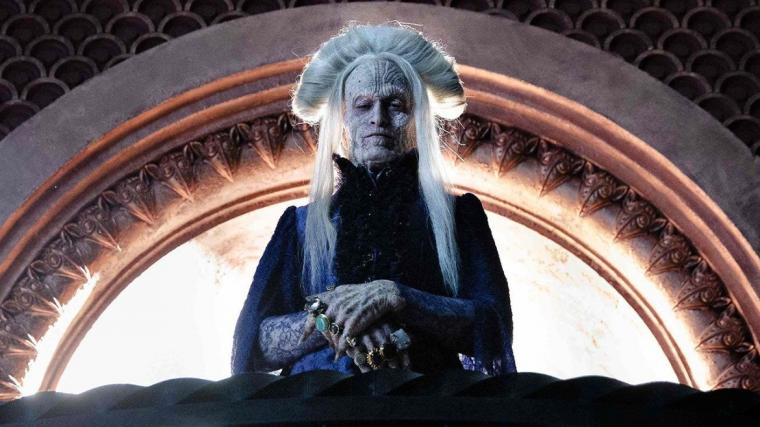
Caleb Landry Jones in Dracula
DRACULA
Written and directed by Luc Besson, the French auteur's new rendition of Dracula is lurid, melodramatic, somehow both over- and under-scripted, routinely silly, and occasionally off-the-charts ridiculous. It is also, I hasten to add, just about irresistible – two-plus hours of gorgeously designed, nearly operatic excess that's certainly one of the nervier takes on Bram Stoker's material yet produced. This isn't an easy movie to defend; its flaws are right there in front of you, ripe for the picking. But I had so much fun at Besson's garish vampire yarn that I can easily imagine watching it again, this time with more than the one friend who joined me, and with all of us preferably looped out of our minds. That way, we'd at least come close to approximating Besson's vibe.
Employing the Stoker as inspiration rather than blueprint, Besson's Dracula opens in 1480, with our Count-to-be a Romanian prince named Vladimir (Caleb Landry Jones). Apparently newly and very happily married to the lovely Elisabeta (Zoë Bleu), Vlad agrees to lead his troops into battle against the Ottoman Empire, but only if God promises to keep his beloved safe in his absence. Speaking on the Lord's behalf, a high-ranking Cardinal (Haymon Maria Buttinger) agrees to Vlad's condition – and soon wishes he hadn't, as Elisabeta is knifed and killed while fleeing the castle. Cut to Prince Vladimir of Wallachia murdering the Cardinal in return, renouncing God, and being cursed by the almighty to live out the rest of eternity on Earth, without love, as a vampire. Luckily for the newly named Dracula, though, there's a loophole, because if he can find Elisabeta in reincarnated form, they can live together in blood-sucking bliss forevermore. Four-hundred-and-nine years later, young solicitor Jonathan Harker (Ewens Abid) knocks on the Count's castle door. And wouldn't you know it! As evidenced by the image in Harket's locket, the man's fiancée Mina (also played by Bleu) looks just like Drac's deceased bride!
This revelation that occurs at roughly the movie's halfway point is, of course, an over-the-top coincidence. That makes the moment a perfectly fitting capper for the hour preceding it, As anyone familiar with his filmography knows, Besson isn't really a proponent of “subtle,” and in many ways, Dracula is like what you'd get if the original text mated with The Fifth Element. The introductory montage demonstrating Vlad's and Elisabeta's mutual passion is an explosion of energetic coitus, pillow fights with feathers flying, food smothered over the couple's faces, and the kinda-hot sight of the pair squeezed together in one Ebeneezer Scrooge-esque nightshirt. When Dracula creates a perfume whose scent makes every European woman in a 500-foot radius flock to his side, the sniffers, female and male alike, don't merely swoon; they engage in exactingly choreographed dance suggesting Bram Stoker's Moulin Rouge! When the Count bares his fangs at a swanky soirée, he doesn't snack on one or two party-goers; he feast on at least a dozen, cinematographer Colin Wandersman's camera constantly swirling and the blood constantly spraying. And while I don't want to ruin the kick of the castle's stone gargoyles, let's just say they're more ambulatory than you might anticipate – and that they're not Dracula's minions so much as capitalized Minions.

Meanwhile, in the title role, Caleb Landry Jones engages in as much blatant overacting as anyone should ever attempt without a safety helmet. He's utterly glorious. While you may not know the actor by name, you've likely seen him before; 2017 alone found Jones memorable in Get Out, The Florida Project, Three Billboards Outside Ebbing, Missouri, the Tom Cruise action comedy American Made, and the Twin Peaks revival. At 36, the Texas native and Cannes Film Festival Best Actor champ (for 2021's Nitram) is as feral and imaginative as any youngish talent we have, his singular performance choices tending to make even Robert Pattinson's look downright conventional. That makes Jones ideal casting for Besson's wildly rococo conception of Dracula, the actor's persuasive Eastern European cadences morphing into a deeply enjoyable mastering of “I vant to suck your bloooood” cheesiness, and his bellowing to the heavens vociferous enough, you think, to make God himself tremble.
He also fully convinces you of Vladimir's all-consuming love for Elisabeta (and, eventually, Mina), and Bleu, in her 19th-century incarnation, proves a worthy object of the Count's affection. Smart, sane, yet overcome with a romantic yearning she doesn't comprehend, Bleu delivers earthy radiance that proves an ideal counterbalance to the high-pitched, make that feverishly pitched, grandeur surrounding her. Every so often, Bleu's serene presence calms the film down. And between the phenomenally satisfying hyper-kiteticism of Matilda De Angelis' chirping, vampiric Maria (the character also covering terrain that's usually the province of the absent Renfield), the slavering madhouse scenes straight out of Marat/Sade or the Amadeus bookends, and the rapidly escalating tower of nuns (!!!) begging for Dracula's cologne, Heaven knows the break from all-overwrought-all-the-time isn't unwelcome.
Christoph Waltz provides his own kind of respite, but his seems far less integral to the movie's design. Basically, the actor just seems bored. In what is essentially the Van Helsing role, Waltz plays an unnamed priest whose religious order has been hunting the undead for centuries. You'd think the character's discovery of potentially the Vampiriest Vampire of All Time would be enough to raise Waltz's blood pressure a tad, but nope – he gives the exact same dry, mordant, heavily italicized performance he's been giving in his English-language movies for the past 17 years. Admittedly, Waltz's sharp comic instincts and staccato verbal style can still be good for a laugh or two. Really, though, most of his screen time in Dracula finds him not even trying. Running after Dracula down a hallway – this being Waltz, it's more like a lazy jog – and being met with a door slammed in his face, Waltz's expression could charitably be described as “nonplussed.” It more accurately looks like the camera kept rolling three seconds after Besson yelled “Cut!” and Waltz's brain went instinctively to his trailer, or maybe the craft-service table. He's at this level of energy underload throughout, and it might be time for the Austrian to find work, and speak in his native tongue, in his home country again. I can't think of another two-time Oscar winner who has shown such limited range.

Unfortunately, Waltz is a pretty significant blight on this Gothic horror romance, but his portrayal does have some company. The gargoyle effects, though rather enjoyably goofy, also display a distracting cheapness that doesn't mesh with the lushness of the costuming and décor. Depending on the scene's lighting, the makeup on Jones' elder Dracula makes him look either reasonably decrepit or like a hilariously weak stab at a Dick Tracy villain, specifically Pruneface. And Besson's script, despite being awfully heavy on the exposition, still manages to leave a bunch of questions unanswered, most of them regarding our title character's vampirism. If God indeed cursed Vladimir with his eternally-undead state, why also give him supernatural powers – the ability to move objects with hid mind, say, or transform (REDACTED) into leapfrogging gargoyles? Were there vampires before Dracula? And what was the real-estate plan that led to Harker being invited to the castle in the first place? Was Drac putting the castle on the market? Perhaps looking to franchise the site to Euro Disney?
Even when contemplating these brain twisters, though, I'm pretty sure I was grinning. Maybe you have to enter this Dracula expecting something terrible, as I kinda was, and I won't fight with anyone who finds the movie too overbaked, too absurd, too … Luc Besson. But between the delightfully zippy Danny Elfman score and eye-catching frocks and copious, and intentional, laugh-out-loud sequences (our protagonist's many suicide attempts are legit riotous), not to mention the appropriately gonzo Caleb Landry Jones, I found myself unexpectedly, almost consistently tickled. It's trashy, for sure. But it's also trash that's been cleverly repurposed as art.
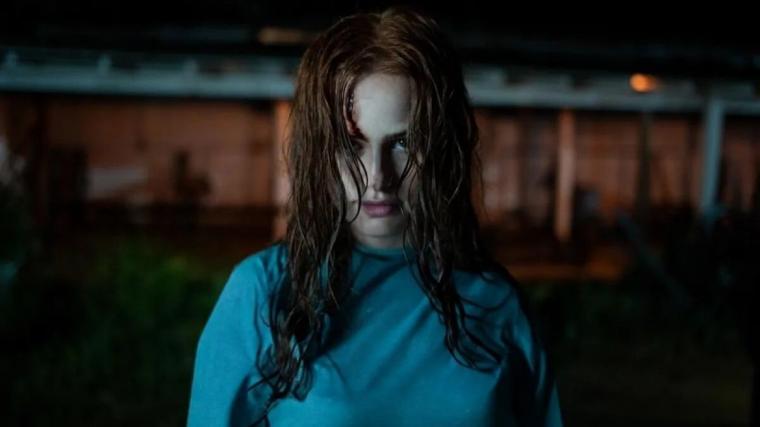
THE STRANGERS: CHAPTER 3
After 21 months, the endurance test of director Renny Harlin's The Strangers slasher trilogy has finally reached its conclusion, and what can I say? At least it's over, and at least it's ending with the least offensive of its three parts.
Chapter 1, which debuted in the comparatively halcyon days of May 2024, was a grotesquely unnecessary reboot of Bryan Bentino's infinitely superior 2008 shocker, its tale of forest-dwelling deviants in Oregon's least welcoming small town theoretically too derivative, generic, and dull to merit a sequel, let alone two. Too bad those follow-ups had already been shot (with a few extra scenes subsequently added at the behest of preview audiences), and this past September brought us Chapter 2, which, sadly, didn't follow the 2018 narrative arc of director Johannes Roberts' pretty-damned-freaky The Strangers: Prey at Night. Instead, we were reunited with the same underwhelming heroine (Madelaine Petsch's Maya) and the same backwoods loons from the year before – only this time, we were also gifted childhood flashbacks and an attack by the least realistic wild boar on God's pixelated earth. It was tough to determine which atrocious element was less essential. Now, blessedly, The Strangers: Chapter 3 wraps up this gory, hackneyed saga for good (or does it???), assaulting Maya with one last round of traumatic vacation memories, and giving us closure on which of Venus, Oregon's local-diner suspects moonlight as knife-wielding, burlap- and porcelain-masked psychopaths. The four or five of you who care must be thrilled.
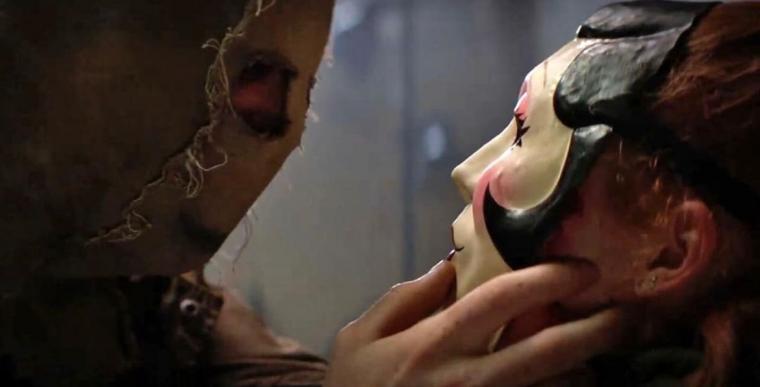
Because everyone in Venus who hasn't been killed could potentially be a killer, and because Maya is clearly our Last Gal Standing, there aren't many fresh-meat options in this second sequel, which does eventually get around to introducing Maya's sister, the woman's husband, and a tall, broad-shouldered guy named Marcus who's either a private detective or the couple's Uber driver. (It's never made clear.) That means, to sate fans' bloodlust, it's gotta be flashback time again – though the one that opens the movie, set three years prior to The Strangers' action, is uncharacteristically solid. As the prelude's victim, Hannah Galway is appealing and affecting, Harlin sustains the tension admirably, and Ema Horvath – whose waitress Shelley (a.k.a. Pinup Girl) was unlikely to return in the present-day scenes – demonstrated how much unsettling fun she might've brought to the previous entries had she been more frequently visible. Another flashback, this one set a dozen years pre-Strangers, does a decent job of expanding what I hesitate to call the series' “mythology,” and also nicely complicates the character of Sheriff Howard Rotter (what a name!), played by the perpetually grim-faced character actor Richard Brake. So let's hear it for progress: two flashbacks, both better than anything Harlin served up in parts and two.
If only we'd been allowed to stay in the past. But no, Maya's horrific getaway demands closure. So it's back to the basics for this latest and please-let-it-be-last installment. More grisly, depressingly unimaginative executions. More exhausting soap-opera acting from Petsch, though Maya leaning toward catatonia does dial down the histrionics a bit. More predictable jump scares that only get a rise out of you from the deafening sound effects that accompany them. More tedious tension between Maya and Chapter 2 recruit Gregory, a townie whose portrayer, Gabriel Basso, usually exudes more personality than this. And more stilted conversations – between Maya and Gregory, between Maya and the sheriff, between Maya's sister and anyone – whose dialogue pauses are so expansive that entire Mardi Gras parades could pass between sentences. Devotees may well love it when Chapter 3 takes a turn toward the truly perverse, implicating Maya in the unfolding nightmare in a way I didn't quite foresee. I, however, was merely relieved that Harlin's trilogy-ender had something on its mind beyond blasé shock effects, even if it didn't come close to necessitating a combined four-and-a-half hours of my moviegoing life. Memo to future rebooters of modern horror classics: Get in and get out, please. Don't be a Strangers.
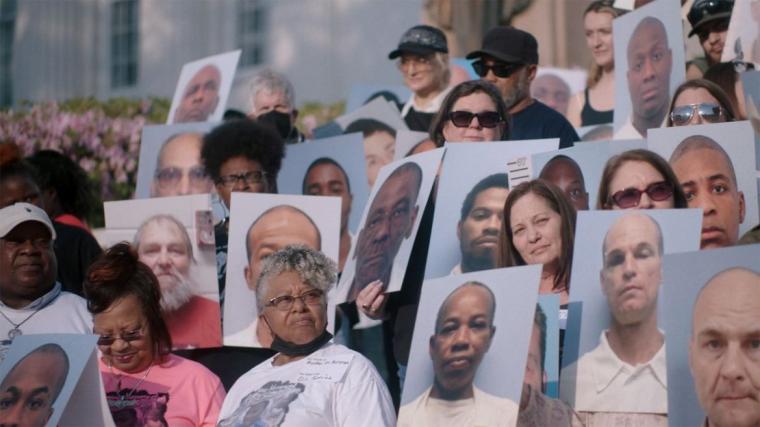
THE ALABAMA SOLUTION
Working my way through 2026 Academy Awards contenders I hadn't previously seen, I finally caught up with directors Andrew Jarecki's and Charlotte Kaufman's The Alabama Solution, an HBO original that was released this past October and is currently nominated for Best Documentary Feature. Viewers acquainted with Jarecki's 2003 Oscar nominee Capturing the Friedmans or, especially, his Emmy-winning Robert Durst saga The Jinx know that the documentarian can unsettle you like nobody's business. But he's actually not among the filmmakers who deliver the most powerful work here. Those contributors would be the incarcerated inmates of Alabama's Easterling Correctional Facility who upended Jarecki's and Kaufman's plan of merely documenting the prison's 2019 religious revival meeting, secretively revealing that they were enduring nightmarish conditions and innumerable human-rights violations. They had contraband cell phones, and were willing to share their footage.
What we see is certainly harrowing: physical abuse; grossly unsanitary quarters; acreage of prison space with no guards in sight. And Jarecki and Kaufman augment the astounding cell-phone footage with a side chronicle involving Alabama resident Sandy Ray, whose incarcerated son Steven Davis was beaten to death by prison guards, with Sandy demanding an explanation, from anyone, about how and why he died. (Several prisoners dispute the prison's public announcement that Davis was killed as a self-defense measure – an enactment of stand-your-ground laws, adopted from Florida, that were made more notorious in Netflix's fellow Oscar nominee The Perfect Neighbor.) But as grim and brutal and perversely watchable as The Alabama Solution is, it might be most fascinating, and troubling, as a personal litmus test.
Prison officials and Alabama lawyers consistently maintain that nothing untoward is happening within the state's detainment system. Alabama governor Kay Ivey blithely disregards public complaints – including the 2020 Department of Justice lawsuit against her state – and announces her plan for nearly $1 billion to create state-of-the-art penal facilities. A pair of snarky talk-show hosts are occasionally heard cruelly passing judgment on the prisoners' plight, à la “You're in prison – you're supposed to be treated like shit!” Jarecki and Kaufman force us to face the potential limits of our own prejudices toward the incarcerated, and ask us to consider when justifiable punishment becomes unjustifiable. Because it's not like Shawshank's unfairly convicted Andy Dufresne is suffering; the men we meet don't deny their crimes. They do insist, however, that they be treated as human beings, and this documentary is never more forceful, or heartbreaking, than when we witness state-wide prisoners joining together in a work strike against their inhumane treatment and realize how little the public, to say nothing of their jailers, really cares. The Alabama Solution hurts to watch. It should.
THE WRECKING CREW
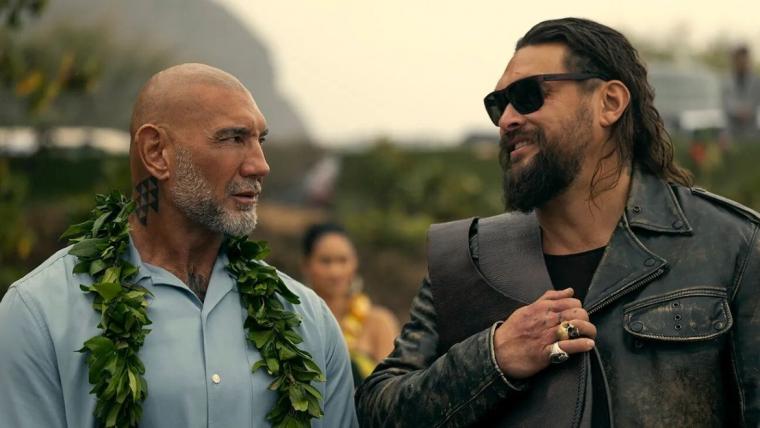
It's a filmed-entertainment cliché so familiar and prevalent that it really shouldn't bother me anymore. But when, in director Angel Manuel Soto's Prime Video action comedy The Wrecking Crew, Morena Baccarin, arguing with her ex over the phone, yelled “There's no way in Hell I'm going to Hawaii!” and there was a smash cut to the woman descending an escalator behind a title card reading “HAWAII,” I wanted to hurl my remote through the TV screen. Could anyone still be even mildly amused by this sort of baldly telegraphed switcheroo? For that matter, is there still an audience for a tiresome caper about warring buds (in this case brothers) who beat the crap out of each other before cementing their eternal bond, or a plot involving vengeful retribution and a missing flashdrive, or a climax that finds the heroes' girlfriends held captive by said flashdrive's holder, or by a finale involving a beach, an escalating helicopter shot, and an overused '80s pop hit on the soundtrack?
Yes. Yes, there is such an audience. This past weekend, I was among their number, hoping that the pairing of Dave Bautista and Jason Momoa – amusing, endearing screen presences and (you gotta admit) B-team members of the Marvel/DC universes – would provide some nominal fun. It doesn't. Momoa, at least, tries to lighten this streaming load. Although he's been a headliner for longer than his co-star, having assumed the title role for 2011's critically reviled Conan the Barbarian remake, the erstwhile Aquaman still seems like he's in his movie-star infancy and grandly enjoying the ride; he commits to his tantrummy-baby-brother act and screenwriter Jonathan Tropper's terrible punchlines in equal measure. But Bautista, who's the stronger actor of the two, can't seem to make peace with the tired genre goods he's being asked to sell, and his performance is so mood-dampening that even Momoa's aggressive cheer can't shake the once-and-probably-future Drax out of his doldrums. There's no point regurgitating the Wrecking Crew experience as a whole; it's precisely the sort of instantly dispensable, maddeningly dull time-killer the streamers routinely traffic in. Those Hawaiian vistas sure look enticing, though. And it's always pleasant to hear, as we do at the end, Phil Collins' “Take Me Home.” Were I watching this at the cineplex, I would've been singing its refrain in antsy anticipation. Singing it when I already was home was just sad.