
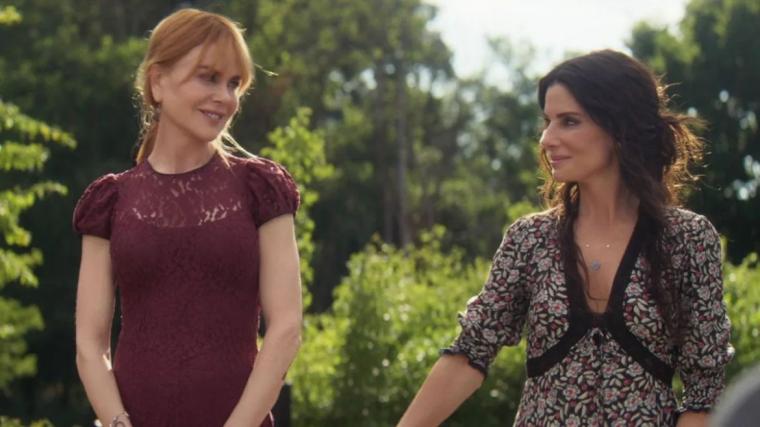
Nicole Kidman and Sandra Bullock in Practical Magic 2
PRACTICAL MAGIC 2
Either Hollywood has to stop making long-delayed sequels to unremarkable comedies or I need to start taking serious memory supplements, because for the second time in two months, I completely forgot about having seen a movie that I not only viewed, but reviewed.
Although I didn't make it to August's Super Troopers 3, I went on radio-show record stating that I didn't catch either of its predecessors, either, which led to one of the hosts proving that, eight years ago, I most certainly did. Then, last week, I professed on that same radio show and on television that I somehow never got around to 1998's Practical Magic until two days before attending Practical Magic 2. Streaming the original on HBO Max last Wednesday, I remembered nothing about the witchy cult hit beyond its basic premise, its two likable stars and two priceless co-stars, and the midnight-margaritas scene, which I presumed I knew only from film-clip montages. But considering that I had long been contributing weekly Reader reviews by the fall of '98, and because it seemed very unlike me to skip a release featuring Stockard Channing and Dianne Wiest (Sandra Bullock and Nicole Kidman, too), I went to my yellowing scrapbooks this morning to see what I instead chose to cover during Practical Magic's opening weekend. Turns out it was Jonathan Demme's Toni Morrison adaptation Beloved. Oh yeah … and Practical Magic. Granted, I probably shouldn't beat myself up for not recalling a movie I saw once 28 years ago and not again until five days ago. I'm still mortified at how thoroughly the first PM left my brain, and feel only moderately vindicated for opening my review – all 150 words of it – by saying that the film “boasts a magic trick in its very being: It's such a forgettable, lightweight, retrograde piece of piffle that it actually seems to disappear while you're watching it.”
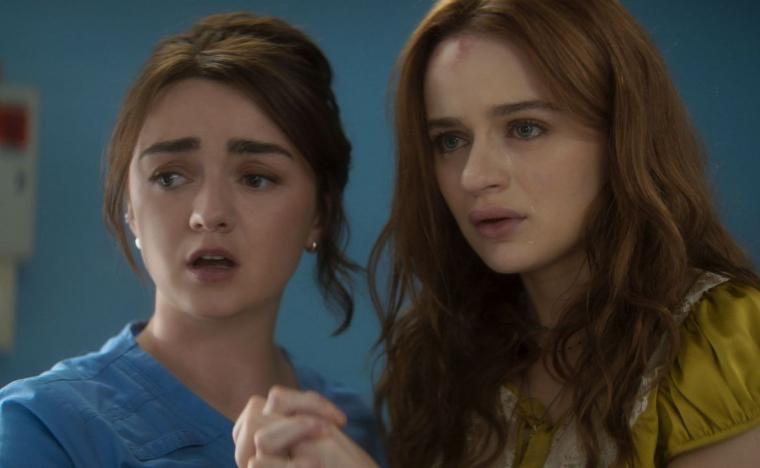
Who knows whether I'll recollect anything about Practical Magic 2 if the subject comes up in 2054. (My guess is that, should I make it to 86, I'll have – we'll all have – bigger things to worry about.) But with the benefit of a mere three days having passed, I'm happy to report that director Susanne Bier's sequel is at least significantly stronger than its forebear, though it's a measure of just how drippy PM1 is that the new outing is still only not-bad, at best. Primarily set a quarter-century after the events of the first film, PM2 reunites us with devoted witch sisters Sally and Gillian Owens (Bullock and Kidman), their eccentric spinster aunts Frances and Jet (Channing and Wiest), and Sally's now-adult daughters Kylie and Antonia (Joey King and Maisie Williams). A prelude reveals that, despite 1998's Happily Ever After, the family curse that dooms all men who love Owens women remains intact. (Aidan Quinn, we hardly knew ye.) In the hopes of sparing them future pain, Sally consequently casts a spell of her own, one that makes her daughters forget all about the clan's witchcraft bent. It's not remotely clear why Sally thinks the girls not knowing about their powers, or about the curse itself, will protect their potential romantic partners. Isn't she just setting her kids up for massive heartbreak when the inevitable does happen? The answer is yes, yes she is, as we discover when Kylie's beau Gideon (Xolo Maridueña) becomes comatose after being hit by a car, and Sally is forced to tell her children the truth.
Given that Bier's followup is based on Alice Hoffman's 2021 novel The Book of Magic, I suppose I can't blame screenwriters Akiva Goldsman, Georgia Pritchett, and Kelly Marcel for the dunderheaded and utterly pointless “Wait, we're magic?!” conceit that's of zero importance to the narrative. If anything, it actively hurts the narrative. Knowing about the curse, after all, didn't stop Sally from marrying (twice!) and didn't prevent Gillian from pursuing an evidently contended life of love-'em-and-leave-'em relationships. Why should things be different for Kylie and Antonia? Also, belatedly learning about their supernatural heritage and dormant powers doesn't alter either girl's character arc one iota. Antonia, whom the film appears shockingly uninterested in, remains dedicated solely to her hospital work and all but ignores the bombshell revelation – we aren't even given a moment in which, just for fun, she practices some minor witchcraft that might make her job easier (or her patients' lives better). As for Kylie, she merely stumbles upon an ancient book that might hold the secret to breaking the curse and saving Gideon's life. But she would've found that tome, and followed its lead to London, even if she did have advance knowledge of her gifts; she might've just found it and gotten there sooner. Sally hiding the truth was senseless. Her revealing the truth, however, proves to be largely meaningless.
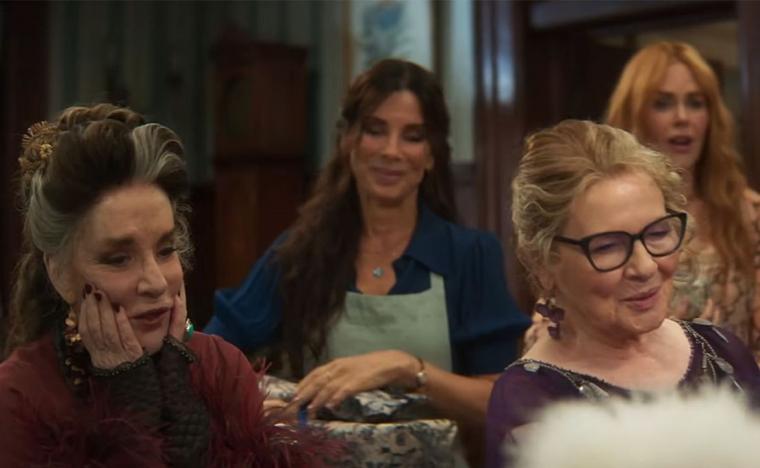
From what I can gauge, most of the complaints about the original Practical Magic stemmed from its awkward tonal blend: supernatural comedy meets abuse drama meets benign romance meets possession thriller meets empowerment saga. Unfortunately, that's kind of the deal here, too, though the abuse is blessedly less physical than emotional. What makes Bier's sequel far more winning that its predecessor is its choice to lean heavily into the laughs. Upon returning to the first movie last week, I giggled precisely once – at one of those breezily daffy readings that only Dianne Wiest can deliver. By contrast, I audibly chuckled a good dozen times at Practical Magic 2, though not, to my recollection, at any specific dialogue or action. It was the cadences that were funny. While Bullock and Kidman are undeniably finer performers now than the already-quite-good ones they were in '98, they're also immeasurably sharper comedians, and know just how to twist a line for maximum punch. Their freewheeling conversational rhythms alone are hilarious – Bullock and Kidman sound exactly like sisters who've been teasing each other for decades – and in the early and closing scenes especially, King and Williams truly seem genetically linked to the leads, particularly in regard to their easy, playful humor.
As should go without saying, Channing and Wiest are traditionally masterful, the former with her soulful throatiness and martini-dry wit, the latter with her effortless poignancy and beaming expressiveness. (I was delighted that the respective 82- and 78-year-olds weren't, as I feared, relegated to mere cameos; beyond scoring multiple laughs, all of the movie's considerable pathos is due to them.) And after Sally and Gillian follow Kylie to England, Lee Pace, playing witchcraft historian and potential love interest Ian, fits right in with the overall amiability that sometimes surprises you by turning genuinely clever. When Sally told Ian that she wasn't going to share her life story with a perfect stranger, Pace inspired a legitimate cackle with his sly, flirtatious reading of “Oh, I'm hardly perfect.” Practical Magic 2 is also hardly perfect. But it's fitfully entertaining and easy to sit through, and my semi-fond memories of it might just last longer than a week … though, obviously, I won't be making any promises.
THE UPRISING
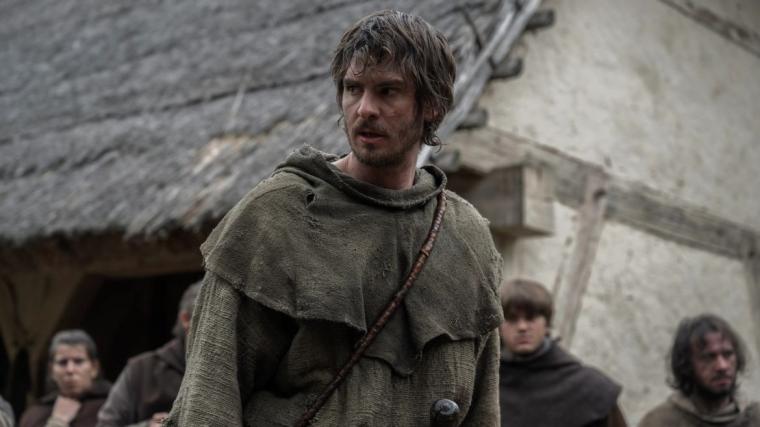
Paul Greengrass' brutal historical drama The Uprising has so many good things going for it that it was bewildering, and a little heartbreaking, to see it go so thoroughly off the rails in its final scenes. A telling of the Peasants' Revolt of 1381 England that has rarely (if ever) been visualized onscreen, the film casts Andrew Garfield as the unnamed Ploughman who unwittingly instigates an insurrection against the teenage king Richard II (Woody Norman) for the monarchy's unfair tax hikes, and it boasts arresting hand-held cinematography (by Pål Ulvik Rokseth), a typically thunderous Volker Bertelmann score, and a number of harrowing sequences. Rather notoriously, prior to its release, writer/director Greengrass' movie was also briefly marketed in the U.S. as The Uprising: The Rise of Robin Hood. Although the script never explicitly implies that Garfield's Ploughman turns into Hood, I can definitely see why people – studio marketing teams, specifically – would make that assumption. But the figure of that former subtitle, ironically, is everything that's wrong with the picture, which only jarringly fails when this otherwise sober, gripping offering threatens to turn into a prototypical action blockbuster – something everyone's favorite forest-dwelling robber in green tights would conceivably headline.
Not knowing anything about this particular, prolonged incident in British history, I found most everything to do with the politics of the revolt fascinating. How Richard, incapacitated by nightmares and feelings of inadequacy, let royal rule fall to his council, who taxed the bejeezus out of the working class rather than ask for more from merchants or (God forbid) the Church of England. How the peasantry violently attacked and murdered tax collectors, eventually taking their mob directly to London to face the king. How Richard initially sent representatives to placate the masses before finally agreeing to meet them himself and acquiesce to their demands. How this detente proved, ultimately, to be bullshit. Greengrass has hold of an enormously compelling and tragic tale here, and his script generally makes everyone's actions and responses lucid and convincing – although, admittedly, the editing choices do occasionally make cause-and-effect confusing. (After Ploughman kills a tax collector at a marketplace mid-day, the action abruptly shifts to that evening, leaving us to wonder how the guy got out of the town square without being arrested or worse.)
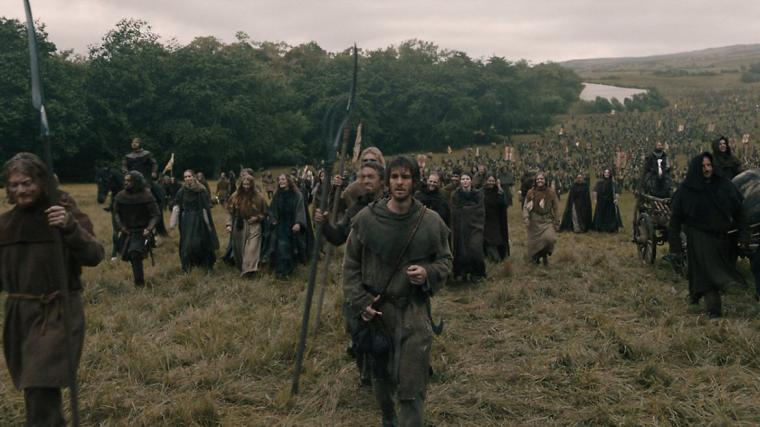
As he has proven in such works as United 93 and Captain Phillips, Greengrass can be a wizard in the staging of tightly coiled pressure cookers, and The Uprising demonstrates that he can perform similar wonders on a much grander scale. The scenes of untold hundreds or thousands covering the landscape in unified fervor are staggering (and don't appear to have been GCI-generated), with the hand-to-hand combat suitably ugly and wrenching. Meanwhile, the actors perform more than commendably, Garfield's fearsome, anguished turn in an underwritten role abetted by the contributions of Jamie Bell, Cosmo Jarvis, Katherine Waterston, Stephen Dillane, and the prodigious Woody Norman. This is the BAFTA-nominated kid who, as a tween, casually out-acted screen dad Joaquin Phoenix in 2021's C'mon C'mon, and he's freakishly good as the young Richard II, his haunted presence and intensely focused gaze suggesting an out-of-his-depth young man who's terrified, pitiable, and, quite possibly, utterly insane.
Yet the specter of Robin Hood, or “Robin Hood,” hovers over the film, and is apparent whenever events lean in the direction of blockbuster formula. You feel it in each appearance of Thomasin McKenzie as a young rebel and potential (thankfully unrealized) love interest who looks inappropriately glam surrounded by armies of brutish, mud-covered men. You feel it in the aggressive stuntwork that seems a tad too polished. You feel it when, toward the climax, Ploughman essentially becomes a one-man-band action hero, performing solo executions with John Wick-style finesse. And you really feel it in the deeply unnecessary and unfortunate “one year later” postscript, a device that is, in itself, a Hollywood cliché, and becomes even more of one with the revolt's tragedy all but undone by virtue of awkwardly tacked-on triumph. The Uprising may be about a revolt, but pandering of this magnitude is truly revolting.
RUNNER
It took many, many years for famously blacklisted screenwriters to receive proper credit for their work during America's Communist-averse “Red Scare” period of the '40s and '50s – writers such as Dalton Trumbo, who won Oscars for 1953's Roman Holiday and 1956's The Brave One under noms de plume. Is it possible that, some years down the line, we may learn that a number of names cited as screenwriters for recent films are, in truth, aliases for AI? I'm not suggesting that Miles Hubley and Tommy White, the credited screenwriters for director Scott Waugh's new action comedy Runner, are imaginary. They're acknowledged as cameramen for 2009's Oscar-winning documentary The Cove, and have also apparently co-written a trio of shorts together. But man alive, the duo's latest script sure sounds like something crafted by artificial intelligence. And to add to the conspiracy theorizing, it was included on 2023's official roster of most-admired unproduced screenplays, an annual compilation known as … The Black List. Coincidence?!
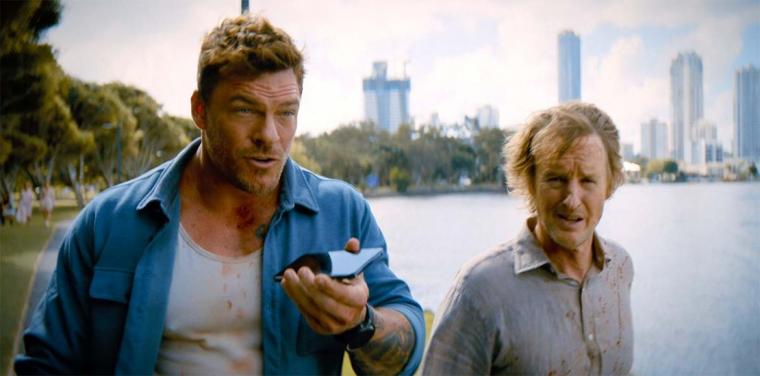
At the very least, Hubley and White have done a topnotch job of suggesting a script wholly devoid of any human touch. Runner's hero is Alan Ritchson's Hank Malone, a former Navy SEAL now in the business of transporting goods, legal and otherwise, for a shady handler. That's a pretty rote character type, so the script makes sure that Hank is “quirky,” too – having him recite French-pronunciation in the car and refusing to work until he's finished his croque monsieur breakfast. Hank's comic foil is Owen Wilson's Ben Bishop, an excitable blabbermouth whose personal transported good is a human liver on its way to a dying little girl. Suffice it to say that the leader of a Colombian cartel (Rodrigo Santoro) wants the liver and will do anything to get it, and sturdy Hank Malone – whose own little girl died from leukemia – will do anything to make that transplant happen. In essence, it's Midnight Run with a refrigerated organ. Ask Claude to compose a “Midnight Run with a refrigerated organ” screenplay and I'm pretty sure it would spit out Runner.
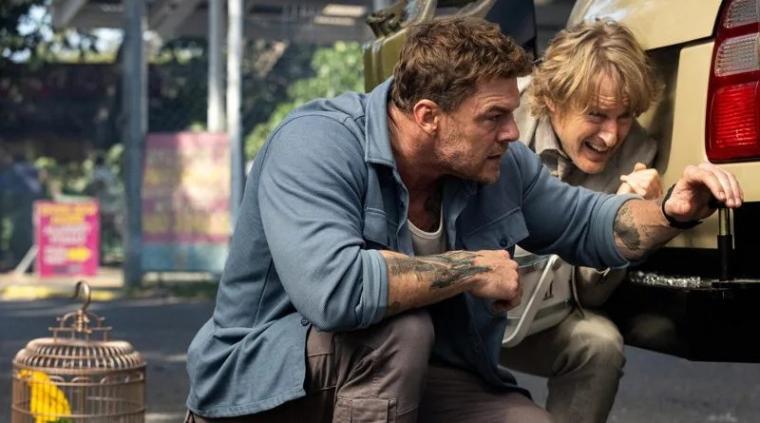
Honestly, I'm a little surprised that Waugh's movie didn't simply debut on a streaming platform where it's sure to soon fade into oblivion. Despite the random eccentricities (The croque monsieur! The parakeet! The turncoat hospital staffer!), there's precious little personality or novelty on display, characters keep reiterating plot points every 10 or 15 minutes to make sure we're kept in the loop, and you can easily comprehend the film without literally watching it. In some cases, this strategy might even make the goings-on make more sense. Roughly four minutes are spent in the doorway of Hank's ex-wife's house as he and Ben attempt to borrow a car from the woman and her new hubby, neither of whom acknowledges that the men's shirts are stained with blood.
Still, it's harmless enough. Ritchson hasn't yet forged an identifiable screen persona beyond “brick shithouse,” but he's fairly genial and is clearly trying hard, and Owen Wilson does his Owen Wilson thing expertly. Runner's finest performance, however, is actually given by its director, who stages one late-in-the-day car chase with spectacular enthusiasm and inventiveness, the camera whizzing in and out of half-demolished vehicles in what appears to be a single take. Considering how many dead bodies pile up, Waugh also keeps the bloodshed to an admirable PG-13 minimum, and at no point in this Angel Studios entertainment boasting rampant gunfire, savage cartel goons, and a desperate mother at the height of her pissed-off-ness does anyone, ever, drop the F-bomb. That's one fewer time than you'll hear the word in Practical Magic 2. F---ing amazing.
HOPE
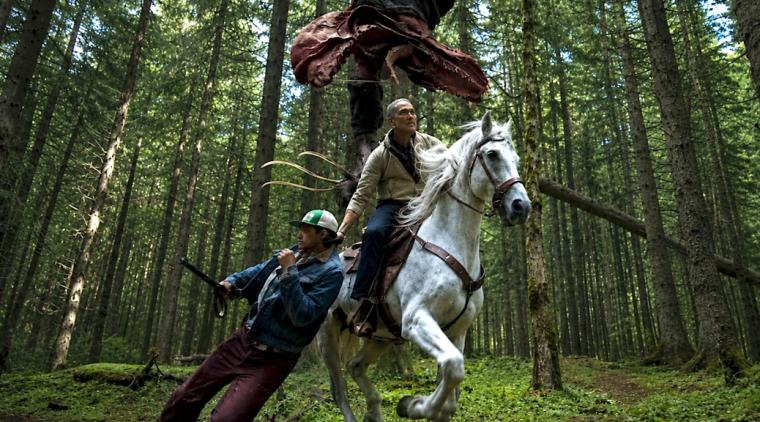
It isn't any ol' South Korean monster movie that opens with the official seal of recognition from the Cannes Film Festival, at which writer/director Na Hong-jin's feature competed for this year's Palme d'Or. Then again, it isn't any ol' South Korean monster movie that runs 156 minutes, features at least one expletive in nearly every subtitled sentence, and boasts a monster who, after a few seconds of slack-jawed astonishment, makes you ask, “Is that Michael Fassbender?!” (Your lunatic guess will be correct, and Fassbender's real-life wife, Oscar winner Alicia Vikander, appears as another of the otherwordly creatures alongside Timothèe Chalamet's Bones & All co-star Taylor Russell.) Needless to say, Hope is abjectly nuts. It's also, frequently, a helluva lot of fun, if also way too long and unduly repetitive. While the meat is delicious, it's hampered by too much stuffing.
Nothing if not a miracle of production-design debris, Na's film concerns a small town on the border of the Korean Demilitarized Zone, where, after a mere 15 minutes of anticipatory setup, a gigantic humanoid creature of some sort is in the process of demolising the area beyond comprehension. The only law enforcement initially on site, police chief Ko Bum-seok (Hwang Jung-min), is an anxious and cowardly reactionary whose policy appears to be “Shoot first, ask questions later.” It's also Ko, however, who first notices a strange expression on the beast's face while it's destroying the populace – is it crying? – and as Hope progresses and the vengeful parties include the chief's unruly second cousin Sung-ki (Zo In-sung) and rookie subordinate Sung-ae (Jung Ho-yeon), we're invited to question who the movie's villains truly are. Is it the race of toothy predators that devour humans while leaving animals dead but intact, or the humans who have perhaps provided good reason to appear on the snacking table?
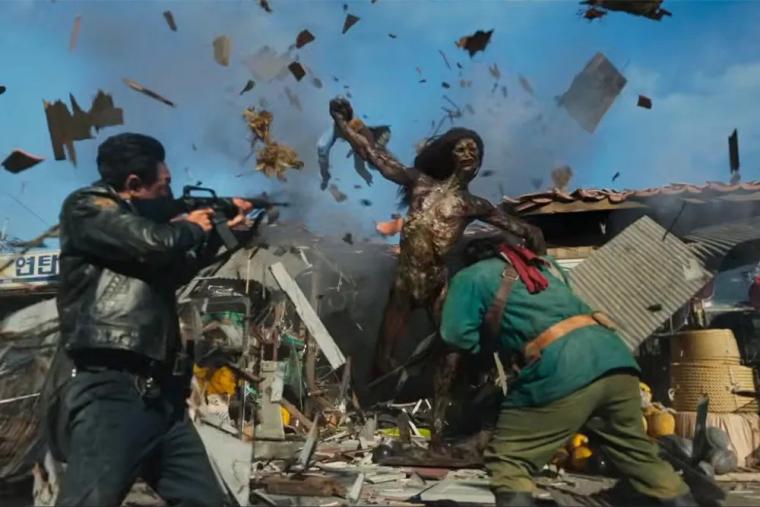
Ever since hearing of the film's divisive reaction at Cannes, a festival historically unused to effects-driven blockbusters, I've wanted to love Hope so much that I'm honestly disappointed that I only wound up liking it a lot. Na's dazzlingly executed action set pieces are both relentless and gloriously protracted – I'm pretty sure the first scene of downtown monster peril lasts a full half-hour – and given a budget of roughly $46 million American, this feature looks extraordinary. (Its cinematographer is Hong Kyung-pyo, who also shot Parasite.) To what will inevitably be some viewers' displeasure, little of that money appears to have been spent making the CGI appear seamless. Yet I'll take imagination over verisimilitude every time, and the monster effects here are legitimately breathtaking. Until they take human-ish form, these potentially intergalactic beings don't look quite like any other space creatures you've ever seen – they're thinner, and slicker, and equally adept running on two legs or four. They also wreak major havoc, and I wasn't the only one in my auditorium who reflexively flinched when one of them – the one “played” by Emmy-nominated Mindhunter psychopath Cameron Britton (!) – hurled a chunk of rubble directly at the screen. I felt immediate kinship with those viewers of 1903's The Great Train Robbery who ducked for cover when that locomotive approached.
Hoo-boy, though, is this thing long – by which I mean it feels long, as plenty of movies running two-and-a-half hours and change seem to zip by in an instant. And the action sequences, happily, do make the time spent mostly irrelevant, even if the carnage begins repeating itself with 45 minutes to go. It's a bunch of Na's meant-to-be-comedic interludes that appear to last forever: Ko and a grumpy ally taking an eternity to decide what to do with an injured body or whether to enter an decimated building; Sung-ki and his boorish, gun-toting allies grossly feasting in the woods (and, in the process, overplaying the movie's “Who are the real monsters?” subtext); an elderly man reciting an unfunny, exceedingly tiresome scatological monologue to make Christopher Walken's Pulp Fiction soliloquy sound like Jane Austen. By the closing credits, I was more than ready to stretch my legs. I was also totally grateful for the copious weirdness of what I just saw, and not at all dismayed by the climax's hint of a potential sequel. Let's keep Hope alive.