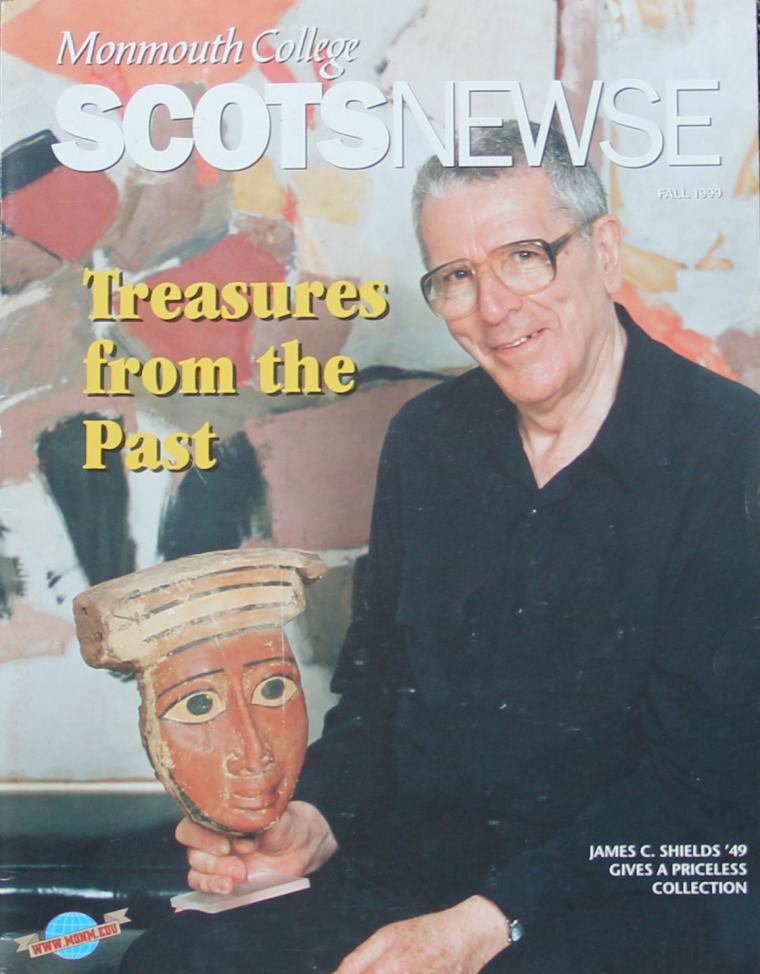
Exactly fifty years after graduating from Monmouth, Shields was pictured on the cover of the Fall 1999 alumni magazine
MONMOUTH, ILLINOIS (May 28, 2026) — Inside the quiet workspaces of Monmouth College's Hewes Library, history is being carefully preserved and rediscovered, one artifact at a time.
This spring, students in the 200-level history course "Archives" worked hands-on with the James Christie Shields Collection of Art and Antiquities, one of the college's most remarkable historical resources. Under the guidance of college archivist Lynn Daw, students spent the semester inventorying, preserving, and studying artifacts collected over a lifetime by Shields, a 1949 Monmouth graduate whose passion for history eventually filled his New York City apartment.
Far more than a traditional museum collection, the Shields Collection was intended to be touched, studied, and experienced by students.
"It is meant to be a teaching collection," said Daw.
"Shields wanted it to be taught across the curriculum. It needs to be looked at and learned from. I think at a bigger institution it would be overlooked and become just 'one more collection.' It's accessible here and fits into so many studies."
That accessibility has allowed students to engage with history in ways few undergraduates typically do.
Throughout the semester, the students carefully compared documentation to physical artifacts, rehoused delicate objects in archival-safe materials, and relabeled items using museum-standard preservation methods.
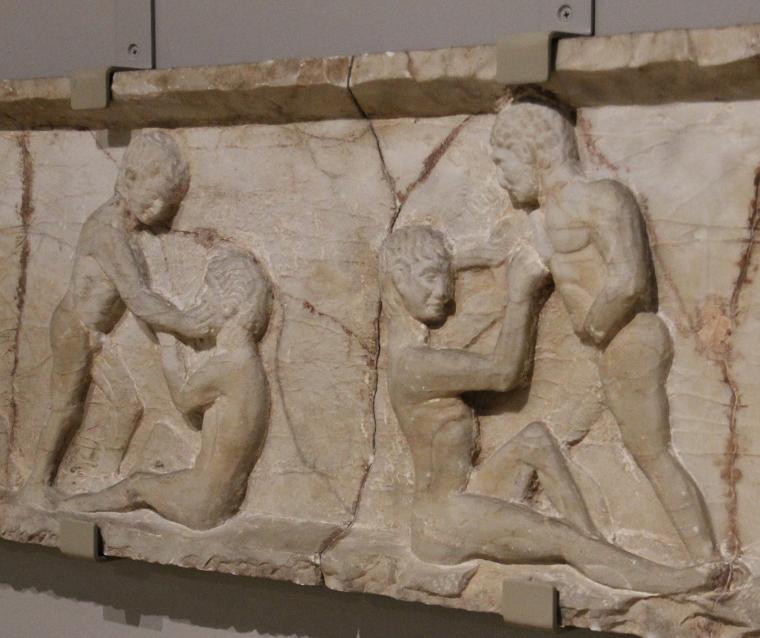
It's not every day you can be face to face with an item that's 2,500 years old, which is the case with this piece from the college's James Christie Shields Collection of Art and Antiquities
The work demanded patience and precision. Many of the objects had originally been stored in bubble wrap, which deteriorates over time and can damage artifacts. Students replaced those materials with buffered tissue, inert poly fiber, and Tyvek to ensure safer long-term preservation. Daw emphasized that preservation is as much about understanding objects as it is about protecting them.
"Primarily, students are learning that it is a process. There is no rush," she said.
"There is no better way to get to know a collection of anything than to spend time with it and understand it. That makes you better able to preserve it, take care of it, describe it and share it."
At first, it felt a bit daunting," said Dante Sardelli ('26) of Woodstock, Illinois. "Some of these items were over 2,000 years old, and of course one has to be very delicate. The more I kept working with them, the more I fell in love with the collection and the archival world. Being able to work with Lynn Daw and the collection really made me appreciate the preservation work that archivists do."
Notes on the collector
The collection itself reflects the personality and curiosity of Shields, who described himself as a "pack rat" fascinated by civilization and history. Born in Ethiopia to missionary parents, Shields spent his life collecting artifacts that connected him to cultures and civilizations across centuries.
"There are over 700 items from around the world, spanning multiple centuries from the age of the Ming dynasty to the Classical Period to pieces made in the 1950s," said Sardelli.
"Shields proudly displayed his exhibit of what others might call 'eccentric' pieces in his Greenwich Village apartment."
After graduating from Monmouth, Shields earned a Master's degree from the University of Pittsburgh, studied at Yale University, and taught English at several institutions before spending 25 years at the Collegiate School in New York City, where he served as head of the English department until his retirement in 1991.
For students, some of the most fascinating pieces in the collection were not necessarily the largest or most valuable artifacts, but the smaller everyday objects that once belonged to ordinary people.
"Small things — little everyday items, vases, amulets," Daw explained.
"Things that they understand once belonged to someone and meant something to the owner."
The collection connection
As part of the course, students also curated displays for the library exhibit, selecting pieces that personally resonated with them during the inventory process. Some chose artifacts because they were visually striking, while others were drawn to the stories and craftsmanship behind them. Daw said one of the semester's most memorable moments came from watching students form personal connections with historical objects.
"As corny as it sounds, the best discoveries come by seeing the students react to 'old things,'" she said.
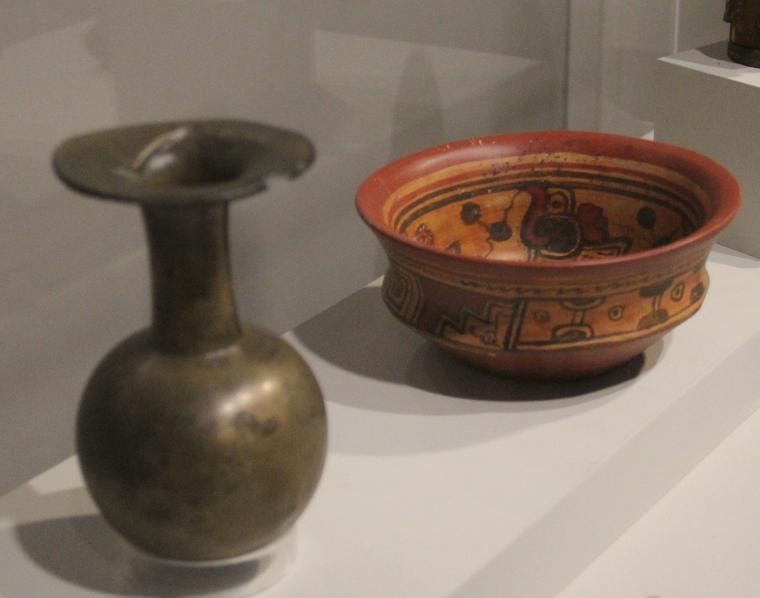
A Mayan bowl is pictured next to a drinking vessel that is approximately 2,500 years old
"Watching them discover or maybe re-discover an object and find its inherent value is what is truly priceless."
One such moment occurred when Jenn Ruscitti ('26) of Ingleside, Illinois, worked with a piece of Roman blown glass for her exhibit display. While she understood intellectually that the object was fragile, physically holding it transformed her perspective.
"You know it's glass and that glass is fragile and pretty," Daw said, "but when she picked it up and realized that it literally weighs next to nothing, then she really felt the fragility, the craftsmanship, the passage of time, and the need to preserve."
Beyond the artifacts themselves, the collection offers a rare glimpse into the life of the collector behind it.
Shields meticulously documented his acquisitions, preserving notes, photographs, receipts, and personal reflections alongside the objects.
"The whole of the collection speaks to that," said Daw.
"For each piece, we have his notes, his cancelled checks, his personal thoughts about the object, his photographs of them. This is good stuff. We have the collection, but we also have the collector icing on the cake."
Ruscitti and Sardelli were joined in the class Sabrina Ochs ('27) of Geneseo, Illinois, and Kyra Bivins ('27) of Esmond, Illinois.