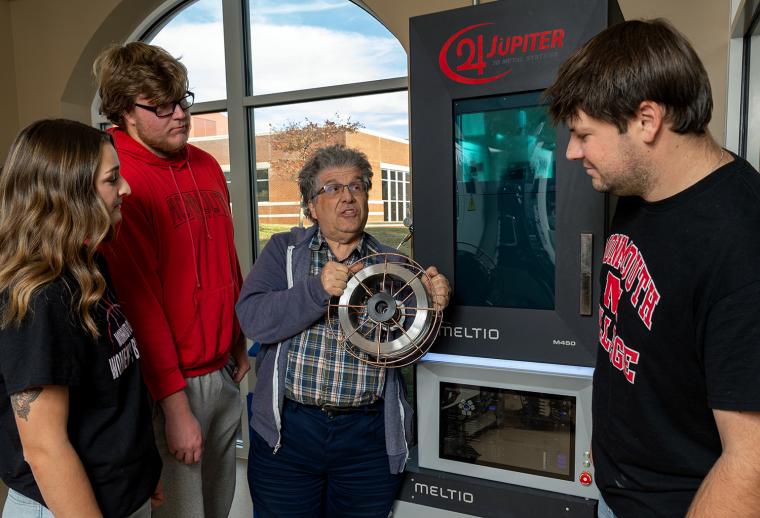
The longtime Monmouth faculty member, who serves as the college's Martha S Pattee Professor of Science, will spend the upcoming academic year in the nation's capital through an American Physical Society program
MONMOUTH, ILLINOIS (May 27, 2026) — The concept of a sabbatical is a familiar one on college campuses, as faculty members take leave for a semester or two, typically to broaden their knowledge in their chosen discipline through intensive research. The experience helps them revitalize their scholarship and bring back fresh perspectives to their students.
The leave of absence that Monmouth College physics professor Chris Fasano will take for the 2026-27 academic year goes beyond that realm. He won't be writing a book or developing new courses. Rather, Fasano will serve as a Congressional Science Fellow in Washington DC, working directly with an office or committee on Capitol Hill to help shape national policy.
The idea behind the American Physical Society's program is that only a handful of lawmakers have science degrees, yet Congress sets policy on issues that hinge on sound science, from climate and energy to national security and STEM education. The Congressional Science Fellowship closes that gap by placing an APS member with a congressional office or committee each year, where they lend their training and expertise to help make science part of the legislative conversation.
Three areas of interest
"I'll be able to talk directly about STEM with staffers, discussing issues that are important, and I'm going to learn a lot about how things work," said Fasano, who is going into the program with three major areas of interest, noting, "I could wind up being involved with any one of the three areas, or it could be some type of mixture of them."
Fasano's areas are STEM research and educational funding; energy policy, which draws on his background in nuclear physics; and agricultural issues, thanks to a start-up company he was involved with a few years ago and, simply, "just living here in the Midwest," he said, adding, "Having a STEM background and an interest in agriculture is really golden for them on the Hill."
Regarding energy, Fasano noted, "With the rise of electric cars and AI, there are a lot more demands on electricity, so energy policy is huge."
And, as a professor, educational funding is naturally an interest.
"Developing talent in STEM is a decades-long process — from middle school, to high school, to college, to graduate school, to post-doc," said Fasano. "We want to maintain that educational pipeline to get people through, or maybe there's a new way to do it. It's a really critical time for STEM as we compete with other countries for talent, compete for ideas."
Fasano said the program starts with a "two-week crash course [sponsored by the American Association for the Advancement of Science] on how government really works." After that, he said it's like being asked to prom — or to coaches turning their chairs on The Voice — as "offices make bids to you to come join them.
You'll have several offers, and you can pick the one that's most interesting to you."
Fasano will be helping lawmakers, but there will be benefits coming his and the college's way, as well.
"It's a nice opportunity," he said. "Former fellows have spoken glowingly about the networking and the contacts you make. They say, 'You won't believe who will call you,'" with the president of Johnson and Johnson being just an example of who might be on the other end of the line.
A door has already opened for Fasano, who won't even start his assignment until September 1.
"It was a fairly elaborate process of application," said Fasano, who was flown out to Washington and interviewed, simultaneously, by more than a half-dozen people. "I thought it went OK, but I wasn't sure if it went that well."
So he was surprised to hear back the next day that his interview was well received — so well, in fact, that officials were giving him the choice of staying with the Congressional Fellow program or taking a newly-created position on educational policy. Fasano decided to stay with the fellowship, but the policy position — which wouldn't require full-time work in Washington — could still be an option in the future.
For the next year, though, Fasano will spend the lion's share of his time in the nation's capital.
"I will come back to campus often," though," he said. "The program has good support for travel. There are things I want to do here — students and new faculty members I want to work with."