
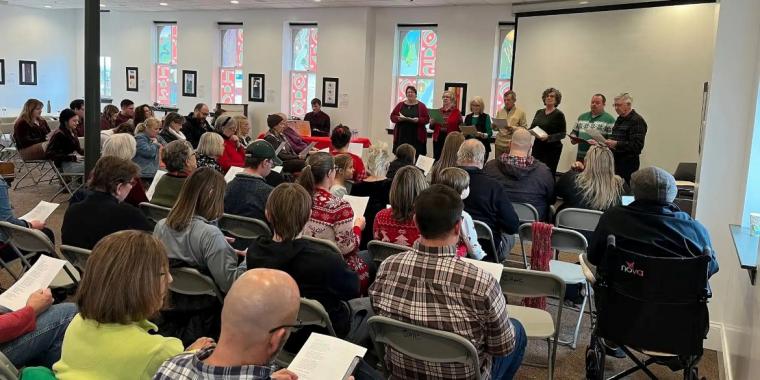
“German Holiday Sing-Along" at the German American Heritage Center -- December 21.
Sunday, December 21, 2 p.m.
German American Heritage Center, 712 West Second Street, Davenport IA
With the December 21 event designed to inspire holiday cheer and nostalgia through the crooning of classics including "O Tannenbaum" and "Stille Nacht," guests of Davenport's German American Heritage Center are invited to join the fun of the German Holiday Sing-Along, a celebration of beloved compositions presented in the final "Kaffee und Kuchen" program of 2025.
The notion of singing carols at Christmas, as stated at IAmExpat.de, "dates back thousands of years. In pre-Christian times, pagans would sing songs at celebrations that marked the changing of the seasons, including at the Winter Solstice, the shortest day of the year. At the time, singing celebrations were actually held during all four seasons, but only the tradition of singing carols at Christmas has really survived.
"As Europe was gradually Christianised, the birth of Jesus began to be celebrated around the same time as the Winter Solstice, and Christianity-themed hymns overtook the pagan songs. In 129 AD a bishop decreed that a song called Angel’s Hymn should be sung at a Christmas service in Rome - that song is generally regarded as one of the first ever Christmas carols.
"Over time, more and more Christmas carols were composed, but as they were mostly written and sung in Latin (a language that most normal people couldn’t understand), they weren’t hugely popular. It wasn’t until the 13th century, when popular Christmas songs in regional languages began to develop, that Christmas carols really took off and began to spread across Europe.
"Most of these early songs were originally communal songs sung during celebrations such as harvest time; it was only later that they began to be sung in church and specifically associated with Christmas. In Germany especially, carols increased in popularity during the Reformation. Reformers like Martin Luther liked music and encouraged the use of songs in worship. By the 19th century, carols were being collected and printed in popular collections."
Regarding "O Tannenbaum," otherwise known as "Oh Christmas Tree," the site says, "Believe it or not, but one of the world’s most famous Christmas carols actually has nothing to do with Christmas. Set to the tune of a traditional folk song, the lyrics to 'O Tannenbaum' were written in 1824 by an organist and composer from Leipzig, Ernst Anschütz. The tree that inspired the song was not actually a Christmas tree, but an ordinary fir tree, whose evergreen branches Anschütz took as a lovely symbol of constancy and faithfulness. It was only later, as the custom of the Christmas tree developed during the 19th century, that the song came to be seen as a Christmas tree carol. At some point, Anschütz’s description of the tree as 'treu' (true or faithful) morphed into the word 'grün' (green) - and the rest, as they say, is history."
As for "Stille Nacht," a.k.a. "Silent Night": "This world-famous Christmas song comes to us from a small Austrian village called Oberndorf. The story goes that, on a cold Christmas Eve in 1818, a pastor called Joseph Franz Mohr was desperately looking for a carol to sing at his midnight mass service later that evening. He picked up a Christmas poem he’d written a few years earlier and took it to his friend Franz Gruber, an organist who lived in a neighbouring village. Gruber allegedly composed the melody for Mohr in just a few hours, and the Christmas service was saved! Since recent flooding had put the church organ out of action, the original composition was laid out for a guitar."
The German Holiday Sing-Along will be held at Davenport's German American Heritage Center on December 21, with refreshments for this “Kaffee und Kuchen” event served at 1:30 p.m. and the musical fun beginning at 2 p.m. Participation is free for Heritage Center members and $8 for non-members, and more information is available by calling (563)322-8844 and visiting GAHC.org.