“The Holocaust by Bullets: The Twisted Path to Auschwitz" at the German American Heritage Center -- April 26.
Sunday, April 26, 2 p.m.
German American Heritage Center, 712 West Second Street, Davenport IA
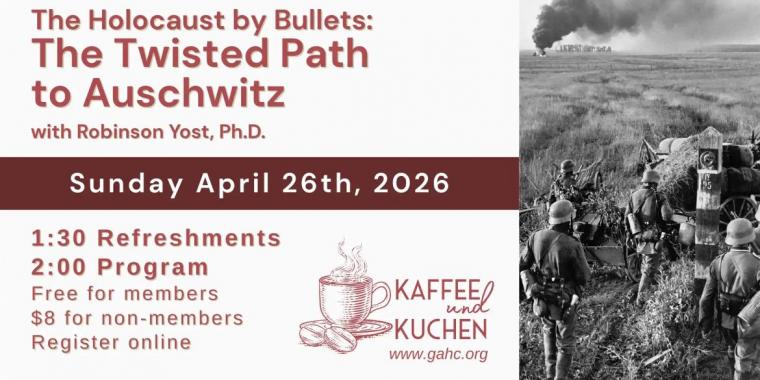
Taking place as part of the venue's popular "Kaffee und Kuchen" series on April 26, the German American Heritage Center's The Holocaust by Bullets: The Twisted Path to Auschwitz will demonstrate how, on June 22, 1941, the German military invaded the Soviet Union in the largest military assault in history – code-named Operation Barbarossa – with four elite SS mobile killing units called Einsatzgruppen. Guests are invited discover the critical role that these units played in the evolution of the Nazi-directed genocide, and why this "Holocaust by Bullets" led directly to the opening of extermination camps.
Operation Barbarossa put into action Nazi Germany's ideological goals of eradicating communism and conquering the western Soviet Union to repopulate it with Germans under Generalplan Ost, which planned for the removal of the native Slavic peoples by mass deportation to Siberia, Germanisation, enslavement, and genocide. The material targets of the invasion were the agricultural and mineral resources of territories such as Ukraine and Byelorussia and oil fields in the Caucasus. The Axis eventually captured five million Soviet Red Army troops on the Eastern Front and deliberately starved to death or otherwise killed 3.3 million prisoners of war, as well as millions of civilians. Mass shootings and gassing operations, carried out by German paramilitary death squads and collaborators,[h] murdered over a million Soviet Jews as part of the Holocaust.
In the two years leading up to the invasion, Nazi Germany and the Soviet Union signed political and economic pacts for strategic purposes. Following the Soviet occupation of Bessarabia and Northern Bukovina in July 1940, the German High Command began planning an invasion of the country, which was approved by Adolf Hitler in December. In early 1941, Soviet leader Joseph Stalin, despite receiving intelligence about an imminent attack, did not order a mobilization of the Red Army, fearing that it might provoke Germany. As a result, Soviet forces were largely caught unprepared when the invasion began, with many units positioned poorly and understrength.
The invasion began on June 22, 1941 with a massive ground and air assault. The main part of Army Group South invaded from occupied Poland, and on July 2, was joined by a combination of German and Romanian forces attacking from Romania. Kiev was captured on September 19, which was followed by the captures of Kharkov in October and Rostov-on-Don in November, by which time most of Crimea had been captured and Sevastopol put under siege.
Ultimately, the failure of Operation Barbarossa reversed the fortunes of Nazi Germany. Operationally, it achieved significant victories and occupied some of the most important economic regions of the Soviet Union, captured millions of prisoners, and inflicted heavy casualties. The German high command anticipated a quick collapse of resistance as in the invasion of Poland, but instead the Red Army absorbed the German Wehrmacht's strongest blows and bogged it down in a war of attrition for which Germany was unprepared. Following the heavy losses and logistical strain of Barbarossa, German forces could no longer attack along the entire front, and their subsequent operations – such as Case Blue in 1942 and Operation Citadel in 1943 – ultimately failed.
Presenting The Holocaust by Bullets: The Twisted Path to Auschwitz in Davenport is Robinson Yost, Ph.D. Since earning a PhD in History from Iowa State University in 1997, Yost has taught a variety of history courses at Kirkwood Community College after being hired full-time in 2000. He has taught the Holocaust & Genocide course there for almost 20 years. Also, Yost has visited several sites in Germany, Poland, Italy, and the Czech Republic, including the first concentration camp (Dachau), the site of the annual Nazi Party Rallies (Nuremberg), the largest transit camp (Terezin), and the largest and deadliest extermination camp (Auschwitz-Birkenau).
The Holocaust by Bullets: The Twisted Path to Auschwitz will be presented at Davenport's German American Heritage Center on April 26 with refreshments for this “Kaffee und Kuchen” event served at 1:30 p.m. and the program beginning at 2 p.m. Guests are welcome to bring their own mugs if they wish; disposable cups are provided, but mugs from home will help the venue reduce waste. Participation is free for Heritage Center members and $8 for non-members, and more information is available by calling (563)322-8844 and visiting GAHC.org.