
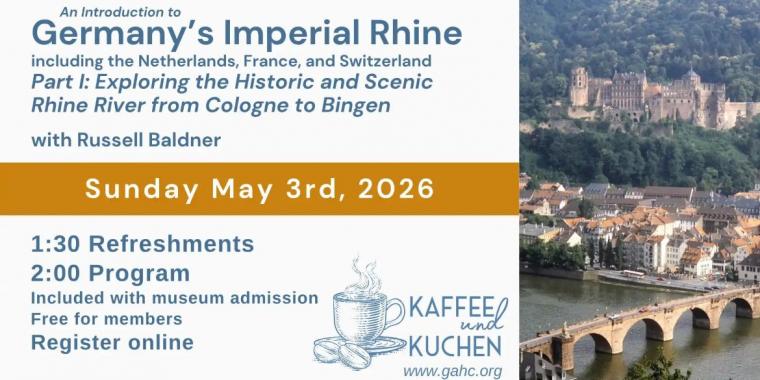
“An Introduction to Germany's Imperial Rhine: Part I" at the German American Heritage Center -- May 3.
Sunday, May 3, 2 p.m.
German American Heritage Center, 712 West Second Street, Davenport IA
With the first part of presenter Richard Baldner's program, guests of Davenport's German American Heritage Center will be treated to An Introduction to Germany's Imperial Rhine on May 3, a fascinating exploration of Western Europe's second-longest river delivered as part of the venue's popular "Kaffee und Kuchen" series.
Baldner's presentation features an extensive visual and interpretive review of significant cities, sites, and attractions on the Lower and Middle Rhine from Cologne to Koblenz and passage through the romantic scenic Rhine Gorge and its remarkable succession of castles, fortresses, and notable locations, ending at Bingen. Part I incorporates a broad selection of personal on-site photography taken by the presenter during several Rhine River sojourns and visits to locations along the Rhine.
The Rhine is one of the major rivers of Europe, beginning in the Swiss canton of Graubünden in the southeastern Swiss Alps. It forms part of the Swiss-Liechtenstein border, then part of the Swiss-Austrian border. From Lake Constance downstream, it forms part of the Swiss-German border. After that the Rhine defines much of the Franco-German border. It then flows in a mostly northerly direction through the German Rhineland. Finally, the Rhine turns to flow predominantly west to enter the Netherlands, eventually emptying into the North Sea. It drains an area of 185,000 km2.
The Rhine is the second-longest river in Central and Western Europe (after the Danube), at about 1,230 km (760 miles) with an average discharge of about 2,900 m3/s. It also contains the most powerful waterfall in Europe, the Rhine Falls. The Rhine and the Danube comprised much of the Roman Empire's northern inland boundary, and the Rhine has been a vital navigable waterway bringing trade and goods deep inland since those days. The various castles and defenses built along it attest to its prominence as a waterway in the Holy Roman Empire. Among the largest and most important cities on the Rhine are Cologne, Rotterdam, Düsseldorf, Duisburg, Strasbourg, Arnhem, and Basel.
As a youth, program presenter Russell Baldner's early affection for the German language and history led to B.A. and M.A. degrees in history and undergraduate and graduate study in German, anthropology, and archaeology, as well as a career in education and a lifetime of research, publication, and public speaking in those and related fields. Those same historical and linguistic interests also led to repeated sojourns in ancestral Germany, most recently in October of 2024. In September of 2022, Russ and wife Cathryn hosted “Medieval to Modern Hearts of Germany,” a two-week, 17-member group tour in northeastern Germany proposed, named, and largely designed by Baldner in conjunction with and sponsored by the University of Northern Iowa, his alma mater.
An Introduction to Germany's Imperial Rhine: Part I will be presented at Davenport's German American Heritage Center on May 3 with refreshments for this “Kaffee und Kuchen” event served at 1:30 p.m. and the program beginning at 2 p.m. Guests are welcome to bring their own mugs if they wish; disposable cups are provided, but mugs from home will help the venue reduce waste. Participation is free for Heritage Center members and $8 for non-members, and more information is available by calling (563)322-8844 and visiting GAHC.org.