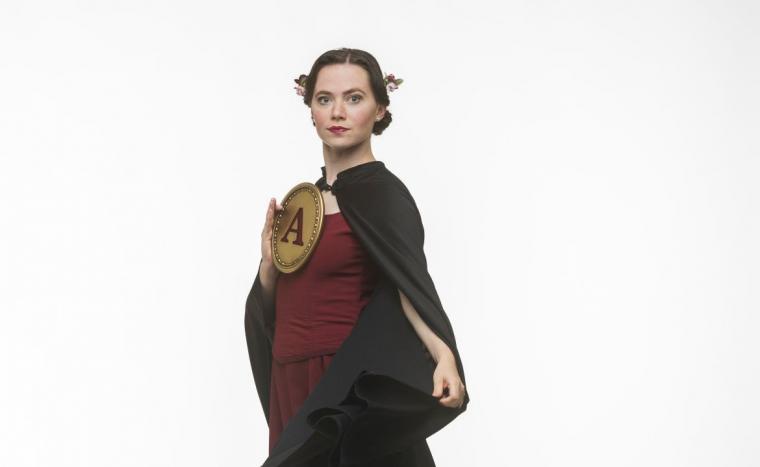
Eleanor Ambler in Ballet Quad Cities' "The Scarlet Letter" at the Spotlight Theatre -- October 23 and 24.
Chatting with Ballet Quad Cities' artistic director Courtney Lyon about the professional dance company's The Scarlet Letter, a world-premiere adaptation of Nathaniel Hawthorne's famed 1850 novel, I'm catching the choreographer early in the rehearsal process. How early? I wind up learning who'll be dancing the ballet's principal roles before the dancers do.
“We've been in rehearsal for two days,” says Lyon during our September 23 conversation. “So I have the next month to create this ballet.”
Yet despite the production debuting in exactly 30 days' time – The Scarlet Letter runs October 23 and 24 at Moline's Spotlight Theatre – Lyon doesn't sound the least bit stressed. She sounds elated. (And her company members, she assures me, will find out who's playing whom before this article's publication.)
“I love a challenge like this,” says Lyon, “because it makes me really honest in my work. You can't sit around and think too hard. You have to just do it. And I feel compelled to keep challenging myself. Which, of course, is great in theory,” she adds with a laugh. “But then you come to practice and you're like, 'What have I done?! How can I pull this off?!'”
This particular challenge, however, is one for which Lyon seems fully prepared – even though, as she says, she's “working without a road map.”
Hawthorne's tale is certainly well-known, its young, Puritan protagonist Hester Prynne forced to wear a red “A” (for adultery) in public after birthing a baby with an unknown father. Yet while The Scarlet Letter has occasionally been adapted for the stage, no “official” ballet of Hawthorne's work exists – there's no score to turn to, and no set guidelines on what from the book should be kept and what excised.
In other words: precisely the sort of challenge Lyon relishes.
Post-Poe October
“The classics are what made me fall in love with ballet,” Lyon says. “Sleeping Beauty and Swan Lake and The Nutcracker. But I was also interested in literature. I was really influenced by some of my English teachers in high school and in college – I was an English major for a while – and dissecting stories and time periods and authors is something that just comes naturally to me. And I'm very invested in bringing new narratives to the ballet world.”
Regarding the initial idea to adapt The Scarlet Letter for Ballet Quad Cities, Lyon says, “We're always thinking ahead for the next several seasons, trying to get a good balance. And the past couple years in October, I've done an Edgar Allan Poe ballet that was really well-received. People seemed to enjoy and resonate with the idea of taking that time period of literature, and that kind of Gothic world, and turning it into a ballet. People remember studying it in school, so they had a kind of emotional connection to the work. But after two years of Poe, we were like 'What now?'”
The Scarlet Letter, it turned out, met all of Lyon's 'What now?” criteria.
“There were a few things I was looking for,” says Lyon. “I wanted something that had a feeling of spookiness – something that would fill an October slot. Because we want to sell tickets and we want to entertain, we like when the ballets tie in with their time period. And even though the idea of witches is only mentioned a handful of times in the book, one of the characters, Mistress Hibbins, invites Hester to come to the woods and dance with the devil. Basically, the woods is where anyone who is not a perfect Puritan – the town 'other'– might go. I liked the idea of having light and dark motifs, so doing this around Halloween made sense.
“I also really loved the idea of having a heroine who is not a princess or looking to fall in love, get married, and live happily ever after like in a lot of the traditional ballets I grew up with. This book was written in 1850, and it's about the time period of the 1650s, so we're looking at 200 years back and 400 years back. But it's way more relatable to me than a Cinderella story.
“Because it's the 250th anniversary of our country,” Lyon continues, “I really wanted to do something by an American novelist, and hopefully something that most people were familiar with. And that's what I've found: People generally understand the story just by saying the title. If I say 'The Scarlet Letter,' they understand – they have an image of the woman with the 'A' on her chest and know it means adultery. They may not remember every detail; that story is pretty dense. But the big picture of it is there.
“And to be honest,” says Lyon, referencing the cost-saving measure, “The Scarlet Letter is public domain. People say to me, 'You should do a Star Wars ballet! You should do a Harry Potter ballet! That'd make a lot of money!' And I'm like, 'That's a great idea. However, we would spend a lot of money in getting the rights. And we probably wouldn't get them anyway.'”
Not Chaos, but Disorder
After she and Ballet Quad Cities CEO/founder Joedy Cook agreed on The Scarlet Letter for the company's 30th season, with the 29th having concluded this past April, Lyon began her extensive research, preparing to turn Hawthorne's literary classic into a stage piece sans dialogue.
“I read the book when I was younger,” Lyon says. “Back then, of course, I wasn't reading it to make a full-length ballet. I was reading it because it was a school assignment. But it really stayed with me. So this time, I read it very, very carefully, knowing I was making a ballet. And it took me a lo-o-ong time to read it, because as I was going through, I couldn't just take in the story. I was making staging choices. But it's hard to do all that work at the same time. So I tried to shut my brain off from the staging part of it, took a ton of notes, and whittled down the imagery.
“I didn't watch any of the recent Scarlet Letter movies,” she continues, making me grateful that Lyon ignored the ill-fated 1995 adaptation starring Demi Moore. (She also skipped a re-watch of 2010's infinitely superior Emma Stone comedy Easy A, which is related to the Hawthorne only tangentially.) “But I did watch one from the '30s and one from the '20s. The silent version was particularly good. It's so gorgeous, like the book's imagery, and only around an hour. It's fantastic.
“Then I did a lot of time-period research. I looked back at the beginning of our nation's history: the buildings; the colonies of Massachusetts where the Puritans were living; what that life was like; what it meant to be a Puritan; why they came to America; what the misconceptions about them were. I studied Puritanism in general. I studied Nathaniel Hawthorne in general. I went to Boston. I went to Salem. I retraced the footsteps of those people and pretended I was standing in the same spot where Hawthorne was standing, seeing what he saw.
“And then,” says Lyon, “I stopped thinking about it. This is what I usually do after I've flooded my brain with information: I let everything sit and do other projects. And then when I return to something, the things that come right back to the top are the things that stuck with me, and I know those are the most important things to focus us.”
Although, at the time of our conversation, Lyon had only begun preliminary Scarlet Letter staging, she said, “I definitely have some imagery that I think is super-important to keep for the main characters, and I'm dividing it into visually opposing sides, the witches in the woods contrasting with the Puritans. It's images of daylight and sunshine against images of darkness, and very atmospheric.
“The music, though, I have done,” she says. “I needed a framework before I started the ballet, so the music is set. To open and end the ballet, I have two pieces by Percy Grainger. He's an Australian-born composer who moved to America, and he's known for taking the revival of British folk music in the 20th century to America. I thought that was perfectly symbolic for these Puritans who moved to America and are bringing Old World ways into the New World.
“Any time we're with the Puritans in the village,” Lyon continues, “and for most of the indoor scenes, I pulled from Gustav Holst. He's an English composer, so that felt right to me to have that English, organized music for these rigid, righteous Puritans who are trying to live correctly in the eyes of God. And whenever we're outdoors in nature or in the cover of night, I use Béla Bartók. He's a Hungarian composer and he contrasts so well with the other composers. There's a lot of percussion and it's all over the place; it's not as organized to the ear, at first. So he gives you a place to go in your mind where you can picture … . Not chaos, but disorder. Darkness.”
No Pointy Hats
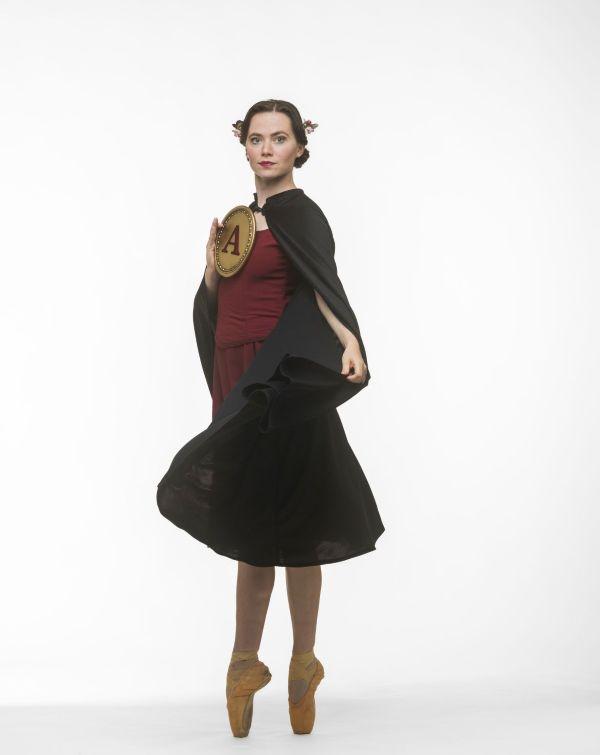
With Marcus Pei cast as the charismatic Reverend Arthur Dimmesdale and Corbin Phillips as our heroine's estranged husband Roger Chillingworth, the full Ballet Quad Cities company filling out the ensemble, Lyon chose Eleanor Ambler to dance the role of Hester Prynne. Considering Ambler appears as Hester on the Scarlet Letter poster image that debuted this summer, some might have expected that Ambler's casting was already official. Lyon, though, says that wasn't the case.
“We have to do those images in advance of our seasons,” says Lyon, “and the dancers know that while they may be wearing costumes to advertise a ballet for next year, it doesn't mean they'll necessarily be cast in those roles. It's not a guarantee.
“So I was making a visual for a ballet that didn't exist yet, and Eleanor has a great way of embodying a lot of layers of character. So for the poster, we worked to create Hester's hair, the makeup, that feeling of Puritanism, the drama, the confidence, the sexuality. We worked really hard on it. And after seeing Madeline in those photos, I thought, 'That's Hester.' She can play the princess beautifully, but she can also do humanity really well.”
Meanwhile, for The Scarlet Letter's abundance of 17th-century costumes, Lyon turned to a longtime friend and mentor.
“Joedy Cook is my go-to gal,” says Lyon. “I trust her so much. As the founder of the company, she's a visionary. She doesn't choreograph, but when I choreograph, she'll come watch my work and see so clearly how things should be costumed – and a lot of times, they're not choices an audience would immediately think of.
“I think that uniqueness helps give my work a particular stamp and style. I so appreciate it. And I cannot wait to see how she decides to show Puritan sins through the witches in the woods.” With a laugh, she adds, “They're certainly not gonna be dressed as witches with pointy hats.”
It's possible that only the ballet's youngest viewers will take issue with that. And although The Scarlet Letter concerns adultery, public shaming, and a number of other mature themes, Lyon is quick to state, “This show is family friendly.
“I've learned that a lot of people read this book in, like, seventh grade,” Lyon says with a laugh. “And because this is a ballet, it's not explicit; things are only implied. So either what happens will go over kids' heads or they'll be okay with it. Hawthorne wrote a very proper book about Puritans.”
Ballet Quad Cities' The Scarlet Letter will be staged at the Spotlight Theatre (1800 Seventh Avenue, Moline IL) on Friday, October 23, and Saturday, October 24. Admission the 7 p.m. performances is $22.13-37.89, and more information and tickets are available by calling (309)786-3779 and visiting BalletQuadCities.com.